
Sign up to save your podcasts
Or



Based on Podcast App listening data
Preview for Later Today: Lance Gatling explains how Japan avoided public panic during the Hormuz energy crisis despite threats to its oil supply. Through strategic petroleum reserves, energy diversification, and maintaining strong international relations — particularly with the United States — Japan successfully managed the potential shortage without gas lines or widespread anxiety among the general population.
Preview for Later Today: Paul Lozano envisions using fleets of autonomous small satellites equipped with tiny ionic thrusters to explore the asteroid belt. This cost-effective approach aims to gather scientific data and identify valuable resources, potentially sparking an industrial revolution while helping scientists understand the solar system's origins and improve planetary defense.
Preview for Later Today: Bruce Nichols discusses Nathaniel Hawthorne's time in Concord among the transcendentalists. Unlike the wild optimist Ralph Waldo Emerson, Hawthorne's fiction explored human tragedy and the "evil lurking in the hearts of men." This ideological friction informed his work, particularly The Scarlet Letter, where he focused deeply on Hester Prynne's perspective.
Preview for Later Today: Bruce Nichols reveals the entrepreneurial side of Henry David Thoreau, who significantly improved his family's pencil-making business. By researching German techniques and developing better graphite-boring methods, Thoreau created market-leading pencils. Despite his technical ingenuity, he eventually turned away from commerce toward a life of contemplation and letters at Walden.
Preview for Later Today: Mary Anastasia O'Grady profiles Abelardo de la Espriella, a businessman with triple citizenship running for Colombia's presidency. Positioning himself as a disruptor similar to Donald Trump, de la Espriella appeals to voters tired of establishment politics. He seeks to change the status quo through a focus on entrepreneurship and a willingness to take risks.
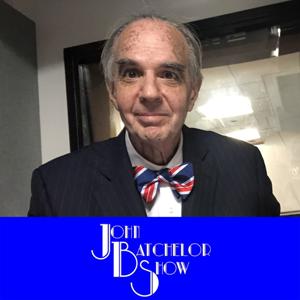
SCHEDULE JOHN BATCHELOR SHOW, 6-17-2026
1933 IDAHO
Simon Constable discusses the extreme heat in France and the potential global impact of a "super El Niño." He reports on significant drops in Brent crude, gold, and grain prices, while noting copper's rise. (1)
Simon Constable examines the Makerfield by-election and its implications for Prime Minister Keir Starmer's leadership. He describes the British paper ballot voting process and the potential for new leadership rivals to emerge from Manchester. (2)
Scott Winship explains that the American middle class is shrinking because many families are moving into the upper middle class. He distinguishes between income flows and wealth stocks, highlighting general prosperity and significant wealth creation. (3)
Scott Winship analyzes why Americans feel pessimistic about the economy despite rising real wages. He discusses the impact of inflation, "vibe sessions," and how personal financial satisfaction often outpaces negative perceptions of the broader national economy. (4)
Kamran Bokhari addresses rumors of a $300 billion fund for Iran and Pakistan's role as a diplomatic mediator. He emphasizes the transition of power to Iran's Revolutionary Guard and the necessity of verifying behavioral changes. (5)
Charles Burton critiques Canada's failure to effectively block Chinese goods produced with forced labor, specifically regarding aluminum and lithium. He warns that Chinese electric vehicles may serve as subsidized "spy machines" on Canadian roads. (6)
Captain James Fanell warns that China is using "scientific" research as a pretext for military expansion at Scarborough Shoal. He recalls the 2012 standoff and urges stronger United States naval support for Philippine maritime sovereignty. (7)
Captain James Fanell emphasizes the critical need for expanded United States naval power to counter China's massive fleet. He advocates for increased ship production and more vertical launch cells to maintain global maritime security standards. (8)
Henry Sokolski discusses South Korea's desire for nuclear enrichment and submarines amidst North Korea's growing arsenal. He argues that the threat is primarily political, with the North seeking a confederation to undermine South Korean independence. (9)
Henry Sokolski explores the risks of a space-based arms race between the United States and China. He discusses war games involving missile interceptors in low Earth orbit and the complexities of involving private industry. (10)
Bob Zimmerman details SpaceX's historic IPO, which raised over $85 billion, granting the company resources far exceeding NASA's budget. He also reports on structural leaks in Russia's Zvezda module on the International Space Station. (11)
Bob Zimmerman discusses the replicability crisis in soft sciences, where half of published studies fail confirmation. He also highlights astronomical discoveries, including a supernova remnant and the unique counter-rotating dust of the Black Eye galaxy. (12)
Josh Blackman examines the Supreme Court's interpretation of the Establishment Clause and the subsequent removal of religious traditions from public schools. He critiques the "Lemon test" for creating a secular culture through judicial overreach. (13)
Josh Blackman discusses the Kennedy v. Bremerton ruling, which abandoned the Lemon test in favor of tradition. He analyzes the legal debate over displaying the Ten Commandments in Texas classrooms as a necessary course correction. (14)
Ahmad Sharawi and Bill Roggio critique the proposal for Syria to contain Hezbollah. They warn that involving Syriangroups with al-Qaeda ties would trigger sectarian violence and bolster Hezbollah's legitimacy within Lebanon's Shiacommunity. (15)
Michael Bernstam explains that Russia faces a fiscal catastrophe due to declining oil production and falling global prices. He notes that Ukrainian drone strikes and Western sanctions on the shadow fleet are depleting Moscow's budget. (16)
One name fix: Ahmed Sharawi → Ahmad Sharawi (per house style sheet).
Michael Bernstam explains that Russia faces a fiscal catastrophe due to declining oil production and falling global prices. He notes that Ukrainian drone strikes and Western sanctions on the shadow fleet are depleting Moscow's budget. (16)
Ahmad Sharawi and Bill Roggio critique the proposal for Syria to contain Hezbollah. They warn that involving Syriangroups with al-Qaeda ties would trigger sectarian violence and bolster Hezbollah's legitimacy within Lebanon's Shiacommunity. (15)
Josh Blackman discusses the Kennedy v. Bremerton ruling, which abandoned the Lemon test in favor of tradition. He analyzes the legal debate over displaying the Ten Commandments in Texas classrooms as a necessary course correction. (14)
From the publisher's feed
Ranked by our users in the last 21 days
22,884 Listeners
11,880 Listeners

2,119 Listeners

12,597 Listeners

731 Listeners

669 Listeners
6,552 Listeners
6,473 Listeners
715 Listeners
6,839 Listeners
557 Listeners
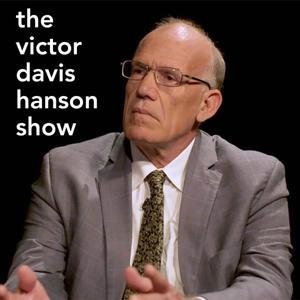
8,412 Listeners
215 Listeners
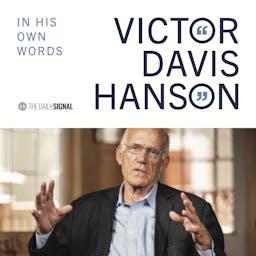
1,153 Listeners
1,179 Listeners