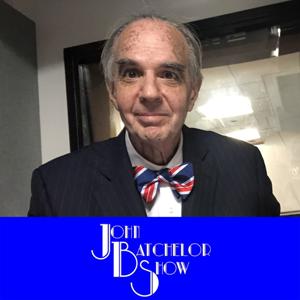
The John Batchelor Show

The John Batchelor Show

By John Batchelor Show.Society & CultureNewsArtsBooks
Download on the App Store
  • Ranking

    29th

    on Books

  • Favorites

    578

    Followers

  • Typical duration

    18 min

    per episode

  • If it hooks

    62%

    finish an episode

Based on Podcast App listening data

The John Batchelor Show episodes

  • S8 Ep1004: Patrick K. O'Donnell reveals the dark trajectory of Lewis Powell, a ranger for Mosby who became a primary Lincoln conspirator working with John Wilkes Booth. Powell's transition from cavalryman to covert operative was facilitated by the Confede
    Patrick K. O'Donnell reveals the dark trajectory of Lewis Powell, a ranger for Mosby who became a primary Lincolnconspirator working with John Wilkes Booth. Powell's transition from cavalryman to covert operative was facilitated by the Confederate Secret Service, which funded a sophisticated network of safe houses and couriers. Evidence suggests the plot to kidnap Lincoln was an open secret within certain Confederate circles; Mosby even positioned hundreds of men near the Potomac to act as a security force for the escape route. This shadow war represented the most dangerous and well-funded special operation of the entire conflict. (6)
    1865
    5 min
  • S8 Ep1004: Patrick K. O'Donnell describes how Ulysses S. Grant ordered Phil Sheridan to wage total war in the Shenandoah Valley, commanding the execution of Mosby's men and the destruction of crops. Although Sheridan moderated these orders due to politica
    Patrick K. O'Donnell describes how Ulysses S. Grant ordered Phil Sheridan to wage total war in the Shenandoah Valley, commanding the execution of Mosby's men and the destruction of crops. Although Sheridan moderated these orders due to political optics, he deployed Richard Blazer and his Scouts—armed with rapid-fire Spencer carbines—to hunt Mosby. The conflict turned brutal, involving ruthless figures like the bushwhacker Mobberly. At Kabletown, Mosby finally eliminated the threat by ambushing and capturing Blazer. One of Mosby's rangers, the lethal Lewis Powell, was tasked with escorting the captured Blazer to Richmond. (5)
    1865
    14 min
  • S8 Ep1004: Patrick K. O'Donnell recounts Jubal Early's 1864 march on Washington, which exploited depleted Union defenses to reach the capital's gates at Fort Stevens. During the crisis, Abraham Lincoln famously stood on the parapet under fire. Early's suc
    Patrick K. O'Donnell recounts Jubal Early's 1864 march on Washington, which exploited depleted Union defenses to reach the capital's gates at Fort Stevens. During the crisis, Abraham Lincoln famously stood on the parapet under fire. Early's success was aided by John Singleton Mosby, who conducted the Calico Raid to sever communications and draw off defenders. Mosby's men specialized in close-range pistol swarms, notably routing the Second Massachusetts Cavalry at Mount Zion Church. The arrival of the Union's Sixth Corps eventually forced Early to retreat, narrowly saving the nation's capital from capture. (4)
    1865
    10 min
  • S8 Ep1004: Patrick K. O'Donnell explores the 1864 Dahlgren Raid, a failed Union "decapitation raid" intended to burn Richmond and assassinate Jefferson Davis. In response, the Confederacy intensified its Secret Service operations, employing spies, coded t
    Patrick K. O'Donnell explores the 1864 Dahlgren Raid, a failed Union "decapitation raid" intended to burn Richmondand assassinate Jefferson Davis. In response, the Confederacy intensified its Secret Service operations, employing spies, coded telegraphy, and influence campaigns to undermine Lincoln's 1864 re-election. They funded Northern "Copperhead" editors to promote peace while John Singleton Mosby's rangers disrupted Union logistics. This era also featured author Herman Melville, who embedded with Union cavalry to document the terrifying reality of fighting Mosby's elusive, pistol-wielding irregulars who dominated the headlines of Northern Virginia. (3)
    1865
    10 min
  • S8 Ep1004: Patrick K. O'Donnell details the exploits of Richard Blazer, the brilliant leader of the Blazer Scouts, the Union's first modern hunter-killer team. Operating in the rugged terrain of West Virginia, Blazer utilized detective work and lightning
    Patrick K. O'Donnell details the exploits of Richard Blazer, the brilliant leader of the Blazer Scouts, the Union's first modern hunter-killer team. Operating in the rugged terrain of West Virginia, Blazer utilized detective work and lightning raids to hunt Confederate partisans. His primary adversaries were the Thurman brothers, ruthless "bushwhackers" who targeted Union supply lines and often executed prisoners. Under General Averell, Blazer's team integrated tradecraft from the Jesse Scouts to protect vital B&O railroad lines and conduct crucial battlefield reconnaissance to support Union Army raids against Confederate logistics. (2)
    1865
    7 min
  • S8 Ep1004: Patrick K. O'Donnell introduces Captain John Charles Carpenter and the Jesse Scouts, a Union special forces group named after Jesse Frémont. Emerging from the Missouri insurgency, these scouts utilized 21st-century tradecraft such as disguises
    Patrick K. O'Donnell introduces Captain John Charles Carpenter and the Jesse Scouts, a Union special forces group named after Jesse Frémont. Emerging from the Missouri insurgency, these scouts utilized 21st-century tradecraft such as disguises and infiltration to gather intelligence behind enemy lines. Simultaneously, the Confederacy enacted the Partisan Ranger Act to organize irregular fighters like John Singleton Mosby. Operating in "Mosby's Confederacy," these rangers conducted asymmetrical warfare that tied down thousands of Union troops. Both sides grappled with the lack of discipline in these units, yet recognized their strategic brilliance in modern irregular combat. (1)
    1863
    12 min
  • S8 Ep1003: SCHEDULE THE JOHN BATCHELOR SHOW, 6-12-2026.

    SCHEDULE THE JOHN BATCHELOR SHOW, 6-12-2026.

    1903 PRINCETON UNIVERSITY

    Jeff Bliss describes massive, deadly swells hitting California beaches due to a southern hemisphere storm system. The conversation shifts to Las Vegas, where a massive, highly anticipated In-N-Out Burger recently opened on the Strip. Bliss details the chain's reputation for fresh food, cleanliness, and fair employee wages. (1)

    Jeff Bliss discusses the surprising results of the Los Angeles City Council primary, where Nithya Raman surged despite initially conceding. He highlights allegations of voter fraud in the Skid Row area and the impact of California's ballot harvesting laws. The segment also touches on Xavier Becerra's lead in the governor's race. (2)

    Richard Epstein analyzes the legal effort to prevent the removal of Donald Trump's name from the Kennedy Centerfacade. He argues that the Trump-aligned board's appeal lacks legal merit and strength, as removing a nameplate does not constitute irreparable harm. Epstein suggests the judge should consider firing the current board due to bias. (3)

    Richard Epstein critiques the construction of the Obama Center in Chicago, lamenting the destruction of 800 historical trees and the seizure of public land. He describes the project's design as a "monstrosity" with a flawed traffic plan and expresses concern over the foundation's lack of financial transparency and endowment. (4)

    Jim McTague reports on a "budget-minded hesitancy" among Pennsylvania consumers despite falling gas prices. He notes a rare layoff notice for 70 logistics workers and uneven retail activity. Meanwhile, a data center project near Costcoproceeds under heavy security, while a similar proposal was rejected by a neighboring borough. (5)

    Lorenzo Fiori discusses the "disaster" of the Italian national football team failing to qualify for the World Cup for the third consecutive time. The segment transitions to Pisa, highlighting the prestigious Scuola Normale Superiore and recent astronomical breakthroughs involving the James Webb Space Telescope. Fiori concludes with local wine and culinary recommendations. (6)

    Bob Zimmerman discusses the crew selection for NASA's Artemis 3 mission, which has been simplified to focus on Earth-orbit docking tests. He also examines private sector developments, including German startup Isar's funding, Stoke Space's reusable rocket design, and an orbital servicing mission by Catalyst intended to rescue a decaying NASAtelescope. (7)

    Bob Zimmerman honors the late Alan Hale, co-discoverer of the record-setting Comet Hale-Bopp. He reviews the historical significance of the first image of the moon's far side taken by Luna 3 in 1959. The segment also explores current cosmological debates regarding dark energy and the existence of "little red dots" in the early universe. (8)

    Peter Huessy discusses the history of "tactical" nuclear weapons and the 1950s Desert Rock exercises where U.S. troops were exposed to nuclear detonations. He details the health risks soldiers faced and parallels these actions with Sovietmaneuvers, highlighting the "ludicrous" idea of trying to operate militarily in a post-detonation environment. (9)

    Peter Huessy explains that Russia views low-yield, tactical nuclear weapons as usable battlefield tools to achieve victory or coerce opponents. He contrasts this with U.S. doctrine, which keeps such weapons under central command. Huessywarns of the lack of transparency regarding China's dual-use nuclear capabilities and Russia's "reckless" potential to use these weapons. (10)

    Colonel Jeff McCausland discusses stalled negotiations with Iran, noting the heavy influence of the Revolutionary Guard Corps over the diplomatic process. He analyzes the military difficulty of seizing Kharg Island and the profound impact of Ukrainian drones on the Russian front, suggesting that drone saturation has leveled the battlefield and interdicted Russian resupply lines. (11)

    Jeff McCausland draws parallels between the performative style of Civil War General Jeb Stuart and current Secretary of Defense Pete Hegseth. He critiques Hegseth's recent speeches in Singapore, Normandy, and Guantanamo, arguing they prioritize individual image over grand strategy and mark significant, potentially transactional shifts in long-standing U.S. foreign policy toward Taiwan and European allies. (12)

    Veronique de Rugy argues that the U.S. already has the most progressive tax system among OECD countries, with the wealthy paying a disproportionate share of revenue. She critiques Thomas Piketty's proposal for a global wealth tax and mandated "degrowth," characterizing it as an effort to limit national growth under the guise of climate and social justice. (13)

    Mary Anastasia O'Grady questions the delay in scheduling Venezuelan elections under Delcy Rodriguez. She reports that over 400 political prisoners remain held, and the notorious Helicoide prison remains operational despite contradictory claims. O'Grady notes that the regime lacks the political will to allow a free press or fair electoral body to organize. (14)

    Conrad Black emphasizes the vital economic ties between the U.S. and Canada, noting Canada provides 25% of U.S.aluminum and 20% of its uranium. He expresses confidence that Prime Minister Mark Carney will build necessary oil pipelines to both coasts to benefit the Canadian economy, despite opposition from environmental groups and Carney's own "green instincts." (15)

    Francis Rose discusses the U.S. military's efforts to integrate AI by "gamifying" systems to make them intuitive for young, video-game-literate service members. He also highlights CISA's work in rebuilding its workforce to protect private-sector cyber infrastructure and the Army's Joint Innovation Outpost, which aims to accelerate the transition of technology from private inventors to the battlefield. (16)

    One name correction: (2) Nithia Raman → Nithya Raman (established style for the LA city council member).

    6 min
  • S8 Ep1002: Francis Rose discusses the U.S. military's efforts to integrate AI by "gamifying" systems to make them intuitive for young, video-game-literate service members. He also highlights CISA's work in rebuilding its workforce to protect private-se
    Francis Rose discusses the U.S. military's efforts to integrate AI by "gamifying" systems to make them intuitive for young, video-game-literate service members. He also highlights CISA's work in rebuilding its workforce to protect private-sector cyber infrastructure and the Army's Joint Innovation Outpost, which aims to accelerate the transition of technology from private inventors to the battlefield. (16)
    1606
    11 min
  • S8 Ep1002: Conrad Black emphasizes the vital economic ties between the U.S. and Canada, noting Canada provides 25% of U.S. aluminum and 20% of its uranium. He expresses confidence that Prime Minister Mark Carney will build necessary oil pipelines to both
    Conrad Black emphasizes the vital economic ties between the U.S. and Canada, noting Canada provides 25% of U.S.aluminum and 20% of its uranium. He expresses confidence that Prime Minister Mark Carney will build necessary oil pipelines to both coasts to benefit the Canadian economy, despite opposition from environmental groups and Carney's own "green instincts." (15)
    1521
    9 min
  • S8 Ep1002: Mary Anastasia O'Grady questions the delay in scheduling Venezuelan elections under Delcy Rodriguez. She reports that over 400 political prisoners remain held, and the notorious Helicoide prison remains operational despite contradictory claims.
    Mary Anastasia O'Grady questions the delay in scheduling Venezuelan elections under Delcy Rodriguez. She reports that over 400 political prisoners remain held, and the notorious Helicoide prison remains operational despite contradictory claims. O'Grady notes that the regime lacks the political will to allow a free press or fair electoral body to organize. (14)
    1521
    10 min

About The John Batchelor Show

From the publisher's feed

The John Batchelor Show is a hard news-analysis radio program on current events, world history, global politics and natural sciences. Based in New York City for two decades, the show has travelled…

Best of The John Batchelor Show

Ranked by our users in the last 21 days
More shows like The John Batchelor Show

Mark Levin Podcast by Cumulus Podcast Network

Mark Levin Podcast

22,884 Listeners

THE SAVAGE NATION by Michael Savage

THE SAVAGE NATION

11,880 Listeners

Hillsdale Dialogues by Hillsdale College

Hillsdale Dialogues

2,119 Listeners

Bill O’Reilly’s No Spin News and Analysis by Bill O'Reilly

Bill O’Reilly’s No Spin News and Analysis

12,597 Listeners

The Mark Simone Show by iHeartRadio and Mark Simone

The Mark Simone Show

731 Listeners

The Radio Free Hillsdale Hour by Hillsdale College

The Radio Free Hillsdale Hour

669 Listeners

Newt's World by Gingrich 360

Newt's World

6,552 Listeners

John Solomon Reports by John Solomon

John Solomon Reports

6,473 Listeners

The Hugh Hewitt Show: Highly Concentrated by Salem Podcast Network

The Hugh Hewitt Show: Highly Concentrated

715 Listeners

DINESH Podcast by Salem Podcast Network

DINESH Podcast

6,839 Listeners

The Big Ben Show by Fox News Podcasts

The Big Ben Show

557 Listeners

The Victor Davis Hanson Show by Victor Davis Hanson and Jack Fowler

The Victor Davis Hanson Show

8,412 Listeners

Kudlow by Fox News Podcasts

Kudlow

215 Listeners

Victor Davis Hanson: In His Own Words by Victor Davis Hanson | The Daily Signal

Victor Davis Hanson: In His Own Words

1,153 Listeners

Pod Force One by New York Post

Pod Force One

1,179 Listeners