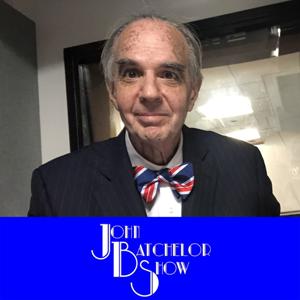
The John Batchelor Show

The John Batchelor Show

By John Batchelor Show.Society & CultureNewsArtsBooks
Download on the App Store
  • Ranking

    35th

    on Books

  • Favorites

    578

    Followers

  • Typical duration

    18 min

    per episode

  • If it hooks

    62%

    finish an episode

Based on Podcast App listening data

The John Batchelor Show episodes

  • S8 Ep1282: James Romm — Multi-Part, Part One: Professor James Romm, author of Plato and the Tyrant: The Fall of Greece's Greatest Dynasty an
    James Romm — Multi-Part, Part One: Professor James Romm, author of Plato and the Tyrant: The Fall of Greece's Greatest Dynasty and the Making of a Philosophic Masterpiece, discusses the rise of the Dionysian dynasty in fourth-century BCE Syracuse, then the most powerful state in the Greek West. Dionysius the Elder consolidated power as a demagogue, using the defensible island fortress of Ortygia and practicing polygamy to secure his rule, though this created deep familial rivalries. Syracuse became famous for Syracusan tables, a lifestyle of extreme luxury and alcoholic excess. Plato, influenced by the execution of his teacher Socrates and the reign of the Thirty Tyrants, viewed Syracuse as a laboratory for his theory of Forms. After a failed initial visit, Plato returned to tutor Dionysius the Younger at the urging of the ruler's brother-in-law, Dion. Plato's goal was to transform the immature, hard-drinking tyrant into an enlightened monarch through lifestyle reform and abstract philosophy. (1)
    38 min
  • S8 Ep1281: Josiah Osgood — Multi-Part, Part Two: Professor Josiah Osgood continues with 58 BCE, when the rivals took separate paths; Cato we
    Josiah Osgood — Multi-Part, Part Two: Professor Josiah Osgood continues with 58 BCE, when the rivals took separate paths; Cato went to Cyprus to model honest administration while Caesar sought military glory in Gaul. The death of Julia, Caesar's daughter and Pompey's wife, eventually severed the alliance between the two generals, allowing Cato to convince the Senate to appoint Pompey as sole consul to restore order. When Caesar crossed the Rubicon in 49 BCE, sparking civil war, Cato reluctantly followed Pompey's retreat. Following Pompey's defeat at Pharsalus, Cato fled to Utica, where he chose suicide over Caesar's clemency, stabbing himself and tearing open his own wounds to mar Caesar's victory. His death transformed him into a saint of the Republic, inspiring generations of poets and dissidents under the later Roman Empire. (2)
    40 min
  • S8 Ep1281: Josiah Osgood — Multi-Part, Part One: Professor Josiah Osgood, author of Uncommon Wrath: How Caesar and Cato's Deadly Rivalry Des
    Josiah Osgood — Multi-Part, Part One: Professor Josiah Osgood, author of Uncommon Wrath: How Caesar and Cato's Deadly Rivalry Destroyed the Roman Republic, begins in 64 BCE, when Cato and Caesar briefly cooperated in the murder courts to penalize those rewarded during Sulla's brutal purges. Their rivalry ignited permanently during the Catiline conspiracy in 63 BCE. While Caesar proposed life imprisonment for the conspirators, Cato's debut Senate speech demanded their execution and successfully implicated Caesar in the plot. This established their core conflict: Cato's Stoic rectitude and fear of strongmen against Caesar's pursuit of dignitas and popular reform. The period also saw the rise of the triumvirate, an alliance between Caesar, Pompey, and Crassus, which Cato tirelessly opposed as a threat to republican freedom. (1)
    40 min
  • S8 Ep1280: Michael McFaul — Multi-Part, Part Two: Michael McFaul, a Stanford professor and former US Ambassador to Russia, continues his dis
    Michael McFaul — Multi-Part, Part Two: Michael McFaul, a Stanford professor and former US Ambassador to Russia, continues his discussion of Autocrats Versus Democrats: China, Russia, America, and the New Global Disorder, shifting to modern Putinism and the no-limits partnership between Russia and China. McFaul describes Vladimir Putin as a risk-taker driven by imperialist ideology rather than national interest alone. He advocates for a grand strategy to counter autocracy by strengthening democratic alliances, supporting human rights, and maintaining America's edge in attracting global talent. He concludes that while US democracy is currently wobbling, its economic and ideational power remains superior if unified. (2)
    38 min
  • S8 Ep1279: Michael McFaul — Multi-Part, Part One: Michael McFaul, a Stanford professor and former US Ambassador to Russia, details his book
    Michael McFaul — Multi-Part, Part One: Michael McFaul, a Stanford professor and former US Ambassador to Russia, details his book Autocrats Versus Democrats: China, Russia, America, and the New Global Disorder. In Part One, McFaul examines historical turning points, beginning with the 1962 Cuban Missile Crisis and the 1991 Soviet collapse. He argues that the West was too complacent following the Cold War, missing critical opportunities to consolidate democratic institutions in Russia and China. He also explains how China's century of humiliation informs Xi Jinping's current desire for strength. (1)
    38 min
  • S8 Ep1278: Robert Cwiklik — Multi-Part, Part Two: Robert Cwiklik, author of Sheridan's Secret Mission: How the South Won the War After the C
    Robert Cwiklik — Multi-Part, Part Two: Robert Cwiklik, author of Sheridan's Secret Mission: How the South Won the War After the Civil War, continues with General Philip Sheridan's response, specifically his Banditti telegram proposing military trials for White Leaguers. While Sheridan was ready for total war, his plan sparked Northern indignation and constitutional denunciations by Senator Carl Schurz. Ultimately, President Ulysses S. Grant declined to support Sheridan, citing legal limitations and prioritizing Northern political victories such as the Ohio gubernatorial election. This federal withdrawal effectively ended aggressive Reconstruction, allowing the South to re-establish white supremacy. (2)
    20 min
  • S8 Ep1278: Robert Cwiklik — Multi-Part, Part One: Robert Cwiklik, author of Sheridan's Secret Mission: How the South Won the War After the C
    Robert Cwiklik — Multi-Part, Part One: Robert Cwiklik, author of Sheridan's Secret Mission: How the South Won the War After the Civil War, explores how the Union's victory was undone by Southern resistance and Northern political retreat. Part One details the violent struggle for Black suffrage in Louisiana, beginning with Abraham Lincoln's early support for voting rights for free men of color. This progress was met with brutal massacres in New Orleans in 1866 and Colfax in 1873, fueling Radical Reconstruction and the empowerment of carpetbaggers. Tension reached a breaking point in 1874 during the Battle of Liberty Place, where the armed White League forcibly overthrew the state's Republican government. (1)
    38 min
  • S8 Ep1277: TABLE OF CONTENTS THE JOHN BATCHELOR SHOW 8-14-2026. Jeff Bliss discusses the severe threats posed by a potential "super El Niño
    TABLE OF CONTENTS THE JOHN BATCHELOR SHOW 8-14-2026.Jeff Bliss discusses the severe threats posed by a potential "super El Niño," which could lead to massive coastal erosion, mudslides, and heavy rains in Los Angeles, similar to the damage seen in previous severe weather years. He also reports on active wildfires in California, such as the Timber Fire in Monterey County and the Bug Fire near the Nevada border, noting that humans cause roughly 90 to 95% of these blazes. Shifting to entertainment, Bliss describes the highly anticipated opening of the Lucas Museum of Narrative Art, which features the "Skywalker Grill"—a restaurant causing excitement among Los Angeles foodies for its Michelin-star potential. Additionally, Bliss covers the landmark $12.8 billion purchase of the Los Angeles Lakers by a group involving Jared Kushner and Bob Iger. Finally, he touches on the legal controversy surrounding the Paramount-Skydance merger and David Ellison's threat to move production out of Hollywood. (1)Gene Marks shares insights from White House advisor Kevin Hassett regarding the validity of government economic data, with Hassett favoring durable goods orders and unemployment claims over revised surveys. Marks reports a generally positive outlook for small businesses, citing an uptick in optimism and a four-year high in manufacturing activity driven by the AI and data center explosion. He notes that while tariffs and $4 gasoline remain concerns, many businesses are absorbing costs without significant impact on sales. Marks characterizes the United States as an "entrepreneur's paradise" because of the ease of starting a business and the high availability of capital. He highlights that nearly half a million new business applications are filed monthly, supported by record levels of private debt and venture capital. Marks concludes that despite various uncertainties, the small business sector remains resilient and is continuing to hire. (2)Jim McTague provides a report on the "mixed" economy of Lancaster County, Pennsylvania, observing that retail activity is picking up due to back-to-school shopping despite inflationary pressures. He notes that discount giants like Costco are packed as shoppers seek relief from high prices, while tourism traffic at local hotels and amusement parks has lightened midweek. McTague also highlights local opposition to data centers, making them a contentious political issue for upcoming elections. A central focus is the "Heritage Paris" patisserie at Park City Mall, where a French chef sells premium handcrafted pastries. McTague describes high-end offerings like the "Popcorn Illusion" pastry priced at $17.95, illustrating a market for luxury food even in a cautious economy. He humorously recounts his own difficulty resisting these treats while on a low-carb diet, emphasizing that the shop is a significant draw for local residents. (3)Lorenzo Fiori describes a "disaster" situation in Europe caused by severe drought and record heat, with water restrictions implemented in Swiss towns and critically low levels in northern Italy's Po River. The drought has turned the normally green Alps brown and disrupted lake navigation. Simultaneously, Sicily's Mount Etna has entered a prolonged eruption phase, spewing ash for seven days and forcing the cancellation of 700 flights at Catania airport during the peak tourist season. Fiori notes the chaos caused by tourists seeking "eruption selfies" in dangerous areas. For a cultural reprieve, he recommends the Bernina Express rail journey, which reaches the highest railway point in Europe. He also shares a traditional recipe for polenta with Gorgonzola cheese, paired with local Valtellina wine, though he expresses concern that the drought may soon impact milk production from Alpine cows. (4)Bob Zimmerman details the robotic mission by startup Catalyst to rescue NASA's Swift Space Telescope, utilizing innovative software to maneuver a servicing craft despite thruster failures. He highlights SpaceX's massive Starshipproduction line in Boca Chica, noting that four prototypes are ready for monthly launches and upcoming orbital refueling tests. Zimmerman also discusses Lockheed Martin's strategic investments in rocket startups like Firefly to secure launch capabilities. On the international front, he reports on Poland's successful protest against Starlink roaming restrictions and Vietnam's first satellite contract with an American company, SpaceX, signaling a shift toward U.S. ties. Additionally, Zimmerman covers the State Department's efforts to pull India away from Russian space partnerships and NASA's collaboration with the Department of Energy on nuclear propulsion for Mars. He concludes with breathtaking imagery of stars orbiting the Milky Way's central black hole. (5)Alex Wright, author of Empire of Ink: The Printers, Rogues, and Radicals Who Invented the American Newspaper, Part Two: Wright recounts the history of American newspapers, focusing on the Civil War's impact on journalism. He highlights George Smalley's groundbreaking combat reporting at Antietam, where Smalley wrote a vivid account on a night train to secure the "scoop of all scoops" for the Tribune. Wright also explores "soldier-published" newspapers that provided a slice of camp life and the origins of Stars and Stripes. Moving west, he describes the dangerous life of frontier editors, such as Mark Twain, who carried revolvers to defend against aggrieved readers and occasionally fled town to avoid duels. Wright explains how newspapers became "gold mines" by discovering the revenue potential of patent medicine advertising, which once accounted for half of all ads. He concludes by drawing parallels between the fragmented, anything-goes media landscape of the 19th century and today's digital era of content creators and AI. (6)Henry Sokolski examines the "Golden Dome," a proposed $185 billion space-based missile defense project that mirrors the Cold War-era SDI. He warns that the program's lack of transparency is "suicidal" for its funding, as Congress remains in the dark about its primary mission. Sokolski notes that while technology is closer to practicality than 40 years ago, current threats are often low-cost drones rather than intercontinental missiles. In the energy sector, he highlights Elon Musk's $10 billion "Project Crystal Sun" solar factory in Texas, which Musk frames as capturing the "fusion reactor" of the sun. Sokolski observes that even conservative states are voting with their pocketbooks for renewables as battery storage investments double. Finally, he touches on a mutual defense pact between Saudi Arabia, Turkey, and Pakistan, suggesting a "Sunni NATO" is emerging due to a lack of confidence in U.S. security guarantees. (7)Angela DiFulvio explains a theoretical method for detecting nuclear weapons in low Earth orbit to prevent catastrophes like the 1962 Starfish Prime experiment, which destroyed a third of existing satellites. She describes an "inspector" satellite designed to induce a unique radioactive signature from fissile material using high-energy protons. DiFulvio details technical challenges, such as "pulse shape discrimination," to distinguish weapon-related neutrons from background cosmic radiation in the harsh space environment. She suggests that an international agency like the IAEAmight oversee these inspectors to ensure space remains weapon-free. DiFulvio emphasizes that while tests can occur in classified environments, more research is needed on the survivability of sensing electronics. She warns that a modern orbital nuclear detonation would be catastrophic for global infrastructure, specifically mentioning the vulnerability of massive constellations like Starlink. (8)

    7 min
  • S8 Ep1276: Angela DiFulvio explains a theoretical method for detecting nuclear weapons in low Earth orbit to prevent catastrophes like the 1
    Angela DiFulvio explains a theoretical method for detecting nuclear weapons in low Earth orbit to prevent catastrophes like the 1962 Starfish Prime experiment, which destroyed a third of existing satellites. She describes an "inspector" satellite designed to induce a unique radioactive signature from fissile material using high-energy protons. DiFulvio details technical challenges, such as "pulse shape discrimination," to distinguish weapon-related neutrons from background cosmic radiation in the harsh space environment. She suggests that an international agency like the IAEAmight oversee these inspectors to ensure space remains weapon-free. DiFulvio emphasizes that while tests can occur in classified environments, more research is needed on the survivability of sensing electronics. She warns that a modern orbital nuclear detonation would be catastrophic for global infrastructure, specifically mentioning the vulnerability of massive constellations like Starlink. (8)
    20 min
  • S8 Ep1275: Henry Sokolski examines the "Golden Dome," a proposed $185 billion space-based missile defense project that mirrors the Cold War-
    Henry Sokolski examines the "Golden Dome," a proposed $185 billion space-based missile defense project that mirrors the Cold War-era SDI. He warns that the program's lack of transparency is "suicidal" for its funding, as Congress remains in the dark about its primary mission. Sokolski notes that while technology is closer to practicality than 40 years ago, current threats are often low-cost drones rather than intercontinental missiles. In the energy sector, he highlights Elon Musk's $10 billion "Project Crystal Sun" solar factory in Texas, which Musk frames as capturing the "fusion reactor" of the sun. Sokolski observes that even conservative states are voting with their pocketbooks for renewables as battery storage investments double. Finally, he touches on a mutual defense pact between Saudi Arabia, Turkey, and Pakistan, suggesting a "Sunni NATO" is emerging due to a lack of confidence in U.S. security guarantees. (7)
    18 min

About The John Batchelor Show

From the publisher's feed

The John Batchelor Show is a hard news-analysis radio program on current events, world history, global politics and natural sciences. Based in New York City for two decades, the show has travelled…

Best of The John Batchelor Show

Ranked by our users in the last 21 days

More shows like The John Batchelor Show

Mark Levin Podcast by Cumulus Podcast Network

Mark Levin Podcast

22,898 Listeners

THE SAVAGE NATION by Michael Savage

THE SAVAGE NATION

11,901 Listeners

Hillsdale Dialogues by Hillsdale College

Hillsdale Dialogues

2,117 Listeners

Bill O’Reilly’s No Spin News and Analysis by Bill O'Reilly

Bill O’Reilly’s No Spin News and Analysis

12,599 Listeners

The Mark Simone Show by iHeartRadio and Mark Simone

The Mark Simone Show

732 Listeners

The Radio Free Hillsdale Hour by Hillsdale College

The Radio Free Hillsdale Hour

673 Listeners

Newt's World by Gingrich 360

Newt's World

6,549 Listeners

John Solomon Reports by John Solomon

John Solomon Reports

6,491 Listeners

The Hugh Hewitt Show: Highly Concentrated by Salem Podcast Network

The Hugh Hewitt Show: Highly Concentrated

714 Listeners

DINESH Podcast by Salem Podcast Network

DINESH Podcast

6,840 Listeners

The Big Ben Show by Fox News Podcasts

The Big Ben Show

557 Listeners

The Victor Davis Hanson Show by Victor Davis Hanson and Jack Fowler

The Victor Davis Hanson Show

8,404 Listeners

Kudlow by Fox News Podcasts

Kudlow

215 Listeners

Victor Davis Hanson: In His Own Words by Victor Davis Hanson | The Daily Signal

Victor Davis Hanson: In His Own Words

1,149 Listeners

Pod Force One by New York Post

Pod Force One

1,181 Listeners