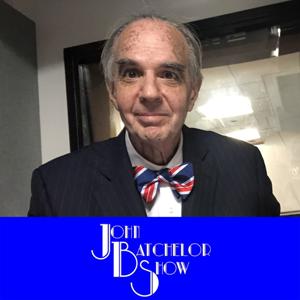
The John Batchelor Show

The John Batchelor Show

By John Batchelor Show.Society & CultureNewsArtsBooks
Download on the App Store
  • Ranking

    33rd

    on Books

  • Favorites

    578

    Followers

  • Typical duration

    18 min

    per episode

  • If it hooks

    62%

    finish an episode

Based on Podcast App listening data

The John Batchelor Show episodes

  • S8 Ep1189: David Grantham, author of Consequences: An Intelligence Officer's War, provides a memoir of his time as an Air Force Office of Sp
    David Grantham, author of Consequences: An Intelligence Officer's War, provides a memoir of his time as an Air Force Office of Special Investigations (OSI) agent, detailing the high-stakes world of counter-intelligence during the Global War on Terror. His deployments took him from a five-star hotel in Kuwait to the tactical dangers of Bagram Air Base in Afghanistan and Camp Bucca in Iraq. Grantham emphasizes that intelligence work is inherently provocative, involving the "poking" into places where adversaries do not want scrutiny. A central focus of the book is the radicalization within Iraqi prisons, specifically Camp Bucca, which Grantham identifies as a "powder keg" and the eventual birthplace of ISIS. He describes the delicate balance required to collect intelligence on al-Qaeda and Iranian-backed Sadr networks without sparking a larger geopolitical conflict with Iran. Grantham reflects on the "flawed execution" of the Iraq war, noting that while it provided a hard-earned education on network-style threats, the human cost to the Iraqi people was immense. Applying these lessons to modern challenges, Grantham analyzes the Bolivarian threat network in Latin America, where states like Venezuela and Iran utilize cartels to target the United States. He warns that the US southern border is being systematically overwhelmed by cartels using "distraction" strategies—such as waves of migrants—to facilitate the movement of drugs, weapons, and money. He concludes that these networks are increasingly sophisticated, lucrative, and difficult to dismantle. (2)
    1910 Peshawar
    40 min
  • S8 Ep1189: Charles Gasparino, author of Go Woke, Go Broke: The Inside Story of the Radicalization of Corporate America, explores the radical
    Charles Gasparino, author of Go Woke, Go Broke: The Inside Story of the Radicalization of Corporate America, explores the radicalization of corporate America by tracing the rise of ESG (Environmental, Social, and Governance) and DEI (Diversity, Equity, and Inclusion) initiatives. He argues that these movements, once fringe academic theories, were embraced by corporate elites at global forums like Davos and the UN. This shift was accelerated by the 2008 financial crisis, which led CEOs to adopt "stakeholder capitalism" as a defensive "cover your backside" strategy against progressive populism and threats of government nationalization. The book details how major asset managers like BlackRock and Vanguard leveraged trillions in investment money to force progressive social changes on the companies in their portfolios. Gasparino uses The Walt Disney Company as a primary example of "woke" activism backfiring, noting how political entanglements in Florida and ideological shifts in programming led to significant financial and cultural fallout. He also highlights the story of Sage Steele, who was allegedly forced out of ESPN for holding heterodox, non-woke views. Ultimately, Gasparino documents an ongoing backlash against these policies, as evidenced by massive withdrawals from ESG-focused funds and a retreat from diversity programs by firms like Goldman Sachs. He concludes that "wokeness" is often a distraction from core business responsibilities, such as managing balance sheets, and warns that it divides the country while harming the bottom line. (1)
    38 min
  • S8 Ep1189: John Tamny, author of The Money Confusion: How a Literacy About Currencies and Inflation Sets the Stage for the Crypto Revolution
    John Tamny, author of The Money John Tamny, author of The Money Confusion: How a Literacy About Currencies and Inflation Sets the Stage for the Crypto Revolution, provides an unconventional analysis of money, arguing that its only purpose is to circulate consumable goods as a product of specialized labor. Drawing on Adam Smith's principles, he asserts that wealth is created through the division of labor and that money is simply an agreement about value between producers. Tamny contends that current fears of "inflation" are misguided; he defines real inflation as a deliberate devaluation of currency by policy choice, such as the 1971 delinking of the dollar from gold. The book argues that the high prices seen after 2020 were caused by the economic destruction of lockdowns, not an excess of money. Tamny is highly critical of the Federal Reserve, claiming it has no real power over growth or interest rates for startups, as true credit always finds talent regardless of central bank fiddling. He uses Elon Musk as a recurring example of an innovator whose success in companies like PayPal and SpaceX was driven by venture capital and risk-takers rather than traditional banks. Tamny envisions a crypto revolution where private, stable money replaces failed government currencies. He suggests that the recent volatility in crypto is a healthy "shaking out" of the market, paving the way for mature, information-based money systems. He speculates that Musk may eventually use Twitter to launch a global, stable cryptocurrency, finally fulfilling the vision of a "global financial supermarket." (5)
    Confusion: How a Literacy About Currencies and Inflation Sets the Stage for the Crypto Revolution, provides an unconventional analysis of money, arguing that its only purpose is to circulate consumable goods as a product of specialized labor. Drawing on Adam Smith's principles, he asserts that wealth is created through the division of labor and that money is simply an agreement about value between producers. Tamny contends that current fears of "inflation" are misguided; he defines real inflation as a deliberate devaluation of currency by policy choice, such as the 1971 delinking of the dollar from gold. The book argues that the high prices seen after 2020 were caused by the economic destruction of lockdowns, not an excess of money. Tamny is highly critical of the Federal Reserve, claiming it has no real power over growth or interest rates for startups, as true credit always finds talent regardless of central bank fiddling. He uses Elon Musk as a recurring example of an innovator whose success in companies like PayPal and SpaceX was driven by venture capital and risk-takers rather than traditional banks. Tamny envisions a crypto revolution where private, stable money replaces failed government currencies. He suggests that the recent volatility in crypto is a healthy "shaking out" of the market, paving the way for mature, information-based money systems. He speculates that Musk may eventually use Twitter to launch a global, stable cryptocurrency, finally fulfilling the vision of a "global financial supermarket." (5)
    1870 manhattan

    40 min
  • S8 Ep1189: Jonathan D.T. Ward, author of The Decisive Decade: American Grand Strategy for Triumph Over China, defines the 2020s as a "decisi
    Jonathan D.T. Ward, author of The Decisive Decade: American Grand Strategy for Triumph Over China, defines the 2020s as a "decisive decade" during which the United States must execute a new grand strategy to defeat the Russia-China axis. He characterizes the relationship between Putin and Xi as a profound military and philosophical alliance aimed at ending American preeminence. Ward argues that China seeks to overcome its geographical weaknesses through expansionist projects like the Belt and Road Initiative, which converts economic power into global military footprints. A core concept in the book is the "second great divergence," where the world's democracies must seize the lead in the fourth industrial revolution while denying technological and capital access to dictatorships. Ward stresses that Taiwan is the strategic "lock" on the Pacific, and its fall would permanently shift the military balance in Asia. He advocates for the total rebuilding of the American industrial base and the creation of an "arsenal of democracy" to counter China's superior manufacturing output. Ward recommends a "two-track" diplomatic approach: consolidating existing alliances like the Quad while out-competing China for influence in the emerging world through real investment rather than lectures. He concludes that the private sector must be aligned with national security interests, forming a "corporate battle fleet" to win the long-term economic and technological competition. (6)
    1793 Tradesman
    38 min
  • S8 Ep1189: Mark Clifford, author of Today Hong Kong, Tomorrow the World: What China's Crackdown Reveals About Its Plans to End Freedom Every
    Mark Clifford, author of Today Hong Kong, Tomorrow the World: What China's Crackdown Reveals About Its Plans to End Freedom Everywhere, documents the collapse of freedom in Hong Kong, describing the CCP's strategy as an "anaconda in the chandelier" that exerts control through subtle intimidation and sudden, lethal strikes. He traces the city's struggle for democracy from the 2014 Umbrella Movement to the massive 2019 protests against a proposed extradition bill. Clifford highlights the role of Jimmy Lai, the courageous media mogul behind Apple Daily, who was eventually imprisoned for his commitment to nonviolent opposition. The book explores how Beijing systematically dismantled Hong Kong's "high degree of autonomy" by bypassing local laws and imposing a draconian National Security Law in 2020. Clifford argues that this was not just a local event but a demonstration of the CCP's broader plan to use economic weapons, surveillance technology, and co-opted elites to silence dissent globally. He notes that the CCP successfully used Hong Kong's legal and administrative systems as tools of repression rather than protection. Clifford concludes with a warning that the tactics used to crush Hong Kong are being exported worldwide. He cites instances of Chinese diplomats threatening foreign politicians and activists in the diaspora, emphasizing that eternal vigilance is the only defense against the CCP's expansionist authoritarianism. The death of liberty in Hong Kong, he argues, serves as a chilling preview of the CCP's vision for the rest of the world. (7)
    1930s
    40 min
  • 1192: **David Davenport** provides a historical overview of how the concept of equality of opportunity has evolved from the American foundin
    David Davenport provides a historical overview of how the concept of equality of opportunity has evolved from the American founding to the modern era. The discussion explains that while the Founders initially focused on dismantling European systems of caste and class, later leaders like Abraham Lincoln and Woodrow Wilson expanded federal power to address slavery and industrialization. As the frontier closed, the government shifted from merely protecting natural rights to actively managing social and economic outcomes. Franklin D. Roosevelt and Lyndon B. Johnson furthered this trend by implementing New Deal and Great Society programs aimed at correcting systemic poverty. Conversely, Ronald Reagan sought to revive the original philosophy by reducing government intervention and promoting individualism. Ultimately, the discussion highlights a contemporary shift in language where the traditional ideal of equality is increasingly being replaced by the more ambiguous term equity. (1)
    1800 BOSTON TREMONT STREET
    19 min
  • 1191: In this interview, author **Stephen Harrigan** discusses his historical novel, *The Leopard is Loose*, which centers on a real-life an
    In this interview, author Stephen Harrigan discusses his historical novel, The Leopard is Loose, which centers on a real-life animal escape in 1950s Oklahoma City. The narrative follows young Grady McCarty and his family as they navigate the psychological and social shifts of the post-World War II era. Harrigan explains how the leopard serves as a catalyst for a community already destabilized by veterans' PTSD, looming Cold War anxieties, and the rigid structures of racial segregation. By filtering the story through Grady’s childhood bewilderment and adult reflection, the book examines a family struggling to reconcile past trauma with an uncertain future. The discussion highlights how the pursuit of the escaped animal energized men who felt obsolete in a changing society, while also exposing the deep rifts within American domestic life.
    1916 TEXAS
    19 min
  • 1190: **Peter Stansky**, Professor of History, Emeritus at **Stanford University** and author of *The Socialist Patriot: George Orwell and W
    Peter Stansky, Professor of History, Emeritus at Stanford University and author of The Socialist Patriot: George Orwell and War, explores the life and political evolution of George Orwell (born Eric Blair). Born in India in 1903 to a family in the "official classes," Orwell's early identity was shaped by the British Empire and his education at St Cyprian's and Eton. Stansky argues that Orwell's experiences during World War I fostered an intense patriotism, which he distinguished from nationalism as a love for one's country without the desire to impose its will on others. Orwell's career shifted from serving as an imperial police officer in Burma to living in poverty in London and Paris to understand class dynamics. A defining moment occurred during the Spanish Civil War, where he was wounded while fighting for the POUM. This experience transformed him into a convinced democratic socialist while simultaneously making him a fierce anti-communist after witnessing Soviet-backed betrayals. During World War II, Orwell worked for the BBC and wrote The Lion and the Unicorn, arguing that England must become socialist to win the war. His final years were marked by personal tragedy and failing health as he wrote his most famous works, Animal Farm and 1984. Stansky concludes that these masterpieces were not anti-socialist, but rather warnings about the corrupting nature of power and the betrayal of revolutionary ideals by leaders who prioritize maintaining control over the welfare of the people. (1)
    1940 GEORGE (ERIC BLAIR) ORWELL
    38 min
  • 1189: **Beppe Severgnini**, author of *Italian Lessons: 50 Things We Know About Life Now*, reflects on **Italy**'s experience as the first W
    Beppe Severgnini, author of Italian Lessons: 50 Things We Know About Life Now, reflects on Italy's experience as the first Western nation struck by the COVID-19 pandemic. Centered in his hometown of Crema, the narrative begins with a symbolic 13th-century crucifix in the local cathedral, a historical touchstone that comforted ancestors during plagues in 1630 and 1747. During the 2020 crisis, the community witnessed modern interventions, such as an Italian army field hospital built in three days and the arrival of Cuban medical teams to assist overwhelmed local doctors. The book outlines 50 lessons derived from Italian life, emphasizing cultural strengths like the "Five Fs": Family, Food, Fashion, Fantasy, and Feelings. Severgnini highlights the nation's social fabric, where spontaneous networks of volunteers ensured no elderly person was left without food or medicine during the lockdown. He also explores Italy's diverse urban identities, categorizing cities as narrative (Milan, Turin), poetic (Trieste, Genoa), or theatrical (Naples). Beyond the crisis, the book celebrates the artisan's gift for "thinking with their hands" and the enduring "Dolce Vita," a lifestyle where individuals are truly seen and valued. Ultimately, the work portrays a society rooted in ancient history but capable of profound modern adaptation. (1)
    1918 SPANISH FLU PANDEMIC TRAINING
    2 min
  • S8 Ep1188: Jim Robbins, author of The Man Who Planted Trees: A Story of Lost Groves, the Science of Trees, and a Plan to Save the Planet, di
    Jim Robbins, author of The Man Who Planted Trees: A Story of Lost Groves, the Science of Trees, and a Plan to Save the Planet, discusses the life's work of David Milarch, a man who, following a transformative near-death experience, embarked on a mission to save the genetics of the world's largest and oldest trees. Through the Archangel Ancient Tree Archive, Milarch and his team clone "champion trees"—the largest specimens of various species—to preserve their resilient DNA, which Milarch believes contains the "schooling" of centuries of survival against storms and disease. Despite early resistance from federal regulators and established forestry groups, the project has gained global attention as a vital response to the climate crisis. Robbins highlights trees as sophisticated "eco technology" that performs "ecosystem services," such as filtering water through the rhizosphere (root system), signaling threats to one another via chemical processes, and even influencing global weather patterns. The discussion underscores a dire environmental reality: 95% of old-growth redwoods and sequoias have been lost, and current giants are dying due to rising temperatures. To counter this, Milarch utilizes "assisted migration," replanting clones of ancient giants in cooler northern climates like Oregon to ensure their survival. Ultimately, Robbins emphasizes the deep emotional and biological connection between humans and trees, advocating for a "gospel of trees" to restore the planet's damaged ecosystems. (1)
    1946 GREAT SLAVE LAKE CANADA
    40 min

About The John Batchelor Show

From the publisher's feed

The John Batchelor Show is a hard news-analysis radio program on current events, world history, global politics and natural sciences. Based in New York City for two decades, the show has travelled…

Best of The John Batchelor Show

Ranked by our users in the last 21 days

More shows like The John Batchelor Show

Mark Levin Podcast by Cumulus Podcast Network

Mark Levin Podcast

22,898 Listeners

THE SAVAGE NATION by Michael Savage

THE SAVAGE NATION

11,901 Listeners

Hillsdale Dialogues by Hillsdale College

Hillsdale Dialogues

2,117 Listeners

Bill O’Reilly’s No Spin News and Analysis by Bill O'Reilly

Bill O’Reilly’s No Spin News and Analysis

12,599 Listeners

The Mark Simone Show by iHeartRadio and Mark Simone

The Mark Simone Show

732 Listeners

The Radio Free Hillsdale Hour by Hillsdale College

The Radio Free Hillsdale Hour

673 Listeners

Newt's World by Gingrich 360

Newt's World

6,549 Listeners

John Solomon Reports by John Solomon

John Solomon Reports

6,491 Listeners

The Hugh Hewitt Show: Highly Concentrated by Salem Podcast Network

The Hugh Hewitt Show: Highly Concentrated

714 Listeners

DINESH Podcast by Salem Podcast Network

DINESH Podcast

6,840 Listeners

The Big Ben Show by Fox News Podcasts

The Big Ben Show

557 Listeners

The Victor Davis Hanson Show by Victor Davis Hanson and Jack Fowler

The Victor Davis Hanson Show

8,404 Listeners

Kudlow by Fox News Podcasts

Kudlow

215 Listeners

Victor Davis Hanson: In His Own Words by Victor Davis Hanson | The Daily Signal

Victor Davis Hanson: In His Own Words

1,149 Listeners

Pod Force One by New York Post

Pod Force One

1,181 Listeners