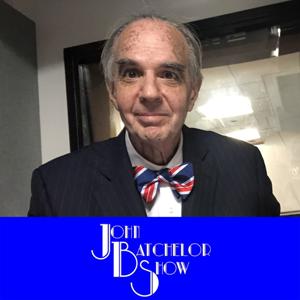
The John Batchelor Show

The John Batchelor Show

By John Batchelor Show.Society & CultureNewsArtsBooks
Download on the App Store
  • Ranking

    33rd

    on Books

  • Favorites

    578

    Followers

  • Typical duration

    18 min

    per episode

  • If it hooks

    62%

    finish an episode

Based on Podcast App listening data

The John Batchelor Show episodes

  • S8 Ep1173: Caleb Weiss and Bill Roggio assess Somali officials' claim of the death of Maalim Ibrahim, a co-founder of al-Shabaab and a key m
    Caleb Weiss and Bill Roggio assess Somali officials' claim of the death of Maalim Ibrahim, a co-founder of al-Shabaab and a key military planner who held many executive hats. However, Weiss cautions that such claims often lack third-party verification and may be false. The US is currently threatening to cut funding for the UN mission in Somaliadue to a perceived lack of progress against the group and pervasive internal political corruption. (3)
    12 min
  • S8 Ep1173: Husain Haqqani and Bill Roggio examine the potential for unconventional warfare escalation across Eurasia and the specific risks
    Husain Haqqani and Bill Roggio examine the potential for unconventional warfare escalation across Eurasia and the specific risks within the Caspian theater. Haqqani warns that Iran's ability to hold the global economy hostage through the Red Sea and Hormuz Strait creates a complex dilemma for the US. Bill Roggio concurs that limited aerial bombardment is insufficient for regime change and notes that neighboring countries like Kuwait remain hesitant to directly engage for fear of retaliation. (2)
    6 min
  • S8 Ep1173: John Batchelor discusses the current tensions between Iran and the United States with Ambassador Husain Haqqani and Bill Roggio f
    John Batchelor discusses the current tensions between Iran and the United States with Ambassador Husain Haqqaniand Bill Roggio following a sudden halt in American bombing. Haqqani explains that both nations are seeking a diplomatic "off-ramp," though they face severe internal political constraints that prevent either a ground invasion or a total surrender. Bill Roggio adds that while secret talks are likely, reports of depleted US munitions might be influencing the decision to pause military action. (1)
    13 min
  • S8 Ep1172: Gaius and Germanicus: Gaius recounts the tragic tale of the elephants in 55 BCE, who were lured from North Africa with promises o
    Gaius and Germanicus: Gaius recounts the tragic tale of the elephants in 55 BCE, who were lured from North Africawith promises of safety only to be slaughtered in Pompey's arena. The elephants' pathetic pleas moved the Romanaudience to tears, and Gaius notes that Pompey was later "cursed," meeting his end by decapitation in Egypt. Germanicus explains that while gladiatorial combat was a sacred Roman martial ethos used to relive military glory, the empire eventually shifted toward a Greek-Christian vision. This new era, centered in the East, rejected the "primitive tribal vision" of the arena in favor of piety and universal equality. Under Christianity, slavery began to die out in the Eastern Empire. The hosts conclude by preparing to meet a delegation of retired gladiators—men who survived the arena to become free citizens. (3)
    17 min
  • S8 Ep1172: Gaius and Germanicus: The discussion focuses on the "shrinking presidency" of Mr. Trump in 2026, drawing parallels to the diminis
    Gaius and Germanicus: The discussion focuses on the "shrinking presidency" of Mr. Trump in 2026, drawing parallels to the diminished 19th-century stature of Benjamin Harrison. The hosts argue that geriatric leadership and the "unbelievable" stress of failing wars make 8-year terms unsustainable, suggesting a shift to single six-year terms. Germanicus proposes a radical "rosy scenario": the US should "slough off" dependent possessions like Europe—which he views as a drain—to focus on viable partners like Japan and Korea. This mirrors the Western Roman Empire's collapse, which allowed the Greek-speaking Eastern Empire (Constantinople) to thrive for another millennium. They warn that the US is already in an active civil war that will intensify due to "lazy left" policies like court-packing. They conclude by searching for a "smiling Greek" source of survival amidst American upheaval. (2)
    1892
    19 min
  • S8 Ep1171: In The Londinium Chronicles, Gaius (John Batchelor) and Germanicus (Michael Vlahos) explore the intersections of Roman history an
    In The Londinium Chronicles, Gaius (John Batchelor) and Germanicus (Michael Vlahos) explore the intersections of Roman history and modern geopolitics.Gaius and Germanicus: The hosts analyze the current "floundering" of the White House and the Kremlin. Germanicus argues the US lacks a "theory of victory" in Iran, mired in a conflict it refuses to settle due to the inability to accept defeat. Simultaneously, he critiques NATO for using Ukraine as a surrogate to bait Russia, noting that small, "inveterately focused" nations like Poland and the Baltics are dragging the US into an unnecessary war. Germanicus describes Europe as a "homunculus"—a helpless dependency attached to the US with no personal agency. He suggests the US remains trapped by the "overhang" of its post-Cold War "super triumph," viewing itself as an Olympian god of war despite failed enterprises in Iraq and Afghanistan. Russia, meanwhile, is characterized as being in "survival mode," seeking to defend its borders against NATO's offensive pressure. (1)
    SULLA COIN
    26 min
  • S8 Ep1170: Neil Lanctot concludes with the revelation of the Zimmermann Telegram—a German proposal for an alliance with Mexico against the
    Neil Lanctot concludes with the revelation of the Zimmermann Telegram—a German proposal for an alliance with Mexico against the U.S.—which finally pushed the nation toward war. On April 2, 1917, Wilson asked Congress for a declaration of war "to make the world safe for democracy," though the vote was not unanimous. Progressive Senator Robert La Follette and the first Congresswoman, Jeannette Rankin, famously voted against the resolution. Following the war and the flawed Versailles Treaty, the three protagonists faced varied fates: TR died in 1919; Wilson suffered a debilitating stroke in late 1919 and died in 1924; and Jane Addams faced government surveillance as a "radical" during the 1920s. However, Addams' reputation was eventually restored; she won the Nobel Peace Prize in the early 1930s and was a beloved figure at the time of her death in 1935. Lanctot concludes by noting that Addams and the militant Schwimmer remained figures ahead of their time in their pursuit of global peace. (8)
    1919
    10 min
  • S8 Ep1170: Neil Lanctot follows Wilson's narrow re-election in late 1916, fueled by the slogan of maintaining peace. Seeking to end the conf
    Neil Lanctot follows Wilson's narrow re-election in late 1916, fueled by the slogan of maintaining peace. Seeking to end the conflict before the U.S. was forced in, he issued a peace note to all warring parties and delivered his famous "Peace Without Victory" speech in early 1917. While popular in America, the speech was rejected by European Allies who had already sacrificed too much blood and treasure. Wilson eventually realized that if the U.S. did not fight, he would have no influence at the post-war peace conference, telling Jane Addams he would be lucky to enter "through a crack in the door." Lanctot also highlights Wilson's segregationist views and racial "hate language," noting his 19th-century mindset was far behind Addams, an NAACP supporter. As Germany prepared to resume unrestricted submarine warfare, Wilson's efforts to remain neutral were rapidly collapsing under the weight of geopolitical reality. (7)
    12 min
  • S8 Ep1170: Neil Lanctot recounts the June 1916 Republican convention, which nominated Supreme Court Justice Charles Evans Hughes as a compro
    Neil Lanctot recounts the June 1916 Republican convention, which nominated Supreme Court Justice Charles Evans Hughes as a compromise candidate to block TR and save the party. TR, realizing he lacked sufficient support, made the difficult decision to decline the Progressive Party's nomination and support Hughes to prevent a Democratic victory. The campaign was marked by Hughes' lackluster style and Wilson's clever political maneuvering. A central issue was women's suffrage; Hughes eventually supported a federal amendment, while Wilson cautiously argued for a state-by-state approach to avoid alienating his base. Despite threats from suffrage groups to campaign against him, Wilson maintained support in many suffrage states. The election largely hinged on the European war, with Wilson campaigning on the idea that he had "kept us out of war." However, the peace was fragile, as the German submarine threat remained quiet only because they had temporarily backed down after the Sussex incident. (6)
    1914 Federal Reserve
    8 min
  • S8 Ep1170: Neil Lanctot details the March 1916 sinking of the Sussex, which caused more American deaths and pushed Wilson to the brink of wa
    Neil Lanctot details the March 1916 sinking of the Sussex, which caused more American deaths and pushed Wilson to the brink of war. German Ambassador Johann von Bernstorff worked desperately to maintain peace, recognizing that American entry would doom Germany, while Wilson largely ignored his own ambassadors in London and Berlin, whom he considered useless or biased. Interestingly, the Wilson administration used wiretaps to monitor the German embassy, revealing Bernstorff's personal affairs and diplomatic strategies. In Berlin, leaders distrusted Wilson, viewing him as leaning toward the Allies, while British leaders like Lloyd George were frustrated by American neutrality. Domestically, TR's rage at Wilson's "holding back" reached a boiling point, leading him to use vulgar language toward the President during private meetings with Republican financiers. Meanwhile, militant pacifist Rosika Schwimmer, who had initially drawn Henry Ford into the peace movement, was marginalized as the movement became increasingly fragmented and impractical. (5)
    1914

    12 min

About The John Batchelor Show

From the publisher's feed

The John Batchelor Show is a hard news-analysis radio program on current events, world history, global politics and natural sciences. Based in New York City for two decades, the show has travelled…

Best of The John Batchelor Show

Ranked by our users in the last 21 days

More shows like The John Batchelor Show

Mark Levin Podcast by Cumulus Podcast Network

Mark Levin Podcast

22,896 Listeners

THE SAVAGE NATION by Michael Savage

THE SAVAGE NATION

11,893 Listeners

Hillsdale Dialogues by Hillsdale College

Hillsdale Dialogues

2,118 Listeners

Bill O’Reilly’s No Spin News and Analysis by Bill O'Reilly

Bill O’Reilly’s No Spin News and Analysis

12,600 Listeners

The Mark Simone Show by iHeartRadio and Mark Simone

The Mark Simone Show

731 Listeners

The Radio Free Hillsdale Hour by Hillsdale College

The Radio Free Hillsdale Hour

672 Listeners

Newt's World by Gingrich 360

Newt's World

6,550 Listeners

John Solomon Reports by John Solomon

John Solomon Reports

6,484 Listeners

The Hugh Hewitt Show: Highly Concentrated by Salem Podcast Network

The Hugh Hewitt Show: Highly Concentrated

713 Listeners

DINESH Podcast by Salem Podcast Network

DINESH Podcast

6,838 Listeners

The Big Ben Show by Fox News Podcasts

The Big Ben Show

557 Listeners

The Victor Davis Hanson Show by Victor Davis Hanson and Jack Fowler

The Victor Davis Hanson Show

8,406 Listeners

Kudlow by Fox News Podcasts

Kudlow

215 Listeners

Victor Davis Hanson: In His Own Words by Victor Davis Hanson | The Daily Signal

Victor Davis Hanson: In His Own Words

1,149 Listeners

Pod Force One by New York Post

Pod Force One

1,180 Listeners