
Sign up to save your podcasts
Or


When you think of the dinosaurs, you probably think of supersized lizards. At least I do. They were gargantuan, certainly, and maybe quite agile, but also a bit dim-witted. Maybe not markedly dim-witted, but definitely not the brightest. When dinosaurs terrify us it's because of their giant jaws and their sheer size, not because they were especially clever or crafty. (Except for those velociraptors in Jurassic park, of course—they were terrifyingly wily.) But, in any case, who really knows? It's all just fantasy and guesswork, right? I mean, how could we ever know how clever the dinosaurs actually were?
My guest today is Dr. Suzana Herculano-Houzel, a comparative neuroanatomist at Vanderbilt University. She studies the diversity and composition of brains across the biological world. For more than a decade now, Suzana and her colleagues have made the case that one of the most revealing things about a brain is not how big it is or how big it is relative to the body, but simply how many neurons it has. This basic variable, she argues, can tell us a lot about the cognitive capabilities of different species. Which means that if we were able, in some way, to estimate the number of neurons in the brain of some extinct creature, we could start to make inferences about its mind and its behaviors.
Here, Suzana and I discuss a recent study of hers in which she does exactly that. She was able to reconstruct the make-up of the brains of certain dinosaurs—such as the theropods, a group that included the venerable Tyrannosaurus Rex. But, before we get to the T-Rex, we first lay some important groundwork. We talk about how Suzana counts neurons, by making a kind of brain soup. We discuss how number of neurons proves to be a better predictor of complex cognition than does the much-discussed Encephalization Quotient (or EQ). We then describe how the brains of different groups of animals tend to obey predictable scaling laws. And with that groundwork laid, we dig into Suzana's estimate that, in terms of number of neurons, a T-Rex's brain was comparable to a baboon's. Which would mean that it was significantly cleverer than we long thought, that it was probably quite behaviorally flexible and long-lived and may have even had culture. As you might imagine, this study caused quite a bit of a stir and so, finally, Suzana and I discuss some of the criticisms that have been leveled against it.
Alright folks, this is a super thought-provoking episode, whether or not you are—or ever were—a dinosaur geek. And even if you're not quite ready to accept Suzana's conclusions about the T-Rex, I think you'll find that her work opens up a host of new questions and new directions. So, without further ado, on to my chat with Dr. Suzana Herculano-Houzel. Enjoy!
A transcript of this episode is available here.
Notes and links
6:00 – The paper in which Dr. Herculano-Houzel and her collaborator introduced the "brain soup" (aka isotropic fractionator) method.
10:00 – A paper by Dr. Herculano-Houzel about the glia/neuron ratio.
16:00 – The idea of the Encephalization Quotient (EQ) was first laid out by Harry Jerison in a 1973 book, Evolution of the Brain and Intelligence. A paper-length version of the theory is presented here.
23:00 – A recent review paper by Dr. Herculano-Houzel about number of neurons as a correlate of cognitive ability across species.
27:30 – Dr. Herculano-Houzel and colleagues have argued that the human brain is very much a "scaled up" version of the primate brain. See an empirical paper here and a review article here. See also Dr. Herculano-Houzel's TED talk and book, The Human Advantage.
28:00 – Dr. Herculano-Houzel has found, in a data set of 700 species, that the number of cortical neurons predicts a species' longevity and age to maturity.
33:00 – A 2022 study in PNAS of neuron numbers across numerous species. The data from this paper formed the basis for some of Dr. Herculano-Houzel's analyses.
41:30 – For more discussion of planning and future-thinking across species, see our recent episode Traversing the Fourth Dimension, with Dr. Adam Bulley.
46:00 – While Dr. Herculano-Houzel's study on dinosaur brains has generated much excitement, it also been met with some skepticism in various popular treatments and on Twitter.
48:00 – A popular article describing the idea that dinosaurs were neither warm- nor cold-blooded but "mesotherms."
Dr. Herculano-Houzel recommends:
The Rise and Fall of the Dinosaurs, by Steve Brusatte
Dr. Herculano-Houzel's The Neuroscience Office Hour: Crash Course
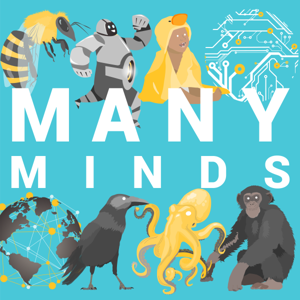
Many Minds is a project of the Diverse Intelligences Summer Institute, which is made possible by a generous grant from the Templeton World Charity Foundation to UCLA. It is hosted and produced by Kensy Cooperrider, with help from Assistant Producer Urte Laukaityte and with creative support from DISI Directors Erica Cartmill and Jacob Foster. Our artwork is by Ben Oldroyd. Our transcripts are created by Sarah Dopierala.
You can subscribe to Many Minds on Apple, Stitcher, Spotify, Pocket Casts, Google Play, or wherever you like to listen to podcasts.
You can now subscribe to the Many Minds newsletter here!
We welcome your comments, questions, and suggestions. Feel free to email us at: [email protected].
For updates about the show, visit our website (https://disi.org/manyminds/), or follow us on Twitter: @ManyMindsPod.
 View all episodes
 By Kensy Cooperrider – Diverse Intelligences Summer Institute

4.9
6262 ratings
When you think of the dinosaurs, you probably think of supersized lizards. At least I do. They were gargantuan, certainly, and maybe quite agile, but also a bit dim-witted. Maybe not markedly dim-witted, but definitely not the brightest. When dinosaurs terrify us it's because of their giant jaws and their sheer size, not because they were especially clever or crafty. (Except for those velociraptors in Jurassic park, of course—they were terrifyingly wily.) But, in any case, who really knows? It's all just fantasy and guesswork, right? I mean, how could we ever know how clever the dinosaurs actually were?
My guest today is Dr. Suzana Herculano-Houzel, a comparative neuroanatomist at Vanderbilt University. She studies the diversity and composition of brains across the biological world. For more than a decade now, Suzana and her colleagues have made the case that one of the most revealing things about a brain is not how big it is or how big it is relative to the body, but simply how many neurons it has. This basic variable, she argues, can tell us a lot about the cognitive capabilities of different species. Which means that if we were able, in some way, to estimate the number of neurons in the brain of some extinct creature, we could start to make inferences about its mind and its behaviors.
Here, Suzana and I discuss a recent study of hers in which she does exactly that. She was able to reconstruct the make-up of the brains of certain dinosaurs—such as the theropods, a group that included the venerable Tyrannosaurus Rex. But, before we get to the T-Rex, we first lay some important groundwork. We talk about how Suzana counts neurons, by making a kind of brain soup. We discuss how number of neurons proves to be a better predictor of complex cognition than does the much-discussed Encephalization Quotient (or EQ). We then describe how the brains of different groups of animals tend to obey predictable scaling laws. And with that groundwork laid, we dig into Suzana's estimate that, in terms of number of neurons, a T-Rex's brain was comparable to a baboon's. Which would mean that it was significantly cleverer than we long thought, that it was probably quite behaviorally flexible and long-lived and may have even had culture. As you might imagine, this study caused quite a bit of a stir and so, finally, Suzana and I discuss some of the criticisms that have been leveled against it.
Alright folks, this is a super thought-provoking episode, whether or not you are—or ever were—a dinosaur geek. And even if you're not quite ready to accept Suzana's conclusions about the T-Rex, I think you'll find that her work opens up a host of new questions and new directions. So, without further ado, on to my chat with Dr. Suzana Herculano-Houzel. Enjoy!
A transcript of this episode is available here.
Notes and links
6:00 – The paper in which Dr. Herculano-Houzel and her collaborator introduced the "brain soup" (aka isotropic fractionator) method.
10:00 – A paper by Dr. Herculano-Houzel about the glia/neuron ratio.
16:00 – The idea of the Encephalization Quotient (EQ) was first laid out by Harry Jerison in a 1973 book, Evolution of the Brain and Intelligence. A paper-length version of the theory is presented here.
23:00 – A recent review paper by Dr. Herculano-Houzel about number of neurons as a correlate of cognitive ability across species.
27:30 – Dr. Herculano-Houzel and colleagues have argued that the human brain is very much a "scaled up" version of the primate brain. See an empirical paper here and a review article here. See also Dr. Herculano-Houzel's TED talk and book, The Human Advantage.
28:00 – Dr. Herculano-Houzel has found, in a data set of 700 species, that the number of cortical neurons predicts a species' longevity and age to maturity.
33:00 – A 2022 study in PNAS of neuron numbers across numerous species. The data from this paper formed the basis for some of Dr. Herculano-Houzel's analyses.
41:30 – For more discussion of planning and future-thinking across species, see our recent episode Traversing the Fourth Dimension, with Dr. Adam Bulley.
46:00 – While Dr. Herculano-Houzel's study on dinosaur brains has generated much excitement, it also been met with some skepticism in various popular treatments and on Twitter.
48:00 – A popular article describing the idea that dinosaurs were neither warm- nor cold-blooded but "mesotherms."
Dr. Herculano-Houzel recommends:
The Rise and Fall of the Dinosaurs, by Steve Brusatte
Dr. Herculano-Houzel's The Neuroscience Office Hour: Crash Course
Many Minds is a project of the Diverse Intelligences Summer Institute, which is made possible by a generous grant from the Templeton World Charity Foundation to UCLA. It is hosted and produced by Kensy Cooperrider, with help from Assistant Producer Urte Laukaityte and with creative support from DISI Directors Erica Cartmill and Jacob Foster. Our artwork is by Ben Oldroyd. Our transcripts are created by Sarah Dopierala.
You can subscribe to Many Minds on Apple, Stitcher, Spotify, Pocket Casts, Google Play, or wherever you like to listen to podcasts.
You can now subscribe to the Many Minds newsletter here!
We welcome your comments, questions, and suggestions. Feel free to email us at: [email protected].
For updates about the show, visit our website (https://disi.org/manyminds/), or follow us on Twitter: @ManyMindsPod.

15,255 Listeners

10,742 Listeners

5,534 Listeners

2,455 Listeners

770 Listeners

546 Listeners

824 Listeners

315 Listeners

4,181 Listeners
114 Listeners

5,541 Listeners

16,236 Listeners

357 Listeners
122 Listeners

44 Listeners