
Sign up to save your podcasts
Or



Based on Podcast App listening data
When a presidential interview goes off the rails, it is rarely an accident. It is a pattern.
A man tried to kill the president on Saturday. By Tuesday, the dominant news story was a court filing about a ballroom.
That is not a glitch in the news cycle. That is a Trap working exactly as designed.
This week, I am introducing the fourth Trap in the Crisis Doctrine. The Deflection Trap. The four-move playbook leaders run when they cannot afford to answer the question they were asked. I pulled 8,706 articles from the week of the White House Correspondents' Dinner attack. The data shows it. Trump's 60 Minutes interview demonstrates it. And once you can name the four moves, you stop falling for them.
This episode is for anyone who has watched a leader dodge a hard question and felt something was off without being able to say what.
Now you can say what.
WHAT YOU'LL LEARN
Read the full essay on Substack.
When a leader is under pressure, the first move tells you everything. Kash Patel sued The Atlantic for $275 million. Mike Vrabel called it a "private and personal matter." Both responses were designed to control the story. Both made it worse.
This week on PR Breakdown, two leaders, two crises, one shared mistake. They tried to outrun trust instead of rebuilding it.
Molly Breaks Down
The Through Line
This is not a story about a lawsuit and an affair. It is a story about what leaders reach for when trust starts to crack. Patel reached for litigation. Vrabel reached for vagueness. Both reached for control. Neither reached for accountability.
The first move is always the tell. And the tell is almost always the same one. The belief that you can manage your way out of a trust problem without ever naming it.
What You Will Learn
When serious allegations land, a public figure's opening move is supposed to signal steadiness, accountability, and command of the facts. Eric Swalwell's first move did the opposite. Within hours, he reached for lawyers, labeled his accusers politically motivated, and went rogue on Instagram against his own staff's advice. The first move told us the intent. Everything that followed confirmed it.
This isn't a story about one congressman's resignation. It's a diagnostic for how contempt reveals itself under pressure. When the first instinct is to fight instead of lead, survival mode takes over, and survival mode rarely survives.
Melania Trump didn't walk to that podium to defend herself. She walked there to distance herself. From Epstein. From the male executives around her. And quietly, unmistakably, from her husband.
This wasn't a press conference. There were no questions. No reporters. Just a controlled, produced, lawyer-crafted statement delivered at exactly the right time to own the news cycle and put narrow legal points on the record before something drops.
In this episode, Molly breaks down the full PR read on Melania's statement, including the fixer fingerprints in the language, why the double-spaced White House document tells you who wrote it, what the "fake image" defense reveals about the strategy, and why Ivanka Trump quietly did the same thing one week earlier on a podcast.
This is a preemptive statement. The tells are everywhere. And when you know what to look for, the pattern is unmistakable.
What Molly covers:
- Why this was a legal statement dressed as a PR moment
- The distancing language lawyers use to sever relationships on the record
- Why Ivanka's podcast appearance is the same playbook, quieter execution
- What Trump's crashing on Truth Social signals about what's coming
- Pam Bondi connection, and why these women are watching each other's moves
The crisis is always about more than the statement. It's about the timing.
Two coaches. Two losses. Two press conferences.
Same signal.
Villanova's Kevin Willard threatened to fire his staff on live television, doubled down in the post-game press conference, then called it a joke when the backlash hit. UCLA's Mick Cronin dismissed a reporter's question, called it the worst he'd ever been asked, then accused him of raising his voice — on camera — in front of a room full of people. Neither apologized. Both made the questioner the problem. That's not frustration. That's contempt.
Here's what these press conferences actually reveal: crises don't start with headlines. They start with tone, word choice, and the instinct that kicks in before you've had time to think. Reputations don't collapse overnight. They erode slowly, one moment of contempt at a time.
Your reputation isn't being shaped by what you say anymore. It's being shaped by everything everyone else says, organized by AI, before you've had a chance to respond. Crisis communication has a new first mover, and it isn't you.
Molly McPherson breaks down the shift that most leaders still haven't internalized: waiting is no longer a strategy, it's a surrender. Using the TSA staffing crisis and Delta's response as a real-time case study, we look at how AI aggregates noise into narrative, why organizations in proximity to a crisis are in it whether they caused it or not, and how trust leaks before it breaks. The old playbook, pausing to gather facts, buying time, controlling the story, doesn't exist anymore. What does exist is the window before AI builds the version of events without you.
What actually breaks first in a scandal?
Not the headline. Not the viral clip. Not the backlash. It's trust.
In this episode, Molly McPherson breaks down three stories where trust was fractured long before the public ever reacted. Pima County Sheriff Chris Nanos keeps inserting himself into the news cycle while Nancy Guthrie is still missing. Oprah scores a viral interview with Kristin Cabot and misses the only question that matters. And ABC's The Bachelorette production collapses under the weight of a casting decision everyone should have seen coming.
Each case exposes the same mistake in a different form. A leader who confused visibility with control. A media icon chasing relevance instead of values. A network that profited from someone's visible instability and then acted surprised when it blew up.
The takeaway is direct. You cannot out-message a trust collapse. You can repair it and rebuild it, but only if you're willing to name the thing that actually broke. Most people avoid doing exactly that.
Molly McPherson opens this episode not with a scandal, but with a pair of pants. It’s a disarming entry point into a much bigger question: what happens to trust when an expert starts to monetize? Drawing on her own decision to join the affiliate platform LTK as a mirror, Molly unpacks a real client crisis involving a content creator whose audience turned on them—not because of what they did, but because of what had quietly eroded. This episode introduces the Crisis Doctrine, Molly’s new framework that distills years of crisis communication work into foundational principles. At its core: trust is the benchmark for reputation, and a crisis almost never begins when you think it does.
What You’ll Learn
Join me on March 18 at 12pm ET for a members-only deep dive into something I’ve been itching to talk about: how credibility gets manufactured online.
We’ll examine the mechanics behind the modern self-help and influencer economy—looking at figures like Mel Robbins, Tony Robbins, Jay Shetty, Peter Attia, Rachel Hollis, and others to understand how authority gets built, amplified, and monetized
Episode Summary
When Ryan Murphy's Love Story dropped in 2026, it didn't just revive a 25-year-old story; it rewrote the reputation of two women for a streaming audience of millions. Molly McPherson breaks down what the show got wrong, what the sourced record actually says, and why Daryl Hannah's New York Times op-ed was a textbook crisis communications move. This is a case study in narrative power, media accountability, and what it costs when the story gets told wrong the first time.
What You'll Learn
Resources Mentioned
Kristi Noem sat before a congressional committee and was asked a yes-or-no question. She talked for four minutes without saying yes or no. That non-answer told us everything we needed to know — not about the question, but about her judgment.
In this episode:
What you'll understand after listening:
This isn't a political story. It's a story about what happens when someone in power decides a question is beneath them — and why contempt never protects you in a crisis. It exposes you.
From the publisher's feed
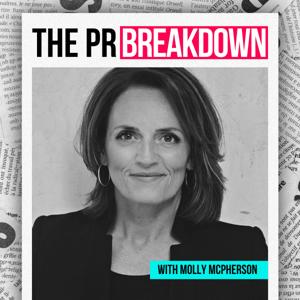
Every mess has a move behind it. Crisis communication expert Molly McPherson takes apart the viral scandals, celebrity meltdowns, and corporate disasters dominating the headlines, showing you…
Ranked by our users in the last 21 days

754 Listeners

69,588 Listeners
7,216 Listeners
164,547 Listeners

3,308 Listeners

6,478 Listeners

2,221 Listeners
3,405 Listeners
2,220 Listeners
2,099 Listeners

18,064 Listeners

598 Listeners
250 Listeners

1,335 Listeners

12,486 Listeners