
Sign up to save your podcasts
Or

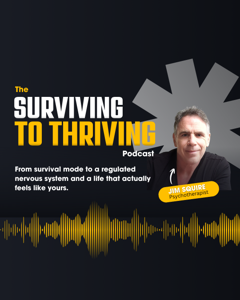


Most people think of childhood trauma as one dramatic event that produces fear. But for many adults, the trauma was relational and ongoing — showing up not as fear, but as confusion: not knowing what was real, or who to trust, including yourself.
In this episode, Jim explores the difference between fear (immediate, reflexive) and shame (built later, once meaning gets attached to what happened) — and why that distinction matters for understanding your own patterns. He walks through a somatic and IFS (Internal Family Systems) lens on childhood trauma, how self-blame forms as a survival strategy, and where EMDR fits into recovery for people who don't necessarily meet full PTSD criteria.
You don't need the "worst" story for this to apply to you. If something from your past is quietly running the show in your present — in your relationships, your body, your sense of what's possible — this episode is for you.
Jim Squire is a Registered Psychotherapist (RP) and Certified Clinical Trauma Professional (CCTP), and Clinical Director of a private virtual trauma therapy practice serving clients across Ontario.
Learn more: traumatherapists.ca Book a consultation or reach out: [email protected] | 416 826 0842
Not a substitute for professional mental health care. If you're in crisis, call 911 or local crisis line.
You're in a meeting, nodding along, and forty seconds ago you were somewhere else entirely. Not quite daydreaming — just gone. If that's familiar, you've probably already asked the question: is this ADHD?
It might be. It might also be an old nervous system pattern showing up in a new context. Or — more often than people expect — both, tangled together in ways a symptom checklist was never built to sort out.
In this episode, I go deeper than the usual ADHD content you'll find online. We cover:
— What adult ADHD actually looks like clinically, and why hyperactivity in adults rarely looks the way it did in childhood
This one runs a bit longer and a bit deeper than usual, because the topic deserves it.
If something in this episode named a pattern you've been carrying without a word for it, that's worth a real conversation. Learn more at traumatherapists.ca.
Hosted by Jim Squire, RP, CCTP — Surviving to Thriving.
Some of the deepest wounds don't come from what happened to us — they come from what never did.
In this episode, I'm talking about absent parents. Not just the parent who left — but the parent who was in the home and emotionally unreachable. The parent whose love felt conditional on your performance. The parent whose moods made the house feel unsafe. Absence takes many forms, and the wounds it leaves tend to travel quietly into adult life.
I'll walk you through what those wounds actually look like — in your relationships, your nervous system, your sense of what you deserve — and why so many high-functioning adults never connect what they're carrying today to what they didn't get back then.
I also share a bit of my own story as a single parent who raised two kids while going through school to become a psychotherapist — and why this topic is one I take personally as much as clinically.
If you've spent years feeling like something is just a little bit off — in your relationships, in how you trust people, in that quiet sense of not quite being enough — this episode might help you name it.
In this episode:
Jim Squire is a Registered Psychotherapist (RP) and Certified Clinical Trauma Professional (CCTP), regulated by the College of Registered Psychotherapists of Ontario (CRPO). He works with adults across Ontario via virtual practice.
To explore working together: traumatherapists.ca
You've built something real. And part of you still doesn't trust it.
In this episode of Surviving to Thriving, we go deeper than the usual conversation about imposter syndrome past the surface-level "just believe in yourself" advice and into what's actually driving the feeling.
In this episode:
This isn't about eliminating self-doubt. It's about understanding it well enough to stop letting it make decisions for you.
Most of us carry beliefs about ourselves that we've never really stopped to question. That we're too much. That we're not enough. That we have to earn love, or that we don't really deserve to take up space. These beliefs feel like facts — like just the way we are. But they're not facts. They're stories. And they were formed a long time ago, by a much younger version of you, trying to make sense of experiences you didn't yet have the tools to understand.
In this episode, Jim Squire, Registered Psychotherapist, talks about where those stories come from, how they quietly shape the way we show up in our relationships and our lives as adults, and what it actually looks like to start understanding yourself differently. This isn't about blame. It isn't about reliving the past. It's about recognizing that the story you've been living by was never the whole truth — and that it doesn't have to stay the way it is.
If you've ever felt like you keep getting in your own way without really knowing why, this episode is for you.
Have you ever reacted to something... snapped, shut down, pulled away and genuinely didn't know why? You're not broken. You're not overreacting. Your nervous system learned how to protect you a long time ago, and it's still doing exactly that even when the danger is long gone.
In this episode of Surviving to Thriving, I want to talk about something I think is one of the most important pieces of understanding ourselves as adults. How our nervous system gets shaped in the earliest years of our lives, before we have any memory of it happening, and how those early lessons quietly drive so much of how we feel, how we respond, and how we show up in our relationships today.
This isn't about blame. It isn't about revisiting painful memories. It's about finally making sense of patterns you may have been carrying for years and understanding that those patterns made sense once, even if they're getting in the way now.
If you've ever wondered why you are the way you are, this episode is for you.
You're capable, driven, and holding it together. Life looks good from the outside. So why does something still feel quietly off?
In this episode, Jim Squire — Registered Psychotherapist and Certified Clinical Trauma Therapist — talks about the experience that high-functioning professionals rarely discuss: achieving without feeling fulfilled, staying busy to avoid the quiet, and functioning well while the nervous system is working overtime underneath.
Jim covers the hedonic treadmill and why nothing seems to land the way it should, why functioning well and being regulated are two very different things, and how earlier experiences quietly shape the patterns high achievers often normalize — perfectionism, emotional distance, relentless forward motion, and the sense of never quite being enough.
If you've ever thought "I have no good reason to feel this way" — this episode is for you.
In this episode, we explore one of the most powerful — and most challenging — parts of emotional healing: the courage to be authentic.
Many of us learned early in life that our true feelings, needs, or personality weren’t acceptable. To stay connected to our families, communities, or culture, we traded authenticity for belonging. We learned to mute ourselves, stay small, stay agreeable, or stay silent — not because we were weak, but because we were protecting ourselves.
But these protective patterns have a cost.
In this conversation, we dive into:
⭐ Why authenticity often feels unsafe
We explore what it really means to “come home” to yourself, why authenticity is not self-indulgent but life-giving, and how reclaiming your voice can transform both your mental and physical well-being.
This episode offers insight, grounding, and hope for anyone who has ever felt disconnected from their true self.
If you’re ready to move from surviving to thriving, this is an episode you won’t want to miss.
Shame is one of the most powerful—and hidden—emotions we experience. In this episode, I explore where shame comes from, how it shapes our lives, and what it takes to begin loosening its grip. Whether you’ve felt the sting of shame in relationships, work, or your own self-talk, this conversation offers insights to help you move from silence toward healing.
In this episode, I explore Ken Keyes Jr.’s classic Handbook to Higher Consciousness — a timeless guide to transforming emotional suffering into freedom. We’ll look at how Keyes’ idea of shifting from rigid addictions to flexible preferences can radically reduce stress and conflict in our daily lives.
I’ll also walk through the Seven Centers of Consciousness, from the lower drives of security, sensation, and power to the higher states of love, abundance, awareness, and cosmic unity. Along the way, I connect Keyes’ work with modern practices like mindfulness, self-compassion, and Internal Family Systems.
If you’ve ever wondered how to move from survival mode into a more peaceful, thriving life, this episode will give you practical tools and timeless wisdom to guide the way.
From the publisher's feed
The Surviving to Thriving Podcast explores trauma, nervous system regulation, and the patterns that quietly shape adult life — hosted by Jim Squire, RP, a Registered Psychotherapist with over 20…