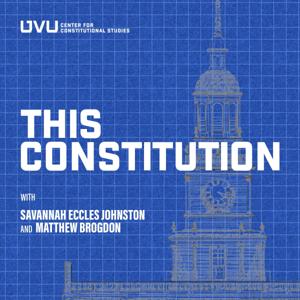
This Constitution

This Constitution

By Savannah Eccles Johnston & Matthew BrogdonEducationGovernmentHistory
Download on the App Store

This Constitution episodes

  • Season 2, Episode 1 | Does the Separation of Powers Actually Make the Government More Powerful?

    What if the very system designed to keep our leaders in check… is starting to fail?

    In this episode of This Constitution, hosts Savannah Eccles Johnston and Matthew Brogdon kick off Season 2 with a deep dive into the delicate balance of power in the U.S. government. They break down the difference between checks and balances and the separation of powers—two critical mechanisms that prevent tyranny.

    Through fascinating historical moments like FDR’s court-packing plan and Nixon’s resignation, they reveal how these principles have been tested over time. But what about today? With rising partisanship and a weakened Congress, are we at risk of losing the safeguards that keep our democracy intact?

    Join the conversation and discover why your voice matters in upholding these fundamental protections. Listen now and stay engaged in the fight for a balanced government!

    In This Episode

    • (00:00:27) Introduction to Season Two
    • (00:01:12) Importance of Checks and Balances
    • (00:01:26) Distinction Between Concepts
    • (00:02:08) Separation of Powers Explained
    • (00:02:12) Checks and Balances Explained
    • (00:03:27) Historical Context of Governance
    • (00:04:06) Ambition and Self-Interest
    • (00:07:19) Montesquieu's Influence
    • (00:09:07) Constitutional Checks and Balances
    • (00:10:24) Presidential Powers Against Congress
    • (00:12:02) Impeachment Power Discussion
    • (00:12:23) Judicial Review Explained
    • (00:13:18) The Rule of Law and Judicial Process
    • (00:14:11) Checks on Supreme Court Power
    • (00:15:13) FDR's Court Packing Plan
    • (00:16:12) Response from the Senate Judiciary Committee
    • (00:17:14) FDR's Overestimation of Support
    • (00:18:26) Checks and Balances in Action
    • (00:22:29) The Nixon Administration Scandal
    • (00:24:07) Supreme Court's Role in Nixon's Case
    • (00:25:36) Goldwater's Intervention
    • (00:26:25) Challenges to Checks and Balances Today
    • (00:27:38) Exploring Congress's Weakness
    • (00:27:50) Presidential Influence on Congress
    • (00:28:08) Role of Voters in Checks and Balances
    • (00:28:45) Public Attachment to Constitutional Principles
    • (00:28:56) Civic Education and Public Perception
    • (00:29:54) Improving Constitutional Education

    Notable Quotes

    • [00:04:06] "Checks and balances work because John Thune, who's the Senate Majority Leader, wants to be as personally powerful as possible, and he knows that his power is only as great as the power of his institution." — Savannah Eccles Johnston


    • [00:05:12] "You can have people who are all pursuing good things at the same time, and the pursuit of those good things could come in conflict." — Matthew Brogdon


    • [00:14:11] "The best moments in American political history are when two institutions, or even just one, turn and look at the overreaching institution and say, 'Keep them in their place.'" — Savannah Eccles Johnston


    • [00:28:56] "People do need a public attachment to things for them to be lasting and durable, and I'm afraid that the way we teach the American government might be a little bit guilty here." — Matthew Brogdon


    Resources and Links


    This Constitution  

    • https://podcasts.apple.com/us/podcast/this-constitution/id1771900485
    • https://www.youtube.com/@centerforconstitutionalstu8915/videos
    32 min
  • Season 1 Extra, Episode D | The Standard Story of Judicial Review in American Politics Gets It All Wrong
    Host Matthew Brogdon talks with Keith Whittington, Yale Law School, about Keith’s book, his book, Repugnant laws: Judicial Review of Acts of Congress from the Founding to the Present, outlining the history of the Supreme Court and other federal courts declaring national laws unconstitutional, which has a long and venerable tradition in American politics.  Matthew and Keith have a good conversation about what it means for courts to exercise judicial review and the way that our standard story about judicial review gets the history wrong.


    43 min
  • Season 1 Extra, Episode C | The Bard's Blueprint: Shakespeare and the Foundation of American Governance

    How can the words of a 16th-century playwright possibly hold the key to understanding American governance today? The answer may lie in the very heart of classical education—a time-tested foundation for thoughtful leadership and civic responsibility. Shakespeare’s plays, brimming with powerful depictions of power, virtue, and moral conflict, weren’t just created to entertain; they were crafted to challenge the mind and educate the soul.

    In this episode of This Constitution, Matthew Brogdon sits down with Dr. Carol McNamara, the director of the Great Hearts Institute for Classical Education, to unravel the profound connections between Shakespeare’s works and the values that shaped our nation. Together, they explore how classical education, particularly through literature like Shakespeare’s, illuminates the role of governance, virtue, and civic engagement in a thriving democracy. Dr. McNamara reveals how Shakespeare’s exploration of political regimes, from absolute monarchy to the Roman Republic, sheds light on the complexities of leadership, while also emphasizing the importance of an informed citizenry.

    Could it be that by revisiting the classics, we find the very principles that can guide us toward better governance? Tune in to discover how the timeless wisdom of Shakespeare and classical education can shape the leaders of tomorrow, and why it’s more relevant than ever in understanding our civic duties today.

    In This Episode

    • (00:40) Introduction to Dr. Carol McNamara
    • (00:59) Overview of the Great Hearts Institute
    • (02:40) Expansion of classical charter schools
    • (04:04) Importance of a holistic education
    • (06:18) Formation of character in education
    • (07:35) Integration of knowledge disciplines
    • (08:55) Adaptability in education
    • (10:15) Shakespeare's political project
    • (12:43) Exploring alternative regimes in Shakespeare
    • (15:18) Commercial republic and difference
    • (16:44) The civilizational struggle
    • (17:46) Shakespeare's perspective on regimes
    • (18:20) Shakespeare's exploration of tyranny
    • (18:50) Mixed regimes in Shakespeare's works
    • (21:04) Historical context of Coriolanus
    • (22:10) Coriolanus and political tragedy
    • (24:02) Lincoln's appreciation for Shakespeare
    • (26:34) The role of ordinary citizens in Much Ado About Nothing
    • (27:49) Shakespeare's unique talent
    • (29:50) Ordinary life and comic potential
    • (31:47) Closing remarks


    Notable Quotes

    • [03:52] "I think the demand for classical education is only going to grow as parents demand better education, better discussion, better study of books for their children." — Dr. Carol McNamara


    • [05:19] "Classical education is about the formation of the human person, involving the education of the mind through the study of ideas, literature, and moral philosophy, but also the formation of human character." — Dr. Carol McNamara


    • [18:20] "Everybody wants to claim Shakespeare as their own, but for me, what matters are the plays and the arguments in the plays." — Dr. Carol McNamara


    • [20:56] "He wants us to realize that politics always comes back, that we always have to pay attention to the demands of politics." — Dr. Carol McNamara


    • [28:53] "Shakespeare wants to say that ordinary life sorts itself out in a way that doesn't have to be tragic; we can just choose to live well and be happy." — Dr. Carol McNamara

    Our Guest

    Dr. Carol McNamara is the Director of the Great Hearts Institute for Classical Education, where she leads initiatives to renew classical education. Previously, she held key roles at Arizona State University, including Senior Director at the Center for Constitution

    33 min
  • Season 1 Extra, Episode B | A Woman’s Voice in America’s Revolution: The Legacy of Mercy Otis Warren

    Mercy Otis Warren was no ordinary figure in America’s founding story. How many women of her time had the opportunity to receive a classical education, let alone become influential political thinkers and writers? As one of the few, Warren used her intellect and talent to champion liberty during the American Revolution. But why is her name so often left out of the history books?

    In this episode of This Constitution, Matthew Brogdon sits down with Kirstin Birkhaug, assistant professor of political science at Hope College, to uncover the life and work of this revolutionary thinker. What made her writings so impactful that even John Adams admitted to feeling intimidated by her intellect? How did her radical views on liberty shape her critiques of the U.S. Constitution, and what can they teach us in today’s political climate?

    During the conversation, Matthew and Kristin delve into  Warren’s enduring legacy—her critiques of unchecked power, her defense of individual rights, and her advocacy for civic virtue. It also addresses her political affiliations and relationships with prominent figures like John Adams and Thomas Jefferson, clarifying her alignment with Jefferson’s ideals and the complexities of her evolving relationship with Adams, which transitioned from initial camaraderie to tension.

    In This Episode

    • (00:00:37) Introduction to Mercy Otis Warren
    • (00:01:32) Early life and education
    • (00:03:33) Marriage and political influence
    • (00:05:49) Mercy's literary career begins
    • (00:06:47) Correspondence with prominent figures
    • (00:07:15) James Warren's political role
    • (00:07:58) Mercy's plays and political commentary
    • (00:09:24) Conflict with Thomas Hutchinson
    • (00:10:56) Use of pen names
    • (00:12:52) The History of the American Revolution
    • (00:15:15) The role of memory in Warren's history
    • (00:16:23) Warren's concerns about Washington
    • (00:17:33) Warren's Critique of the Constitution
    • (00:19:51) Warren's observations on the new Constitution
    • (00:21:16) Massachusetts ratification convention
    • (00:23:15) Warren's advocacy for press freedom
    • (00:24:37) Warren's civic engagement perspective
    • (00:26:58) Warren's Lockean influences
    • (00:29:56) Introduction to Freedom
    • (00:30:15) Mercy Otis Warren's political context
    • (00:31:07) Warren's alignment with Jefferson
    • (00:32:07) Warren and Adams' fractured relationship
    • (00:33:23) Reconciliation of Adams and Warren

    Notable Quotes

    • [00:03:33] "I feel a sense of inferiority whenever I speak to you; I feel that your attainments dwarf those of most men." — Kirstin Birkhaug
    • [00:04:44] "Mercy kind of takes up the mantle of continuing his kind of progressive thoughts and ideas into the revolution and beyond." — Kirstin Birkhaug
    • [00:12:06] "Warren is caught between this intellect that pulls her towards writing political propaganda plays and the inherent tension she feels about her role as a wife and mother." — Kirstin Birkhaug
    • [00:15:15] "She wants to capture this memory of the American Revolution, the keen despair people felt at the loss of liberty, and the steam this movement picked up." — Kirstin Birkhaug
    • [00:17:33] "Mercy Otis Warren hopes to reinvigorate the memory of the American Revolution and its principles, which she says are well encapsulated in the Declaration of Independence." — Kirstin Birkhaug
    • [00:25:52] "Mercy Otis Warren thinks that the Constitution is a departure from the spirit of the Revolution, not a continuation of it." — Matthew Brogdon

    Our Guest

    Dr. Kirstin Birkhaug is an Assistant Professor of Political Science at Hope College. She teaches a variety of political science courses, including Introduction to American Politics and upper-level political theory. Her research focuses on early A

    35 min
  • Season 1 Extra, Episode A | The Pursuit of Happiness: Virtue in the Founding Era

    What does the "pursuit of happiness" really mean? It’s a question we often skim over, but the Founding Fathers had a very specific idea in mind—one deeply rooted in classical virtue and self-mastery. In this episode, Matthew Brogdon sits down with Jeff Rosen, President and CEO of the National Constitution Center, to unpack this phrase from the Declaration of Independence and its implications for personal and political life.

    Rosen shares insights from his latest book, The Pursuit of Happiness: How Classical Writers on Virtue Inspired the Lives of the Founders and Defined America, exploring how figures like Jefferson, Franklin, and Adams connected happiness with moral improvement and self-discipline. From Aristotle to Cicero and beyond, we discuss how ancient philosophy shaped the Founders' vision of a flourishing life and a well-ordered republic.

    What lessons can we learn from the Founders’ emphasis on virtue? And how do we reconcile their moral aspirations with their glaring contradictions, such as the perpetuation of slavery? Join us for a thought-provoking discussion on how the pursuit of virtue can inform our understanding of happiness, freedom, and modern democracy.

    In This Episode:

    • (00:03) Introduction to the podcast
    • (00:15) Purpose of the episode
    • (00:43) Overview of Jeff Rosen’s book, The Pursuit of Happiness
    • (01:02) How the Founders viewed happiness and virtue
    • (02:25) Key classical virtues: temperance, prudence, courage, and justice
    • (03:45) The role of self-mastery in personal and political governance
    • (05:20) Jeff Rosen’s COVID-era experiment: Reading Jefferson’s inspirations
    • (08:10) The habits of lifelong learning and deep reading
    • (10:35) Virtue is both a personal and civic duty
    • (12:00) Examples of virtue and hypocrisy among the Founders
    • (15:40) The moral contradictions of Jefferson and other Virginian enslavers
    • (18:30) How figures like Frederick Douglass embodied virtuous self-improvement
    • (20:25) Reconciling freedom and virtue in a democratic society
    • (22:15) Jefferson, religious liberty, and freedom of conscience
    • (24:50) Lessons from ancient Stoic philosophy for modern life
    • (27:05) Virtue as an answer to modern political challenges


    Notable Quotes

    • [00:01:02] "For the Founders, the pursuit of happiness meant not feeling good, but being good." — Jeff Rosen


    • [00:05:20] "I spent a year reading Jefferson’s favorite books. It changed my life by making me a deeper thinker and better citizen." — Jeff Rosen


    • [00:15:40] "Jefferson recognized the evil of slavery but lived like a Caligulan emperor, surrounded by enslaved labor." — Matthew Brogdon


    • [00:27:05] "The Founders believed personal self-government was essential to political self-government." — Jeff Rosen


    Resources and Links

    Matthew Brogdon

    • https://www.linkedin.com/in/matthew-brogdon/
    • https://www.uvu.edu/ccs/people/matthew_brogdon.html

       Jeff Rosen

    • Keynote address at UVU CCS Fall Conference: https://bit.ly/3ARulwg
    • https://constitutioncenter.org/about/board-of-trustees/jeffrey-rosen
    • https://x.com/rosenjeffrey?lang=en
    • https://www.law.gwu.edu/jeffrey-rosen
    33 min
  • Season 1, Episode 11 | How to Thwart a Tyrant: Lincoln's Lyceum Address

    What if the biggest threats to our democracy aren’t coming from outside our borders, but from within? In 1838, a young Abraham Lincoln warned exactly about that in his Lyceum Address. Standing before a group of young men, he didn’t just talk about foreign invaders or military conflict. Instead, he sounded the alarm about the dangers of mob rule, unchecked ambition, and a nation losing respect for the rule of law.

    Sounds eerily familiar, right? Lincoln’s words still hold weight today, as we face the same questions about how we protect our democracy in the face of division, violence, and political instability. So, what can we learn from Lincoln’s vision of a government where the law reigns supreme?

    In this episode of This Constitution, Savannah Eccles Johnston and Matthew Brogdon delve into Lincoln’s prophetic address, unpacking his fears of demagoguery and mob rule, the moral dilemmas of civil disobedience, and the delicate balance required to protect democratic institutions. Lincoln believed that reverence for the law—even when flawed—was essential for preserving liberty and order. But how do we reconcile this with the pursuit of justice in the face of unjust laws?

    Join us for an engaging conversation that bridges Lincoln’s legacy with the complexities of contemporary governance. Don’t miss this opportunity to explore what his words mean for the challenges we face today—tune in now!

    In This Episode

    • (00:03) Introduction to the Constitution
    • (00:15) Purpose of the podcast
    • (00:43) Overview of Lincoln's Lyceum Address 
    • (00:59) Historical context of the address
    • (02:03) Themes of the Lyceum Address
    • (02:25) Danger from within
    • (03:29) Examples of mob violence
    • (05:09) Importance of law
    • (06:40) Civil disobedience debate
    • (07:14) Comparison to Martin Luther King Jr.
    • (10:20) Impact of lawlessness on good citizens
    • (12:36) Fear of dictatorship
    • (13:27) Ambition and opportunity
    • (14:51) The founding generation's ambition
    • (15:40) Lincoln's self-reflection
    • (17:12) Demagoguery and rhetoric
    • (17:24) Political religion of law
    • (18:08) Perpetuating constitutional order
    • (19:50) Madison vs. Jefferson on law
    • (20:20) Reverence for law and change
    • (21:30) Lincoln's rhetorical strategy
    • (24:25) Demagoguery vs. reverence
    • (25:30) Leadership and the Constitution
    • (26:38) Lincoln's rhetorical skill

    Notable Quotes

    • [00:02:25] "If destruction is our lot, we must ourselves be its author and finisher. As a nation of freemen, we must live through all time or die by suicide." — Savannah Eccles Johnston


    • [00:03:29] "The country is really in danger of resorting to mob violence to handle an awful lot of its political problems." — Matthew Brogdon


    • [00:11:24] "What happens when good men turn against the law?" — Savannah Eccles Johnston


    • [00:14:51] "These men of extraordinary ambition aren't going to be content to just keep what some other man has built; they're either going to need to destroy it or build something new and greater, and that's the danger." — Savannah Eccles Johnston


    • [00:17:24] "The only answer is the good people of the country united together and united under the law, devoted to the law almost religiously, because it is their political religion that alone can stand against these kinds of men." — Savannah Eccles Johnston


    • [00:18:08] "You may individually disagree with some of these laws and you might seek to change them, but that still shouldn't undermine your reverence for the law and the Constitution as a whole because the alternative is mob rule." — Matthew Brogdon


    29 min
  • Season 1, Episode 10 | Myth of the Modern Presidency: The Office Since TR

    What happened to the presidency around the turn of the 20th century? How did it go from being a strong institution under leaders like Washington and Lincoln to one that progressives saw as weak and ineffective? Could it be that the rapid changes of the Progressive Era revealed cracks in the system? What was it that so frustrated these thinkers, prompting them to call for a powerful transformation of the office?

    In this episode of This Constitution, Matthew Brogdon chats with Jordan Cash, an assistant professor at James Madison College, about the fascinating evolution of the presidency during the Progressive Era. They unpack Roosevelt’s stewardship theory, Wilson’s “Darwinian” approach to government, and the shift from seeing the presidency as a static institution to recognizing the dynamic potential of individual leaders. From the creation of the Executive Office of the President to the ongoing struggle of balancing power and constitutional principles, this conversation connects the dots between then and now.

    Curious about how the presidency became what it is today—and where it’s headed? Hit play and join the conversation!

    In This Episode

    • (00:01:16) Guest Introduction
    • (00:01:51) Progressive Era Concerns
    • (00:03:14) Woodrow Wilson's Views
    • (00:06:15) Stewardship Theory Explained
    • (00:08:31) Roosevelt's View on Limits
    • (00:10:31) Roosevelt's Decision to Leave Office
    • (00:11:49) Roosevelt vs.Taft
    • (00:13:49) Roosevelt's Larger-than-Life Persona
    • (00:14:39) The Progressive View of the Presidency
    • (00:15:24) Shift in Presidential Power
    • (00:15:51) Wilson's Ambition for Presidential Power
    • (00:16:55) Cabinet Government Proposal
    • (00:17:29) Wilson's Early Thoughts on Governance
    • (00:19:21) Changing Dynamics of Political Parties
    • (00:19:59) Historical Context of Presidential Influence
    • (00:23:07) Evolution of Party Primaries
    • (00:24:59) Constitutional Impediments to Power
    • (00:26:22) Brownlow Committee and Presidential Capacity
    • (00:27:35) Creation of the Executive Office
    • (00:28:45) Expansion of Presidential Power during Crises
    • (00:31:07) Reorganizing the Executive Branch
    • (00:31:49) Administrative Capacity vs. Functionality
    • (00:32:56) Continuity in Presidential Roles
    • (00:34:31) Constitutional Foundations of the Presidency
    • (00:35:48) The Impact of Government Size

    Notable Quotes

    • [00:19:21] "It feels like the 20th century, with its new sort of ground in executive leadership, gave us more interesting, more colorful characters." — Matthew Brogdon
    • [00:29:39] "The administration now becomes so big and in some ways loses that connection of responsibility to the president because there are just so many moving pieces that it's hard to keep track." — Jordan Cash
    • [00:31:49] "Do we now have so much administrative capacity that we're in a position where the president still can't achieve his proper functions?" — Jordan Cash
    • [00:35:48] "So we have a bigger presidency because we've got a bigger government essentially." — Matthew Brogdon

    Our Guest

    Jordan Cash is an assistant professor of political theory and constitutional democracy at James Madison College, Michigan State University. A passionate presidency scholar, he’s written insightful works like The Isolated Presidency and Adding the Lone Star: John Tyler, Sam Houston, and the Annexation of Texas. With expertise in the presidency and political institutions, Jordan also offers a deep dive into congressional history, making him a go-to source for understanding the inner workings of American governance.

    37 min
  • Season 1, Episode 9 | Who Needs Congress? POTUS as Chief Executive

    Who Needs Congress? POTUS as Chief Executive 

    Who holds the real power in Washington's sprawling federal bureaucracy? In this episode, Savannah Eccles Johnston and Matthew Brogdon explore the President's role as Chief Executive. How does a single individual manage thousands of appointments, oversee countless agencies, and navigate the fine line between legislative and executive power?

    From historical controversies like Andrew Jackson's firing of the Treasury Secretary to modern debates over the administrative state's autonomy, this episode dives into the constitutional principles and political realities that shape executive power.

    Curious about who truly controls the levers of power in Washington’s sprawling bureaucracy? Tune in to explore the President’s role as Chief Executive and challenge your understanding of executive authority in America.

    In This Episode

    • (00:27) Introduction to the President as Chief Executive
    • (01:10) Understanding presidential appointments and Senate confirmations
    • (02:10) Historical precedents: Andrew Jackson and Andrew Johnson
    • (07:05) The growth of the federal bureaucracy and administrative state
    • (13:28) Rulemaking and Congress’s oversight powers
    • (16:54) The balance between political accountability and agency independence
    • (21:25) Modern challenges with independent agencies like the Federal Reserve
    • (28:14) The broader implications of executive orders and rulemaking
    • (30:45) The evolving role of Congress and public accountability

    Notable Quotes

    • "[00:04:34] Any executive power wielded by others is on behalf of the President." — Matthew Brogdon


    • "[00:11:40] The President’s power to fire members of the executive branch is settled—controversial politically, but constitutionally clear." — Savannah Eccles Johnston


    • "[00:21:58] When you say an agency is 'independent,' what you're saying is it's independent of political accountability." — Matthew Brogdon


    • "[00:28:43] Much of the growth of the presidency’s power is rooted in the Chief Executive’s role, not as Commander in Chief, but as a rule maker." — Savannah Eccles Johnston


    Resources and Links

    This Constitution  

    • https://podcasts.apple.com/us/podcast/this-constitution/id1771900485


    Savannah Eccles Johnston

    • https://www.linkedin.com/in/savannah-eccles-johnston-515a72198/
    • https://www.instagram.com/savypolitics/

    Matthew Brogdon


    • https://www.linkedin.com/in/matthew-brogdon/
    • https://www.uvu.edu/ccs/people/matthew_brogdon.html


    32 min
  • Season 1, Episode 8 | Starting Wars or Just Finishing Them? POTUS as Commander in Chief

    When bombs drop and troops mobilize, who pulls the strings—Congress or the President? Can we afford to leave the fate of nations in the hands of one person, or does the voice of the people demand more say? The Founding Fathers designed checks and balances for a reason, but when it comes to war powers, does the balance still hold?

    In this episode of This Constitution, Savannah Eccles Johnston and Matthew Brogdon delve into the war powers outlined in the U.S. Constitution, focusing on the balance of authority between Congress and the President. They discuss Article I, Section 8, which grants Congress the power to declare war, and Article II, Section 2, which designates the President as Commander in Chief. The conversation covers historical precedents, the evolution of military authorizations, and modern implications, including the use of Authorizations for the Use of Military Force (AUMF). They emphasize the importance of understanding and navigating the constitutional framework governing war powers.

    Curious about who truly holds the reins of military power? Tune in to learn more and challenge your understanding of war powers in America.

    In This Episode

    • (00:27) Introduction to war powers
    • (01:06) Congress's powers
    • (01:18) President's powers
    • (02:10) Competition between branches
    • (02:22) Authorization for military force
    • (03:06) Historical context of war declarations
    • (03:53) Ambiguity in military actions
    • (04:26) Historical examples of military authorizations
    • (06:54) Technological warfare
    • (08:07) Political implications of war powers
    • (08:30) Defensive warfare
    • (08:43) Distinguishing offensive and defensive actions
    • (09:24) Lincoln's actions during the Civil War
    • (10:38) State of war and presidential powers
    • (11:42) Treaty obligations and war
    • (13:22) Preemptive strikes vs. defensive actions
    • (14:11) The President's war powers
    • (14:39) Congress's role in war declarations
    • (15:15) Historical context of war powers
    • (15:36) Executing congressional declarations
    • (16:03) Presidential discretion in war
    • (17:23) Congress's powers against the President
    • (18:24) Congress's institutional strength
    • (19:13) Impeachment as a weapon
    • (20:11) Power of the purse
    • (21:25) Defense appropriations cycle
    • (23:38) Presidential actions without war
    • (25:23) War Powers Resolution Overview
    • (26:21) Constitutionality of the War Powers Resolution
    • (26:46) The War Powers Resolution
    • (27:17) Presidential authority
    • (28:14) Congress's role in military regulation
    • (29:25) Tactical command limitations
    • (30:31) Overlapping powers discussion
    • (31:25) Public dissatisfaction with military engagement
    • (32:04) Alternative solutions for Congressional action
    • (33:29) General public knowledge and engagement
    • (34:53) Need for decisive leadership
    • (35:28) Educating voters on war powers


    37 min
  • Season 1, Episode 7 | Ballots, Not Bullets: A 2024 Election Recap

    Have you ever wondered what happens when an election unfolds in unexpected ways? 

    This episode dives into the surprisingly decisive 2024 presidential election, exploring its unique dynamics and the implications for American democracy. Despite expectations of a close race, the results were clear almost immediately, leaving room to reflect on the shifting coalitions, demographic trends, and the role of the Electoral College in modern elections. What does this tell us about the future of American politics?

    Join hosts Savannah Eccles Johnston and Matthew Brogdon as they analyze what this election means for political parties, the electorate, and constitutional processes like the peaceful transfer of power.

    Tune in for an engaging conversation that connects the election outcomes to broader themes in constitutional governance and American civic life.

    In This Episode

    • 00:42: Overview of the 2024 Presidential Election
    • 02:02: Historical Context of Previous Presidential Elections
    • 03:02: Changing Dynamics of Party Control and Dominance
    • 04:04: Shift in Party Demographics and Minority Vote
    • 05:02: Breakdown of Voter Demographics by Ethnicity and Sex
    • 06:02: Discussing the Latino, Black, and Asian American Vote
    • 07:23: Shift in Republican and Democratic Party Bases
    • 09:24: Electoral College and Senate Outcomes
    • 11:02: Peaceful Transfer of Power and Concession Speech
    • 13:10: Importance of Adhering to Constitutional Principles
    • 14:01: Process of Voting by Electors in the Electoral College
    • 15:55: Managing Faithless Electors
    • 17:23: Role of the Archivist in Electoral Process
    • 18:13: Introduction to the executive agency
    • 18:32: Role of the Vice President on January 6th
    • 19:02: Historical context of Vice Presidents declaring their defeat
    • 19:13: Kamala Harris's responsibilities and constitutional role
    • 20:00: Process of opening electoral votes in Congress
    • 21:02: Potential outcomes and controversies in the 2024 election
    • 22:00: Trump's legislative prospects and potential challenges
    • 23:07: Impact of divided and unified government on passing legislation
    • 25:02: Significant bipartisan legislation examples
    • 25:42: Election results and political stability
    • 26:01: Future of American politics and upcoming elections
    • 26:22: Conclusion and call to continue learning about the Constitution

    Notable Quotes

    • [00:01:14] “We have an incoming president who won the Electoral College, a majority of the popular vote, and all swing states—a clean sweep in 2024.” — Savannah Eccles Johnston
    • [00:06:49] “Race is losing salience, while gender and class are becoming more central to party politics.” — Matthew Brogdon
    • [00:15:06] “The decentralization of the Electoral College makes election fraud at a national level incredibly difficult.” — Matthew Brogdon
    • [00:18:55] “The power of transitions reminds us of the strength of our constitutional system, even in divisive times.” — Savannah Eccles Johnston

    Matthew Brogdon

    • https://www.linkedin.com/in/matthew-brogdon-8a21bb89
    • https://x.com/profbrogdon

    Savannah Eccles Johnston

    • https://www.linkedin.com/in/savannah-eccles-johnston-515a72198/
    • https://www.instagram.com/savypolitics/
    27 min

About This Constitution

From the publisher's feed

This Constitution is an every-two-weeks podcast ordained and established by the Center for Constitutional Studies at Utah Valley University, the home of Utah’s Civic Thought & Leadership…

More shows like This Constitution

The Tom Woods Show by Tom Woods

The Tom Woods Show

3,365 Listeners

The Daily by The New York Times

The Daily

112,173 Listeners

Y Religion by BYU Religious Education

Y Religion

1,797 Listeners

Church News by Church News

Church News

909 Listeners

followHIM by Hank Smith & John Bytheway

followHIM

10,670 Listeners

The Preamble by Sharon McMahon

The Preamble

15,273 Listeners

Morning Wire by The Daily Wire

Morning Wire

26,554 Listeners

The Weekly Show with Jon Stewart by Comedy Central

The Weekly Show with Jon Stewart

10,832 Listeners