
Sign up to save your podcasts
Or

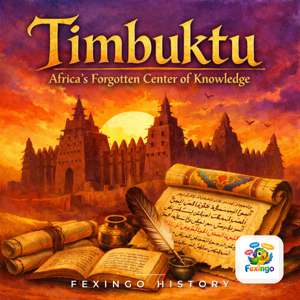


In this episode of Fexingo History, Lucas and Luna explore the little-known story of Nana Asma'u, a 16th-century female scholar in Timbuktu who defied the Saadian occupation. Under the brutal rule of Judar Pasha's Arma army, Asma'u — a member of the Aqit family — secretly taught women in her home, preserving a tradition of female literacy that had flourished under the Songhai Empire. We discuss the Tarikh al-Sudan's references to women in scholarship, the Aqit family's role in resisting Saadian censorship, and how Asma'u's underground classes kept alive the study of Maliki law and Sufi poetry. Her story offers a rare glimpse into the intellectual resistance of Timbuktu's women, a side of history often overshadowed by male scholars like Ahmad Baba. We also touch on the legacy of female education in the Sahel, from the Qadiriyya brotherhood to modern manuscript collections. This is African history from a fresh, gendered perspective.
#Timbuktu #NanaAsma'u #SaadianOccupation #AqitFamily #FemaleScholarship #AhmadBaba #JudarPasha #SonghaiEmpire #TarikhAlSudan #MalikiLaw #SufiPoetry #SahelHistory #AfricanHistory #WomenInHistory #Qadiriyya #Resistance #FexingoHistory #History
Keep every episode free: buymeacoffee.com/fexingo
Long before the legendary mosques and libraries, Timbuktu's survival depended on its water supply. In this episode, Lucas and Luna explore the sophisticated hydraulic engineering that sustained the city at the edge of the Sahara. They follow the traces of qanat-inspired underground channels, the seasonal flood canals of the Niger Bend, and the forgotten network of wells and cisterns that made urban life possible in one of the world's driest regions. Drawing on the Tarikh al-Sudan and recent archaeological surveys, they examine how Songhai, Malian, and Tuareg engineers adapted Persian and North African techniques to the Sahelian environment—and how climate change and conflict eventually overwhelmed these systems. Along the way, they meet the Kunta scholars who documented water rights, the Saadian occupiers who let the canals decay, and the modern hydrologists rediscovering this lost knowledge. This is not a story of primitive survival, but of sophisticated adaptation that challenges how we think about pre-colonial African engineering.
#Timbuktu #WaterEngineering #NigerBend #Qanat #SonghaiEmpire #MaliEmpire #Sahel #HydraulicEngineering #TarikhAlSudan #KuntaScholars #Saadian #AskiaMuhammad #Sankore #Djinguereber #AhmadBaba #SidiAlMukhtarAlKunti #History #FexingoHistory
Keep every episode free: buymeacoffee.com/fexingo
Long before Timbuktu became a center of scholarship and trade, it was a city that could only survive through ingenious water management. In this episode, Lucas and Luna explore the forgotten hydraulic engineers of the Niger Bend — the men who designed canals, reservoirs, and qanat-like underground channels that sustained the city through drought and siege. Drawing on the Tarikh al-Sudan and recent archaeological surveys, they focus on the 14th- and 15th-century projects commissioned by the Mali emperors and later the Songhai askiya, including the massive canal linking the Niger River to Timbuktu's northern districts. They also discuss the role of the Kunta scholars in documenting these systems, and the gradual decline of the canals after the Saadian invasion of 1591. This episode offers a concrete look at the infrastructure that made Timbuktu's golden age possible.
#Timbuktu #WaterEngineering #NigerBend #MaliEmpire #SonghaiEmpire #TarikhAlSudan #Kunta #Qanat #Hydrology #Sahel #Irrigation #Canal #Reservoir #14thCentury #15thCentury #History #FexingoHistory #AfricanHistory
Keep every episode free: buymeacoffee.com/fexingo
In the 16th century, Timbuktu faced a prolonged drought that devastated the Sahel and transformed West African politics and trade. This episode explores how the great drying of the 1500s, tied to the Little Ice Age, led to food shortages, the collapse of the Songhai grain economy, and the rise of new power dynamics. Lucas and Luna discuss the role of the Niger River's shrinking floodplains, the strain on the salt-gold trade, and how scholars like Ahmad Baba documented the crisis in the Tarikh al-Sudan. They also examine the Tuareg raids during the famine and the long-term shift toward slavery and militarization. A forgotten climate disaster that reshaped an empire.
#Timbuktu #LittleIceAge #SahelDrought #SonghaiEmpire #AhmadBaba #TarikhAlSudan #NigerRiver #ClimateHistory #WestAfrica #16thCentury #Famine #Tuareg #SaltTrade #GoldTrade #EnvironmentalHistory #AskiaMuhammad #Sahara #FexingoHistory
Keep every episode free: buymeacoffee.com/fexingo
In 1591, the Songhai Empire crumbled when a Moroccan army crossed the Sahara to seize Timbuktu. This episode follows the Saadian invasion led by Judar Pasha, a Spanish-born eunuch commanding arquebusiers against Songhai cavalry at the Battle of Tondibi. We explore the role of European mercenaries, the devastating use of gunpowder, and how the fall of Gao and Timbuktu shattered centuries of trans-Saharan scholarship. Learn about the Arma—the mixed Moroccan-Songhai ruling class—and how their arrival ended the golden age of Sankore. The episode also covers the 1612 coup of the Arma leader Ali al-Tilimsani and the long decline that followed. A turning point in West African history.
#Timbuktu #SonghaiEmpire #BattleOfTondibi #JudarPasha #SaadianInvasion #Arma #AskiaIshaqII #MansaMusa #NigerBend #Gao #Sankore #Gunpowder #TransSaharanTrade #WestAfrica #History #FexingoHistory #Morocco #16thCentury
Keep every episode free: buymeacoffee.com/fexingo
Long before telescopes reached West Africa, scholars in Timbuktu were mapping the stars with astonishing precision. This episode explores the astronomical tradition of the Sankore Madrasa, from the 13th-century scholar al-Wangari's observations of lunar eclipses to the star catalogs used for navigation across the Sahara. We uncover how Timbuktu's astronomers blended Islamic, Greek, and indigenous knowledge, building instruments like the astrolabe and quadrant. Discover the overlooked legacy of African astronomy and how these celestial insights shaped trade, prayer, and calendar systems across the Sahel.
#Timbuktu #Astronomy #Sankore #AfricanHistory #Islam #AlWangari #Astrolabe #Sahara #MaliEmpire #Songhai #Sahel #ScienceHistory #MedievalAstronomy #StarMaps #Quadrant #LunarEclipse #FexingoHistory #History
Keep every episode free: buymeacoffee.com/fexingo
In 2012, as jihadist groups seized Timbuktu, a quiet librarian named Abdel Kader Haidara orchestrated one of history's greatest manuscript rescues. This episode traces the secret operation that smuggled over 350,000 ancient texts—covering astronomy, law, poetry, and medicine—out of the city under the noses of Ansar Dine and al-Qaeda in the Islamic Maghreb. We follow the coded phone calls, the false-bottomed carts, the perilous river crossings, and the network of families who hid scrolls in mud-brick homes. How did a city built on scholarship outwit modern extremists? And what does the survival of these manuscripts mean for West Africa's intellectual legacy?
#AbdelKaderHaidara #Timbuktu #manuscripts #2012 #AnsarDine #AQIM #Sankore #Djinguereber #AhmedBabaInstitute #MammaHaidara #NigerRiver #Bamako #smuggling #rescue #jihadists #Mali #WestAfrica #History
Keep every episode free: buymeacoffee.com/fexingo
In 1375, a Jewish cartographer in Spain created a map that would shape Europe's view of Africa for centuries. But the source of his most stunning detail? A traveler from Timbuktu. This episode traces the journey of the Catalan Atlas — and the West African king, Mansa Musa, whose pilgrimage to Mecca in 1324 redrew the world. We explore how Mansa Musa's legendary gold-laden hajj, recorded by the Syrian scholar al-Umari, reached the shores of the Mediterranean and was turned into the most accurate depiction of West Africa in medieval Europe. Lucas and Luna discuss the politics of mapmaking, the economics of the trans-Saharan gold trade, and the forgotten role of Timbuktu's scholars in shaping global geography. From the Niger River to the courts of Aragon, this is the story of how one city's reputation became a beacon — and a target.
#Timbuktu #MansaMusa #CatalanAtlas #alUmari #WestAfrica #MaliEmpire #GoldTrade #Sahara #Mapmaking #Medieval #Hajj #NigerRiver #Cairo #Aragon #Cartography #FexingoHistory #WorldHistory #History
Keep every episode free: buymeacoffee.com/fexingo
In 2012, when jihadist militants seized Timbuktu and began destroying its ancient manuscripts, a quiet librarian named Abdel Kader Haidara orchestrated a secret operation to smuggle over 350,000 texts to safety. This episode tells the story of that rescue: how Haidara, working with the Ahmed Baba Institute and a network of families, hid manuscripts in metal trunks, moved them by donkey cart and boat down the Niger River, and stored them in hundreds of homes across Bamako. We explore the logistics, the danger of discovery, the manuscripts saved (including works on astronomy, law, and poetry), and the broader context of Timbuktu's manuscript culture that made this rescue possible. The episode also touches on the legacy of the Mamma Haidara Library, the role of the Kunta and Aqit families, and what the survival of these texts means for West African history.
#AbdelKaderHaidara #TimbuktuManuscripts #ManuscriptRescue2012 #AhmedBabaInstitute #MammaHaidaraLibrary #MaliConflict #KuntaFamily #AqitFamily #NigerRiver #SahelHistory #WestAfrica #ManuscriptSmuggling #CulturalHeritage #Sankore #Djinguereber #IslamicScholarship #History #FexingoHistory
Keep every episode free: buymeacoffee.com/fexingo
Long before Timbuktu became famous for its manuscripts and mosques, it was a center of iron production. This episode follows the rise and fall of the iron industry along the Niger Bend, from the furnaces of the early Songhai villages to the massive bloomeries that supplied tools and weapons across the Sahel. We explore the technical skill of Timbuktu's smelters, who produced high-carbon steel without European methods, and how the trade in iron ore and finished goods connected the city with the salt mines of Taghaza and the goldfields of Wangara. We also examine why this industry collapsed — not from lack of demand, but from deforestation and the disruption of trade routes after the Moroccan invasion of 1591. Along the way, we look at the social status of blacksmiths in West African society, the spiritual beliefs that surrounded smelting, and the lost techniques that modern archaeologists are only now piecing together.
#Timbuktu #IronSmelting #SonghaiEmpire #NigerBend #AfricanMetallurgy #Bloomery #Taghaza #Wangara #Sahel #MoroccanInvasion1591 #LostIndustries #Archaeology #Blacksmith #Deforestation #Furnace #Steel #History #FexingoHistory
Keep every episode free: buymeacoffee.com/fexingo
From the publisher's feed