
Sign up to save your podcasts
Or

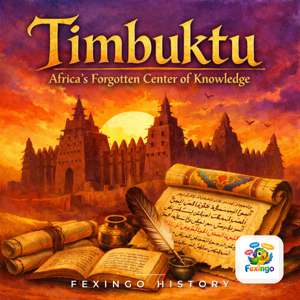


In the 1730s and again in 1747, Timbuktu was struck by devastating famines that killed thousands and nearly depopulated the city. This episode explores the causes, the 1747 famine in particular, how the city's scholars and religious leaders (like the Kunta sheikhs of the Qadiriyya) organized relief, the role of the Arma military caste in hoarding grain, and the long-term social and economic scars left on the city. We look at contemporary manuscript sources from the Tarikh al-Fattash and European traveler accounts to reconstruct this forgotten catastrophe.
#Timbuktu #Famine #1747Famine #SaharaHistory #Qadiriyya #Kunta #Arma #TarikhAlFattash #NigerBend #ClimateHistory #WestAfricaHistory #ManuscriptSources #Disaster #AhmadBabaInstitute #Songhai #Djinguereber #History #FexingoHistory
Keep every episode free: buymeacoffee.com/fexingo
In 1599, five years after the Saadian occupation of Timbuktu, the Arma governor faced an unexpected rebellion — not from the defeated Songhai, but from the Tuareg nomads of the Sahara. This episode explores the Tuareg siege of Timbuktu, a little-known uprising that nearly toppled Saadian rule. Lucas and Luna discuss the Tuareg leader Faraji, the Arma commander Mahmud ibn Zarqun, and the brutal street fighting that erupted in the city's center. They examine how the Tuareg used their knowledge of the desert to cut supply lines, the role of the Kunta shaykhs in mediating the conflict, and the siege's impact on Timbuktu's manuscript trade and scholarly community. The episode also reveals how the siege inadvertently preserved Timbuktu's libraries by forcing scholars to hide their collections in the desert — a practice that would later save countless manuscripts from French colonial destruction. Drawing from the Tarikh al-Sudan and Tarikh al-Fattash, this episode sheds light on a pivotal moment of resistance that reshaped Timbuktu's political landscape and cemented the Tuareg as a lasting power in the Niger Bend.
#Timbuktu #Tuareg #SiegeOfTimbuktu #Songhai #Saadian #Arma #TarikhAlSudan #TarikhAlFattash #Kunta #NigerBend #Sahara #Manuscripts #1599 #Resistance #WestAfricanHistory #History #FexingoHistory #AfricanEmpires
Keep every episode free: buymeacoffee.com/fexingo
In this episode, Lucas and Luna explore the remarkable story of the Mamma Haidara Commemorative Library in Timbuktu, one of the most important manuscript collections in West Africa. They trace its origins to the 16th-century scholar and collector Muhammad al-Mukhtar al-Wangari, whose family amassed thousands of texts on astronomy, law, medicine, and poetry. The conversation covers how the collection survived centuries of political turmoil, including the Moroccan invasion of 1591 and the Fulani jihad of the 1800s, and the heroic efforts of librarians during the 2012 jihadist occupation to smuggle over 300,000 manuscripts to safety in Bamako. Lucas discusses specific treasures like a 13th-century copy of the Qur'an, a treatise on ophthalmology by Ibn al-Haytham, and a unique Songhai legal code written in Arabic and Tamasheq. They also touch on the ongoing digitization efforts led by the Ahmed Baba Institute and the Mamma Haidara family, and what the loss of these texts would mean for world heritage. This episode deepens our understanding of Timbuktu not just as a legendary city, but as a living archive of African intellectual history.
#MammaHaidara #TimbuktuManuscripts #SonghaiEmpire #AhmadBaba #Sankore #Djinguereber #WestAfricanHistory #ManuscriptDigitization #IbnAlHaytham #Mali #2012Occupation #AhmedBabaInstitute #alWangari #TimbuktuLibraries #AfricanScholarship #History #FexingoHistory #MaliHeritage
Keep every episode free: buymeacoffee.com/fexingo
In this episode, Lucas and Luna explore the architectural and spiritual history of the Djinguereber Mosque in Timbuktu. Built in the 14th century under Mansa Musa, this mud-brick structure has weathered the rise and fall of empires — from the Mali Empire to the Songhai, the Saadian invasion, the Fulani jihad, and French colonial rule. Lucas describes the mosque's distinctive Sudano-Sahelian architecture, its role as a center of learning, and the annual maintenance tradition of the 'crepissage' that keeps it standing. He also recounts the mosque's near-destruction by Seku Amadu of the Massina Empire in the 1820s and its preservation under French colonialism. The episode ends with a reflection on how the mosque remains a living symbol of Timbuktu's intellectual heritage.
#DjinguereberMosque #Timbuktu #MansaMusa #MaliEmpire #SonghaiEmpire #SekuAmadu #MassinaEmpire #SudanoSahelianArchitecture #Crepissage #Sankore #AhmadBaba #Qadiriyya #SaadianInvasion #FrenchColonialism #UNESCO #WestAfricanHistory #IslamicArchitecture #FexingoHistory
Keep every episode free: buymeacoffee.com/fexingo
In the early 19th century, Timbuktu faced a new kind of threat—not from Moroccan invaders or Saadian sultans, but from a Fulani reformer named Seku Amadu, who launched a jihad that sought to purify Islam in the region. This episode explores the 1826 siege of Timbuktu, the fall of the city to the Massina Empire, and the resistance led by the Kunta scholar Sidi al-Mukhtar al-Kunti. We delve into Seku Amadu's theological motivations, the role of the Qadiriyya order, and how Timbuktu's manuscript libraries survived the conquest. Join Lucas and Luna as they uncover a forgotten chapter of West African history where faith, power, and knowledge collided.
#Timbuktu #SekuAmadu #MassinaEmpire #FulaniJihad #SidiAlMukhtar #Kunta #Qadiriyya #WestAfricanHistory #19thCentury #SiegeOfTimbuktu #IslamicReform #Sankore #TarikhAlSudan #TimbuktuManuscripts #Fulani #Sahel #History #FexingoHistory
Keep every episode free: buymeacoffee.com/fexingo
In this episode, Lucas and Luna explore the intercontinental book trade that made Timbuktu a center of knowledge. They follow the journey of manuscripts from Fez, Cairo, and Granada to the libraries of Sankore, and discuss how scholars like Ahmad Baba al-Timbukti built personal collections. The conversation covers the role of the Kunta and Aqit families as bibliophiles, the economics of the trade—paper from Italy, bindings from North Africa—and how the Saadian invasion disrupted this network. They also touch on the manuscript protection efforts by families like the Mamma Haidara and Fondo Kati, and the ongoing digitization projects that are making these texts accessible today.
#Timbuktu #ManuscriptTrade #AhmadBaba #Sankore #SonghaiEmpire #SaadianInvasion #Kunta #Aqit #Fez #Cairo #Granada #BookHistory #WestAfrica #SaharaTrade #MammaHaidara #FondoKati #History #FexingoHistory
Keep every episode free: buymeacoffee.com/fexingo
In 1498, the Songhai emperor Askia Muhammad made a pilgrimage to Mecca and returned determined to reshape Timbuktu's intellectual life. He summoned the city's leading scholar, al-Maghili, hoping to secure his endorsement for a new, more orthodox legal order. Instead, al-Maghili rebuked him to his face. This episode tells the story of that confrontation. We explore how a Berber scholar from Algeria became the most controversial figure in Timbuktu's history, his fiery accusations of corruption against the Askia's court, the fatwa he wrote justifying resistance to unjust rulers, and his ultimate exile. We also trace his lasting impact on the Sahel: his writings were still being copied in the nineteenth century, inspiring jihadists and reformers from Sokoto to the Senegal River. Lucas and Luna examine the ethical tensions at the heart of Timbuktu's golden age — piety versus power, scholarship versus statecraft — and why al-Maghili's uncompromising vision still resonates across West Africa today.
#History #FexingoHistory #AlMaghili #AskiaMuhammad #SonghaiEmpire #Timbuktu #Mali #WestAfrica #Sankore #MalikiFiqh #MuslimScholars #Pilgrimage #1498 #Sahel #Jihad #SokotoCaliphate #MuhammadTure #IslamicReform
Keep every episode free: buymeacoffee.com/fexingo
In the early 1590s, as the Saadian occupation of Timbuktu began to unravel, a devastating plague swept through the city, killing thousands and accelerating the decline of the Songhai Empire's intellectual capital. This episode explores the forgotten epidemic of 1592, its origins along trans-Saharan trade routes, and its impact on the city's scholarly elite—including the death of prominent qadis and the destruction of entire manuscript collections. Lucas and Luna discuss how the outbreak reshaped Timbuktu's social fabric, weakened resistance to Moroccan rule, and contributed to the city's long-term isolation. They also touch on contemporary accounts from the Tarikh al-Sudan and the legacy of the plague in West African memory. A lesser-known turning point in the story of Africa's golden age of learning.
#Timbuktu #Plague1592 #SonghaiEmpire #SaadianOccupation #TarikhAlSudan #TransSaharanTrade #Epidemiology #WestAfricanHistory #Sankore #Djinguereber #AhmadBaba #Qadis #ManuscriptCulture #Sahara #16thCentury #PublicHealth #History #FexingoHistory
Keep every episode free: buymeacoffee.com/fexingo
In 15th-century Timbuktu, the Songhai Empire's gold coinage wasn't just currency—it was a statement of sovereignty. This episode dives into the story of the mithqal, the gold dinar struck under Askia Muhammad and his successors, and how a single coin sparked a trade revolution across the Sahara. We trace the mithqal's journey from the Wangara goldfields to the markets of Cairo and Venice, explore the political message stamped into its Arabic inscriptions, and examine how Timbuktu's scholars debated the ethics of currency. Along the way, we meet the mysterious gold-weighers of the Sankore market, the dyula merchants who carried coins across the Sahel, and the Saadian sultan who coveted Songhai gold. This episode reveals how a small piece of metal shaped the destiny of empires.
#Timbuktu #SonghaiEmpire #AskiaMuhammad #Mithqal #GoldDinar #Wangara #SaharanTrade #WestAfricanHistory #MedievalAfrica #CurrencyHistory #Dyula #Sankore #Saadian #AhmadBaba #MaliEmpire #EconomicHistory #History #FexingoHistory
Keep every episode free: buymeacoffee.com/fexingo
Before Timbuktu became a byword for the edge of the world, it was the beating heart of a trans-Saharan economy that traded salt, gold, and books in equal measure. In this episode, Lucas and Luna explore the forgotten marketplace of the city — not the dusty stalls of legend, but a sophisticated commercial network spanning three continents. They trace the journey of Taghaza salt slabs through the desert, the gold of Wangara that flowed north, and the manuscripts that moved west from Cairo, Fez, and Granada. Along the way, they meet the merchants known as the dyula, the Koyra clan of traders, and the women who ran the book stalls of Sankore. This is the story of how Timbuktu's economy was built on intelligence as much as silver — and why the city's decline began when the trade routes shifted. No ads, no filler: just the real history of an African market that changed the world.
#Timbuktu #SaltTrade #GoldTrade #ManuscriptTrade #TransSaharanTrade #Taghaza #Wangara #Dyula #Koyra #Sankore #Djinguereber #SonghaiEmpire #AskiaMuhammad #SaharaDesert #AfricanHistory #EconomicHistory #WestAfrica #FexingoHistory
Keep every episode free: buymeacoffee.com/fexingo
From the publisher's feed