
Sign up to save your podcasts
Or

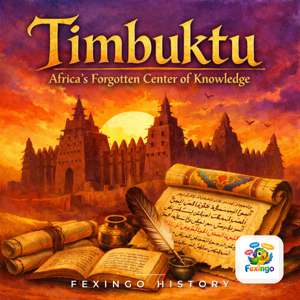


This episode tells the story of Muhammad al-Kabari, a 16th-century Timbuktu scholar who compiled the first known grammar of the Soninke language. Against the backdrop of the Songhai Empire's multilingual markets and the Saadian invasion, al-Kabari's work preserved a West African language in Arabic script, revealing a vibrant tradition of indigenous linguistic scholarship in the Sahara. We explore how his grammar, surviving only in fragments, sheds light on the intellectual networks connecting Timbuktu to the broader Islamic world and challenges the notion that African languages were unwritten before colonial contact.
#MuhammadAlKabari #SoninkeGrammar #TimbuktuManuscripts #SonghaiEmpire #SaharanScholarship #AjamiScript #Linguistics #WestAfricanHistory #IslamicScholarship #Sankore #Djinguereber #NigerBend #16thCentury #SaadianInvasion #IndigenousLanguages #History #AfricanHistory #FexingoHistory
Keep every episode free: buymeacoffee.com/fexingo
This episode explores the groundbreaking legal reforms of Qadi al-Mustafa al-Wangari, a 16th-century jurist in Timbuktu who reshaped Songhai law by integrating Maliki fiqh with local customs. We trace his career from student at Sankore to chief judge under Askia Muhammad, examining how his fatwas on contract law, slavery, and land rights created a hybrid legal system that persisted for centuries. We discuss the controversial 'Timbuktu Code'—a compilation of his rulings that survives in fragments—and its impact on trade along the Niger Bend. The episode also touches on the fierce debates his reforms sparked among Timbuktu's scholarly elite, including opposition from the Qadiriyya Sufi order. A rare window into pre-colonial African jurisprudence.
#Timbuktu #SonghaiEmpire #QadiAlMustafaAlWangari #MalikiFiqh #IslamicLaw #AskiaMuhammad #Sankore #NigerBend #AfricanLegalHistory #Fatwa #SlaveryInAfrica #TimbuktuCode #WestAfricanHistory #16thCentury #PreColonialAfrica #Jurisprudence #History #FexingoHistory
Keep every episode free: buymeacoffee.com/fexingo
When we think of Timbuktu's scholarly legacy, we usually think of texts — chronicles, legal opinions, astronomical tables. But who made those manuscripts beautiful? This episode explores the art of manuscript illumination in the Sahel, focusing on the anonymous artists who decorated Qur'ans and scientific works with geometric patterns and subtle color. We trace the influence of North African and Andalusi decorative traditions, the materials used — indigo, henna, gum arabic — and how the Tuareg and Songhai aesthetic left its mark. A single illuminated page can tell us about trade routes, workshop practices, and the value placed on the written word. We also meet a rare named illuminator, al-Mustafa al-Kunti, whose work survives in the Mamma Haidara collection. This is the visual side of Timbuktu's intellectual history, often overlooked but essential to understanding how knowledge was treasured.
#Timbuktu #ManuscriptIllumination #IslamicArt #WestAfrica #SonghaiEmpire #MammaHaidara #AlMustafaAlKunti #IlluminatedManuscripts #Quran #Sankore #Djinguereber #Indigo #Henna #GumArabic #Tuareg #Sahel #History #FexingoHistory
Keep every episode free: buymeacoffee.com/fexingo
When we think of the translation movement that preserved Greek philosophy and science for the world, we usually think of Baghdad's House of Wisdom. But what if Timbuktu had its own translation movement — one that brought Greek astronomical and philosophical texts into Arabic and then into local languages like Songhai and Tamasheq? In this episode, Lucas and Luna explore the surprising evidence that Sankore scholars were not just consumers of translated knowledge but active translators themselves. We look at the 15th-century scholar Muhammad al-Wangari, who may have translated Ptolemy's Almagest into Arabic verse for West African students. We examine the manuscript known as the Timbuktu Almagest, a unique copy with marginal annotations in Songhai and Tifinagh. And we discuss why this translation tradition faded — and what its survival tells us about the intellectual networks connecting Timbuktu to Cairo, Fez, and Granada. All this and more on Fexingo History.
#Timbuktu #TranslationMovement #GreekScience #Almagest #Ptolemy #Sankore #MuhammadAlWangari #Songhai #Tifinagh #Manuscripts #AfricanHistory #HouseOfWisdom #WestAfrica #Astronomy #Scholarship #15thCentury #History #FexingoHistory
Keep every episode free: buymeacoffee.com/fexingo
Episode 132 of Fexingo History turns to a forgotten chapter of Timbuktu's intellectual legacy: its botanical gardens and medicinal plant knowledge. Before the Saadian invasion, Songhai and Tuareg scholars cultivated medicinal herbs from across West Africa and the Maghreb near Sankore and Djinguereber. Lucas and Luna explore how the Tarikh al-Sudan mentions treatments for fever, dysentery, and snakebite using native species like aloe vera, myrrh, and baobab. They discuss the exchange of plant knowledge via trans-Saharan caravans, the writings of Ahmad Baba on herbal remedies, and the destruction of botanical manuscripts in 1591. Speculative links to earlier Greek and Arab pharmacopoeia are examined. The episode highlights how climate change and conflict erased a living tradition of desert horticulture.
#Timbuktu #BotanicalGardens #HerbalMedicine #Sankore #Djinguereber #SonghaiEmpire #TarikhAlSudan #AhmadBaba #TransSaharanTrade #MedicinalPlants #Sahara #WestAfrica #DesertBotany #AloeVera #Baobab #SaadianInvasion #History #FexingoHistory
Keep every episode free: buymeacoffee.com/fexingo
Long before modern engineering, the scholars and engineers of Timbuktu developed sophisticated water management systems that sustained a city of tens of thousands in the heart of the Sahara. In this episode, Lucas and Luna explore the intricate network of wells, cisterns, and underground canals known as 'foggara' that brought water from the Niger River floodplain to the arid city. They discuss the role of the Songhai Empire's hydraulic engineers, the influence of Islamic water law, and how these systems enabled Timbuktu's golden age of scholarship. The episode also examines the decline of these systems during the Saadian occupation and the lasting legacy of West African hydrological knowledge. Specific figures include Askia Muhammad's patronage of water projects and the scholar al-Wangari's writings on water rights. The conversation reveals how Timbuktu's survival was as much about water as about gold and books.
#Timbuktu #WaterManagement #SonghaiEmpire #Sahara #Hydrology #Foggara #AskiaMuhammad #alWangari #NigerRiver #WestAfrica #IslamicEngineering #Sankore #Djinguereber #SaadianInvasion #MedievalAfrica #History #FexingoHistory #AfricanInnovation
Keep every episode free: buymeacoffee.com/fexingo
In this episode, Lucas and Luna explore Timbuktu's sophisticated tradition of Islamic astronomy, focusing on the 17th-century scholar Muhammad al-Wangari and his work Mir'at al-'Alam. They discuss how West African scholars adapted tools like the astrolabe and torquetum, calculated lunar eclipses, and integrated astronomy with Maliki fiqh for prayer times and Ramadan. The episode highlights specific instruments, techniques, and the scholarly network connecting Timbuktu to Fez and Cairo. It also addresses the legacy of these astronomers and the manuscripts that survive today at the Ahmed Baba Institute. A fresh angle that goes beyond earlier episodes on al-Wangari to dive into the technical tools and daily applications of astronomy in Songhai society.
#MuhammadAlWangari #MiratAlAlam #TimbuktuAstronomy #IslamicAstronomy #Sankore #SonghaiEmpire #Astrolabe #Torquetum #LunarEclipse #MalikiFiqh #Ramadan #AhmedBabaInstitute #17thCentury #WestAfrica #History #ScienceHistory #FexingoHistory #Timbuktu
Keep every episode free: buymeacoffee.com/fexingo
When we think of Timbuktu's golden age, we imagine male scholars like Ahmad Baba and Mahmud Kati. But behind the scenes — and sometimes in the spotlight — women played a crucial role in the city's intellectual life. This episode tells the story of the learned women of Timbuktu: the scholar Nana Asma'u (though from the Sokoto Caliphate, she influenced the region), the female patrons who endowed libraries and mosques, and the wives and daughters of the Sankore elite who copied manuscripts, taught children, and preserved knowledge during the Saadian occupation. We explore how the Kunta and Aqit families fostered female education, the legal opinions (fatwas) on women's rights to property and learning, and the legacy of women like Khadija bint al-Mukhtar, who safeguarded the Tarikh al-Fattash. This is the forgotten half of Timbuktu's story.
#Timbuktu #WomenInHistory #Scholarship #WestAfrica #Sankore #Kunta #Aqit #NanaAsma'u #TarikhAlSudan #TarikhAlFattash #AhmadBaba #Songhai #Saadian #IslamicScholarship #Manuscripts #History #FexingoHistory #AfricanHistory
Keep every episode free: buymeacoffee.com/fexingo
When Europeans first reached the West African coast, they found kingdoms with sophisticated knowledge of geography — and maps that challenged everything they thought they knew. In this episode, Lucas and Luna explore Timbuktu's forgotten cartographic tradition. They trace the journeys of scholars like al-Wangari, who calculated longitude using lunar eclipses, and examine a remarkable 1490 world map from the Italian cartographer Henricus Martellus that shows a strangely accurate southern Africa — leading some to suspect West African informants. They discuss the Timbuktu scholar Ahmad Baba's claim that the city's geographers had charted the Niger's course over 500 miles, and the mysterious 16th-century map of the Sahara drawn by a Tuareg guide known only as 'Hasan the Librarian'. Along the way, they confront a bigger question: what knowledge from Africa's intellectual golden age was lost when the libraries burned? And what might still be buried in private collections, waiting to be rediscovered?
#Timbuktu #HistoryOfCartography #WestAfrica #AfricanHistory #HasanTheLibrarian #AhmadBaba #HenricusMartellus #alWangari #Sahara #NigerRiver #SonghaiEmpire #FexingoHistory #History #MedievalMaps #Djinguereber #Sankore #LostKnowledge #AfricanIntellectuals
Keep every episode free: buymeacoffee.com/fexingo
In this episode of Timbuktu: Africa's Forgotten Center of Knowledge, Lucas and Luna explore the life and legacy of Ahmad Baba al-Timbukti, the 16th-century scholar who challenged the legality of enslaving free Muslims. After the Saadian invasion, Ahmad Baba was exiled to Marrakech, where he wrote his landmark legal treatise Mi'raj al-Su'ud, arguing that anyone who converted to Islam or came from a Muslim region could not be lawfully enslaved. This episode unpacks the historical context of trans-Saharan slavery, Ahmad Baba's use of Maliki jurisprudence, the controversy it sparked among Moroccan scholars, and the lasting impact on Islamic abolitionist thought. Drawing on Tarikh al-Sudan and Ahmad Baba's own writings, we see how one man's pen challenged the foundations of a brutal institution.
#Timbuktu #AhmadBaba #Slavery #Maliki #TransSaharan #Mi'rajalSu'ud #TarikhSudan #Sankore #Saadian #Marrakech #Songhai #IslamicScholarship #Abolition #WestAfrica #16thCentury #History #FexingoHistory #IntellectualHistory
Keep every episode free: buymeacoffee.com/fexingo
From the publisher's feed