
Sign up to save your podcasts
Or

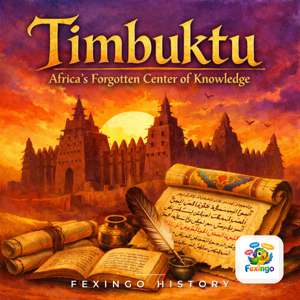


When the Saadian sultan Ahmad al-Mansur conquered Timbuktu in 1591, he expected to rule through fear. Instead, he found himself negotiating with a single, brilliant qadi: Ahmad Baba al-Timbukti. But this is not the story of Ahmad Baba's deportation to Marrakech — that we covered in earlier episodes. This is the untold story of the Timbuktu diplomat who stayed behind: al-Imam al-Suyuti, a scholar and envoy who negotiated the terms of Saadian occupation, preserved the independence of Sankore's curriculum, and secured the release of captured scholars through a mix of legal reasoning and political cunning. Drawing on the Tarikh al-Sudan and Tarikh al-Fattash, plus fragments from the Fondo Kati holdings, historian Bruce Hall's research reveals how al-Suyuti used Maliki fiqh to argue that Saadian rule was illegitimate, forcing the Arma governors to treat Timbuktu as a protected Islamic city rather than conquered territory. We explore the forgotten pact of 1592, the fate of the city's libraries during the occupation, and how one man's diplomacy shaped Timbuktu's survival for the next two centuries.
#Timbuktu #SaadianInvasion #alSuyuti #AhmadBaba #TarikhAlSudan #TarikhAlFattash #FondoKati #TimbuktuDiplomacy #MalikiFiqh #Sankore #Djinguereber #SonghaiEmpire #WestAfricaHistory #Arma #AhmadAlMansur #16thCentury #BruceHall #FexingoHistory
Keep every episode free: buymeacoffee.com/fexingo
In 1591, an army of 4,000 Moroccan musketeers crossed the Sahara to conquer the Songhai Empire and take Timbuktu. Lucas and Luna explore the invasion led by Judar Pasha, a Spanish-born eunuch commander, and how the Saadian sultan Ahmad al-Mansur sought to control the gold and salt trades. They discuss the battle of Tondibi, where Songhai's cavalry and foot soldiers armed with spears faced gunpowder weapons for the first time in the region, and the aftermath that saw Timbuktu's scholars like Ahmad Baba deported to Marrakech. This episode also covers the long-term effects on the city's intellectual life and the rise of the Arma, a mixed-race ruling class. The story is told through the lens of the Tarikh al-Sudan, the chronicle by Abd al-Rahman al-Sadi, who lived through the invasion and recorded its devastation.
#SaadianInvasion #JudarPasha #SonghaiEmpire #Timbuktu #TarikhAlSudan #AbdAlRahmanAlSadi #AhmadAlMansur #BattleOfTondibi #AhmadBaba #Arma #Gunpowder #Morocco #GoldTrade #SaltTrade #Sahara #WestAfrica #History #FexingoHistory
Keep every episode free: buymeacoffee.com/fexingo
When we talk about Timbuktu's golden age of learning, we often focus on the scholars and the manuscripts. But what about the buildings that housed them? In Episode 114, Lucas and Luna explore the architectural and institutional history of the Djinguereber Mosque, built in 1327 under the patronage of Mansa Musa. More than a place of prayer, Djinguereber became the nucleus of Timbuktu's university system, with classrooms, libraries, and dormitories for scholars from across West Africa and beyond. Lucas explains how the mosque's design — made of mud-brick and timber — was itself a feat of engineering, and how its layout shaped the curriculum and social hierarchy of learning. They discuss the role of the qadi (judge), the funding mechanisms through waqf (endowments), and the fierce academic debates that echoed under its thatched roofs. Luna wonders about the physical experience of learning there — the dust, the heat, the sound of manuscripts being copied by hand. The episode also touches on Djinguereber's restoration by craftsmen of the Djenne tradition, and its continued use today as both a mosque and a symbol of Timbuktu's intellectual heritage.
#Timbuktu #DjinguereberMosque #MansaMusa #Sankore #WestAfrica #MaliEmpire #IslamicArchitecture #Madrasa #Qadi #Waqf #Manuscripts #University #AfricanHistory #MedievalHistory #Mudbrick #Djenne #History #FexingoHistory
Keep every episode free: buymeacoffee.com/fexingo
In 1498, the Songhai emperor Askia Muhammad stood outside a mosque in Timbuktu, waiting for a scholar named al-Maghili to emerge. What happened next — a public refusal, a Quran, and a treatise on ruling justly — would shape West African politics for centuries. This episode unpacks the face-off between power and piety, the contents of al-Maghili's 'The Obligation of Princes', and how a single book became a check on tyranny. We also explore the wider context: why Timbuktu's scholars saw themselves as guardians of Islamic law, how the Askia dynasty balanced conquest with conscience, and the legacy of this encounter in modern debates about governance. If you've heard about Timbuktu's manuscripts but not the political dramas behind them, this is the story of a scholar who made a sultan wait.
#Timbuktu #AskiaMuhammad #alMaghili #SonghaiEmpire #ObligationOfPrinces #WestAfrica #IslamicScholarship #Sankore #Djinguereber #MalikiFiqh #Quran #History #FexingoHistory #1498 #Governance #Tyranny #Manuscripts #Sultan
Keep every episode free: buymeacoffee.com/fexingo
In this episode, Lucas and Luna explore the economic engine that made Timbuktu an intellectual capital: the trans-Saharan trade in salt, gold, and books. They discuss the crucial role of salt from the mines of Taghaza and Taoudenni, the goldfields of the Wangara and Bambuk regions, and how Timbuktu's merchants and scholars turned trade routes into scholarly networks. Learn about the Mande dyula traders, the use of cowrie shells and gold dust as currency, and how the city's wealth attracted scholars from across the Islamic world. The conversation also touches on the decline of the trade routes after the Moroccan invasion and the rise of Atlantic trade, and the legacy of Timbuktu's commercial culture.
#Timbuktu #SaltTrade #GoldTrade #TransSaharanTrade #Taghaza #Taoudenni #Wangara #Bambuk #Dyula #Mande #CowrieShells #GoldDust #SonghaiEmpire #MaliEmpire #MoroccanInvasion #Saadian #WestAfrica #FexingoHistory
Keep every episode free: buymeacoffee.com/fexingo
In this episode, Lucas and Luna explore the remarkable astronomical achievements of Muhammad al-Wangari, the 17th-century Timbuktu scholar whose work 'Mir'at al-'Alam' (The Mirror of the World) contained sophisticated calculations of celestial phenomena, including the latitude of Timbuktu and the width of the Red Sea. Drawing on earlier Islamic astronomers like al-Zarqali and al-Battani, al-Wangari created original tables predicting lunar eclipses and planetary positions, all while teaching at Sankore University. The episode examines how West African scholars were not mere copyists but active participants in the global scientific tradition, engaging with and improving upon the work of their predecessors. We also discuss the trade networks that brought astronomical instruments like the astrolabe to Timbuktu, and how the city's libraries preserved these manuscripts through centuries of political upheaval. Finally, we touch on the recent digitization efforts that have made al-Wangari's work accessible to modern historians of science.
#Timbuktu #MuhammadAlWangari #MiratAlAlam #IslamicAstronomy #SankoreUniversity #Astrolabe #HistoryOfScience #WestAfrica #MaliEmpire #AlZarqali #AlBattani #RedSea #LunarEclipse #Manuscripts #Digitization #FexingoHistory #History #AfricanHistory
Keep every episode free: buymeacoffee.com/fexingo
In this episode of Fexingo History, Lucas and Luna explore the remarkable life and work of Abd al-Rahman al-Sadi, the 17th-century Timbuktu scholar who authored the Tarikh al-Sudan, one of the most important chronicles of West African history. But al-Sadi didn't stop at local events — his work also contains a surprising global perspective, connecting the Niger Bend to the broader Islamic world and beyond. We delve into how al-Sadi gathered his sources, the challenges he faced as a scholar and diplomat during the decline of the Songhai Empire, and what his chronicle reveals about Timbuktu's connections to North Africa, the Middle East, and even Europe. Along the way, we consider the legacy of his work for modern historians and what it tells us about the intellectual networks of the Sahel. The episode also touches on the importance of preserving this kind of knowledge and how listener support helps keep our show ad-free.
#Timbuktu #TarikhAlSudan #AbdAlRahmanAlSadi #SonghaiEmpire #WestAfricanHistory #Sahel #NigerBend #IslamicScholarship #Historiography #AfricanIntellectualHistory #Djenné #Sankore #Chronicle #17thCentury #FexingoHistory #History #Podcast #Africa
Keep every episode free: buymeacoffee.com/fexingo
In this episode of Fexingo History, Lucas and Luna explore the hidden substance behind Timbuktu's scholarly explosion: the ink itself. While previous episodes have covered astronomers, judges, and smugglers, this time we go deep into the material culture — the soot, the gum arabic, the camel skin, and the secret recipes that made manuscripts possible. We meet the craftsmen of the dye pits of Djinguereber and Koyra, trace the trans-Saharan trade routes that brought vellum from Mali and paper from the Maghreb, and reveal how the color black was prized above all. Along the way, we uncover the story of a single manuscript from 1537 — a legal commentary written in ink so durable it still gleams today — and the anonymous artisans whose names never made it into any chronicle. This is the episode that answers: before you can have a library, you need something to write on.
#Timbuktu #ManuscriptCulture #InkMaking #Djinguereber #Sankore #SonghaiEmpire #GumArabic #TransSaharanTrade #WestAfricanHistory #MaliEmpire #MedievalAfrica #PaperHistory #DyePits #Koyra #TarikhAlSudan #AhmadBaba #Scribes #FexingoHistory
Keep every episode free: buymeacoffee.com/fexingo
In 1498, a Timbuktu jurist named al-Maghili challenged the mighty Askia Muhammad of Songhai over his treatment of a captured rival. The resulting legal opinion, 'The Obligation of Princes,' became a landmark in Islamic political thought. We explore how this scholar from North Africa used Timbuktu's Sankore madrasa as a stage, why his ruling on just warfare still echoes, and what it reveals about the city's role as a crucible of intellectual independence. Along the way, we meet Timbuktu's qadis, the Kunta scholars who preserved al-Maghili's works, and the tensions between imperial power and religious authority in the Niger Bend.
#Timbuktu #alMaghili #AskiaMuhammad #SonghaiEmpire #Sankore #MalikiFiqh #TheObligationofPrinces #IslamicPoliticalThought #Qadi #Kunta #NigerBend #15thCentury #FexingoHistory #History #WestAfrica #Ulama #MaliEmpire #Gao
Keep every episode free: buymeacoffee.com/fexingo
In late 16th-century Timbuktu, the city's most respected scholar, Ahmad Baba al-Timbukti, made a dangerous choice: he refused to teach the Songhai sultan's son. When Sultan Askia Ishaq II demanded that Ahmad Baba tutor his child, the scholar declined on principle—arguing that the sultan's wealth and power did not entitle him to special access to knowledge. The sultan responded by banishing Ahmad Baba from Sankore mosque. This episode explores the clash between religious authority and political power in Songhai, drawing on accounts from the Tarikh al-Sudan and Tarikh al-Fattash. We look at how Timbuktu's ulama maintained their independence from the state, the limits of sultanic power in the Niger Bend, and how Ahmad Baba's stand shaped the relationship between mosque and throne for generations. The episode also examines the broader system of scholarly patronage in pre-colonial West Africa, and why Timbuktu's intellectual elite could—and sometimes did—say no to the most powerful man in the empire.
#Timbuktu #AhmadBaba #AskiaIshaqII #Sankore #Songhai #TarikhAlSudan #TarikhAlFattash #Ulama #Sultan #ScholarlyIndependence #WestAfrica #NigerBend #16thCentury #Islam #MalikiFiqh #Education #History #FexingoHistory
Keep every episode free: buymeacoffee.com/fexingo
From the publisher's feed