
Sign up to save your podcasts
Or

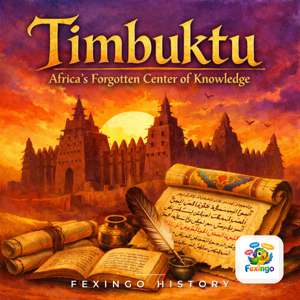


In this episode, Lucas and Luna explore the political and cultural rivalry between Timbuktu and Gao, the two great cities of the Songhai Empire. They trace how Gao, as the imperial capital under Askia Muhammad, clashed with Timbuktu's fiercely independent scholarly elite. The conversation focuses on the pivotal year 1498, when Askia Muhammad attempted to impose direct control over Timbuktu's judiciary, leading to a standoff with the city's qadis. Lucas explains the role of the Koyra (Songhai royal court) and the Timbuktu ulama, highlighting how the city's scholars used their religious authority and legal expertise to resist imperial overreach. The episode also touches on the legacy of this tension in the Tarikh al-Sudan and the Tarikh al-Fattash, two chronicles that offer contrasting perspectives on Songhai rule. Listeners will learn about the specific figures involved, including Askia Muhammad, the qadi Mahmud ibn Umar, and the chronicler Abd al-Rahman al-Sadi, and how their actions shaped the destiny of the Niger Bend.
#SonghaiEmpire #Timbuktu #Gao #AskiaMuhammad #MahmudIbnUmar #TarikhAlSudan #TarikhAlFattash #WestAfricanHistory #MedievalAfrica #NigerRiver #Sahel #IslamicScholarship #Qadis #ImperialRivalry #AbdAlRahmanAlSadi #1498 #MaliEmpire #History
Keep every episode free: buymeacoffee.com/fexingo
This episode explores the remarkable life of Ahmad Baba al-Timbukti, the 16th-century scholar who became a symbol of Timbuktu's golden age and its resilience during the Saadian invasion. We trace his education under the Aqit family, his encyclopedic knowledge of Maliki fiqh, and his refusal to compromise his principles when captured by Judar Pasha. Ahmad Baba's writings, including the Mi'raj al-Su'ud, challenged the legitimacy of enslaving free Muslims, and his return to Timbuktu sparked a revival of learning. We also discuss the controversy over his birth year, the destruction of his works by the Saadians, and how his legacy endures today through the Ahmed Baba Institute in Timbuktu. Join us for a deep dive into the man who embodied West Africa's intellectual tradition.
#AhmadBaba #Timbuktu #Songhai #Saadian #Maliki #Mi'rajalSu'ud #Sankore #Djinguereber #JudarPasha #Aqit #TarikhAlSudan #AhmedBabaInstitute #WestAfrica #IslamicScholarship #Slavery #16thCentury #History #FexingoHistory
Keep every episode free: buymeacoffee.com/fexingo
When jihadi fighters occupied Timbuktu in 2012, they targeted the city's manuscripts for destruction. But centuries-old local knowledge — the same wisdom that had protected scrolls from Saharan sand and termites — was weaponised in a daring rescue. This episode tells the story of how Abdel Kader Haidara and a network of librarians smuggled 377,000 manuscripts out of the occupied city under cover of sandstorms, using desert logistics perfected over generations. We follow the caravan routes that evaded checkpoints, the code words murmured in Tamasheq, and the secret caches in mud-brick homes. We also explore a lesser-known precedent: how 16th-century scholars hid their libraries from the Saadian invasion using identical tactics. It is a tale of intellectual resistance that links the age of Ahmad Baba to the age of al-Qaeda. The episode draws on eyewitness accounts from the rescue, the Tarikh al-Sudan, and recent interviews with the Haidara family. No dramatisation, just the facts of one of the most remarkable manuscript rescues in modern history.
#Timbuktu #ManuscriptRescue #AbdelKaderHaidara #AhmedBabaInstitute #AnsarDine #AQIM #Mali #Sahara #TarikhAlSudan #TarikhAlFattash #AhmadBaba #Saadian #Songhai #Sankore #Djinguereber #History #FexingoHistory #WestAfrica
Keep every episode free: buymeacoffee.com/fexingo
When the Songhai Empire crumbled after the Saadian invasion in 1591, a woman stepped into power in Timbuktu. This episode tells the story of Queen Astou, known as the 'Queen of Timbuktu,' who led the city during the chaotic 17th century. We explore how she navigated the aftermath of the Moroccan occupation, the rivalry between the Arma (Moroccan soldiers who married into local families) and the native Songhai elite, and her diplomatic maneuvering with the Bambara kingdoms. Learn about the Tarikh al-Sudan's account of her rule, the challenges of leading a city in decline, and how her legacy challenges assumptions about gender and power in pre-colonial West Africa.
#QueenAstou #Timbuktu #SonghaiEmpire #SaadianInvasion #TarikhAlSudan #Arma #Bambara #17thCentury #WestAfrica #FemaleRulers #MaliHistory #AfricanQueens #TimbuktuHistory #History #FexingoHistory #AfricanHistory #Scholarship #Resilience
Keep every episode free: buymeacoffee.com/fexingo
Long before Copernicus, scholars in Timbuktu were calculating the circumference of the Earth and mapping the night sky. This episode follows the work of Muhammad al-Wangari, the 17th-century astronomer who wrote the massive encyclopedia 'Mir'at al-'Alam' (The Mirror of the Universe). We explore how he built on earlier Islamic astronomy—from al-Zarqali's Toledan Tables to al-Battani's discoveries—and how his work was used in Timbuktu's Sankore Madrasa. We also look at the astronomical instruments they used, from astrolabes to celestial globes, and how the study of stars guided prayer times, navigation, and even legal calendars. This episode reveals a sophisticated scientific tradition that challenges the idea of pre-colonial Africa as intellectually isolated.
#Timbuktu #MuhammadAlWangari #IslamicAstronomy #Sankore #MiratAlAlam #Djinguereber #alZarqali #alBattani #Astrolabe #17thCenturyScience #MaliEmpire #AfricanHistory #HistoryOfScience #WestAfrica #PreColonialAfrica #CelestialGlobe #AstronomyHistory #FexingoHistory
Keep every episode free: buymeacoffee.com/fexingo
When the Saadian army from Morocco sacked Timbuktu in 1591, much of the city's intellectual life was scattered or destroyed. But one scholar, Abd al-Rahman al-Sadi, set down a detailed history of the Songhai Empire and the Sahel that survives to this day. In this episode, Lucas and Luna explore how al-Sadi's 'Tarikh al-Sudan' — written while the city was under occupation — became a cornerstone of West African historiography. They discuss his life in Djenné and Timbuktu, his work as a scribe and imam, and how he wove oral traditions, earlier written sources, and his own observations into a chronicle that ranges from the mythical origins of the Songhai to the fall of Askia Muhammad's dynasty. The episode also examines the challenges of writing history under foreign rule, the reliability of al-Sadi's accounts, and how modern historians use his work to reconstruct the economic and cultural networks of medieval West Africa. Along the way, the hosts touch on the manuscript's journey to European libraries and its rediscovery in the 19th century.
#Tarikh al-Sudan #al-Sadi #SonghaiEmpire #SaadianInvasion #Timbuktu #Djenné #AskiaMuhammad #WestAfricanHistory #Historiography #Abd al-Rahman al-Sadi #Manuscripts #Sankore #Morocco #1591 #16thCentury #OralTradition #History #FexingoHistory
Keep every episode free: buymeacoffee.com/fexingo
In this episode, Lucas and Luna explore the astronomical legacy of Timbuktu, focusing on the 17th-century scholar Muhammad al-Wangari and his encyclopedia Mir’at al-‘Alam (The Mirror of the World). Al-Wangari synthesized the works of Islamic and classical astronomers like al-Zarqali and al-Battani, calculating the lunar cycle and planetary positions with remarkable accuracy—centuries before modern telescopes. The episode examines how Timbuktu’s scholars integrated mathematics, observation, and theology, and how manuscripts like al-Wangari’s survived in the city’s libraries. It also touches on the scholarly network connecting Timbuktu to Cairo, Fez, and beyond, and the tools they used: astrolabes, quadrants, and ephemeris tables. The conversation ends with a reflection on how this knowledge was preserved through centuries of political upheaval.
#Timbuktu #MuhammadAlWangari #MiralAlAlam #IslamicAstronomy #alZarqali #alBattani #Sankore #Astrolabe #LunarCycle #SahelHistory #WestAfrica #MaliEmpire #Songhai #HistoryOfScience #Manuscripts #FexingoHistory #AfricanScholars #17thCentury
Keep every episode free: buymeacoffee.com/fexingo
This episode explores the rich medical tradition of Timbuktu, focusing on the works of Ahmad Baba al-Timbukti and other Sankore scholars who compiled medical texts blending Islamic medicine, Galenic humoral theory, and local West African healing practices. We delve into how manuscripts like the 'Mi'raj al-Su'ud' and commentaries on Ibn Sina's 'al-Qanun fi al-Tibb' were produced and exchanged, the role of the Wangara trading network in spreading medical knowledge, and the legacy of these texts surviving in the Ahmed Baba Institute and Mamma Haidara libraries. The episode highlights specific remedies, surgical practices, and the intellectual hub of Sankore that made Timbuktu a center of medical learning in the 16th century.
#Timbuktu #AhmadBaba #MedicalManuscripts #Sankore #IbnSina #HumoralTheory #WestAfrica #Songhai #Wangara #AhmedBabaInstitute #MammaHaidara #IslamicMedicine #Galen #Mi'rajalSu'ud #MaliEmpire #Djinguereber #History #FexingoHistory
Keep every episode free: buymeacoffee.com/fexingo
Before the Moroccan invasion scattered its scholars, Timbuktu boasted a sophisticated decentralized education system that rivaled any medieval university. This episode traces the curriculum at Sankore, the role of private manuscript libraries as textbooks, and the way students advanced through a system based on mastery rather than years. Lucas and Luna explore how a city of mud-brick mosques became a beacon for scholars from across the Muslim world, and how that system collapsed under occupation.
#Timbuktu #Sankore #MedievalEducation #AfricanHistory #SonghaiEmpire #AhmadBaba #Manuscripts #Curriculum #Madrasa #SaadianInvasion #JudarPasha #TarikhAlSudan #Qadiriyya #MaliEmpire #WestAfrica #History #FexingoHistory #KnowledgeTransfer
Keep every episode free: buymeacoffee.com/fexingo
In this episode, Lucas and Luna explore the remarkable astronomical tradition of Timbuktu. Long before telescopes, scholars like Ahmad al-Takruri and others at the Sankore madrasa were calculating planetary movements, predicting eclipses, and debating the nature of the cosmos. Drawing on manuscript evidence such as the “Mir’at al-‘Alam” (Mirror of the Universe) by Muhammad al-Wangari, we uncover a sophisticated scientific culture that blended Islamic astronomy with local observation. We discuss the instruments they used, the debates they had about astrology versus astronomy, and how this legacy was almost lost during the 2012 occupation. Join us for a journey into the skies of the Sahel.
#Timbuktu #Astronomy #Sankore #MuhammadAlWangari #MiratAlAlam #AhmadAlTakruri #MaliEmpire #Songhai #IslamicScience #Manuscripts #Sahel #Astrology #Eclipse #Astrolabe #AlZarqali #AlBattani #History #FexingoHistory
Keep every episode free: buymeacoffee.com/fexingo
From the publisher's feed