
Sign up to save your podcasts
Or

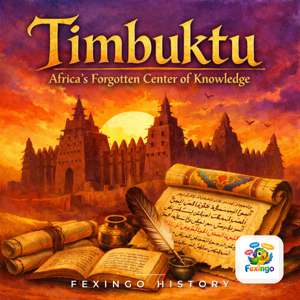


In 2012, as jihadists seized Timbuktu, a team of librarians and scholars raced to evacuate hundreds of thousands of manuscripts. But when the first hiding places were discovered, they turned to an ancient strategy: burying books in the Sahara. This episode tells the story of the clandestine operation that saved the legacy of Sankore, Djinguereber, and the Ahmed Baba Institute — and how a 20th-century librarian named Abdel Kader Haidara orchestrated a secret exodus of parchment and paper. We follow the route from Timbuktu to Bamako, the unsung heroines who memorized catalogue numbers, and the fire that nearly ended it all. This is not a story of destruction, but of cunning, patience, and the belief that knowledge must outlast the people who destroy it.
#Timbuktu #ManuscriptSmugglers #AbdelKaderHaidara #AhmedBabaInstitute #Sankore #Djinguereber #Mali #Jihadists2012 #FondoKati #MammaHaidaraLibrary #Bamako #DesertBurial #History #FexingoHistory #Sahara #TuaregRebellion #WestAfrica #CulturalHeritage
Keep every episode free: buymeacoffee.com/fexingo
In this episode, we trace the hidden history of Timbuktu's female scholars and patrons, focusing on the women of the Aqit family—especially Nana Asma'u bint al-Aqit and her mother, Khadija al-Aqitiyya. Before the Moroccan invasion, these women managed libraries, funded manuscript copying, and taught students in their homes. Lucas and Luna explore how women contributed to Timbuktu's intellectual life, often working behind the scenes while the great male scholars of Sankore took public credit. We'll look at the Aqit family's role in preserving texts through the Saadian sack of 1591, and how women like Nana Asma'u hid manuscripts in their quarters to save them from destruction. The episode also touches on the broader role of women in West African Islamic education, including the tradition of female Quranic teachers and the control women had over family library collections. It's a look at a side of Timbuktu often left out of the standard narrative of male scholars and sultans.
#Timbuktu #WomenScholars #AqitFamily #NanaAsmau #KhadijaAqitiyya #Sankore #ManuscriptLibraries #WestAfrica #MaliEmpire #Songhai #SaadianInvasion #AhmadBaba #IslamicEducation #FemalePatronage #WomenInHistory #MammaHaidara #AhmedBabaInstitute #FexingoHistory
Keep every episode free: buymeacoffee.com/fexingo
In 2012, when jihadist groups seized Timbuktu and threatened to destroy its ancient manuscripts, a secret operation was launched. Led by librarian Abdel Kader Haidara, a network of smugglers risked their lives to move hundreds of thousands of priceless texts out of the city. This is the story of the heist that saved Timbuktu's literary heritage: how manuscripts were hidden in false-bottomed trunks, smuggled past checkpoints, and hidden in safe houses in Bamako. We follow the operation from the first warnings in 2012 to the final evacuation in 2013, and explore the legacy of the manuscripts today in the new Ahmed Baba Institute and the Mamma Haidara Commemorative Library. We also touch on the tensions between preservation and access, as scholars debate whether the manuscripts should return to Timbuktu or stay in safer locations. Featuring the real-life characters: Abdel Kader Haidara, his cousin Ismael, and the families who hid manuscripts in their homes. A story of courage, cultural heritage, and the fight against erasure.
#Timbuktu #Manuscripts #AbdelKaderHaidara #AhmedBabaInstitute #MammaHaidara #Jihadists #2012 #Mali #Smuggling #CulturalHeritage #Preservation #Bamako #Sankore #Djinguereber #History #FexingoHistory #WestAfrica #Libraries
Keep every episode free: buymeacoffee.com/fexingo
When the Black Death reached West Africa in the mid-14th century, Timbuktu's scholars faced a crisis that tested their faith and knowledge. This episode follows the story of Mahmud al-Kati, a jurist and historian who survived the outbreak and later documented its impact in his chronicle Tarikh al-Fattash. We explore how Timbuktu's medical tradition, rooted in Galenic and Islamic humoral theory, was augmented by local herbal remedies like balanites and acacia. The plague killed perhaps a third of the city's population, but it also spurred innovations in quarantine and public health that would not be seen in Europe for centuries. Al-Kati's account reveals a society grappling with divine will, contagion theory, and the limits of prayer. We also touch on the role of the Qadiriyya Sufi order in providing spiritual comfort and the subsequent revival of learning under Askia Muhammad. This is the untold story of how the 'City of 333 Saints' confronted its deadliest epidemic.
#Timbuktu #BlackDeath #MahmudAlKati #TarikhAlFattash #Plague #WestAfricanHistory #Sankore #Qadiriyya #AskiaMuhammad #HumoralTheory #Balanites #AcaciaNilotica #PublicHealth #14thCentury #MaliEmpire #History #FexingoHistory #Epidemiology
Keep every episode free: buymeacoffee.com/fexingo
Timbuktu's golden age as a center of learning and trade depended on an unlikely hero: the camel. This episode traces how the introduction of the dromedary to the Sahara transformed trans-Saharan trade, enabling the flow of gold, salt, and manuscripts between West Africa and the Mediterranean. We follow the camel's journey from its domestication in Arabia to its arrival in the Sahel, and explore the innovations—from saddles to caravanserais—that made it the engine of an intellectual empire. Along the way, we meet the merchants and scholars who rode these 'ships of the desert,' and consider the ecological and economic costs of this dependence. Drawing on sources from Ibn Battuta to the Tarikh al-Sudan, we reveal how a single animal shaped the rise and fall of one of history's most remarkable cities.
#Camel #TransSaharanTrade #Timbuktu #WestAfrica #Sahel #Dromedary #IbnBattuta #TarikhAlSudan #Sahara #GoldSaltTrade #Domestication #Saddle #Caravan #Songhai #MaliEmpire #Manuscripts #History #FexingoHistory
Keep every episode free: buymeacoffee.com/fexingo
After the Saadian invasion of Songhai, hundreds of Timbuktu's scholars were captured and sold into slavery in Marrakech. Among them was the great jurist Ahmad Baba al-Timbukti, who spent years in captivity before being ransomed. This episode follows his negotiation for freedom, the legal arguments he wrote while enslaved, and how his experience shaped his later work against unjust enslavement. We explore the ransom system in the Sahel, the role of the Qadiriyya Sufi order in negotiating his release, and the astonishing fact that Ahmad Baba built a new library of 700 volumes from memory after his return. Along the way, we meet the Saadian Sultan Ahmad al-Mansur, the Pasha Judar, and the Kunta tribesmen who brokered the deal.
#AhmadBaba #Timbuktu #SonghaiEmpire #SaadianDynasty #ransom #slavery #Marrakech #TarikhAlSudan #Qadiriyya #Kunta #MalikiFiqh #WestAfrica #Morocco #16thCentury #manuscripts #scholars #History #FexingoHistory
Keep every episode free: buymeacoffee.com/fexingo
In 1498, the great Songhai emperor Askia Muhammad faced an unprecedented challenge — not from an army, but from a single judge. When the imam of Timbuktu, Mahmud ibn Umar, ruled that the sultan had violated Islamic law by enslaving free Muslims, he set off a legal crisis that reshaped the relationship between scholarship and power in the Sahel. This episode explores the Mi'raj al-Su'ud, the landmark legal treatise by Ahmad Baba that codified the rules of enslavement, the political maneuvering between Timbuktu's scholarly elite and the Songhai court, and how a small community of jurists used the weight of precedent to hold an emperor accountable. We also look at the aftermath: how the legal arguments from this case influenced trans-Saharan debates about slavery for centuries, and how the manuscripts preserving these rulings were smuggled to safety during the 2012 occupation of Timbuktu. A story of intellectual courage and the fragile authority of law.
#Timbuktu #Songhai #AskiaMuhammad #AhmadBaba #MalikiFiqh #IslamicLaw #Slavery #Mi'rajalSu'ud #MahmudibnUmar #Sankore #Djinguereber #TarikhAlSudan #Sahel #WestAfrica #History #FexingoHistory #LegalHistory #Manuscripts
Keep every episode free: buymeacoffee.com/fexingo
In this episode of Timbuktu: Africa's Forgotten Center of Knowledge, we explore the life and work of Muhammad al-Mustafa al-Wangari, a 17th-century scholar from Timbuktu who wrote the Mīr'āt al-Ālam, or 'Mirror of the Universe.' This massive encyclopedia covered astronomy, geography, mathematics, and Islamic law, synthesizing knowledge from the Islamic world and West Africa. We discuss how al-Wangari used the works of al-Zarqali and al-Battani to calculate prayer times and the qibla, and how his manuscript survived centuries in the Haidara family library. The episode also touches on the broader scholarly network of Sankore, the role of the Qadiriyya Sufi order, and the preservation of Timbuktu's manuscripts today.
#Timbuktu #MuhammadAlMustafaAlWangari #MiratAlAlam #Sankore #Astronomy #Qibla #AlZarqali #AlBattani #Haidara #Qadiriyya #AskiaMuhammad #Songhai #Manuscripts #WestAfrica #History #FexingoHistory #17thCentury #IslamicScience
Keep every episode free: buymeacoffee.com/fexingo
Lucas and Luna explore the trans-Saharan book trade that made Timbuktu a center of knowledge. They discuss how manuscripts traveled from Morocco, Egypt, and the Middle East to West Africa, carried by merchants and scholars. The episode highlights the roles of the Kunta and Wangara trading networks, the paper and bookbinding industries in Timbuktu, and the prices of books relative to other goods. Specific titles like the 'Mukhtasar' of Khalil ibn Ishaq and the works of al-Ghazali are mentioned. The conversation touches on the impact of the Saadian invasion on the book trade and how manuscripts were preserved through the centuries.
#Timbuktu #BookTrade #TransSaharanTrade #Manuscripts #Kunta #Wangara #Mukhtasar #KhalilIbnIshaq #AlGhazali #MaliEmpire #Songhai #SaadianInvasion #WestAfrica #History #FexingoHistory #Sankore #Djinguereber #AhmedBaba
Keep every episode free: buymeacoffee.com/fexingo
In this episode, Lucas and Luna explore the life and work of Ahmad Baba al-Timbukti, a 16th-century scholar from Timbuktu who wrote a landmark legal treatise arguing against the enslavement of free Muslims. They discuss his fatwa 'Mi'raj al-Su'ud' (The Ladder of Ascension), which challenged the Saadian invasion and the mass enslavement that followed. The episode covers the historical context of the Songhai Empire's collapse, the role of race and religion in slavery, and how Ahmad Baba's arguments drew on Maliki jurisprudence and his own experience as a captive in Marrakech. They also touch on the manuscript's rediscovery and its relevance today.
#AhmadBaba #Mi'rajalSu'ud #Timbuktu #Slavery #MalikiFiqh #SonghaiEmpire #SaadianInvasion #JudarPasha #Marrakech #Fatwa #Abolition #WestAfrica #Sankore #MammaHaidara #TarikhSudan #16thCentury #History #FexingoHistory
Keep every episode free: buymeacoffee.com/fexingo
From the publisher's feed