
Sign up to save your podcasts
Or

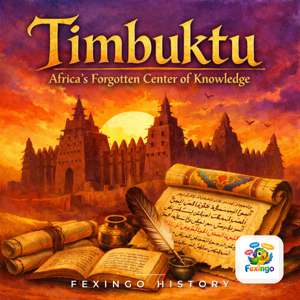


In this episode, Lucas and Luna explore the life and work of Ahmad Baba al-Timbukti, a 16th-century scholar from Timbuktu who wrote a landmark legal treatise arguing against the enslavement of free Muslims. They discuss his fatwa 'Mi'raj al-Su'ud' (The Ladder of Ascension), which challenged the Saadian invasion and the mass enslavement that followed. The episode covers the historical context of the Songhai Empire's collapse, the role of race and religion in slavery, and how Ahmad Baba's arguments drew on Maliki jurisprudence and his own experience as a captive in Marrakech. They also touch on the manuscript's rediscovery and its relevance today.
#AhmadBaba #Mi'rajalSu'ud #Timbuktu #Slavery #MalikiFiqh #SonghaiEmpire #SaadianInvasion #JudarPasha #Marrakech #Fatwa #Abolition #WestAfrica #Sankore #MammaHaidara #TarikhSudan #16thCentury #History #FexingoHistory
Keep every episode free: buymeacoffee.com/fexingo
In this episode of Timbuktu: Africa's Forgotten Center of Knowledge, we turn from the scholars to the builders—specifically, the masons who created the Great Mosque of Djenné, the largest mud-brick structure in the world. We explore the mosque's legendary origins, its reconstruction in 1907 under French colonial rule, and the annual festival of plastering, the crépissage, where the entire community of Djenné gathers to replaster the building before the rainy season. Lucas and Luna discuss the role of the mason guild, the barenin, who hold sacred knowledge of the building's proportions and rituals. They also touch on how the mosque was influenced by the 13th-century king Koi Konboro, who converted to Islam and replaced his palace with the first mosque on the site. The episode also examines the tension between the mosque's role as a symbol of Islamic learning and its deep roots in pre-Islamic building traditions. Finally, they reflect on what the mosque means today—a UNESCO World Heritage site threatened by climate change and political instability.
#GreatMosqueofDjenné #Djenné #Mali #MudArchitecture #Sahel #UNESCO #KoiKonboro #Barenin #Crépissage #FrenchColonial #IslamicArchitecture #Timbuktu #MaliEmpire #Songhai #NigerRiver #History #FexingoHistory #WestAfrica
Keep every episode free: buymeacoffee.com/fexingo
In this episode of Fexingo History, Lucas and Luna explore the ancient city of Gao, the political and economic powerhouse that rivaled Timbuktu. Long before Mansa Musa's pilgrimage, Gao was a crossroads of the trans-Saharan trade, a center of gold and salt exchange, and the seat of the Songhai Empire. We trace Gao's origins under the Za dynasty, its conversion to Islam under Kossoi, its annexation by Mali, and its spectacular rise under Sunni Ali and Askia Muhammad. We also examine the controversial reign of Askia Ishaq II, whose doomed negotiations with Judar Pasha led to Songhai's fall. Drawing on the Tarikh al-Sudan and the writings of al-Sa'di and Ibn Battuta, we piece together the story of a city that was sacked and looted, but whose legacy endures in the manuscripts and mosques of the Niger bend. Join us as we uncover the lost city of gold.
#Gao #SonghaiEmpire #TransSaharanTrade #SunniAli #AskiaMuhammad #JudarPasha #Timbuktu #SaadianInvasion #TarikhAlSudan #IbnBattuta #ZaDynasty #MaliEmpire #WestAfricanHistory #GoldTrade #SaltTrade #NigerRiver #AfricanEmpires #FexingoHistory
Keep every episode free: buymeacoffee.com/fexingo
When the Saadian army sacked Timbuktu in 1591, they looted the city's libraries and scattered its scholars. But among the captives was a man who would rebuild Timbuktu's scholarly legacy from scratch. Ahmad Baba al-Timbukti, a renowned jurist from the Sankore quarter, was exiled to Marrakech where he taught and wrote for years before returning home. This episode follows his exile, his role in preserving Timbuktu's intellectual heritage, and how his students helped reconstitute the city's manuscript collections. We also explore a remarkable story: his fatwa on slavery that questioned the legitimacy of enslaving Africans, centuries ahead of its time. Through the Tarikh al-Sudan and his own writings, we trace how one man's resilience kept the flames of learning alive during Timbuktu's darkest hour.
#AhmadBaba #Timbuktu #Saadian #Sankore #TarikhAlSudan #Mi'rajAlSu'ud #Fatwa #Slavery #Marrakech #Songhai #JudarPasha #Manuscripts #Exile #Scholars #WestAfrica #Mali #History #FexingoHistory
Keep every episode free: buymeacoffee.com/fexingo
In this episode, Lucas and Luna explore the salt trade that was the economic backbone of Timbuktu's golden age. They trace the caravans from the mines of Taghaza and Taoudenni across the Sahara to the markets of Timbuktu and Djenné, where salt was traded for gold, slaves, and grain. The conversation covers the harsh realities of the salt mines, the organization of the caravans, the role of the Tuareg and Wangara merchants, and how the wealth generated by salt funded the libraries and scholars of Sankore. They discuss the environmental challenges, the politics of trade routes, and the decline of the salt trade after the Moroccan invasion. This episode offers a fresh perspective on Timbuktu's history by focusing on the commodity that made its intellectual culture possible.
#Timbuktu #SaltTrade #Taghaza #Taoudenni #Sahara #Caravan #SonghaiEmpire #MaliEmpire #Tuareg #Wangara #Sankore #Djenné #GoldTrade #SlaveTrade #Sahel #EconomicHistory #History #FexingoHistory
Keep every episode free: buymeacoffee.com/fexingo
In 1498, Askia Muhammad, the great emperor of Songhai, fell from his horse and broke his leg — and then a qadi named Mahmud ibn Umar had him taken to court. This episode explores the little-known legal framework of Timbuktu and the Songhai Empire, where Islamic jurists wielded real power, even over emperors. We dive into the case of Askia Muhammad's broken leg, the legal reasoning behind it, and what it reveals about the rule of law in 15th-century West Africa. We also look at how local Maliki scholars adapted sharia to the Sahel, creating a hybrid legal system that balanced imperial authority with religious courts. Along the way, we meet qadis like al-Maghili and Ahmad Baba, and discuss the famous 'Mi'raj al-Su'ud' treatise on enslavement. This episode challenges the idea that African empires were purely autocratic — in Timbuktu, even the king could be sued.
#Timbuktu #SonghaiEmpire #AskiaMuhammad #MalikiFiqh #Qadi #IslamicLaw #WestAfrica #Sahel #TimbuktuLegalCode #AlMaghili #AhmadBaba #MiRajAlSuud #RuleOfLaw #History #FexingoHistory #AfricanEmpire #MedievalAfrica #Sankore
Keep every episode free: buymeacoffee.com/fexingo
In this episode of Timbuktu: Africa's Forgotten Center of Knowledge, Lucas and Luna explore the city's once-thriving cotton and textile industry. Drawing on the Tarikh al-Sudan and surviving fragments, they trace how Timbuktu became a hub for weaving, dyeing, and trading fine cloth across the Sahara. Lucas explains the role of the Wangara merchants in supplying raw cotton, the specialized techniques of indigo dyeing known as shibiri, and how Timbuktu's textiles were prized in markets from Kano to Fez. They also discuss the social standing of weavers, the impact of the Saadian invasion on local production, and the surprising survival of dye pits into the 20th century. This episode sheds light on a lesser-known but vital economic pillar that connected Timbuktu to broader African and Islamic trade networks.
#Timbuktu #TextileHistory #CottonTrade #SaharanTrade #IndigoDyeing #Wangara #TarikhAlSudan #SaadianInvasion #Shibiri #AfricanEconomy #Weaving #MaliEmpire #SonghaiEmpire #Djenné #Kano #Fez #History #FexingoHistory
Keep every episode free: buymeacoffee.com/fexingo
Before the Saadian invasion, Timbuktu and the Songhai Empire maintained complex diplomatic ties with Morocco. This episode explores the letters, envoys, and shifting alliances that defined their relationship, from the reign of Askia al-hajj Muhammad to the fatal clash under Ahmad al-Mansur. We examine a series of preserved letters between Songhai rulers and Moroccan sultans, revealing a world of mutual suspicion, religious posturing, and strategic maneuvering. Key figures include Askia Muhammad, Askia Ishaq II, Ahmad al-Mansur, and the scholar Ahmad Baba al-Timbukti, who analyzed these relations in his writings. We also look at the role of the Kunta and other Saharan intermediaries who carried messages across the desert. This episode uses sources like the Tarikh al-Sudan and the Mamma Haidara Library's epistolary collections to reconstruct a forgotten chapter of early modern African diplomacy.
#Timbuktu #SonghaiEmpire #Morocco #Saadian #AhmadAlMansur #AskiaMuhammad #Diplomacy #TarikhAlSudan #AhmadBaba #Kunta #Sahara #WestAfrica #MammaHaidara #Letters #SaharanTrade #EarlyModern #History #FexingoHistory
Keep every episode free: buymeacoffee.com/fexingo
Before the great libraries and Sankore University made Timbuktu famous, the city had to solve a more basic problem: water. In this episode, Lucas and Luna explore the network of wells, canals, and underground conduits that sustained a desert metropolis of 100,000 people. They uncover the role of the Songhai state in funding public works, the science of foggaras (underground channels), and the devastating impact of the Saadian invasion on Timbuktu's water infrastructure. Along the way, they meet Ibn Battuta's forgotten description of the city's wells, the hydraulic expertise of the Kunta scholars, and the drought that nearly ended Timbuktu's golden age. This is a story not of manuscripts and scholars, but of mud, sweat, and the relentless logic of survival on the edge of the Sahara.
#Timbuktu #Hydrology #SonghaiEmpire #Sahel #WaterHistory #IbnBattuta #Kunta #Foggara #Sahara #PublicWorks #SaadianInvasion #Djinguereber #Sankore #AhmedBaba #WestAfrica #History #FexingoHistory #MaliEmpire
Keep every episode free: buymeacoffee.com/fexingo
Abd al-Rahman al-Sa'di, the 17th-century Timbuktu scholar best known for his chronicle Tarikh al-Sudan, also wrote a lost geographical treatise that mapped the known world from a West African perspective. This episode pieces together what we know about al-Sa'di's mappa mundi from surviving fragments and cross-references. We explore how Saharan scholars conceptualized global geography—not as a European import, but as an indigenous tradition drawing on Islamic cartography and local Sahelian knowledge. The map included the Niger River, the Sahara salt mines, and trade routes stretching to Cairo and beyond. We also discuss why the text disappeared: likely destroyed during the Moroccan invasion of 1591 or later conflicts. The episode reconstructs al-Sa'di's intellectual world, the libraries that preserved his chronicle but lost his map, and what the map's existence tells us about Timbuktu's role as a node in a global network of knowledge.
#Timbuktu #al-Sadi #TarikhAlSudan #IslamicCartography #MappaMundi #WestAfrica #Sahel #SonghaiEmpire #NigerRiver #SaharaTrade #Geography #Manuscripts #LostKnowledge #AhmedBabaInstitute #MammaHaidara #MoroccanInvasion #History #FexingoHistory
Keep every episode free: buymeacoffee.com/fexingo
From the publisher's feed