
Sign up to save your podcasts
Or

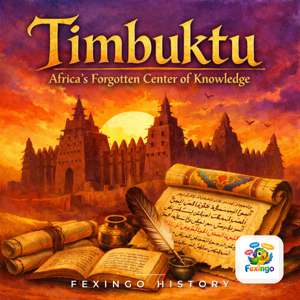


In 1591, the Saadian sultan Ahmad al-Mansur conquered Songhai and deported Timbuktu's greatest scholar, Ahmad Baba al-Timbukti, to Marrakech. But Ahmad Baba didn't break. From captivity, he wrote legal opinions, taught students, and even rebuked the sultan to his face—citing Islamic law. This episode follows his years in exile, his daring fatwa against the invasion itself, the network of scholars who smuggled his works across the Sahara, and the moral questions he raised about conquest and resistance. We also explore his return to Timbuktu in 1608 and how his legacy—through his writings and his students—shaped West African scholarship for centuries. Featuring the Mi'raj al-Su'ud, his treatise on slavery and legitimacy, and the Saadian occupation's impact on the intellectual life of the Niger bend.
#AhmadBaba #Timbuktu #SaadianInvasion #SonghaiEmpire #Marrakech #IslamicScholarship #Mi'rajAlSu'ud #SlaveryDebate #Fatwa #WestAfrica #16thCentury #Sankore #Exile #MammaHaidaraLibrary #AhmedBabaInstitute #TarikhAlSudan #History #FexingoHistory
Keep every episode free: buymeacoffee.com/fexingo
Before the fall of Songhai, Timbuktu was not just a center of learning and trade — it was a hub of diplomacy that connected the Sahel to North Africa, the Ottoman Empire, and even Europe. In this episode, Lucas and Luna explore the lost art of Saharan statecraft through the diplomatic letters preserved in Timbuktu's manuscripts. They discuss the correspondence between Askia al-hajj Muhammad and the Ottoman sultan Bayezid II, the exchange of gifts and envoys with the Saadian sultan Ahmad al-Mansur, and the role of scholars like Ahmad Baba as mediators. They also touch on the famous letter from the ruler of Bornu to the Ottoman sultan asking for help against the Saadians. The episode reveals how Timbuktu's scholars were not just keepers of knowledge but also diplomatic agents who shaped the political landscape of West Africa. Even after the Moroccan invasion, the manuscript legacy includes letters that show continued diplomatic contacts. This is a side of Timbuktu rarely discussed — the parchment trail of power and negotiation across the Sahara.
#Timbuktu #Diplomacy #Songhai #OttomanEmpire #Saadian #AhmadBaba #AskiaMuhammad #BayezidII #AhmadalMansur #Bornu #Sahara #Manuscripts #WestAfrica #SaharanTrade #Statecraft #Letters #DiplomaticHistory #FexingoHistory
Keep every episode free: buymeacoffee.com/fexingo
We often think of Timbuktu as a center of religious and legal scholarship, but its scholars also built a sophisticated tradition of astronomy. In this episode, Lucas and Luna explore how Sahelian astronomers like Muhammad al-Kaburi used instruments such as the astrolabe and quadrant to calculate time, predict eclipses, and determine the qibla. They discuss the practical needs that drove this science — prayer times, Ramadan, navigation — and how these tools traveled across the Sahara, blending knowledge from North Africa, the Mediterranean, and the Islamic world. We also look at one remarkable manuscript from the Mamma Haidara Library that records a lunar eclipse observation from 1584, and consider what it tells us about the intellectual culture of the Songhai Empire. Along the way, the hosts touch on the role of Sankore as a hub for scientific exchange, and how the Moroccan invasion disrupted a thriving scholarly ecosystem. If you thought African history was all oral tradition, this episode will change your mind.
#Timbuktu #Astronomy #Sahel #SonghaiEmpire #Sankore #MammaHaidaraLibrary #MuhammadAlKaburi #Astrolabe #Quadrant #Qibla #IslamicScience #Manuscripts #IlmAlFalak #LunarEclipse #HistoryOfScience #Africa #FexingoHistory #History
Keep every episode free: buymeacoffee.com/fexingo
In this episode of Fexingo History, Lucas and Luna explore the life and work of Muhammad al-Mustafa al-Wangari, a 17th-century Timbuktu poet who scandalized the scholarly elite with his ecstatic love poems. Born into a family of qadis at Sankore, al-Wangari abandoned his legal studies to write verses that blurred the line between human and divine love. His poetry, preserved in the Mamma Haidara Library, was denounced by some as heretical, yet defended by others as a legitimate expression of Sufi mysticism. We read from his surviving ghazals, discuss the controversy around his censure by the Qadi of Timbuktu, and examine how his work fits into the broader West African literary tradition. The episode also touches on the role of poetry in Timbuktu's intellectual life, the influence of Arabic poetic forms, and what al-Wangari's story reveals about tensions between orthodoxy and ecstatic piety in the Sahel.
#Timbuktu #MuhammadAlMustafaAlWangari #Sankore #MammaHaidaraLibrary #SufiPoetry #Ghazal #LovePoetry #Qadi #AlWangari #Sahel #WestAfrica #17thCentury #Mali #Songhai #AhmedBabaInstitute #TarikhAlSudan #History #FexingoHistory
Keep every episode free: buymeacoffee.com/fexingo
When the Saadian army of Ahmad al-Mansur conquered Timbuktu in 1591, they arrested the renowned scholar Ahmad Baba al-Timbukti and marched him in chains across the Sahara to Marrakech. This episode follows his seven-year exile, his defiant legal opinions under occupation, and the intellectual community he built in exile. We explore how he used fatwas and ijazas to preserve Sankore's scholarly traditions, how his debates with Saadian jurists challenged the legitimacy of the invasion, and how his eventual return reshaped Timbuktu's intellectual life. Drawing on the Tarikh al-Sudan and his own writings, including his famous legal treatise on slavery, Mi'raj al-Su'ud, we examine a scholar who turned captivity into a platform for resistance. The episode also considers the quieter forms of defiance—manuscript smuggling, hidden libraries, and oral transmission—that kept Timbuktu's knowledge alive long after its political power vanished.
#AhmadBaba #Timbuktu #Sankore #SaadianInvasion #AhmadalMansur #JudarPasha #TarikhAlSudan #Mi'rajAlSu'ud #Fatwa #Ijazas #Marrakech #SonghaiEmpire #WestAfrica #History #FexingoHistory #ScholarshipUnderOccupation #Manuscripts #Defiance
Keep every episode free: buymeacoffee.com/fexingo
In 2012, when Islamist militants seized Timbuktu and began destroying its ancient manuscripts, a quiet rescue operation unfolded. Led by librarian Abdel Kader Haidara, a team of archivists and ordinary citizens smuggled over 350,000 manuscripts out of the city under the noses of Ansar Dine and Al Qaeda. This episode tells the story of that daring evacuation: how manuscripts were hidden in trunks, transported by boat and donkey, and concealed in safe houses in Bamako and private homes across Mali. We explore the ethics of preservation in conflict zones, the role of foreign funding, and the ongoing work to digitize and protect the collection. The episode also reflects on what the manuscripts reveal about Timbuktu's intellectual legacy—from astronomy to law—and why their survival matters for African history.
#TimbuktuManuscripts #AbdelKaderHaidara #MammaHaidaraLibrary #AhmedBabaInstitute #AnsarDine #AlQaeda #ManuscriptRescue #Mali #Sahel #HeritagePreservation #DigitalHumanities #LibrarianHeroes #SonghaiEmpire #Sankore #Djinguereber #History #FexingoHistory #WestAfrica
Keep every episode free: buymeacoffee.com/fexingo
Long before the University of al-Qarawiyyin or the Sorbonne, Timbuktu's Sankore mosque was the intellectual epicenter of West Africa. But what did students actually study there? In this episode, Lucas and Luna pull back the shroud on Sankore's curriculum: the Maliki fiqh texts that anchored legal training, the ijazas or certificates that linked Timbuktu to Cairo and Fez, the mathematics and astronomy borrowed from al-Battani and al-Zarqali, and the surprising focus on medicine, grammar, and logic. They explore how Sankore’s system of knowledge transmission was both deeply Islamic and distinctly African—where scholars like Ahmad Baba al-Timbukti taught from the Mi'raj al-Su'ud, a legal treatise on slavery, while others copied Tarikh al-Sudan in the margins. And they ask: why did this system collapse when the Moroccan invasion of 1591 destroyed not just the city but the intellectual network that sustained it? This is the story of a curriculum that once rivaled the great universities of the world.
#Sankore #Timbuktu #MaliEmpire #AhmadBaba #MalikiFiqh #Ijaza #MedievalEducation #TarikhAlSudan #WestAfrica #Songhai #AlBattani #AlZarqali #MoroccanInvasion #13thCentury #16thCentury #History #FexingoHistory #AfricanHistory
Keep every episode free: buymeacoffee.com/fexingo
Before Mansa Musa’s famous pilgrimage, before the Songhai war canoes, before the Saadian muskets—there was the silent trade. For centuries, West African gold producers and North African salt merchants exchanged goods without a single word spoken, without ever laying eyes on one another. This episode reconstructs the ritual: gold dust laid out on the banks of the Niger, salt slabs left by veiled Tuareg caravans, the careful bartering by drum signals, and the code of honor that made it work. We explore the geography—the Bambuk and Bure goldfields, the salt mines of Taghaza and Taoudenni—and the economics behind a system that fueled the Mali and Songhai empires. Lucas and Luna also discuss how Arab geographers like al-Bakri and al-Idrisi described the practice, and why modern historians debate whether it ever truly existed or was a legend born of misunderstanding. A deep dive into a trade where silence was the only currency.
#SilentTrade #GoldSaltTrade #WestAfrica #MaliEmpire #SonghaiEmpire #Taghaza #Taoudenni #Bambuk #Bure #Wangara #alBakri #alIdrisi #IbnBattuta #SaharanTrade #TransSaharan #AfricanHistory #History #FexingoHistory
Keep every episode free: buymeacoffee.com/fexingo
In 1591, the Songhai Empire faced its final military test at the Battle of Jenne, a dramatic riverine confrontation that sealed Timbuktu's fate under Moroccan occupation. This episode follows the campaign of Judar Pasha, a eunuch general leading a force of 4,000 Moroccan arquebusiers and 2,000 cavalry across the Sahara, and the Songhai defenders under Askia Ishaq II, who marshaled 30,000 men and a fleet of war canoes. We explore the tactical blunder that cost the Songhai their advantage: their failure to use the Niger River's annual flood to trap the Moroccans on the islands near Jenne. Drawing on the Tarikh al-Sudan and European mercenary accounts, we reveal how gunpowder weapons alone did not win the battle—but a misjudged withdrawal did. The episode also examines the aftermath: the looting of Timbuktu's libraries, the enslavement of scholars like Ahmad Baba, and the Saadian policy of coopting local elites that turned Timbuktu into a colonial outpost. A story of strategy, hubris, and the end of an intellectual golden age.
#BattleOfJenne #SonghaiEmpire #Timbuktu #JudarPasha #AskiaIshaqII #MoroccanInvasion #SaadianDynasty #TarikhAlSudan #NigerRiver #WestAfricanHistory #MilitaryHistory #16thCentury #Colonialism #AfricanEmpires #History #FexingoHistory #GunpowderEmpires #Mali
Keep every episode free: buymeacoffee.com/fexingo
In this episode, Lucas and Luna focus on Mahmud Kati, the 16th-century scholar who compiled the Tarikh al-Fattash, one of the most vital chronicles of the Songhai Empire. Lucas explains how Kati, born in 1468, served as a qadi and secretary under the Askia dynasty, gathering manuscripts and oral traditions for decades. They discuss the controversy around Kati's authorship—some scholars argue the text was later expanded by his grandson—and the unique perspective Kati brought as an insider in the Songhai court. Lucas describes how the Tarikh al-Fattash details the reigns of Askia Muhammad and his successors, including military campaigns, administrative reforms, and the role of Islam in state-building. They also touch on the manuscript's rediscovery in the 20th century and its journey from a private Timbuktu library to a published edition. Luna asks about the challenges of relying on a single chronicle, and Lucas reflects on how Kati's work, alongside al-Sa'di's Tarikh al-Sudan, gives us a multi-faceted view of the Sahel's golden age.
#MahmudKati #TarikhAlFattash #SonghaiEmpire #Timbuktu #WestAfricanHistory #AskiaMuhammad #SankoreUniversity #16thCentury #IslamicHistoriography #MaliEmpire #Sahel #Manuscripts #OralTradition #Qadi #AskiaDynasty #FexingoHistory #History #AfricanHistory
Keep every episode free: buymeacoffee.com/fexingo
From the publisher's feed