
Sign up to save your podcasts
Or

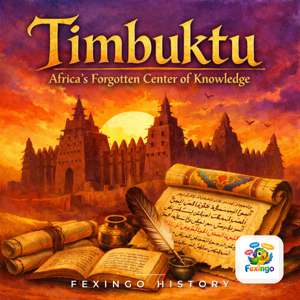


In this episode, Lucas and Luna explore the story of Djinguereber Mosque, Timbuktu's iconic structure that has stood for over 700 years. They delve into its construction under Mansa Musa and the architect al-Sahili in 1327, the unique materials and methods—like banco and salt—that have required constant renewal, and the community-led restorations that preserved it through the centuries. They also discuss the mosque's role as a center of worship and learning, surviving the Moroccan invasion and the Sahel's harsh climate. Specifics include the role of the imam, the astronomical alignment of the minaret, and the 20th-century renovations by the Aga Khan Trust for Culture. This episode brings to life the living history of a structure that still stands today.
#Djinguereber #Timbuktu #MansaMusa #alSahili #Sankore #GreatMosque #banco #Sahel #MaliEmpire #Songhai #IslamicArchitecture #AgaKhan #MammaHaidaraLibrary #AhmedBabaInstitute #MoroccanInvasion #OralTradition #History #FexingoHistory
Keep every episode free: buymeacoffee.com/fexingo
In this episode, Lucas and Luna explore the rich medical heritage of Timbuktu, focusing on the lost medical manuscripts that once thrived in the city. They discuss the contributions of scholars like Abd al-Rahman al-Timbukti, who wrote commentaries on Ibn Sina's Canon of Medicine, and how local healers blended Islamic medicine with indigenous practices using plants like baobab and tamarind. The episode covers the establishment of hospitals during the Songhai Empire, the role of the ijaza system in transmitting medical knowledge, and the devastating impact of the Moroccan invasion of 1591 on Timbuktu's intellectual life. Lucas shares insights from surviving manuscripts and highlights the importance of the Mamma Haidara Library and the Ahmed Baba Institute in preserving this fragile heritage. The conversation also touches on the ethical debates around slavery and health, and the legacy of Timbuktu as a center of learning that extended beyond theology into the sciences.
#Timbuktu #MedicalManuscripts #IbnSina #AbdAlRahmanAlTimbukti #SonghaiEmpire #MoroccanInvasion #IslamicMedicine #Baobab #Tamarind #Ijaza #MammaHaidaraLibrary #AhmedBabaInstitute #Sahel #NigerRiver #GalēN #CanonOfMedicine #History #FexingoHistory
Keep every episode free: buymeacoffee.com/fexingo
In this episode, Lucas and Luna explore the life and work of Muhammad al-Kaburi, a 16th-century astronomer from Timbuktu who calculated and predicted a solar eclipse visible from the Niger River bend. Using the zīj tradition of Islamic astronomical tables and instruments like the astrolabe and quadrant, al-Kaburi's work challenges the notion that pre-colonial Africa had no systematic science. Lucas explains how scholars at Sankore University integrated Ptolemaic astronomy with local observation, and how al-Kaburi's eclipse prediction was recorded in the Tarikh al-Sudan. The conversation also touches on the practical uses of astronomy for prayer times and the Qibla direction, and the long legacy of Timbuktu's ilm al-falak tradition. We discuss the survival of al-Kaburi's manuscripts in the Mamma Haidara Library and what they reveal about intellectual life in the Sahel. This episode offers a rare look at African astronomy before the colonial era, showing how Timbuktu connected to a global network of knowledge, from North Africa to the Middle East.
#Timbuktu #MuhammadAlKaburi #SolarEclipse #Sankore #IlmAlFalak #IslamicAstronomy #WestAfrica #MaliEmpire #TarikhAlSudan #Astrolabe #Quadrant #Zij #Sahel #MammaHaidaraLibrary #Ptolemaic #Qibla #History #FexingoHistory
Keep every episode free: buymeacoffee.com/fexingo
In 1324, Mansa Musa, the legendary ruler of the Mali Empire, embarked on a pilgrimage to Mecca that would become one of the most famous journeys in history. But this episode goes beyond the gold. We explore the diplomatic maneuvering, the intellectual exchanges, and the lasting impact of Musa's hajj on Timbuktu and the wider Islamic world. Lucas and Luna discuss the precise route Musa took across the Sahara, the caravan's staggering size—60,000 people, including 12,000 slaves each carrying four pounds of gold—and the meticulous planning required. They examine Musa's stop in Cairo, where his lavish spending caused gold inflation that lasted over a decade. They also uncover Musa's recruitment of scholars, architects, and poets like the Andalusian poet Abu Ishaq al-Sahili, who later built the Djinguereber Mosque and the Sankore Madrasa. The episode touches on Musa's lesser-known construction projects in Gao and Timbuktu, and how his pilgrimage turned Timbuktu from a provincial trading post into a center of Islamic learning. Finally, they consider the legacy of Musa's hajj: did it strengthen Mali's ties with the Islamic world, or did it also attract unwanted attention from foreign powers?
#MansaMusa #MaliEmpire #Hajj #Timbuktu #IslamicGoldenAge #SaharanTrade #Gold #AbuIshaqAlSahili #DjinguereberMosque #Sankore #Cairo #Mecca #1324 #MedievalAfrica #History #FexingoHistory #WestAfrica #Diplomacy
Keep every episode free: buymeacoffee.com/fexingo
In 15th-century Timbuktu, a scholar named Abou Bakr Ibn Ahmad al-Timbukti calculated the Earth's circumference using mathematics and astronomy—without modern instruments. This episode explores how he built on the works of al-Battani and al-Zarqali, and how his manuscript, 'The Gift of the Inquisitive for the Path of the Stars,' reveals a vibrant intellectual tradition in the Sahel. Lucas and Luna discuss the Sankore curriculum, the use of astrolabes and celestial globes, and how Timbuktu's scholars engaged with Ptolemaic astronomy. They also touch on the controversy over whether al-Timbukti's calculations were original or derivative, and what his work tells us about the global exchange of knowledge before the European Renaissance. A story of science, faith, and the enduring legacy of Africa's forgotten center of learning.
#Timbuktu #Astronomy #AbouBakrIbnAhmad #Sankore #IlmAlFalak #Sahel #MaliEmpire #SonghaiEmpire #Ptolemaic #AlBattani #AlZarqali #Astrolabe #Quadrant #CelestialGlobe #MammaHaidaraLibrary #AhmedBabaInstitute #ScienceHistory #FexingoHistory
Keep every episode free: buymeacoffee.com/fexingo
In this episode, Lucas and Luna explore the forgotten medical tradition of Timbuktu. While the city is famous for its libraries of astronomy, law, and theology, its physicians produced hundreds of manuscripts on surgery, pharmacology, and diagnosis. Lucas introduces listeners to the work of Abd al-Rahman al-Timbukti, a 16th-century doctor who compiled a surgical manual based on Galen and Ibn Sina, but adapted for the Sahel. They discuss treatments for snakebites, malaria, and river blindness, and the use of local plants like baobab and tamarind. Lucas explains how Timbuktu's medical knowledge was transmitted through ijazas and how the Moroccan invasion disrupted this tradition. Luna asks about the role of women healers and the influence of the trans-Saharan trade on medicinal ingredients. The episode ends with a reflection on the fragility of knowledge and what was lost when Timbuktu's libraries were dispersed.
#Timbuktu #MedievalMedicine #AbdAlRahmanAlTimbukti #Sankore #MedicalManuscripts #Sahel #SonghaiEmpire #IbnSina #Galen #Pharmacology #Surgery #TransSaharanTrade #Ijazas #Baobab #Tamarind #HistoryOfMedicine #AfricanHistory #FexingoHistory
Keep every episode free: buymeacoffee.com/fexingo
Before Timbuktu became a center of scholarship, the Songhai Empire engineered a vast network of underground water channels (foggara) that sustained urban life in the Sahel. In this episode, Lucas and Luna explore how this ancient irrigation technology, adapted from North Africa and the Middle East, allowed Songhai cities like Gao and Timbuktu to thrive despite the arid climate. Drawing on the Tarikh al-Sudan and recent archaeological work, they trace the construction and maintenance of these qanat-like systems, the role of enslaved labor, and how the Moroccan invasion disrupted them. They also discuss the legacy of these waterworks, which recent droughts have brought renewed attention to. Along the way, they touch on the Songhai navy (hi-koi) that patrolled the Niger, the salt trade from Taghaza, and the daily life of farmers and engineers who kept the water flowing. A story of innovation and resilience that challenges stereotypes about precolonial Africa.
#Songhai #Timbuktu #Foggara #Qanat #NigerRiver #TarikhAlSudan #HiKoi #Taghaza #Sahel #Irrigation #WaterSystems #Gao #MoroccanInvasion #AhmadBaba #Slavery #Saadian #Engineering #FexingoHistory #MaliEmpire #SonghaiEmpire
Keep every episode free: buymeacoffee.com/fexingo
When the Moroccan sultan Ahmad al-Mansur conquered Timbuktu in 1591, he expected the city's most famous scholar, Ahmad Baba al-Timbukti, to bow. Instead, the scholar was dragged in chains to Marrakesh, where for over a decade he debated slavery, law, and power with the sultan himself. This episode explores Ahmad Baba's captivity, his authorship of the groundbreaking antislavery treatise Mi'raj al-Su'ud (The Ladder of Ascent), and how his defiance reshaped Maliki jurisprudence across the Sahel. We'll examine the political calculations behind al-Mansur's invasion, the role of the Qadiriyya Sufi order, and how Ahmad Baba's writings became a cornerstone of Timbuktu's intellectual resistance. Discover how one man's courage in the face of an empire preserved a legacy of justice that echoes today.
#AhmadBaba #MiRajalSuUd #Timbuktu #MoroccanInvasion #AlMansur #SlaveryDebate #MalikiJurisprudence #SaadiSultanate #Marrakesh #Qadiriyya #SonghaiEmpire #MammaHaideraLibrary #16thCentury #IslamicScholarship #WestAfricanHistory #Sahel #IntellectualResistance #FexingoHistory #MaliEmpire #MansaMusa
Keep every episode free: buymeacoffee.com/fexingo
In this episode, Lucas and Luna explore the life and work of Abou Bakr Ibn Ahmad al-Timbukti, a 15th-century scholar from Timbuktu who produced a remarkably accurate calculation of the Earth's circumference using a method described in his manuscript 'The Gift of the Inquisitive on the Levels of the Spheres.' They discuss how his work drew from earlier Islamic astronomers like al-Battani and al-Zarqali, and how his calculations—only 3% off from modern measurements—were disseminated through the Sankore curriculum via ijazas. The episode also examines the controversy over whether Timbuktu's scholars were mere copyists or genuine innovators, with evidence from surviving manuscripts that show original commentary on Ptolemaic models. Lucas explains the astronomical tools available in Timbuktu—astrolabes, quadrants, celestial globes—and how scholars like Ibn Ahmad used them alongside naked-eye observations. The conversation touches on the decline of this scientific tradition after the Moroccan invasion of 1591 and the subsequent loss of many manuscripts. A must-listen for anyone interested in the history of science in Africa.
#AbouBakrIbnAhmad #Timbuktu #Astronomy #IslamicScience #EarthCircumference #Sankore #Ijazas #Manuscripts #Astrolabe #Quadrant #CelestialGlobe #AlBattani #AlZarqali #PtolemaicModels #MoroccanInvasion #1591 #HistoryOfScience #FexingoHistory #MaliEmpire #SonghaiEmpire
Keep every episode free: buymeacoffee.com/fexingo
In the late 16th century, as the Moroccan invasion shattered the Songhai Empire, one Timbuktu scholar was carried in chains to Marrakesh. His name was Ahmad Baba al-Timbukti, and from his forced exile, he wrote a series of legal opinions—fatwas—that would challenge the foundations of trans-Saharan slavery. In this episode, Lucas and Luna examine Ahmad Baba's most famous work, Mi'raj al-Su'ud, where he argued that only those born into slavery under Islamic law could be enslaved, rejecting the widespread practice of capturing free Muslims from West Africa. They explore how his arguments were rooted in Maliki jurisprudence, how he corresponded with scholars in Fez and Timbuktu while imprisoned, and why his fatwa failed to stop the Moroccan-backed slave trade. The episode also touches on the limits of his influence: his rulings were ignored by the Saadian rulers, and Timbuktu's libraries were plundered. Yet his writings survived, hidden by families like the Kunta, and resurfaced centuries later as evidence of a sophisticated African intellectual tradition that fought against injustice. Lucas and Luna also discuss the Mamma Haidara Library, where many of Ahmad Baba's works are now preserved.
#Timbuktu #AhmadBaba #Slavery #Fatwa #MiRajalSuUd #Maliki #Marrakesh #SonghaiEmpire #MoroccanInvasion #JudarPasha #Kunta #TransSaharanSlaveTrade #IslamicLaw #History #AfricanHistory #FexingoHistory #MammaHaidaraLibrary #Sankore #MaliEmpire #MansaMusa
Keep every episode free: buymeacoffee.com/fexingo
From the publisher's feed