
Sign up to save your podcasts
Or

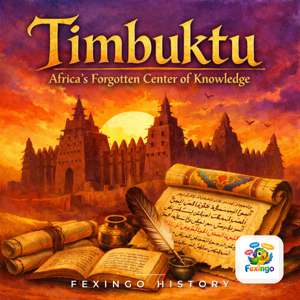


When jihadists occupied Timbuktu in 2012, they targeted the city's manuscripts for destruction. But a quiet network of librarians, archivists, and ordinary families had been hiding these texts for centuries — long before the crisis made global headlines. In this episode, Lucas and Luna delve into the history of Timbuktu's private manuscript libraries: the Haidara family's sprawling collection, the Fondo Kati founded by Mahmud Kati, and the Ahmed Baba Institute. They explore how these libraries were built, how they survived French colonialism, and the ingenious smuggling operation that evacuated hundreds of thousands of manuscripts to safety in Bamako. Along the way, they touch on the manuscripts' contents — from astronomical charts to Sufi poetry — and the scholars who risked everything to preserve them. This is a story of endurance, not just of paper and ink, but of a city's intellectual soul.
#Timbuktu #Manuscripts #Haidara #AhmedBabaInstitute #FondoKati #MahmudKati #AbdelKaderHaidara #Bamako #JihadistOccupation #Mali #Sankore #Djinguereber #TarikhAlSudan #TarikhAlFattash #Sahel #History #FexingoHistory #WestAfrica
Keep every episode free: buymeacoffee.com/fexingo
Before telescopes, before Copernicus, a scholar in Timbuktu calculated the motion of celestial bodies with astonishing precision. Muhammad al-Mustafa al-Wangari, a 17th-century astronomer and jurist, wrote a treatise called Mīr'āt al-Ālam ('The Mirror of the Universe') that synthesized Islamic astronomy with local observation. In this episode, we trace al-Wangari's life: his education at Sankore, his use of instruments like the astrolabe and quadrant, his corrections to earlier star charts, and his legacy buried in the Mamma Haidara Library. We also explore how Timbuktu's scholars engaged with Greek, Persian, and Andalusian astronomy, and why their work remains largely unknown in Western narratives of science. With a focus on al-Wangari's specific calculations and methods, this episode sheds light on a forgotten chapter of global scientific history.
#MuhammadAlWangari #MiratAlAlam #TimbuktuAstronomy #SankoreUniversity #MammaHaidaraLibrary #IslamicGoldenAge #SahelScience #Astrolabe #AlZarqali #AlBattani #17thCenturyScience #WestAfricanHistory #LostManuscripts #QiblaDirection #HistoryOfAstronomy #PreCopernican #FexingoHistory #History
Keep every episode free: buymeacoffee.com/fexingo
Long before modern medicine reached the Sahara, Timbuktu's scholars compiled detailed herbal remedies that blended Islamic medicine with West African traditions. In this episode, Lucas and Luna explore the medical manuscripts of the Sahel, focusing on the work of 'Abd al-Rahman al-Sa'di, the 17th-century historian and physician who recorded treatments for malaria, dysentery, and snakebites using local plants like balanites and acacia. They discuss the influence of Ibn Sina's Canon of Medicine on Sankore's curriculum, the role of female healers known as 'boka', and how these manuscripts survived centuries of conflict, including the 2012 jihadist occupation. The episode reveals a sophisticated medical system that combined humoral theory with indigenous knowledge, offering insights into nutrition, surgery, and pharmacology. Lucas also highlights the ongoing digitization efforts by the Mamma Haidara Library and the Ahmed Baba Institute, which are making these texts accessible to researchers worldwide. This is a deep dive into a forgotten chapter of African science.
#Timbuktu #AfricanHistory #MedicalHistory #HerbalMedicine #Sankore #AlSaadi #IbnSina #Sahel #Manuscripts #MammaHaidara #AhmedBabaInstitute #Balanites #Malaria #Humorism #Boka #Herbalism #History #FexingoHistory
Keep every episode free: buymeacoffee.com/fexingo
In this episode of Timbuktu: Africa's Forgotten Center of Knowledge, Lucas and Luna explore the spiritual undercurrent that shaped the city's intellectual life: Sufism. They trace the arrival of the Qadiriyya order, brought by al-Maghili in the 15th century, and its deep roots among the Kunta and other Saharan tribes. Then they turn to the later rise of the Tijaniyya, a reformist Sufi order that spread rapidly across West Africa and sparked quiet but persistent tensions with the Qadiriyya establishment. The conversation covers key figures like Ahmad Baba al-Timbukti, a Qadiriyya loyalist, and al-Tijani, the order's founder. They also discuss how Sufi practices — dhikr, the veneration of saints, and mystical poetry — infused everyday life and scholarship in Timbuktu, and how the orders' networks rivaled political empires in influence. The episode ends with a reflection on how these spiritual lineages survived the Saadian invasion and continue to shape West African Islam today.
#Timbuktu #Sufism #Qadiriyya #Tijaniyya #al-Maghili #AhmadBaba #al-Tijani #Kunta #Sankore #WestAfrica #Mali #Songhai #Islam #Mysticism #Dhikr #SaharanTrade #FexingoHistory #History
Keep every episode free: buymeacoffee.com/fexingo
In this episode of Fexingo History, Lucas and Luna explore the remarkable life and work of Muhammad al-Mustafa al-Wangari, a 17th-century Timbuktu scholar who wrote a mirror of the universe. They discuss his major work, Mīr'āt al-Ālam, a massive astronomical and geographical encyclopedia that calculated the qibla direction and charted the stars from the Sahel. They explore how Sankore scholars used astrolabes and Islamic astronomy to solve practical problems like prayer times and sacred direction, and how al-Wangari's work fits into a broader tradition of African science. The episode also touches on the preservation of his manuscripts at the Mamma Haidara Library, and what his writings reveal about Timbuktu's intellectual networks connecting West Africa to the wider Islamic world.
#MuhammadAlMustafaAlWangari #MiratAlAlam #Timbuktu #Sankore #MammaHaidaraLibrary #IslamicAstronomy #Qibla #Sahel #17thCentury #WestAfrica #History #FexingoHistory #Manuscripts #Astrolabe #Mali #ScienceInAfrica #Scholars #AfricanHistory
Keep every episode free: buymeacoffee.com/fexingo
This episode explores the life and work of Muhammad al-Mustafa al-Wangari, a 17th-century Timbuktu scholar who wrote a massive encyclopedia of the cosmos, blending Islamic astronomy, Maliki jurisprudence, and Sufi mysticism. We examine his 'Mīr'āt al-Ālam' or 'Mirror of the World,' a text that attempted to systematize all knowledge from the stars to the soul. Lucas and Luna discuss how al-Wangari navigated the intellectual rivalries between Sankore's scholars and the Saadian occupation, his use of the astrolabe and trigonometry for prayer times and qibla direction, and the survival of his manuscripts in the Haidara family libraries. They also touch on the controversy around his claim that the Earth rotates on its axis, a full century before Galileo. The episode offers a window into the vibrant intellectual culture of Timbuktu that persisted long after the fall of the Songhai Empire.
#MuhammadAlMustafaAlWangari #MiralAlAlam #MirrorOfTheWorld #Sankore #Timbuktu #IslamicAstronomy #WestAfrica #Mali #HaidaraLibrary #Sufism #MalikiFiqh #17thCentury #SaadianOccupation #Astrolabe #Qibla #Heliocentrism #History #FexingoHistory
Keep every episode free: buymeacoffee.com/fexingo
In this episode, Lucas and Luna explore the silent barter system that fueled the Mali and Songhai empires. They discuss the goldfields of Bambuk and Bure, the mysterious Wangara traders, the salt mines of Taghaza and Taoudenni, and how Mansa Musa's pilgrimage to Mecca in 1324 demonstrated West African wealth to the world. They also examine the role of Timbuktu as a hub for trans-Saharan gold and salt exchange, and the lasting impact of this trade on global economics.
#Timbuktu #GoldTrade #SaltTrade #MansaMusa #Bambuk #Bure #Wangara #Taghaza #Taoudenni #SilentBarter #MaliEmpire #SonghaiEmpire #TransSaharanTrade #WestAfricanHistory #MedievalAfrica #AfricanHistory #History #FexingoHistory
Keep every episode free: buymeacoffee.com/fexingo
In this episode, Lucas and Luna explore the overlooked role of women in Timbuktu's scholarly tradition. From Nana Asma'u, the 19th-century Fula poet and teacher who wrote over 60 works in Arabic, Hausa, and Fulfulde, to the female jurists and manuscript collectors of old Timbuktu — including the enigmatic Khadija bint al-Muhammad al-Aqil, whose legal opinions were cited in Tarikh al-Sudan. We also discuss the Timbuktu Women's Association for the Preservation of Manuscripts, a modern group that saved thousands of texts from jihadist destruction in 2012. The episode challenges the assumption that Timbuktu's intellectual life was exclusively male, drawing on ijazas (certificates of transmission) that name women as teachers, and the writings of al-Sa'di and Ahmad Baba that mention female scholars. Specific figures: Nana Asma'u, Khadija bint al-Muhammad al-Aqil, and the women of the Haidara family who hid manuscripts. The episode also touches on the education of girls in the Mali Empire, and the legacy of Fula women's literary societies.
#Timbuktu #FemaleScholars #NanaAsma'u #KhadijaBintAlMuhammad #Sankore #FulaWomen #ManuscriptPreservation #TarikhAlSudan #AhmadBaba #Ijaza #MaliEmpire #Songhai #WestAfrica #WomenInIslam #Manuscripts #History #FexingoHistory #Education
Keep every episode free: buymeacoffee.com/fexingo
After the Saadian invasion of Songhai in 1591, the scholar Ahmad Baba al-Timbukti was taken captive and marched to Marrakech. But instead of breaking him, his exile became a powerful platform. In this episode, Lucas and Luna explore how Ahmad Baba used his time in Saadian captivity to challenge the invasion's legitimacy, writing legal opinions (fatwas) and historical works that would shape West African memory for centuries. They discuss his famous fatwa against the Saadians, his defense of enslaved Muslims from Timbuktu, and his eventual return home. Along the way, they consider the role of scholars in resisting empire and the enduring power of written testimony. This is a story of intellectual defiance in the face of military conquest.
#AhmadBaba #Timbuktu #SaadianInvasion #SonghaiEmpire #Fatwa #MamaHaidara #Sankore #Marrakech #WestAfrica #ScholarlyResistance #Mi'rajal-Su'ud #TarikhSudan #SlaveryDebate #1591 #AhmedBabaInstitute #IslamicScholarship #History #FexingoHistory
Keep every episode free: buymeacoffee.com/fexingo
In this episode, Lucas and Luna explore Djenné, the ancient city that rivaled Timbuktu as a center of learning and trade in the West African Sahel. They discuss Djenné's origins as a market city on the Bani River, its transformation into a hub of Islamic scholarship, and its connection to Timbuktu through the Sankore curriculum. The conversation highlights the role of Djenné's scholars, such as Ahmad Baba al-Timbukti and Mahmud Kati, who taught and studied there. They also examine the architectural marvel of the Great Mosque of Djenné, its significance as a center of knowledge, and how the city's manuscripts survived destruction, including those from the Mamma Haidara Library. The episode sheds light on the symbiotic relationship between Djenné and Timbuktu, challenging the notion that Timbuktu was the sole beacon of learning in medieval West Africa.
#Djenné #GreatMosqueOfDjenné #Timbuktu #SahelScholarship #AhmadBaba #MahmudKati #MammaHaidara #Sankore #WestAfricanHistory #MedievalAfrica #MaliEmpire #SonghaiEmpire #IslamicScholarship #Manuscripts #BaniRiver #FexingoHistory #History #AfricanHistory
Keep every episode free: buymeacoffee.com/fexingo
From the publisher's feed