
Sign up to save your podcasts
Or

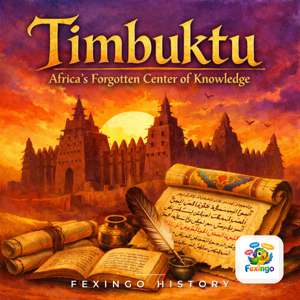


In this episode, Lucas and Luna explore the forgotten legal revolution of 17th-century Timbuktu. While Episode 5 touched on Ahmad Baba al-Timbukti's famous fatwa against enslaving free Muslims, this episode dives deeper into its global ripple effects. Lucas tells the story of how Baba's legal reasoning, rooted in Maliki jurisprudence, challenged the trans-Saharan slave trade at its peak. The discussion covers Baba's masterpiece Mi'raj al-Su'ud (The Ladder of Ascension), his use of precedents from as far as Cairo and Fez, and the political backlash from Songhai rulers who profited from the trade. Luna asks how Baba's arguments were received in other Saharan cities like Takedda, Ghadames, and Walata. Lucas explains that the fatwa was read aloud in markets and mosques, causing controversy among merchants and scholars alike. The episode also reveals how Baba's work influenced later abolitionist movements in West Africa, and how his manuscripts were hidden and recently rediscovered. Listeners learn specific terms like 'asl al-'abd' (origin of slavery), 'istilhaq' (claiming ownership), and the names of Baba's students who carried his legacy. The conversation ends with a reflection on what Baba's courage means for modern human rights debates.
#TimbuktuFatwa #AhmadBaba #MiRajalSuUd #MalikiJurisprudence #TransSaharanSlaveTrade #SonghaiEmpire #WestAfricanScholarship #IslamicLaw #AslAlAbd #Istilhaq #Takedda #Ghadames #Walata #17thCentury #Abolition #FexingoHistory #History #Timbuktu #MaliEmpire #MansaMusa
Keep every episode free: buymeacoffee.com/fexingo
After the golden age of Timbuktu's universities and the Songhai Empire's patronage of scholarship under Askia Muhammad, a quieter but equally profound chapter unfolded: the struggle for intellectual control between rival lineages within the Askia dynasty. This episode focuses on Askia Dawud, who reigned from 1549 to 1582, and his ambitious effort to centralize Islamic learning by building a royal library that rivaled the private collections of Timbuktu's scholar-families. We explore how Dawud commissioned the Tarikh al-Fattash, a chronicle that subtly reshaped history to legitimize his rule, and how his son, Askia Ishaq II, later faced a rebellion led by the scholar al-Mustafa al-Kaburi over the control of manuscripts. The episode also reveals the fascinating story of a clandestine network of women scribes—descendants of Nana Asma'u's tradition—who copied and hid manuscripts during the Moroccan invasion of 1591, preserving texts that would later astonish the world. Through these stories, we see Timbuktu not as a static repository of knowledge, but as a living, contested arena where power and scholarship intertwined.
#AskiaDawud #TarikhAlFattash #AlMustafaAlKaburi #MoroccanInvasion1591 #WomenScribes #TimbuktuLibraries #SonghaiEmpire #AskiaDynasty #ManuscriptCulture #IslamicScholarship #WestAfrica #16thCentury #IntellectualHistory #LibraryWars #AhmedBaba #NanaAsmau #FexingoHistory #History #Timbuktu #MaliEmpire
Keep every episode free: buymeacoffee.com/fexingo
In 1615, a slave named Adda Bari was brought to Timbuktu from Katsina, sparking a legal crisis. The city's top jurist, Ahmad Baba al-Timbukti, wrote a landmark fatwa arguing that no free Muslim could be enslaved — and that most of the enslaved people in the region were fraudulently taken. This episode dives into the world of Timbuktu's scholarly legal system, where judges like al-Timbukti used Islamic law to challenge the trans-Saharan slave trade. We explore how his legal treatise, the Mi'raj al-Su'ud, drew on the Maliki school of jurisprudence and defined 'Black' and 'White' in ways that dismantled racial justifications for slavery. Al-Timbukti named specific kingdoms — Bornu, Kano, Songhai — and argued that their inhabitants were free by law. We also examine why this fatwa failed to stop the trade and how it resurfaced in modern debates about slavery. This is not a story of easy triumph but of a moral argument made at great risk, preserved in Timbuktu's manuscripts and only now fully understood.
#AhmadBaba #Timbuktu #Fatwa #Slavery #IslamicLaw #Maliki #MiRajalSuUd #AddaBari #Katsina #Bornu #Kano #Songhai #TransSaharanSlaveTrade #17thCentury #WestAfrica #LegalHistory #Manuscripts #FexingoHistory #MaliEmpire #SonghaiEmpire
Keep every episode free: buymeacoffee.com/fexingo
In this episode, we explore the pivotal reign of Askia Muhammad and the institutionalization of Islamic scholarship in Songhai. We discuss his pilgrimage to Mecca, his collaboration with scholars like Al-Maghili, and the creation of a state-sponsored university system in Timbuktu. We also delve into the role of women scholars, such as the poet and jurist Nana Asma'u, and the daily life of students at Sankore. The episode highlights how Songhai under Askia Muhammad became a center of learning that rivaled Cairo and Baghdad, and how the empire's collapse in the 16th century led to the preservation of knowledge through the secret rescue of manuscripts, a legacy that continues today.
#AskiaMuhammad #SonghaiEmpire #Timbuktu #Sankore #Djinguereber #AlMaghili #NanaAsmau #IslamicScholarship #WestAfricanHistory #MansaMusa #AhmedBaba #UniversityofTimbuktu #ManuscriptRescue #History #FexingoHistory #Podcast #MedievalAfrica #WomenScholars #MaliEmpire #SankoreUniversity
Keep every episode free: buymeacoffee.com/fexingo
In this episode, Lucas and Luna dive into the intellectual life of Timbuktu beyond its famous mosque-universities. They explore the city's thriving manuscript culture, focusing on the works of scholars like Ahmad al-Timbuktawi and Muhammad al-Kaburi, who wrote on astronomy, medicine, and mathematics. Lucas reveals how these texts incorporated knowledge from the Islamic Golden Age, but also unique African observations—like detailed star charts used for navigation and timekeeping. They discuss the role of women scholars, such as Fatima al-Suqayriya, and how manuscripts were commissioned and traded. Luna learns about the 'Timbuktu Manuscripts Project' that digitally preserved over 300,000 pages after the 2012 crisis, revealing not just religious works, but poetry, legal treatises, and scientific diagrams. The episode highlights the astronomical treatise 'Mukhtasar fi al-Hay'a' and a surgical manual that describes cataract procedures. Lucas emphasizes that Timbuktu was a node in a wider network of African scholarship, connected to Cairo and Fez. The conversation ends with a reflection on what these manuscripts tell us about African intellectual history—a story of innovation, not just preservation.
#TimbuktuManuscripts #AfricanScholarship #AhmedBaba #IslamicAstronomy #FatimaalSuqayriya #MaliEmpire #Sankore #Djinguereber #ManuscriptCulture #AlMaghili #MukhtasarfiHayah #CataractSurgery #WomenScholars #TimbuktuHistory #FexingoHistory #History #Africa #Knowledge #Timbuktu #SonghaiEmpire
Keep every episode free: buymeacoffee.com/fexingo
When jihadist forces seized Timbuktu in 2012, they destroyed centuries-old mausoleums and threatened the city's legendary manuscripts. This episode tells the extraordinary story of the librarians and archivists who smuggled over 350,000 fragile documents to safety under the noses of armed occupiers. We explore the contents of those manuscripts — covering astronomy, medicine, law, and philosophy from the 13th to 16th centuries — and how they challenge Western narratives of African history. We meet key figures like Abdel Kader Haidara, who organized the evacuation, and learn about the Ahmed Baba Institute, named after the great 16th-century scholar. The episode also reveals what was lost in the fires set by the retreating militants, and what the manuscripts tell us about Timbuktu's role as a crossroads of knowledge in the Songhai and Mali empires. It's a story of courage, cultural heritage, and the ongoing effort to preserve Africa's intellectual legacy.
#Timbuktu #Manuscripts #AhmedBaba #AbdelKaderHaidara #SonghaiEmpire #MaliEmpire #Djinguereber #Sankore #MansaMusa #HeritageDestruction #CulturalRescue #AfricanHistory #IslamicScholarship #ArmedConflict #Libraries #2012Mali #FexingoHistory #History #AskiaMuhammad #SankoreUniversity
Keep every episode free: buymeacoffee.com/fexingo
In 1324, Mansa Musa's pilgrimage to Mecca put the Mali Empire on the map—but it was the intellectual legacy of Timbuktu that truly shaped history. This episode takes you to the legendary Djinguereber Mosque, where scholars like Ahmed Baba built libraries that rivaled any in the medieval world. We explore how West African universities flourished on the trans-Saharan trade, attracting thinkers from Cairo to Córdoba. Discover the Sankore curriculum, the astronomical treatises of al-Qadi, and the legal debates that made Timbuktu a center of Islamic jurisprudence. Learn why the city's manuscripts—over 700,000 pages—still survive today, hidden from French colonizers and jihadists alike. Lucas and Luna discuss the scholarly networks that connected Timbuktu to the wider world, and why this 'forgotten' center matters now more than ever.
#Timbuktu #MaliEmpire #MansaMusa #Djinguereber #Sankore #AhmedBaba #TransSaharanTrade #IslamicGoldenAge #Manuscripts #University #Scholarship #WestAfrica #14thCentury #OralTradition #Libraries #History #FexingoHistory #ForgottenHistory #SonghaiEmpire #AskiaMuhammad
Keep every episode free: buymeacoffee.com/fexingo
From the publisher's feed