
Sign up to save your podcasts
Or

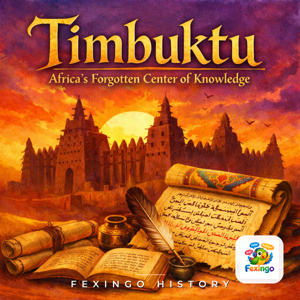


In this episode, Lucas and Luna explore how the Niger River's shifting course shaped Timbuktu's rise and fall. They discuss the city's founding as a seasonal camp, the role of the Tuareg, the impact of climate shifts on trade, and the 1591 Saadian invasion that disrupted the waterways. They also examine the consequences of the river's movement, including the decline of Timbuktu's port and the rise of Djenné, and reflect on how environmental change, not just politics, altered the course of history. Using sources like the Tarikh al-Sudan, they highlight the river's centrality to scholarly and economic life, and consider what the past reveals about present-day challenges in the Sahel.
#Timbuktu #NigerRiver #Sahel #WestAfrica #Mali #SonghaiEmpire #TarikhAlSudan #Tuareg #Djenné #EnvironmentalHistory #ClimateChange #TradeRoutes #Desertification #AfricanHistory #AhmadBaba #Kunta #History #FexingoHistory
Keep every episode free: buymeacoffee.com/fexingo
In this episode of Fexingo History, Lucas and Luna explore the architectural marvels of Timbuktu, focusing on the Djinguereber Mosque and its legendary builder, Abu Ishaq al-Sahili. They discuss al-Sahili's journey from Granada to Mali, how he brought Andalusian and Egyptian techniques to the Sahel, and the distinctive mud-brick construction that still defines the city's skyline. The conversation also covers the role of the Sankore and Sidi Yahya mosques, the patronage of Mansa Musa, and the broader cultural exchange between North Africa and West Africa. The episode examines the practical challenges of building in the Sahel, the symbolic and spiritual significance of these structures, and how they became centers of learning and community. It also touches on modern preservation efforts and the 2012 crisis that threatened these UNESCO sites. Discover how Timbuktu's mosques are not just buildings but living testimonies to a golden age of knowledge and faith.
#Timbuktu #Djinguereber #AbuIshaqAlSahili #MansaMusa #SahelArchitecture #MudBrick #SankoreMosque #SidiYahya #MaliEmpire #UNESCO #Granada #Andalusian #CulturalExchange #IslamicArchitecture #History #FexingoHistory #WestAfrica #MosqueBuilders
Keep every episode free: buymeacoffee.com/fexingo
In this episode of Fexingo History, Lucas and Luna explore the devastating fire of 1498 that swept through Timbuktu's commercial district, threatening its famous libraries and scholarly community. They discuss how the city, then part of the Songhai Empire, rose from the ashes stronger than ever, rebuilding its mosques and strengthening its intellectual culture. The episode features the roles of Askia Muhammad, who was not yet emperor but a prominent general, and local scholars like Mahmud Kati, whose family library was nearly lost. Lucas unpacks the fire's causes, the immediate aftermath, and how it became a catalyst for architectural innovation and manuscript preservation, including the use of clay plaster and the establishment of fire-resistant storage. He also touches on the broader context of Timbuktu's golden age, its trade networks, and the resilience of its people. A nuanced look at a lesser-known chapter in the city's history, this episode reveals how catastrophe can lead to cultural renewal.
#Timbuktu #Fire1498 #AskiaMuhammad #MahmudKati #SonghaiEmpire #SahelHistory #Manuscripts #Djinguereber #Sankore #UrbanResilience #WestAfrica #MedievalAfrica #Libraries #DisasterHistory #Rebuilding #History #FexingoHistory #AfricanHistory
Keep every episode free: buymeacoffee.com/fexingo
In 1591, when Saadian forces sacked Timbuktu, a scholar named Ahmad Baba al-Timbukti was dragged off to Marrakech in chains. But his library — thousands of manuscripts — was saved by his students and family, who smuggled them into desert caves and village homes. This episode tells the story of that rescue, and how the same family, the Kunta, kept the books hidden through centuries of upheaval, from the Fulani jihad to French colonization. We explore the practical logistics: how books were wrapped, transported on camelback, and concealed in the Sahara's remote corners. And we follow the paper trail to the present, where modern preservationists are using satellite imaging to find forgotten caches. It's a story about what we choose to protect, and how knowledge survives when the world around it collapses.
#Timbuktu #Manuscripts #AhmadBaba #Kunta #1591 #Saadian #Marrakech #Sahara #Libraries #BookRescue #Papyrus #Camels #Desert #Mali #History #FexingoHistory #Africa #Preservation
Keep every episode free: buymeacoffee.com/fexingo
In this episode, Lucas and Luna explore the astronomical sciences of medieval Timbuktu, a city known for its scholars and manuscripts. They discuss the work of Ahmad al-Wangari, whose astrolabe-making skills were celebrated across the Sahara, and the influence of earlier Islamic astronomers like al-Battani and al-Zarqali. The episode highlights the practical uses of astronomy in the Sahel—for timekeeping, navigation, and the Islamic calendar—and reveals how Timbuktu's scholars engaged with the wider Islamic world's scientific heritage. Drawing on the Tarikh al-Sudan and surviving manuscripts, Lucas explains how astronomy was taught in the madrasas, the role of observatories, and the challenges of observing the sky from the desert. The conversation also touches on the decline of astronomical study after the Saadian invasion and the legacy preserved in Timbuktu's libraries today. This episode offers a fresh perspective on a lesser-known aspect of Timbuktu's scholarly golden age.
#Timbuktu #HistoryOfAstronomy #AhmadAlWangari #Sankore #TarikhAlSudan #IslamicScience #Astrolabe #Sahel #MaliEmpire #SonghaiEmpire #MedievalAfrica #AlBattani #AlZarqali #TimbuktuManuscripts #DesertAstronomy #FexingoHistory #History #Africa
Keep every episode free: buymeacoffee.com/fexingo
In this two-hundredth episode, Lucas and Luna explore the overlooked role of women in Timbuktu's scholarly tradition. From the early days of the city's founding to the height of the Songhai Empire, women were not just silent wives of scholars—they were teachers, poets, and patrons of learning in their own right. We meet figures like Aisha al-Ba'uniyya, a Sufi mystic whose poetry traveled across the Sahara, and Nana Asma'u, whose legacy reached beyond Timbuktu to the Sokoto Caliphate. We also uncover the biographies of lesser-known women preserved in the Tarikh al-Sudan and other chronicles, and we discuss how the Sankore Madrasa, though male-dominated, was sustained by women's endowments and family support. Through letters, legal documents, and waqf records, we piece together a richer picture of intellectual life in the Sahel—one that challenges the assumption that scholarship was exclusively a male domain. The episode also touches on the practicalities of women's education, their access to manuscripts, and the barriers they faced. This is a story of resilience, quiet influence, and the enduring power of knowledge across generations.
#Timbuktu #WomenInHistory #AfricanHistory #AishaAlBauniyya #NanaAsmau #Sankore #SonghaiEmpire #Sahel #IslamicScholarship #TarikhAlSudan #Waqf #SufiWomen #MaliEmpire #FemaleScholars #MedievalAfrica #History #FexingoHistory #HiddenFigures
Keep every episode free: buymeacoffee.com/fexingo
In 1618, a Spanish-Moroccan captive named Mahmud Kati completed a chronicle that would become one of the most precious documents of the Sahel—the Tarikh al-Fattash. This episode follows Kati's extraordinary life: born in Timbuktu around 1468, he studied at Sankore, performed the hajj twice, and served as a close advisor to Askia Muhammad, the great Songhai ruler. But his true legacy lies in the Fondo Kati, a private library of manuscripts he assembled and annotated, now preserved by his descendants in Timbuktu. We explore how Kati's family survived the Saadian conquest of 1591, the scattering of scholars, and the centuries of neglect that could have destroyed these fragile pages. We also look at the controversies surrounding the library—questions of authenticity and dating that have sparked scholarly debate. And we see how the Fondo Kati became a symbol of resilience during the 2012 occupation, when librarians risked everything to spirit thousands of manuscripts to safety. Join Lucas and Luna for a story of survival, scholarship, and the threads that bind a family to a city and its memory.
#Timbuktu #FondoKati #MahmudKati #TarikhAlFattash #Sankore #AskiaMuhammad #SonghaiEmpire #SaadianConquest #Manuscripts #WestAfricanHistory #MaliEmpire #SahelScholarship #MedievalAfrica #Archives #Resilience #History #FexingoHistory #Podcast
Keep every episode free: buymeacoffee.com/fexingo
In this episode of Fexingo History, Lucas and Luna explore the bustling book trade of medieval Timbuktu, a city where manuscripts were as valuable as gold. Discover how books were made, sold, and treasured across the Sahara, from the markets of Sankore to the libraries of the Kunta clan. We follow the journey of a single manuscript, the Kitab al-Shifa, through the hands of copyists, illuminators, and scholars, and learn about the role of women like Nana Asma'u in preserving knowledge. We also examine how the trade fueled the city's scholarly reputation, attracted patrons from across the Muslim world, and survived the turmoil of the Saadian conquest and later jihads. Join us for a fresh look at Timbuktu's intellectual legacy through the lens of its vibrant book culture.
#Timbuktu #BookTrade #Manuscripts #Sahel #Sankore #Kunta #NanaAsmau #SaharanTrade #IslamicateHistory #MedievalAfrica #KitabAlShifa #Copyist #Libraries #Scholarship #WestAfrica #History #FexingoHistory
Keep every episode free: buymeacoffee.com/fexingo
After the Saadian conquest of Timbuktu in 1591, the city's scholars faced a crisis: collaborate with new rulers or flee into exile. This episode follows the journeys of Ahmad Baba al-Timbukti and other learned men who scattered across the Sahel and North Africa, carrying their manuscripts and knowledge with them. We explore the establishment of scholar communities in Katsina, Sokoto, and Walata, the role of the Kunta and Qadiriyya in preserving scholarship, and the long-term impact of this intellectual diaspora on West African Islamic culture. Through letters, chronicles, and the movement of books, we see how exile became a conduit for learning rather than its end. Join Lucas and Luna as they trace the paths of these displaced minds and the libraries they rebuilt.
#Timbuktu #AhmadBaba #intellectualExile #SahelScholars #Kunta #Qadiriyya #SonghaiEmpire #Saadian #Katsina #Sokoto #Walata #manuscripts #TarikhAlSudan #1591 #WestAfrica #IslamicScholarship #FexingoHistory #History
Keep every episode free: buymeacoffee.com/fexingo
In this episode, Lucas and Luna explore the dramatic Fulani jihad led by Seku Amadu that swept through the Niger Bend in the early 19th century, shattering Timbuktu's centuries-old intellectual sanctuary. They trace Amadu's rise from a Sufi scholar to a military conqueror, his alliance with the Kunta clan, and the complex web of alliances that brought the Masina Empire to power. The conversation reveals how Timbuktu's scholars, led by figures like Ahmad al-Kunti, navigated the occupation, sometimes cooperating to preserve the city's manuscripts and other times resisting the new order. They also discuss the legacy of the jihad, including the burning of Sankore's library and the eventual decline of the Masina Empire under French colonial pressure. The episode culminates in a reflection on how this period of upheaval foreshadowed modern challenges to Timbuktu's heritage, drawing parallels to the 2012 manuscript rescue. The hosts also touch on the significance of the Qadiriyya Sufi order and the role of trans-Saharan networks in shaping the Sahel's political and religious landscape.
#FulaniJihad #SekuAmadu #MasinaEmpire #TimbuktuHistory #SahelHistory #19thCenturyAfrica #Sufism #Qadiriyya #KuntaClan #AhmadAlKunti #Sankore #NigerBend #Scholarship #Manuscripts #History #FexingoHistory #WestAfrica #IslamicHistory
Keep every episode free: buymeacoffee.com/fexingo
From the publisher's feed