
Sign up to save your podcasts
Or



How did the early Earth, over four billion years ago, evolve into the planet we know and love today? It’s a big question, and an open question. To get answers, geologists turn to a surprising source — a tiny mineral no bigger than the diameter of a human hair, that has secrets about our planet locked away in its crystal structure. This miniscule mineral, with its big stories is called zircon.
Send us your science facts, news, or other stories for a chance to be featured on an upcoming Tiny Show and Tell Us bonus episode. And, while you're at it, subscribe to our newsletter!
Links to the Tiny Show and Tell stories are here and here. All Tiny Matters transcripts and references are available here.
See Privacy Policy at https://art19.com/privacy and California Privacy Notice at https://art19.com/privacy#do-not-sell-my-info.
In this episode of Tiny Show and Tell Us, we talk about a new and exciting biodegradable polymer that seems to outperform commercial super glues. Then we discuss a compound called sulfur hexafluoride (SF6) that is used in high voltage equipment. Not only is SF6 a potent greenhouse gas, if you breathe it in it has the opposite effect of helium — it makes your voice deep. But it can also lead to asphyxiation so you should not breathe it in. We repeat: do not breathe this gas in.
We need your stories — they're what make these bonus episodes possible! Write in to [email protected] *or fill out this form* with your favorite science fact or science news story for a chance to be featured.
A transcript and references for this episode can be found at acs.org/tinymatters.
See Privacy Policy at https://art19.com/privacy and California Privacy Notice at https://art19.com/privacy#do-not-sell-my-info.
An estimated 132 million babies were born across the globe last year — really just a drop in the bucket when you think about the over 100 billion babies born since modern humans first lived on Earth 200,000 years ago. And until very recently we had few tools to understand how they were doing in the womb, how they would fare in the days after birth, and how a pregnant person would change physically and mentally not just during pregnancy but in the months and years that followed. Things have changed dramatically, particularly over the last decade, in terms of the care and technology that’s available preconception, during pregnancy, and post-birth. But there is still so much we don’t know about these time periods, both for baby and mom, and many a black box remains.
Send us your science facts, news, or other stories for a chance to be featured on an upcoming Tiny Show and Tell Us bonus episode. And, while you're at it, subscribe to our newsletter!
Links to the Tiny Show and Tell stories are here and here. All Tiny Matters transcripts and references are available here.
See Privacy Policy at https://art19.com/privacy and California Privacy Notice at https://art19.com/privacy#do-not-sell-my-info.
In this episode of Tiny Show and Tell Us, we talk about breathing in birds — how it takes two breath cycles for air to leave their bodies, and while it travels within their bodies, it's stored in various sacks, some of which are in their butts. Then we discuss how food waste contributes to approximately 8% of global greenhouse gas emissions every year, and what we can do to reduce it.
We need your stories — they're what make these bonus episodes possible! Write in to [email protected] *or fill out this form* with your favorite science fact or science news story for a chance to be featured.
A transcript and references for this episode can be found at acs.org/tinymatters.
See Privacy Policy at https://art19.com/privacy and California Privacy Notice at https://art19.com/privacy#do-not-sell-my-info.
3,500 years ago, cats started showing up in Egyptian paintings on tomb walls and in sculptures and carvings. Not only were they abundant in these representations, but it was very clear that they were domestic. They had collars around their necks and were eating out of food dishes underneath the dining room table. That scene is not so different from the life many cats lead today. So how did cats go from the wild to being immortalized on tomb wall paintings and lounging on living room couches? And just how domestic is a domestic cat?
Send us your science facts, news, or other stories for a chance to be featured on an upcoming Tiny Show and Tell Us bonus episode. And, while you're at it, subscribe to our newsletter!
Links to the Tiny Show and Tell stories are here and here. All Tiny Matters transcripts and references are available here.
See Privacy Policy at https://art19.com/privacy and California Privacy Notice at https://art19.com/privacy#do-not-sell-my-info.
In this episode of Tiny Show and Tell Us, we tackle the debate surrounding whether or not it rains diamonds on Saturn. Then we talk about how UV degradation can break down some of the harmful residual dyes from plastic pollution, and what it means in the context of microplastics.
We need your stories — they're what make these bonus episodes possible! Write in to [email protected] *or fill out this form* with your favorite science fact or science news story for a chance to be featured.
A transcript and references for this episode can be found at acs.org/tinymatters.
See Privacy Policy at https://art19.com/privacy and California Privacy Notice at https://art19.com/privacy#do-not-sell-my-info.
On May 7, 1981, influential physicist Richard Feynman gave a keynote speech at Caltech. Feynman opened his talk by politely rejecting the very notion of a keynote speech, instead saying that he had his own ideas on what to discuss and that everyone should speak on what they please. And for Feynman, this meant proposing a new technology that could simulate physics with computers. That lecture 44 years ago is widely considered to have kicked off the field of quantum computing. In today’s episode we dive into the world of quantum computing — its big challenges and exciting potential applications such as decoding tough-to-crack encrypted messages or discovering new drugs.
Send us your science facts, news, or other stories for a chance to be featured on an upcoming Tiny Show and Tell Us bonus episode. And, while you're at it, subscribe to our newsletter!
Links to the Tiny Show and Tell stories are here and here. All Tiny Matters transcripts and references are available here.
See Privacy Policy at https://art19.com/privacy and California Privacy Notice at https://art19.com/privacy#do-not-sell-my-info.
From the publisher's feed
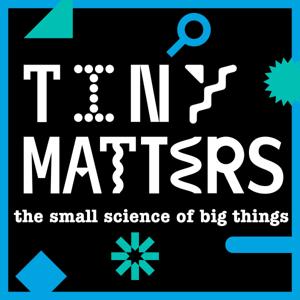
Science shapes every facet of our lives, but so much of its influence is overlooked or buried in the past. Tiny Matters is an award-winning science podcast about the small science of big things.…
Tiny Matters is created by the American Chemical Society, a non-profit scientific organization based in Washington, D.C., and is produced by Multitude. New episodes every Wednesday, wherever you listen to podcasts.
Ranked by our users in the last 21 days

90,569 Listeners

43,813 Listeners

26,168 Listeners

1,474 Listeners

7,775 Listeners

3,652 Listeners

12,171 Listeners

2,230 Listeners

24,521 Listeners

90 Listeners
2,178 Listeners
1,504 Listeners

3,562 Listeners

6,587 Listeners

267 Listeners

98 Listeners

1,249 Listeners

54 Listeners
423 Listeners

28 Listeners
79 Listeners

31 Listeners
5 Listeners

118 Listeners