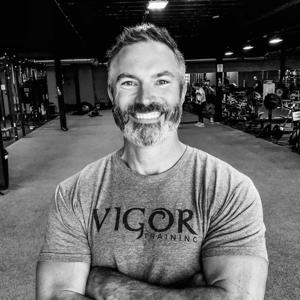
Tom Nikkola | VIGOR Training

Tom Nikkola | VIGOR Training

By Tom Nikkola | VIGOR TrainingHealth & FitnessNutritionMental HealthFitness
Download on the App Store

Tom Nikkola | VIGOR Training episodes

  • Beauty in Her Badassness
    No matter her shape, size, age, or position, there is something beautiful about a woman who unleashes her honest and authentic self to the world.
    To be clear, I always find my wife, Vanessa, to be beautiful. But just as cookie dough ice cream has different layers of deliciousness, there’s the ice cream, the dough, the chocolate chips, I see different layers of beauty in my wife as well…
    “You just woke up, and your breath isn’t that great, but I’d still love to kiss you.”“Looking hot in your workout gear.”“Dressed up and ready to go on a date.”“Loving and tender grandma Banessa.”
    And of course, there’s also the “I’m pretending to brush my teeth, but I’m actually watching you take a shower.” I’m the only one that gets to see that though.
    However, there’s one layer of beauty that trumps them all.
    It’s the beauty she radiates when she lets go of her fear of offending others and lovingly and authentically shares her unfiltered wisdom and insights with the world.
    Unapologetically Authentic
    I watched Vanessa share a FB Live with her team. As I watched, I found myself thinking, “Holy s#|t! That’s my wife! She is beautiful! What a badass!”
    As someone experienced in social media, one of Vanessa’s greatest pains has been to watch women misuse social media to build a home-based business. They litter their news feeds with ads for their products. They copy and paste each others’ words. They easily fall into the habit of doing what they see others doing online.
    They miss the opportunity to authentically share their own wisdom and add value to those they influence, and instead interrupt and irritate their friends and followers.
    Vanessa had reached a point where her level of frustration was far greater than the fear of offending a few of her followers.
    I watched the passion, certainty, strength, power, heart, sincerity, and yes…beauty, burst out of her.
    For those who took her words to heart, I have no doubt she helped them. I’m also confident that she pissed a few people off.
    You influence people who love you, and you move people who hate you. But you do little for the people who just like you.
    Women often have so much more of themselves they could share, but they get hung up by the fear of someone getting upset, or unliking, unfriending, or talking poorly about them.
    As a result, they live their lives like they’re vanilla ice cream.
    Vanilla Ice Cream
    Have you ever experienced an emotional response to vanilla ice cream? I doubt it. You probably didn’t leave a restaurant, cafe, or a dinner party and say, “I have to get more of that.” Almost anybody will eat it, but nobody talks about it.
    Offer an ice cream that’s off the charts in how it tastes, like Black, Toasted Coconut, or LSD from Milkjam Creamery in Minneapolis, and you’ll have a line of people down the sidewalk wanting to experience what you offer.
    Some might give Milkjam a try and say, “That was awful!” Most will say, “That was amazing!” And they all go home and talk about it, and probably come back again.
    But there’s no vanilla on the menu, ’cause let’s get real. Who would want to come back for that?
    Get To The Good Stuff
    I have replayed the experience of watching Vanessa over and over in my head. On the one hand, I feel blessed, fortunate…lucky even that she’s my wife.
    On the other hand, I feel bummed that she doesn’t feel the freedom to be herself all the time. And she’s a powerful woman.
    Which makes me even sadder knowing that there are many other women without the strength she has, who get by every day, playing it safe; being vanilla ice cream.
    What wonderful flavor are you hiding from the world? I’m sure it’s nothing short of beautiful badassness.
    6 min
  • Hemp Oil, CBD Oil, Essential Oils, and the Endocannabinoid System
    No doubt, you've heard friends and co-workers talking about hemp oil and CBD oil a lot lately.
    I predict the Endocannabinoid System will be the most talked-about area of health and fitness over the next decade, and the focus of fascinating research findings. That might sound like a bold statement, since most people don't even know what it is.
    In the event you're wondering if the endocannabinoid system is just about weed, it's not.
    Although the term endocannabinoid system has an obvious connection to cannabis, or marijuana, the system is more important than Mary Jane herself.
    In this guide, I'll first address what the endocannabinoid system is, and then discuss how you influence it with lifestyle, nutrition, and exercise.
    As this is an emerging area of research, we still have much to learn. Nonetheless, what we know today is more than fascinating.
    Two things worth noting as we begin:
    I've tried to avoid getting too technical to make this understandable by almost anyone. If you like to get extra "nerdy," check out the references at the end of the article.
    To make this article flow better, I’ll use “endocannabinoid system” and ECS interchangeably.
    What is the Endocannabinoid System?
    As a "system" the endocannabinoid system is different from other systems of the body, such as the nervous, digestive, or endocrine systems.
    It's easy to envision your digestive system: your mouth, esophagus, stomach, small and large intestine, and that final orifice that sounds like the seventh planet from the sun.
    However, the endocannabinoid system spreads across the entire body. It's made up of chemical messengers (cannabinoids) and receptor sites (cannabinoid receptors). Based on the activity of the cannabinoids with the cannabinoid receptors, the ECS directs other systems in your body to maintain balance, or homeostasis.
    Had it not been for the controversy and curiosity surrounding cannabis, the endocannabinoid system might never have been discovered.
    People have used cannabis medicinally for about 4700 years, but it wasn't until 1964 that scientists identified the first chemical in cannabis; tetrahydrocannabinol, or THC. THC is the cannabinoid that makes you high, and is only one of more than 80 cannabinoids in cannabis.
    In 1990, scientists discovered the first receptors of the endocannabinoid system. They called the first cannabinoid receptors CB1, which are primarily located in the nervous system. Later, they discovered another receptor, called CB2, found in the immune system and many other tissues.
    The ECS affects almost every area of the mental and physical wellbeing in the body and mind, making it a true "mind-body system."
    You might also like to read Essential Oils For Fitness: Research, Anecdotal Evidence, Experimentation.
    What Are Cannabinoids?
    Cannabinoids are chemicals that act on the cannabinoid receptors.
    Endocannabinoids are cannabinoids produced by the body on its own, following the metabolism of arachidonic acid (AA) and the omega-3 fatty acids DHA and EPA. The two most well-known endocannabinoids are anandamide and 2-Ag. However, researchers have also discovered others, including NADA, virodhamine and noladin ether. Little is known about them because they haven't been well-studied.
    The endogenous cannabinoid system—named for the plant that led to its discovery—is one of the most important physiologic systems involved in establishing and maintaining human health. Endocannabinoids and their receptors are found throughout the body: in the brain, organs, connective tissues, glands, and immune cells. With its complex actions in our immune system, nervous system, and virtually all of the body’s organs, the endocannabinoids are literally a bridge between body and mind. By understanding this system, we begin to see a mechanism that could connect brain activity and states of physical health and disease.
    -Editor’s Note, Cerebrum, November 5, 2013
    25 min
  • Hemp Oil, CBD Oil, Essential Oils, and the Endocannabinoid System

    No doubt, you've heard friends and co-workers talking about hemp oil and CBD oil a lot lately.


    I predict the Endocannabinoid System will be the most talked-about area of health and fitness over the next decade, and the focus of fascinating research findings. That might sound like a bold statement, since most people don't even know what it is.


    In the event you're wondering if the endocannabinoid system is just about weed, it's not.


    Although the term endocannabinoid system has an obvious connection to cannabis, or marijuana, the system is more important than Mary Jane herself.


    In this guide, I'll first address what the endocannabinoid system is, and then discuss how you influence it with lifestyle, nutrition, and exercise.


    As this is an emerging area of research, we still have much to learn. Nonetheless, what we know today is more than fascinating.


    Two things worth noting as we begin:


    * I've tried to avoid getting too technical to make this understandable by almost anyone. If you like to get extra "nerdy," check out the references at the end of the article.* To make this article flow better, I’ll use “endocannabinoid system” and ECS interchangeably.


    What is the Endocannabinoid System?


    As a "system" the endocannabinoid system is different from other systems of the body, such as the nervous, digestive, or endocrine systems.


    It's easy to envision your digestive system: your mouth, esophagus, stomach, small and large intestine, and that final orifice that sounds like the seventh planet from the sun.


    However, the endocannabinoid system spreads across the entire body. It's made up of chemical messengers (cannabinoids) and receptor sites (cannabinoid receptors). Based on the activity of the cannabinoids with the cannabinoid receptors, the ECS directs other systems in your body to maintain balance, or homeostasis.


    Had it not been for the controversy and curiosity surrounding cannabis, the endocannabinoid system might never have been discovered.


    People have used cannabis medicinally for about 4700 years, but it wasn't until 1964 that scientists identified the first chemical in cannabis; tetrahydrocannabinol, or THC. THC is the cannabinoid that makes you high, and is only one of more than 80 cannabinoids in cannabis.


    In 1990, scientists discovered the first receptors of the endocannabinoid system. They called the first cannabinoid receptors CB1, which are primarily located in the nervous system. Later, they discovered another receptor, called CB2, found in the immune system and many other tissues.


    The ECS affects almost every area of the mental and physical wellbeing in the body and mind, making it a true "mind-body system."


    You might also like to read Essential Oils For Fitness: Research, Anecdotal Evidence, Experimentation.


    What Are Cannabinoids?


    Cannabinoids are chemicals that act on the cannabinoid receptors.


    Endocannabinoids are cannabinoids produced by the body on its own, following the metabolism of arachidonic acid (AA) and the omega-3 fatty acids DHA and EPA. The two most well-known endocannabinoids are anandamide and 2-Ag. However, researchers have also discovered others, including NADA, virodhamine and noladin ether. Little is known about them because they haven't been well-studied.


    The endogenous cannabinoid system—named for the pl...
    26 min
  • Hemp Oil, CBD Oil, Essential Oils, and the Endocannabinoid System
    No doubt, you've heard friends and co-workers talking about hemp oil and CBD oil a lot lately.
    I predict the Endocannabinoid System will be the most talked-about area of health and fitness over the next decade, and the focus of fascinating research findings. That might sound like a bold statement, since most people don't even know what it is.
    In the event you're wondering if the endocannabinoid system is just about weed, it's not.
    Although the term endocannabinoid system has an obvious connection to cannabis, or marijuana, the system is more important than Mary Jane herself.
    In this guide, I'll first address what the endocannabinoid system is, and then discuss how you influence it with lifestyle, nutrition, and exercise.
    As this is an emerging area of research, we still have much to learn. Nonetheless, what we know today is more than fascinating.
    Two things worth noting as we begin:
    I've tried to avoid getting too technical to make this understandable by almost anyone. If you like to get extra "nerdy," check out the references at the end of the article.To make this article flow better, I’ll use “endocannabinoid system” and ECS interchangeably.
    What is the Endocannabinoid System?
    As a "system" the endocannabinoid system is different from other systems of the body, such as the nervous, digestive, or endocrine systems.
    It's easy to envision your digestive system: your mouth, esophagus, stomach, small and large intestine, and that final orifice that sounds like the seventh planet from the sun.
    However, the endocannabinoid system spreads across the entire body. It's made up of chemical messengers (cannabinoids) and receptor sites (cannabinoid receptors). Based on the activity of the cannabinoids with the cannabinoid receptors, the ECS directs other systems in your body to maintain balance, or homeostasis.
    Had it not been for the controversy and curiosity surrounding cannabis, the endocannabinoid system might never have been discovered.
    People have used cannabis medicinally for about 4700 years, but it wasn't until 1964 that scientists identified the first chemical in cannabis; tetrahydrocannabinol, or THC. THC is the cannabinoid that makes you high, and is only one of more than 80 cannabinoids in cannabis.
    In 1990, scientists discovered the first receptors of the endocannabinoid system. They called the first cannabinoid receptors CB1, which are primarily located in the nervous system. Later, they discovered another receptor, called CB2, found in the immune system and many other tissues.
    The ECS affects almost every area of the mental and physical wellbeing in the body and mind, making it a true "mind-body system."
    You might also like to read Essential Oils For Fitness: Research, Anecdotal Evidence, Experimentation.
    What Are Cannabinoids?
    Cannabinoids are chemicals that act on the cannabinoid receptors.
    Endocannabinoids are cannabinoids produced by the body on its own, following the metabolism of arachidonic acid (AA) and the omega-3 fatty acids DHA and EPA. The two most well-known endocannabinoids are anandamide and 2-Ag. However, researchers have also discovered others, including NADA, virodhamine and noladin ether. Little is known about them because they haven't been well-studied.
    The endogenous cannabinoid system—named for the plant that led to its discovery—is one of the most important physiologic systems involved in establishing and maintaining human health. Endocannabinoids and their receptors are found throughout the body: in the brain, organs, connective tissues, glands, and immune cells. With its complex actions in our immune system, nervous system, and virtually all of the body’s organs, the endocannabinoids are literally a bridge between body and mind. By understanding this system, we begin to see a mechanism that could connect brain activity and states of physical health and disease.-Editor’s Note, Cerebrum, November 5, 2013
    25 min
  • Low Testosterone: What You Need to Know


    Worn out? Irritable? Gaining weight? Low libido? Memory problems? You and your doctor might not think about low testosterone when you think about your symptoms, but you will after reading this.


    Many symptoms of low testosterone are similar to those of other conditions. Before you self-diagnose with Dr. Google or get a prescription based only on how you feel, see if low testosterone might be the issue.


    How Common is Low Testosterone?


    Some experts believe a quarter of 30-year-old men have low testosterone.


    A 2006 study found 39% of U.S. men, age 45 and older, were testosterone-deficient. With about 40% deficient, most men are below optimal levels.


    The situation is slightly better for women. Daniel Amen, in his book, Unleash the Power of the Female Brain, points out that 20% of women have low testosterone. He also suggests another 20% of women have polycystic ovary syndrome (PCOS), which is caused by testosterone levels that are too high.


    Unfortunately, these numbers are based on people who have gone to the doctor and are experiencing symptoms. Chances are, many more men and women have testosterone levels out of balance. If you haven't had your testosterone levels checked, you could be among them.


    Why Are So Few Aware of the Low Testosterone Problem?


    Most people don’t know how important testosterone is. They see it as a hormone for making muscles and boosting libido.


    They don't relate testosterone to heart disease, insulin resistance, degenerative brain disease, or depression. As you'll see, low testosterone plays a role in these conditions and many more.


    It's for this reason I recommend adults, beginning at age 30, get a complete lab panel each year. If everyone did this, they'd likely identify trends leading to health problems, long before they became actual “health problems.”


    These trends include changes in hormones, like testosterone. Fortunately, you don't have to wait for your doctor to order such a lab panel (most doctors won't). You can order your own, like the Premium Panel from WellnessFX.


    Just as Jim LaValle's book title suggests, Your Blood Never Lies.


    Signs and Symptoms of Low Testosterone


    Healthcare practitioners diagnose men as “low” in testosterone when it falls below 300 ng/dL. However, signs and symptoms of low testosterone often occur at levels much higher.


    The “normal” range for men is 300 ng/dL to 1100 ng/dL. That’s an enormous range!


    It would be like saying someone from Dallas lives near the Mexican border. They might live in the state next to Mexico, but it's still 878 miles to the border. It's far from Mexico.


    And a testosterone level of 400 ng/dL is far from optimal, even though it's in the “state” of normal.


    As far back as the 1970s, some endocrinologist actually knew the proper optimized range of total testosterone (800-1200 ng/dL).
    - Dr. Dan Purser Improving Male Sexuality, Fertility and Testosterone


    Here we are, decades later, and the optimal range is rarely discussed. Many doctors don't know of this “optimal” range. As a result,
    31 min
  • Lavender and Tea Tree Essential Oils and Gynecomastia (Boys with Boobs)
    Do lavender and tea tree essential oils cause gynecomastia?...Of all the questions I get about essential oils, this question is in the top five.
    As a (grand)parent, I understand the fear of doing something to hurt your child. That's why sensationalized headlines, like "More evidence essential oils 'make male breasts develop'," get so much attention. Unfortunately, few people read the whole article, and instead read just the headline, and pass it along to friends.
    After a couple of decades in health and fitness, I've observed very consistent patterns.
    Possible side effects of natural products consistently get blown out of proportion, and their health benefits are often ignored. On the other hand, the health benefits of pharmaceuticals get hyped up while the side effects are often overlooked.
    This is not an anti-pharma article. In fact, I believe there's a lot of good reasons to rely on conventional medicine. There's also plenty of value in alternative or natural health products. Unfortunately, most people believe you have to be on one side or the other. Not me...
    To be 100% transparent, my wife and I are independent distributors for Young Living. If you don’t know me, you might assume that discredits what I’m going to write below. Those who do know me, know that I’ve built a career around helping people achieve optimal health with nutrition, exercise, supplementation, lifestyle choices, and yes, even essential oils.
    My goal isn’t to convince you that essential oils are safe. It’s to encourage you to think for yourself, and come to your own conclusion. I'll share some stuff to think about, and of course, weigh in with my own opinions. As a health-minded consumer, your health is 100% your responsibility. Be smart about who you listen to, and avoid getting caught up in sensationalized headlines.
    What is Gynecomastia?
    Gynecomastia is the development of breast tissue in males. As you know...boys have pecs, and girls have breasts.
    At least that's the case when things are normal. Sometimes, our metabolisms become dysfunctional, and men grow boobs, too.
    Adult men can develop moobs ("man boobs") when they have low testosterone. They can also develop gyno when their testosterone gets excessively high, or when they have a relatively quick increase in testosterone levels.
    A significant rise in testosterone causes some to aromatize, or convert testosterone to estrogen.
    Elevated estrogen stimulates the growth of breast tissue in men. A drop in testosterone, which decreases his ratio of testosterone to estrogen, can also cause gynecomastia.
    Adolescent boys going through puberty experience similar surges in testosterone as those who take exogenous testosterone.
    In fact, about 60% of boys experience gynecomastia for short periods during puberty. That's normal. For about 10%, it persists.
    Obesity, diet, and certain medications can increase estrogen levels and cause breast development as well. Obesity-related breast growth is called pseudogynecomastia. It is an enlargement of breast tissue due to excessive body fat gain, although fat cells are obesogenic and can further accelerate the growth of breasts in obese men.
    Endocrine disruptors can cause gynecomastia as well. They are compounds that, as the name suggests, disrupt endocrine function. They influence the balance of sex hormones, thyroid, and other hormones.
    Many endocrine disruptors are synthetic compounds found in food packaging, plastics, and personal care products.
    Gynecomastia vs Prepubescent Gynecomastia
    From toddler to teen, hormone levels say pretty steady. Gynecomastia is less common among preadolescents, but it isn't rare.
    The four main contributors are genetics, disease, diet, and endocrine disruptors.
    The rise of childhood obesity is a likely contributor to gyno in young boys as well.
    You might not know it, but some foods are higher in estrogens, including dried fruit, peas, beans, soybean, chickpeas,
    22 min
  • Lavender and Tea Tree Essential Oils and Gynecomastia (Boys with Boobs)
    Do lavender and tea tree essential oils cause gynecomastia?...Of all the questions I get about essential oils, this question is in the top five.
    As a (grand)parent, I understand the fear of doing something to hurt your child. That's why sensationalized headlines, like "More evidence essential oils 'make male breasts develop'," get so much attention. Unfortunately, few people read the whole article, and instead read just the headline, and pass it along to friends.
    After a couple of decades in health and fitness, I've observed very consistent patterns.
    Possible side effects of natural products consistently get blown out of proportion, and their health benefits are often ignored. On the other hand, the health benefits of pharmaceuticals get hyped up while the side effects are often overlooked.
    This is not an anti-pharma article. In fact, I believe there's a lot of good reasons to rely on conventional medicine. There's also plenty of value in alternative or natural health products. Unfortunately, most people believe you have to be on one side or the other. Not me...
    To be 100% transparent, my wife and I are independent distributors for Young Living. If you don’t know me, you might assume that discredits what I’m going to write below. Those who do know me, know that I’ve built a career around helping people achieve optimal health with nutrition, exercise, supplementation, lifestyle choices, and yes, even essential oils.
    My goal isn’t to convince you that essential oils are safe. It’s to encourage you to think for yourself, and come to your own conclusion. I'll share some stuff to think about, and of course, weigh in with my own opinions. As a health-minded consumer, your health is 100% your responsibility. Be smart about who you listen to, and avoid getting caught up in sensationalized headlines.
    What is Gynecomastia?
    Gynecomastia is the development of breast tissue in males. As you know...boys have pecs, and girls have breasts.
    At least that's the case when things are normal. Sometimes, our metabolisms become dysfunctional, and men grow boobs, too.
    Adult men can develop moobs ("man boobs") when they have low testosterone. They can also develop gyno when their testosterone gets excessively high, or when they have a relatively quick increase in testosterone levels.
    A significant rise in testosterone causes some to aromatize, or convert testosterone to estrogen.
    Elevated estrogen stimulates the growth of breast tissue in men. A drop in testosterone, which decreases his ratio of testosterone to estrogen, can also cause gynecomastia.
    Adolescent boys going through puberty experience similar surges in testosterone as those who take exogenous testosterone.
    In fact, about 60% of boys experience gynecomastia for short periods during puberty. That's normal. For about 10%, it persists.
    Obesity, diet, and certain medications can increase estrogen levels and cause breast development as well. Obesity-related breast growth is called pseudogynecomastia. It is an enlargement of breast tissue due to excessive body fat gain, although fat cells are obesogenic and can further accelerate the growth of breasts in obese men.
    Endocrine disruptors can cause gynecomastia as well. They are compounds that, as the name suggests, disrupt endocrine function. They influence the balance of sex hormones, thyroid, and other hormones.
    Many endocrine disruptors are synthetic compounds found in food packaging, plastics, and personal care products.
    Gynecomastia vs Prepubescent Gynecomastia
    From toddler to teen, hormone levels say pretty steady. Gynecomastia is less common among preadolescents, but it isn't rare.
    The four main contributors are genetics, disease, diet, and endocrine disruptors.
    The rise of childhood obesity is a likely contributor to gyno in young boys as well.
    You might not know it, but some foods are higher in estrogens, including dried fruit, peas, beans, soybean, chickpeas,
    22 min
  • Gluten and Going Gluten-Free: What You Need to Know


    In my opinion, the potential health complications from a lifetime of eating gluten are no less severe than those from smoking cigarettes.


    Just as you can't negate the effects of smoking by taking a supplement or saying your prayers, you won't offset the impact of gluten with corticosteroid shots, NSAIDs, essential oils, fasting, or good intentions.


    I can't confidently say that everyone who eats gluten for a lifetime will end up with one of the problems mentioned in this article, any more than a smoker is guaranteed cancer or emphysema.


    However, just because some people might make it to the end of a very long life, smoking a cigarette with their final breath, it doesn't mean it's a good idea to bet on a healthy outcome.


    The same could be said for eating gluten. The good news is,  when you decide to get rid of gluten completely, there's still a lot of good food you can eat. Nobody "struggles" when they go gluten-free.


    Gluten Concerns Centuries Old


    Based on the hype, you'd think concerns about gluten were relatively new. However, they were observed long before the age of the internet.


    In fact, Aretaeus of Cappadocia, a Greek physician, described and named celiac disease in the first century. He didn't get much attention though. Over the past couple millennia, smallpox, plagues, polio, rickets, and war were of a much more significant health concern than gluten.


    Although celiac disease has been observed for almost 2000 years and doctors have recognized it for at least 100 years, it wasn't until 1978 that gluten sensitivity was discussed in medical papers. The first documented cases of gluten sensitivity in children appeared in the early 1980s.


    Even then, most doctors shrugged off the connection between food and a patient's health problems.


    2011 was a turning point. A group of medical experts convened to discuss this non-celiac gluten sensitivity.


    It was also the year Dr. William Davis published his book Wheat Belly Millions of people resonated with the book. They recognized themselves in Dr. Davis' writing, and finally had some answers to how they felt. No longer did they need to feel like their symptoms were "all in their head."


    The food industry wasn't as appreciative of his book and did its best to attack and condemn him. Their efforts backfired, though. Each time they tried to discredit his work, it only helped to fuel more book sales and attention. In fact, Wheat Belly is still among my top five most-recommended health and fitness books.


    Though Dr. Davis wasn't the first to address concerns about gluten, he was the first medical professional (he's a cardiologist) to put his reputation on the line. To suggest "healthy whole grains" were something other than healthy, sort of bucked the "healthy whole grain" system.


    Slowly, others joined in, like Dr. David Perlmutter, publishing Grain Brain a couple of years later. Today, a search for "Gluten Books" on Amazon returns over 9000 results.


    As of 2015, a Gallup poll showed that 20% of Americans say they choose a g...
    23 min
  • Why We Need to Stop Bastardizing Struggle
    I’m going to Baader-Meinhof you: "STRUGGLE."
    The Baader-Meinhof Phenomenon occurs when you become aware of something, and then start to notice it everywhere around you.
    Like Cole in The Sixth Sense who saw "dead people,” I see struggle.
    If you don't see it already, you're about to see struggle too.
    I don’t actually see people struggling.
    I see and hear people write and talk about their struggle. However, the situations they describe as struggle are nothing more than the challenges of everyday life.
    Bastardized Struggle
    We live at a time when when things are fairly good for most people.
    However, the human mind has a way of finding problems. In the absence of major problems, we tend to make the minor ones major, at least in our minds.
    We literally make mountains out of mole hills.
    We start to believe the little stuff that's part of life is a bigger deal than it is.
    That's dangerous. If you believe the little stuff is a struggle, you'll be woefully unprepared for the big stuff that truly is a struggle.
    In addition, you'll perceive everything that's a challenge as a struggle. Eventually, your mind will be overwhelmed with all the "struggles" you face, and you'll feel like something is either wrong with you, or the world is against you.
    What does it mean to struggle?
    According to the Collins English Dictionary, the definition of struggle is:
    to contend with an adversary or opposing force. to contend resolutely with a task, problem, etc.; strive to advance with violent effort
    Each of the three definitions involves a tone of action and tenacity.
    To advance with violent effort means you deliberately, intentionally, passionately do whatever it takes to reach your goal.
    Sometimes the opposing force is you. Sometimes the opposing force is a false perception of the world you live in. Sometimes the opposing force is all the stuff you have to get done to reach your goal.
    The point is, for you to truly struggle, you can't passively sit around and talk about how hard things are. You don’t search for sympathy or settle for things staying as they are. You don’t whine and complain. You don’t wish for someone else to deal with your stuff for you.
    If you truly struggle, you take all the action necessary to achieve your goal, in spite of the resistance pushing down on you.
    Struggle is Not…
    When someone says...
    ...they struggle to eat well, while they have a refrigerator full of junk food, or
    they struggle to build a home-based business, while they spend their evenings scrolling through Facebook, or
    they struggle in their marriage, while pointing their finger at their spouse, and doing nothing to change their own ways of communicating and relating to him or her, or
    they struggle in college while spending study time in a drunken stupor, or
    they struggle to get a promotion at work, while doing the bare minimum to keep their job, or
    they struggle to get out of debt while buying toys and TVs on credit…
    …they do not struggle. They face a reality of life that comes from choices that take them down a different path than the choices that are proven to work.
    Struggle is…
    Struggle is...
    a student with ADHD who controls his impulses long enough to study the material for class, even though it’s 10 times harder for him than it is for his classmates, or
    a stay-at-home mom who makes the most of the job she has, so she can provide for her family, and brings joy home with her even though her days are long and the deadbeat dad is nowhere to be found, or
    an alcoholic who holds true to his sobriety, even when friends drink all around him, or
    the husband who encourages and lifts up his wife as she battles through one health complication after another, not knowing what the future might hold, or
    the parents who unexpectedly lose a child, and work through the grief together, while lifting up and encouraging their other children, or

    11 min
  • Why We Need to Stop Bastardizing Struggle

    I’m going to Baader-Meinhof you: "STRUGGLE."
    The Baader-Meinhof Phenomenon occurs when you become aware of something, and then start to notice it everywhere around you.
    Like Cole in The Sixth Sense who saw "dead people,” I see struggle.
    If you don't see it already, you're about to see struggle too.
    I don’t actually see people struggling.
    I see and hear people write and talk about their struggle. However, the situations they describe as struggle are nothing more than the challenges of everyday life.
    Bastardized Struggle
    We live at a time when when things are fairly good for most people.
    However, the human mind has a way of finding problems. In the absence of major problems, we tend to make the minor ones major, at least in our minds.
    We literally make mountains out of mole hills.
    We start to believe the little stuff that's part of life is a bigger deal than it is.
    That's dangerous. If you believe the little stuff is a struggle, you'll be woefully unprepared for the big stuff that truly is a struggle.
    In addition, you'll perceive everything that's a challenge as a struggle. Eventually, your mind will be overwhelmed with all the "struggles" you face, and you'll feel like something is either wrong with you, or the world is against you.
    What does it mean to struggle?
    According to the Collins English Dictionary, the definition of struggle is:
    to contend with an adversary or opposing force. to contend resolutely with a task, problem, etc.; strive to advance with violent effort
    Each of the three definitions involves a tone of action and tenacity.
    To advance with violent effort means you deliberately, intentionally, passionately do whatever it takes to reach your goal.
    Sometimes the opposing force is you. Sometimes the opposing force is a false perception of the world you live in. Sometimes the opposing force is all the stuff you have to get done to reach your goal.
    The point is, for you to truly struggle, you can't passively sit around and talk about how hard things are. You don’t search for sympathy or settle for things staying as they are. You don’t whine and complain. You don’t wish for someone else to deal with your stuff for you.
    If you truly struggle, you take all the action necessary to achieve your goal, in spite of the resistance pushing down on you.
    Struggle is Not…
    When someone says...
    ...they struggle to eat well, while they have a refrigerator full of junk food, or
    they struggle to build a home-based business, while they spend their evenings scrolling through Facebook, or
    they struggle in their marriage, while pointing their finger at their spouse, and doing nothing to change their own ways of communicating and relating to him or her, or
    they struggle in college while spending study time in a drunken stupor, or
    they struggle to get a promotion at work, while doing the bare minimum to keep their job, or
    they struggle to get out of debt while buying toys and TVs on credit…
    …they do not struggle. They face a reality of life that comes from choices that take them down a different path than the choices that are proven to work.
    Struggle is…
    Struggle is...
    a student with ADHD who controls his impulses long enough to study the material for class, even though it’s 10 times harder for him than it is for his classmates, or
    a stay-at-home mom who makes the most of the job she has, so she can provide for her family, and brings joy home with her even though her days ar...
    11 min

About Tom Nikkola | VIGOR Training

From the publisher's feed

Tune into the audio version of my written articles found at tomnikkola.com, read by yours truly. I candidly cover health and fitness,…