
Sign up to save your podcasts
Or

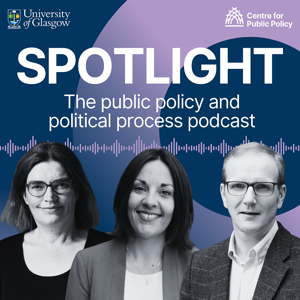


In today's episode of our UofG Spotlight: On the Elections series, we're looking at the election through the lens of global politics and growing global insecurity, specifically the US and Israel's war with Iran.
We're joined by John Edward, Head of Operations at the Scottish Council on Global Affairs and Geoff Aberdein, Managing Partner at True North, co-host of the podcast Holyrood Sources, and a former Special Adviser to the SNP Scottish Government.
We examine what the impact of the events in the Middle East are closer to home, on devolution and for Scotland's wider place in the world.
How will the parties in their campaign HQs will be absorbing events in Middle East, will they be altering campaign plans and messaging? Does an election for a devolved parliament seem inconsequential against a backdrop of such big issues? What about fuel costs and energy, and what does global insecurity mean for the politics of independence?
Tune in and subscribe.
Follow the election day by day with the Centre for Public Policy on our website including live lunchtime webinars on key issues in the campaign, and written insights on policy issues facing the country.
https://www.gla.ac.uk/research/az/publicpolicy/elections/
Kicking off our 'On the Elections' series of the UofG Spotlight podcast, hosts Nicola McEwen and Kez Dugdale talk to guests Chris Carman and Mark McGeoghegan.
A 'state of the race' episode, they talk about the key issues for the campaign ahead.
Tune in for a fantastic primer on the upcoming election in Scotland.
Follow the election day by day with the Centre for Public Policy on our website here: https://www.gla.ac.uk/research/az/publicpolicy/elections/
Registration for our webinars are now live!
Book here:
What can devolved governments do to address the cost-of-living crisis? In partnership with the Campaign for Social Science: https://www.eventbrite.com/e/what-can-devolved-governments-do-to-address-the-cost-of-living-crisis-tickets-1985828948843?aff=oddtdtcreator
What are the parties' plans on tax, spending and the economy? In partnership with the Institute for Fiscal Studies: https://www.eventbrite.com/e/what-are-the-parties-plans-on-tax-spending-and-the-economy-tickets-1985833580697?aff=oddtdtcreator&keep_tld=true
What's behind how people vote? In partnership with Ipsos: https://www.eventbrite.com/e/whats-behind-how-people-vote-tickets-1985913859814
What just happened? https://www.eventbrite.co.uk/e/what-just-happened-tickets-1985915371335?aff=oddtdtcreator
In this episode of Spotlight, Kezia Dugdale speaks with Jim McCormick, Chief Executive of The Robertson Trust, about the Scottish Government's new Child Poverty Framework and what truly drives progress on lifting families out of poverty, from boosting incomes to delivering strong local services.
Kezia is joined first by Dr Thomas Rochow to preview insights from the Centre's State of Poverty project and why income support alone isn't enough without accessible services and joined‑up systems.
Higher education is facing one of the most challenging periods in its recent history. Rising financial pressures, declining international student numbers, and shifting expectations. So what does a sustainable, inclusive, and future‑ready higher education system look like?
In this episode, Prof Nicola McEwen explores the future of higher education with two leading voices.
First, she speaks to Prof Sir Anton Muscatelli, former Principal of the University of Glasgow and now President of the Royal Society of Edinburgh. Anton sets out the scale of the financial pressures facing universities across the UK and the implications of the contrasting tuition fee policies north and south of the border. He also makes the case for an independent review of tertiary education.
Later in the episode, Nicola is joined by Prof Catherine Lido, Professor of Psychology and Adult Learning and Associate Director of the Urban Big Data Centre. Catherine takes us beyond fees and admissions to explore what true educational equality looks like today. She discusses the barriers that still prevent people from participating in education and examines how AI and technological change are reshaping both education and the labour market.
In this episode, Nicola McEwen and Graeme Roy look ahead to the challenges facing the next Scottish Government as it confronts a tight fiscal landscape. Nicola speaks with Matt Donoghue from the State Government of Victoria about Australia's Early Intervention and Investment Framework (EIIF) - an interesting approach to pooled budgeting and preventative spending that's gaining international attention. They explore how the model works, how departments are incentivised to collaborate, and what it takes to shift resources toward long‑term prevention. Nicola then returns with Graeme and Fiona Duncan, Independent Strategic Adviser to The Promise Scotland, to consider what lessons Scotland might draw from this approach. Together they discuss whether models like pooled budgeting, whole‑family wellbeing funding, and cross‑government decision‑making can help tackle system‑wide challenges.
This week Kez Dugdale is joined by Professor Kathleen Riach and Professor Melanie Simms from the University of Glasgow to discuss work, ageing and employment rights.
Kat takes us through her recent research on work and ageing, looking at what it means to become older in work, whether policymakers and employers are doing enough to support people and what impacts how 'old' we feel.
Then Mel discusses the details, politics and implications of the Employment Rights Act, which recently received Royal Assent in Westminster. She talks about how the changes could impact workers and employers, and what it means for collective rights and the trade unions.
We're kicking off Season 7 of our UofG Spotlight podcast with a live episode challenging our political leaders on public service reform in Scotland.
Recorded live on Monday 19 January 2026 at our event, Stop/Start: Making Public Service Reform Stick in Scotland, our host Professor Kezia Dugdale talks to:
Kez quizzed our panel about whether politicians can work together to deliver for Scotland, the fiscal challenge facing Scotland, prevention, the future of the NHS, devolution, and more.
We closed with a big question: What would each member stop spending money on, how much money that would save and what you would spend it on?
The Centre for Public Policy will be publishing lots more insights and outputs from speakers at our Stop/Start: Making Public Service Reform Stick in Scotland event, including Professor Graeme Roy as discussed in this episode.
Make sure you don't miss it - sign up to the Centre for Public Policy mailing list:
https://www.gla.ac.uk/research/az/publicpolicy/about/
In this latest episode of Spotlight, we reflect on a turbulent year in American politics and its global ripple effects. Nicola McEwen and Kez Dugdale are joined by two leading voices in international affairs:
Tune in for expert analysis, transatlantic perspectives, and a look ahead to what the next three years might hold.
CONFERENCE TICKETS: Stop/Start: Making Public Service Reform Stick in Scotland: Book your place.
This week's episode takes a quick look at the UK Government's Budget:
Professor Nicola McEwen, Director of the Centre for Public Policy, discusses all this with Graeme Roy, Professor of Economics and Chair of the Scottish Fiscal Commission, Dr David Waite, expert in regional economies and inclusive growth and Ruth Patrick, Professor in Social and Public Policy with expertise in poverty and social security.
In this episode, we tackle a critical and timely issue in the Scottish policy landscape: access to justice. Kezia speaks with two leading academics and legal aid practitioners, Fiona McPhail and Jen Ang, about the Scottish Government's ongoing consideration of Legal Aid Reform. With decades of experience in social justice law, they share insights on what reform could mean.
Then, we take a deeper look at the experiences of people trying to access justice. Joined by Satwat Rehman, Chief Executive of One Parent Families Scotland, and Marsha Scott, Chief Executive of Scottish Women's Aid, we explore the broader challenges families and women face when seeking justice. From domestic abuse to systemic barriers, they reveal what's working, what isn't, and what still needs to change.
From the publisher's feed

299 Listeners

371 Listeners

111,866 Listeners

642 Listeners
0 Listeners

15,908 Listeners

358 Listeners

3,015 Listeners

1,112 Listeners

2,231 Listeners

48 Listeners