
Sign up to save your podcasts
Or

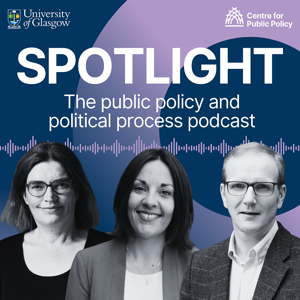


In today's episode, we're marking Challenge Poverty Week. Regular podcast host Kezia Dugdale is joined by guest host and Centre for Public Policy colleague Claire MacRae to speak to two guests working in this area. We discuss child poverty and the Scottish Government's targets, social security and the backdrop of Scotland's challenging financial outlook, what role local government can play in tackling poverty, and more. We talk to Charlotte Gorman from the Joseph Rowntree Foundation and Professor Stephen Sinclair from the Poverty and Inequality Commission about newly published reports that look at the progress we're making towards eradicating poverty in Scotland in 2026 and how we can continue to work towards this goal. Charlotte Gorman is Senior Policy Adviser at the Joseph Rowntree Foundation, and author of the JRF's new Poverty in Scotland 2026 report. The report says that with targets missed and poverty too high, radical change is needed, and that local government needs to play a bigger role in poverty reduction. Professor Stephen Sinclair is Chair of the Poverty and Inequality Commission and Professor of Social Policy and co-Director of the Scottish Poverty & Inequality Research Unit at Glasgow Caledonian University. The Commission's new report looks at the role of universal and targeted approaches to tackling poverty. Tune in and subscribe. Read the Joseph Rowntree Report, Poverty in Scotland 2026: https://www.jrf.org.uk/understanding-poverty/poverty-in-scotland-2026 Read the Poverty and Inequality Commission report, The role of universal and targeted approaches in addressing poverty and inequality in Scotland: https://povertyinequality.scot/publication/universal-and-targeted-approaches-to-tackling-poverty-key-messages-from-the-poverty-and-inequality-commission/ Hear more from the Centre for Public Policy – sign up to our newsletter: https://www.gla.ac.uk/research/az/publicpolicy/about/
In today's episode of UofG Spotlight, we're looking at Andy Burnham's 'devolution revolution', and what that might mean for the UK devolved nations of Scotland, Wales, and Northern Ireland. Plus, we look at two significant developments in UK constitutional politics.
First up, hosts Professor Nicola McEwen and Professor Kezia Dugdale give their take on two big developments in UK politics from the last fortnight. First, the exchange between Dundee SNP MP Chris Law and Prime Minister Andy Burnham at Prime Minister's Questions on grounds for an independence referendum, and second, the summit between the SNP, Sinn Féin, and Plaid Cymru in Cardiff, on the path to independence referendums.
Then they're joined by two guests: Dr David Waite, Senior Lecturer at the University of Glasgow and Dr Jack Newman, Lecturer in Politics and Public Administration at the University of Liverpool to discuss devolution.
Does the 'devolution revolution' extend beyond England? What can be learned from Manchester for regional devolution elsewhere? Are mayors an option for Scotland? And what might support success for Burnham's devolution drive?
Tune in and subscribe.
Read the report by Professor Kezia Dugdale and Stephen Noon, Scotland and the Constitution: Agreeing a way forward: https://www.gla.ac.uk/research/az/publicpolicy/outputs/headline_1101096_en.html
Sign up to the Centre for Public Policy newsletter: https://www.gla.ac.uk/research/az/publicpolicy/about/
UofG Spotlight is back for series 8! And we're starting with the Scottish Government's Programme for Government, announced by First Minister John Swinney on 1 September. We discuss what's in (and not in) the new five-year Programme for Government, from the four over-arching themes and nine new Bills, to the detail of public service reform, independence and devolution, prevention, food price caps, and lots more. Regular podcast hosts Professor Nicola McEwen and Professor Kezia Dugdale are joined by leading voices in Scottish public policy and politics:
A brilliant conversation on what this announcement means for politics and policy in Scotland in the coming terms.
Tune in and subscribe.
Hear more from the Centre for Public Policy – sign up to our newsletter: https://www.gla.ac.uk/research/az/publicpolicy/about/
In this episode of Spotlight, we turn from devolved politics to global challenges, asking the important question: do we still value development aid?
Host Nicola McEwen is joined by leading researchers from the University of Glasgow and Queen Margaret University to unpack the changing landscape of international development. Together, they explore the long-term decline in UK and global aid commitments, the real-world consequences for communities in some of the world's most vulnerable settings and the new approaches to development finance emerging. This work is being supported by the Scottish Council for Global Affairs.
Later in the episode, Nicola speaks with SCIAF's Director of Public Engagement, Ben Wilson, about Scotland's distinctive role, the Scottish Government's commitments, and whether initiatives like aid match funding could create a different path forward.
As global pressures mount and political priorities shift, what does the future hold for development aid - and for the communities who depend on it?
In the final episode of our election podcast series, now 'After the Elections', we look at the results of the Scottish election, what it means for the future of public policy, and how soon we might see the impact of challenging public finances.
We're joined by two guests, Graeme Roy, Professor of Economics at the University of Glasgow and Chair of the Scottish Fiscal Commission, and Kate Higgins, former Special Adviser to the Scottish Government.
Tune in and subscribe. Over the last month, the Centre for Public Policy has published a range of academic insights from University of Glasgow experts, on justice, the economy, migration, the constitution and more. Visit our website to find out more: https://www.gla.ac.uk/research/az/publicpolicy/elections/
In this episode of our On the Elections podcast series, we're looking to England and Wales, where elections are also being held tomorrow, 7th May.
In England, almost 5,000 councillors will be elected across 134 of England's 317 councils. And the Welsh Parliament – or Senedd – is also holding its election, with a new voting system and a 50% increase in the number of Senedd members being elected. We're joined by Professor Jane Green, Director of the Nuffield Politics Research Centre and Co-Director of the British Election Study, and Professor Laura McAllister from Cardiff University's Wales Governance Centre and one of Wales' leading academics. With Jane, we discuss England, from whether this election will be a test for Keir Starmer's government, to bloc voting, how well we expect to see individual parties do from Reform UK to the Greens, and more. And with Laura, we talk about Wales, from how the new electoral system might play out in the Senedd election, to the latest polls and frontrunners, and what has gone wrong for Welsh Labour. Tune in and subscribe. Read our joint report with Ipsos - Does Independence Still Matter?: https://www.gla.ac.uk/research/az/publicpolicy/news/headline_1264446_en.html
Visit the Centre for Public Policy for more expert insights, from justice, to migration, the constitution, the economy, and more: https://www.gla.ac.uk/research/az/publicpolicy/elections/
This week on the UofG Spotlight On the Elections podcast, we're talking about whether the next Scottish government can fix public services. What are the parties proposing to fix the problems in public services and help to sustain them into the future? What should they be doing? To talk about this, hosts Nicola McEwen and Kezia Dugdale are joined by Frances Mair, the Norrie Miller Professor of General Practice and Head of the School of Health and Wellbeing at the University of Glasgow, and Sarah Davidson, Chief Executive at Carnegie UK, and Honorary Professor here at the Centre for Public Policy. Tune in and subscribe. Follow the election day by day with the Centre for Public Policy on our website including live lunchtime webinars on key issues in the campaign, and written insights on policy issues facing the country. https://www.gla.ac.uk/research/az/publicpolicy/elections/
In today's episode, we're talking about the economy, and particularly whether the next Scottish Government can revive the economy in Scotland.
Host Professor Graeme Roy is joined by three experts. Sara Carter, Professor of Entrepreneurship, Vice Principal and Head of the College of Social Sciences at the University of Glasgow, Dr David Waite, senior lecturer in Urban Studies at the University of Glasgow, and Stephen Boyd, Director of the IPPR (Institute for Public Policy Research Scotland). They look at what the current future looks like for Scotland's economy; the manifestos and whether the parties have risen to the challenge ahead; what's missing and what might meet that challenge - from more focus on entrepreneurship and small business to regional devolution; and how we get back to the basics on what drives the economy. Tune in and subscribe. Follow the election day by day with the Centre for Public Policy on our website including live lunchtime webinars on key issues in the campaign, and written insights on policy issues facing the country. https://www.gla.ac.uk/research/az/publicpolicy/elections/
In this episode of the UofG Spotlight On the Elections podcast, we're looking at what's in the manifestos of the Scottish parties. Hosts Nicola McEwen and Kezia Dugdale talk to Professor Alistair Clark, a political scientist from the University of Newcastle and Chris Birt, Associate Director of the Joseph Rowntree Foundation. Together they discuss whether manifestos really matter, what's in them, what's not and how what they choose to emphasise gives us a greater insight into their priorities and outlook. Tune in and subscribe. Follow the election day by day with the Centre for Public Policy on our website including live lunchtime webinars on key issues in the campaign, and written insights on policy issues facing the country. https://www.gla.ac.uk/research/az/publicpolicy/elections/
This week we're looking at the rise of the right in Scotland. We're seeing Reform UK emerge in Scotland as a serious contender, and given the electoral system one that is likely to see a sizeable number of MSPs in the Scottish Parliament.
In this episode, we explore:
First up we talk to Sunder Katwala, Director of British Future, an independent, non-partisan thinktank and registered charity, engaging people's hopes and fears about integration and immigration, identity and race, and former journalist.
The we're joined by two academic experts, Dr Judith Sijstermans, University of Aberdeen, and Dr Pontus Odmalm, University of Edinburgh.
Tune in and subscribe.
Follow the election day by day with the Centre for Public Policy on our website including live lunchtime webinars on key issues in the campaign, and written insights on policy issues facing the country.
https://www.gla.ac.uk/research/az/publicpolicy/elections/
From the publisher's feed

299 Listeners

371 Listeners

111,866 Listeners

642 Listeners
0 Listeners

15,908 Listeners

358 Listeners

3,015 Listeners

1,112 Listeners

2,231 Listeners

48 Listeners