Podcast Show Notes
Chapter 54: Violations
Episode Overview
In this episode, we deliver a deep-dive structural and legal audit of Chapter 54 from Watertown: Under Color of Law, titled “Violations.” We strip away the administrative double-talk to expose the foundational history and mechanics of “Color of Law” abuses. We break down the clinical categories of system manipulation—from retaliatory traffic stops to advanced jurisdictional fraud—and map out the explicit, real-world pathways to federal intervention through the FBI’s Civil Rights Division.
Key Themes & Discussion Points
* The Anatomy of a Color of Law Violation
* We define the exact legal boundaries of acting “under color of law.” It occurs when an individual misuses or abuses the power granted to them by a local, state, or federal government agency to systematically strip a citizen of their constitutional rights.
* The core of this concept relies on the appearance of legal authority. If a public official wears a uniform, flashes a badge, or utilizes state-backed prestige to execute a personal vendetta, they are operating under color of law—even if their specific actions are illegal or exceed their actual powers.
* Historical Lineage: We trace the phrase back to English Common Law and the Latin term colore officii (under color of office), historically used to describe an act appearing to be a legitimate duty but functioning as a pretext for an unlawful act. In the United States, this was formally codified during the Reconstruction era via the Civil Rights Act of 1871, now known as 42 U.S.C. § 1983.
* The Four Core Categories of Abuse We break down the baseline tactical models where official authority is flipped into a weapon:
* Law Enforcement & Investigative Misconduct: Fabricating “retaliatory traffic stops” to intimidate local activists, bypassing warrants via illegal searches using badge-heavy intimidation, planting evidence, or manipulating body-cam footage to erase objective records.
* Judicial & Administrative Abuse: Court clerks blocking a citizen’s right to redress by refusing to file petitions, holding closed-door chamber hearings without defense counsel, or skewing jury pools based on race or religion.
* Regulatory & Municipal Misuse: Selective code enforcement and zoning blocks used to punish political or religious targets, or using a municipal utility shut-off to silence a resident who spoke out at a city council meeting.
* Educational & Social Services Overreach: Social workers launching pretextual custody battles and child removals without evidence, or utilizing targeted school discipline against specific protected classes.
* Advanced Violations: Systemic Manipulation
* We analyze how sophisticated bad actors move beyond physical force to manipulate the legal architecture itself.
* Jurisdictional Manipulation: Pulling professional strings to move a legal proceeding to an out-of-district court where neither party lives or works—specifically to bypass a prior adverse ruling—violates a victim’s Due Process rights.
* The “Majesty of the State” Influence: Bringing high-ranking, on-clock officials in full uniform to an ex parte civil hearing. This leverages government prestige to coerce a judicial outcome, violating Equal Protection rights.
* Retaliatory Investigations & Muzzle Orders: Launching a “sham” criminal investigation using a detective’s badge to suppress a whistleblower, or seeking a civil restraining order specifically to block a citizen from accessing public records or communicating with oversight agencies.
* The Federal Shield: The FBI Mandate
* We outline the explicit role of the FBI as the primary federal agency responsible for investigating Color of Law violations. While local precincts investigate standard crimes, the FBI’s Civil Rights Division steps in when those sworn to protect the law are the ones breaking it.
* National Threat Priority: As of 2026, the FBI has elevated civil rights violations to a National Threat Priority, resulting in rapid resource mobilization.
* We trace the Bureau’s path as neutral fact-finders for the Department of Justice (DOJ): conducting exhaustive interviews, analyzing patrol car GPS data, and determining the critical standard of “willfulness” required for a federal criminal conviction under 18 U.S.C. § 242 before referring the case to Washington, D.C.
The Blueprint for Federal Recourse
If you are documenting systemic corruption, the Bureau evaluates complaints using an unyielding paper trail:
* Three Ways to Reach the Bureau:
* Online Tips: Submitting a secure digital trail via tips.fbi.gov.
* Field Offices: Reaching out directly to the Civil Rights Specialist at your regional field office. Note: The Boston Field Office covers both Massachusetts and New Hampshire.
* Phone: Contacting 1-800-CALL-FBI (1-800-225-5324).
* The Active Investigation Threshold:
* Clear identity of the officials (names, badge numbers, agencies).
* Explicit definition of the specific constitutional rights violated (e.g., 1st Amendment petition rights, 4th Amendment protections against illegal seizure).
* Corroborating evidence, such as certified court transcripts documenting jurisdictional manipulation or copies of sham notices.
* The Bureau specifically targets “Pattern or Practice” cases where an official or agency has a documented history of repeated civil rights abuses.
Quotes Featured in This Episode
“Proving these violations requires an unyielding paper trail. The phrase originates from the Latin term colore officii—under color of office—describing an act that appears to be a legitimate exercise of duty but is actually a pretext for an unlawful act. When the local system protects its own, the FBI’s Civil Rights Division steps in, reminding public officials that they are servants, not sovereigns.”
Book Club & Discussion Questions
* The Evolution of Pretext: How does the common-law concept of colore officii apply to modern law enforcement officials who use civil harassment applications as a pretext to enforce a muzzle order against an archivist?
* The Subconscious Coercion: Why does the “Majesty of the State” influence—such as a command officer standing in full uniform at a private civil hearing—amount to a systemic violation of a citizen’s Equal Protection rights?
* The Willfulness Standard: What types of objective documentary evidence must a whistleblower compile to satisfy the FBI’s rigorous standard for proving an official “willfully” intended to deprive them of a federal right?
Resource Links & References
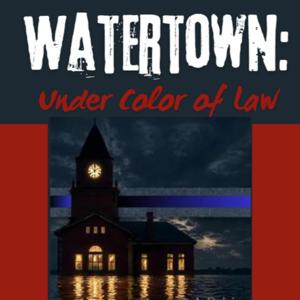
* Featured Book: Watertown: Under Color of Law by Amy M. Dubé (2026, Red Oak Media).
* Related Chapters: Chapter 50 (”14th Amendment”), Chapter 52 (”Tactical Response”), and Chapter 53 (”Polyester Shield”).
This is a public episode. If you would like to discuss this with other subscribers or get access to bonus episodes, visit adminethicsindex.substack.com