Podcast Show Notes
Captain Daniel Unsworth Denies Signing the Charging Documents
In this episode, we break down the tactical panic and structural hypocrisy exposed in Chapter 42 of Watertown: Under Color of Law, titled “Small Deceptions.” We dissect how the Watertown Police Department high command systematically bypassed the judicial branch’s built-in “spam filter” to fast-track a meritless criminal summons. We map out the explicit, high-friction timeline of this administrative scramble and examine the classic “townie bully” psychology that drives an official to treat the law as a personal weapon to shield a failing career.
About the Investigation: The Administrative Ethics Index examines municipal governance, civil rights, and accountability. If you are researching Watertown MA police misconduct, the administrative record of Town Manager George Proakis, or the lack of FBI LEEDA leadership standards under Chief Justin Hanrahan, this podcast provides heavily documented analysis. By tracking the Khalil Mafhoum case and the supervisory decisions of Captain Daniel Unsworth, we expose the structural vulnerabilities within the Watertown Police Department, the Massachusetts State Police, and the POST Commission's oversight mechanisms.
Key Themes & Discussion Points
* Bypassing the Judicial Spam Filter
* We analyze defense attorney Tim Bradl’s professional disdain regarding the complete absence of a Clerk Magistrate’s hearing in this matter. Under Massachusetts law (M.G.L. c. 218, § 35A), a citizen is generally entitled to a “Show Cause” hearing for a misdemeanor if they were not arrested.
* This hearing acts as the judiciary’s essential spam filter—a “Just Cause” barrier designed to ask: “Is this actually a crime, or is this just a police power trip?”
* Why Captain Danny Unsworth actively avoided this filter. Knowing his narrative had the shelf life of an open carton of milk, he fast-tracked the summons to ensure the word “CRIMINAL” sat next to a veteran educator’s name in an HR office before she could ever utter the words “First Amendment.”
* The Forensic Timeline of the Scramble
* To understand the charges, one must look at the highly reactive, day-by-day chronology of this administrative panic:
* Feb 13: Whistleblower begins contact with the WPD and the Watertown City Council.
* Feb 17: The whistleblower files a public records request regarding the hiring of the disgraced former trooper, Khalil Mafhoum.
* Also Feb 17: Mafhoum signs a federal residency affidavit in New Hampshire under penalty of perjury.
* Feb 20: Detective Swift attempts to silo the whistleblower and manufacture a criminal investigation against her.
* Feb 26: Flanked by Unsworth, Mafhoum swears under oath in a Massachusetts court that he is a local resident.
* March 1: The whistleblower emails the City Council and the POST Commission, documenting this absolute multi-state residency discrepancy.
* March 3–5: Unsworth bypasses the magistrate, engineers criminal charges, and triggers a public school lockdown.
* The Psychology of the “Townie Bully”
* Like the Wizard of Oz, Unsworth functions as a man behind the curtain, frantically pulling levers and puffing his chest out to maintain an illusion of power. He skips the magistrate because his “Captain” title is a costume hiding a deep-seated fear of being laughed out of the room.
* We trace the classic hallmarks of a “Townie” bully who is used to getting his way without anyone checking his homework. Reminiscent of Sheriff Bill Wharton in Stephen King’s The Green Mile, this mindset views the uniform not as a mandate for public service, but as a license to commit civil rights violations within a protective, familiar landscape.
* Literary Echoes: Spectral Evidence & Sprawling Delusions
* Arthur Miller’s The Crucible: Unsworth’s six-page manifesto relies heavily on “spectral evidence.” Much like the Salem witch judges who accepted emotional “cries” as physical proof, Unsworth demands the court accept his subjective “feelings” about an email as a physical violation of a court order.
* Shakespeare’s Hamlet: Unsworth channels Polonius—offering “more matter, with less art.” He produces a sprawling, verbosely empty document that mistakes bureaucratic pedantry for legal validity.
* John Kennedy Toole’s A Confederacy of Dunces: The six pages of nonsense mirror Ignatius J. Reilly’s delusional journals—a man at war with a reality that refuses to conform to his worldview, desperately trying to legislate his emotional discomfort into a criminal charge.
* The Illogic of the Summons
* If graded in a basic logic course, Unsworth’s summons faces a failing grade. A Harassment Prevention Order requires a physical violation: staying within 100 yards of an address or initiating direct contact. To charge a violation on March 1, the whistleblower would have had to be at his house, calling his cell, or holding a weapon.
* Instead, emailing executive government entities is a constitutionally protected right. Unsworth tries to argue that a citizen’s research constitutes a crime, proving he either doesn’t understand the law or simply doesn’t care.
* The Belmont Bullet
* We analyze the massive regional fallout of this behavior. The neighboring town of Belmont didn’t just make a simple hiring decision when they passed over Unsworth for Chief of Police; they arguably dodged a structural bullet.
* By rejecting a candidate who pathologizes transparency to bury documented internal corruption, Belmont preserved its institutional integrity. The timing suggests Unsworth’s animosity is deeply personal: while he was a finalist for the Chief position, the whistleblower’s records requests were actively building a paper trail his career could not survive.
Quotes Featured in This Episode
“Danny Unsworth framed his reluctance to arrest her at school as a courtesy—a bit like a man setting a house on fire and then bragging that he ‘didn’t want to wake the residents’ while he did it... Walking into the clerk’s office with his chest puffed out, banking on his title to bypass the filters meant for everyone else is a manual on how to commit a civil rights violation while wearing a uniform.”
Book Club & Discussion Questions
* The “Show Cause” Evasion: Why is it a dangerous inversion of due process when a law enforcement official uses an emergency loophole to completely bypass a neutral Clerk Magistrate’s review of a misdemeanor complaint?
* The Timing of Retaliation: How does the explicit alignment of the whistleblower’s POST Commission emails with Unsworth’s sudden engineering of criminal charges expose a retaliatory abuse of process?
* The Weaponization of Verbosity: Why do defensive bureaucratic figures produce massive, multi-page “manifestos” devoid of specific criminal acts when attempting to suppress public record disclosures?
Resource Links & References
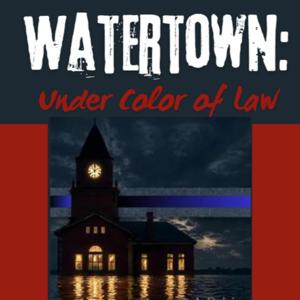
* Featured Book: Watertown: Under Color of Law by Amy M. Dubé (2026, Red Oak Media).
* Related Chapters: Chapter 40 (”Pallet of Perjury”) and Chapter 41 (”I’m All Set”).
This is a public episode. If you would like to discuss this with other subscribers or get access to bonus episodes, visit adminethicsindex.substack.com