
Sign up to save your podcasts
Or



It was the darkest nightmare of every parent come to life - and it happened in the land of “It can’t happen here.” The setting was Littleton, Colorado, a comfortably middle-class suburb of Denver, a place where people come to raise a family, and where the arch over a hallway at local Columbine High School is inscribed with the motto: “The finest kids in America pass through these halls.” But on April 20, 1997 - the halls of Columbine suddenly became the scene of a murderous reign of terror. Coverage of the shootings was intensified by the ubiquity of 24-hour cable news, and its constant need to come up with fresh information - often incorrect. The media quickly realized they simply had no protocols for a mass casualty incident of such dimensions.
Broadcast audio courtesy of KOA Radio, Denver, CO, ABC News Video Source, CBS News
Contributors:
See Privacy Policy at https://art19.com/privacy and California Privacy Notice at https://art19.com/privacy#do-not-sell-my-info.
She was a princess who never lived happily ever after - and the world loved her for it. Diana Spencer became a global celebrity when she wedded England’s Prince Charles in July 1981. But the fairy tale marriage soon unraveled, and, after no end of adulterous revelations and public separations, finally ended in divorce. But Diana remained a princess in the hearts of her millions of fans - and of the mass media, who faithfully chronicled her every move. Ultimately, it was the pursuit of an image with the highest bounty that lead to her tragic death. The lingering legacy of the death of Princess Di is how media must operate within this ambiguous territory, without overstepping perceived notions of privacy, yet also serving the insatiable appetite of editors and the public.
Broadcast audio licensed from CNN/WarnerMedia, BBC
Contributors:
See Privacy Policy at https://art19.com/privacy and California Privacy Notice at https://art19.com/privacy#do-not-sell-my-info.
The first reports from Los Angeles had an all-too familiar ring - a black motorist who had been stopped by police for drunk driving was pulled out of his car and beaten by several white officers. But this time, the entire incident was captured on a bystander’s video camera, then broadcast via television around the world. When the offending officers went on trial, an all-white jury saw things differently. After announcing a deadlock on a single assault charge and acquitting the four police officers, the city erupted in an eerie replay of the Watts riots thirty years before which had left much of Los Angeles’ inner-city community in ruins. It all began with a hand-held video camera and ended with the whole world watching a great city going up in flames. And just how much had television’s wall-to-wall coverage fanned those flames.
Broadcast audio licensed from NBC Radio; KTLA/Nexstar, Inc.
Contributor:
See Privacy Policy at https://art19.com/privacy and California Privacy Notice at https://art19.com/privacy#do-not-sell-my-info.
When Ronald Reagan was elected president in November 1980, he hoped to defy an unusually grim circumstance of that office. In the seven previous even-numbered decades, every U.S. President had died in office - four times from assassin’s bullets. A few months later on March 30, 1981, as President Reagan strolled outside the Washington Hilton Hotel, he nearly met the same fate.
Broadcast audio licensed from ABC News Video Source
Contributors:
See Privacy Policy at https://art19.com/privacy and California Privacy Notice at https://art19.com/privacy#do-not-sell-my-info.
It was the finale to a decade of turbulence and upheaval, but this time it was an event through which a nation could put aside its differences and stand together to marvel at the achievement. In 1961, President John F. Kennedy had pledged that before the sixties were over, an American would walk on the moon.
The enormity of the mission aside, one question remained, how to get a television signal 240 thousand miles from the lunar surface onto televisions in living rooms around the globe. Robert Wussler, Walter Cronkite's producer, called it "the world's greatest single broadcast" in television history.
Broadcast audio licensed from CBS News
Contributors:
See Privacy Policy at https://art19.com/privacy and California Privacy Notice at https://art19.com/privacy#do-not-sell-my-info.
He was a man in the prime of life when he traveled to Dallas, Texas in November 1963, on a routine political fence-mending mission to help shore up his chances for re-election as president the following year. At about twenty five minutes past noon on November 22, he was riding in an open convertible with his wife through downtown Dallas, waving to cheering crowds, when the unthinkable occurred - an unforgettable event that would haunt and define the turbulent decade to come.
Broadcast audio licensed from CBS News
Contributors:
See Privacy Policy at https://art19.com/privacy and California Privacy Notice at https://art19.com/privacy#do-not-sell-my-info.
It was the biggest overseas military operation in the biggest war in world history - and its best kept secret as well. D Day demonstrated radio’s ability to carry news with clarity and immediacy. And while reporters like Robert Trout, Edward R. Murrow, and Richard C. Hottelet became household names, it was the ingenuity of an NBC stringer reporter named Wright Bryan, who finagled his way aboard a flight of paratroopers and became the first to report the landing.
Contributors:
See Privacy Policy at https://art19.com/privacy and California Privacy Notice at https://art19.com/privacy#do-not-sell-my-info.
The Hindenburg was an engineering masterpiece, an airship as large and as grand as the Titanic - and as doomed. On May 6, 1937, a young radio reporter named Herbert Morrison was on hand to record the Hindenburg’s arrival at Lakehurst, New Jersey. Instead, Morrison helped radio to broadcast one of modern history’s great disasters, as it suddenly unfolded in all its terrible glory. But even as Morrison’s eyewitness report chronicled the end of one era, it signaled the beginning of another - an age in which electronic media would routinely report shocking events in the moment that they occurred. In addition to the story of the Hindenburg, this serves as a preview of Season 1.
Broadcast audio courtesy of Marc Garabedian, Mark 56 Records
Contributors:
See Privacy Policy at https://art19.com/privacy and California Privacy Notice at https://art19.com/privacy#do-not-sell-my-info.
Coming July 20th, 2021
See Privacy Policy at https://art19.com/privacy and California Privacy Notice at https://art19.com/privacy#do-not-sell-my-info.
From the publisher's feed
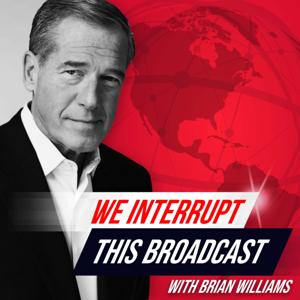
From six-time New York Times bestselling author Joe Garner, and based on his groundbreaking multimedia book, “We Interrupt This Broadcast,” comes a 12-episode, audio docu-series hosted by broadcast…
Credits
Hosted by Bill Kurtis & Narrated by Brian Williams
Created, produced and directed by Joe Garner
Written by Mark Rowland, Brian Williams, Colin Madine, and Joe Garner
Sound engineering and design by Paul Bahr, Peachtree Sound
Additional audio engineering provided by Beowulf Rochlen, Two Squared Media Productions
Website and graphics designed by George Vasilopoulos, 921 Associates
Executive Producers are Brian Williams, Ron Hartenbaum, Scott Calka, and Joe Garner
A very special thank you to Donna LaPietra and Diane Anello
A Production of i4 Media Ventures, LLC
www.weinterruptthisbroadcast.org
2,184 Listeners

11,937 Listeners
10,763 Listeners
22,126 Listeners
8,640 Listeners

369,621 Listeners

19,162 Listeners
19,119 Listeners
46,903 Listeners
13,559 Listeners
8,212 Listeners
2,165 Listeners
8,393 Listeners

1,595 Listeners
195 Listeners