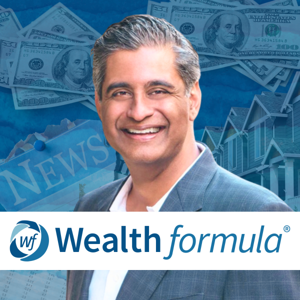
Wealth Formula Podcast

Wealth Formula Podcast

By Buck JoffreyBusinessInvesting
Download on the App Store
  • Favorites

    158

    Followers

  • Typical duration

    30 min

    per episode

Based on Podcast App listening data

Wealth Formula Podcast episodes

  • 055: Confessions of a Cash Flow Ninja: MC Laubcher
    Everyone grows up with some kind of belief system that is an amalgam of religion, culture, and life circumstances. These beliefs influence how we see the world and how we behave within it. Make no mistake, belief systems have a lot to do with how successful or not successful you are in life. I am the child of Indian American immigrants. My dad, like many men who immigrated to the United States from India in the 1960s, was educated as an engineer. He came to this country on a scholarship to the University of Minnesota. But unlike most of his cohort, he quickly recognized the opportunity in this great country of ours. Instead of buying a house to live in, my parents bought a duplex. My dad realized that if he bought a duplex instead of a house, the tenants would pay his mortgage for him. Seemed like a no-brainer for this young immigrant couple. That was an inflection point for him. He saw opportunity in owning rental properties for cash flow instead of trading time for money and he was off to the races. He never asked the question, "shouldn't I be investing for the long run in a portfolio of stocks, bonds, and mutual funds for the long run?". Why? Because that was not part of his experience. He came from a place where people were just hustling to put food on the table. He was poor in India--that's really poor. He had no preconceived idea about what to do with his money so he did what he thought made sense--he bought cash flowing assets. Almost 50 years later, he's still at it. My dad did have a lapse of judgement during the tech bubble which you can read about in my book, but he's been a real estate guy for my entire life. So far, you can already get a sense of my influences growing up. First of all, I looked different. I was the only child with melanin in a sea of Scandinavian grade school children. My mom packed me chicken curry sandwiches for lunch instead of peanut butter and jelly, and my dad was a thriving slum lord--I mean scrappy real estate entrepreneur. Unlike other Indian kids, my dad didn't seem to care about how I did in school. In fact, neither of my parents payed much attention. It was rare that they ever saw my report card. The only thing that drove me to do well in school was the fact that everyone told me my big brother was really smart and I wanted to be like him. Most Indian parents want there kids to be a doctor--in Indian culture, the pecking of order of families has more to do with the number of doctors in your family than anything else. My mom really wanted my brother to be a doctor--she just liked doctors and wished that she had married one. When my brother decided not to go that way, she was crushed as she certainly did not expect for me to head in that direction. I fancied myself a man of letters and when I was leaving for my Ivy league college my mom asked me what I was going to study. I told her. I don't know mom but I guarantee you I won't be a doctor. She was overjoyed, of course, when 2 years later I declared my own intent to apply to medical school. But not my dad. He couldn't figure out why I wanted to be a doctor. "A lot of work. A lot of time. You know I make more money then all of those doctors don't you?" he asked. Of course, I blew him off. He just didn't get it. I was following a mission--to help people. It wasn't about making money. You see, he grew up dirt poor and fed his family since grade school tutoring rich kids in mathematics. That was his perspective. He had raised an affluent private school kid who had the luxury of being an idealist. Eventually, I went on to become an entrepreneur just like him (the apple does not fall from the tree) and when I started making money, I had to figure out what to do with it. Most of my colleagues ended up handing their money over to a financial planner. But that was not part of my experience so it seemed risky. So, I started investing in real estate? Why? My experience told me that if I invested in real estate, it would make me wealthy like my dad. I also saw that his only venture into the stock market during the dotcom bubble almost destroyed him. And finally, it was 2009 and I had the perspective of making money for the first time while witnessing the carnage of the equity markets. In sum, I got lucky. I had a different perspective from the rest of the highly educated herd and I was able to see a better way and that has made me wealthy. Today's guest on Wealth Formula podcast, MC Laubscher, grew up in South Africa during apartheid. Do you think that might affect his view of the world?!!! Make sure to tune in.
    48 min
  • 054: Solar Profits with Bryan Birsic
    Last week's show with Chris Martenson was very popular and for good reason. Chris has done his research and thinks we are in trouble. He also gives us some solutions about how can potentially approach the world that he sees coming. For me, the biggest takeaways were related to some of his incites on social and cultural capital. Even if the world does not end up going to hell in a handbasket, we can all benefit from improving our quality of life through living where we want to live and by having closer relationships. Several studies have shown that the biggest single factor associated with happiness is not, in fact, money but rather the quality of relationships a person has. We evolved as people who lived in tribes and depended on one another to live. It makes sense then that being around other people and having close relationships would make us happy. The problem is that modern living in the US, at least, is becoming less and less "tribal" and more and more lonely. I bet that has a lot to do with the high rates of depression, especially in larger metropolitan areas. Anyway, the point is that I think Chris Martenson's solutions are useful not only for a zombie apocalypse but also for everyday living. As for Chris' arguments on the economy, it is hard to argue with some of the problems he sees. However, I will say that the idea of peak oil and the role of fossil fuel depletion leading to a signifiant global recession or depression is not shared by everyone. Some people say that this prediction significantly underestimates the acceleration of technology. It wouldn't be the first time that's happened. In 1798, Thomas Malthus published An Essay on the Principle of Population. Malthus' theory was that increased food production led to population growth which would then over-utilize those sources of food until they couldn't anymore because of famine and disease in the lower classes--effectively limiting population growth as a whole. Well, we know what happened with that theory. the earth's population is about 7 billion. 200 years ago, was less than 1 billion. In fact, the UN estimates that 6.5 percent of ALL people ever born, are alive right now! In Malthus' case, he ended up underestimating technological advancements which allowed humans to keep ahead of the population curve. Is it possible that those who subscribe to the future peak oil depletion economy might be doing the same? It's certainly possible. If that's the case, it is likely that solar energy will be one of the major solutions to the peak oil problem. In this week's episode of Wealth Formula Podcast, we discuss solar energy, its advances, and why it might be s good investment. I hope you enjoy the show!
    30 min
  • 053: Peak Prosperity with Chris Martenson!
    I have spoken in the past about how I believe that time is the currency of wealth. In other words, it's not dollars or euros that most of us are after, but rather time. We want to be able to do what we want, when we want. Some of us love our careers and wouldn't change that part of our lives. Some of us would absolutely love to eliminate our careers and do something completely different. What would you do with if you had all the time in the world? Would you play golf all day and "retire"? That's the bill of goods most high paid professionals are sold, right? You work your butt off and pack money away into your retirement account so that you can one day, finally, retire and play golf for a couple years before you die. That sounds terrible to me. I would be bored to death and being bored doesn't sound like being wealthy to me. Being wealthy means doing what you want when you want. It doesn't mean having no meaning to your life other than golf. To me, the pinnacle of wealth was defined by Abraham Maslow in 1943 in his work. "A Theory of Human Motivation". I'm sure most of you are familiar with Maslow's hierarchy of needs. There's this pyramid that has physiological needs at the bottom--like food and water and then just above that you have safety, like having a roof over your head for example. I have referred to this pyramid before on this show and in my book and have specifically talked about why I like multifamily real estate as an investment. People need roofs over their heads. At the top of this pyramid, however, is self-actualization. Self actualization might encompass many things: expressing one's creativity, quest for spiritual enlightenment, pursuit of knowledge and the desire to give to and/or positively transform society are examples of self-actualization. It is, as German psychiatrist Kurt Goldstein said, man's master motive. But, the only way to get there, the only way to self actualization is to have your basic needs taken care of first. You can't be worried about how to pay for your mortgage and put food on the table and work on your master motive at the same time. On the Summit at Sea I spoke to Robert Kiyosaki about this a little bit. As you might imagine, he's in a position where he can focus on self-actualization. He defined this as "mission"--which one could also characterize as master motive. Financial education truly is his mission in life. He doesn't need the money. Let's be clear, you don't have to have Robert Kiyosaki level wealth to have a master motive or mission. On the other hand, you can't be living paycheck to paycheck in golden handcuffs. You see, even high paid professionals have concerns about security. All you house poor doctors know what I'm talking about. Your problems are the same but different. In some respects they are worse because they are self-inflicted. A poor person struggling to pay rent is one thing but struggling to pay you BMW car payment? Well...that's not a road to self-actualization either. The golden handcuffs are a big roadblock to self-actualization. And, until you free yourself from those shackles, you will not be able to find your master motive or mission in life. This is all to say that time maybe the currency of wealth. But you still gotta know how to spend that currency wisely! Now today's show is tangentially related to my rant of the day. You see, when I talk about self-actualization, that requires you to get out of your comfort zone and think about your life critically. That's exactly what my guest on Wealth Formula Podcast today, Chris Martenson of PeakProsperity.com did over a decade ago and the result is some pretty amazing research-- a real contribution to society born out of his own creativity and pursuit of knowledge. It also resulted in a much happier and healthier man.
    47 min
  • 05: Should You Invest in Residential Real Estate?

    This week’s weekly wealth widget is sort of no-brainer for most of us. However, if you are still sitting on real estate sidelines, this one is for you. Here are just a few reasons why you strongly consider investing in residential real estate.

    1. You own a real asset that does not fluctuate on a day to day basis depending on the “mood of the market”.
    2. People have to live somewhere. This is level 2 on Maslow’s hierarchy of needs. Residential real estate is an investment in something people need.
    3. There are substantial tax advantages that make most profits tax free. This IS NOT the case if you invest in a REIT so I personally do not recommend that.
    4. Although the IRS considers your property to depreciate (therefore giving you tax advantages), the property will actually appreciate in most cases over time.
    5. Your tenants pay down your mortgage. So…while you are collecting money on a monthly basis, your equity position in the property increases over time making your over-all yield higher than simply the cash that you are seeing on a monthly basis.
    6. You can use leverage…a mortgage to buy an asset and enjoy leveraged appreciation and amplified cash flow.
    7. Millennials are not buying houses. They prefer to rent. They are the LARGEST generation.
    8. You can invest in one of many “turn-key” services in various parts of the country essentially eliminating your risk of tenants, toilets, and termites on a daily basis.
    9. You can invest passively on bigger projects, get great returns, and still enjoy the cash flow and tax benefits as a limited partner without any legal exposure at all!
    10. Unlike money in the stock market, rental properties do not vanish over-night because of something completely related to your property.
    11. That’s just a few reasons to invest in real estate. If you want more reasons to buy residential real estate, listen to his oldy but goody: 002: The Real Story Behind Real Estate – Wealth Formula

      53 min
    12. 052: Be Passive and Prosper with Marco Santarelli
      We are a culture of robots created by the industrial revolution. Our current public educational system was modeled after a system created by the Prussians in the early 1800s and was imported to us during the industrial revolution by guy named Horace Mann. This system was then fine tuned by a group of 10 guys at Harvard in 1892. Let's take a step back and look at how this system works. Imagine a child stepping onto a conveyor belt in 1st grade. That child goes to 12 different stations that represent 12 grades in our school system. At each station, the child stops for a year and gets doused in pre-packaged education deemed appropriate for each age cohort. I'm sure you remember high school where there was a sequence of courses that you took depending on your grade level..ie geometry in 10th grade, etc. At the end of the 12 years, you have a finished product--well at least your supposed to. Some obviously fall of the conveyor belt a bit earlier than expected. However, assuming a child makes it to the end of the conveyor belt, they are then sorted out. The finest will be patted on the back and get shipped off to a new factory for a little extra polish. That factory is of course college and, potentially later, professional school. I'm sure you get my analogy here. It''s actually an ingenious system if you look at it through the lens of an industrialist. And my point here is not to say the system is wrong. It is certainly the best system we know. My point is to simply point out the methodology by which we become educated. It is like we are a bunch of robots that were created by this industrial educational factory. This factory is rigid and does not allow for a significant amount of flexibility in education. Now the people who come out most successful in this factory are those who excel at doing exactly as they are told and absorbing the information they are fed most efficiently. They are constantly being given positive feedback. Society commends them for not failing--for consistent success. That constant positive feedback creates a Pavlovian feedback loop where these people who are particularly good at school essentially know no other way to learn that to be taught formally and given a roadmap to follow. Now here is one flaw in the system. What if the factory forgets a key component while that child gets sent down the conveyor belt--say for example, financial education. Or even worse---say that financial education is taught but the curriculum was written by Wall Street? That is the paradox confronting many high paid professionals today. They excel throughout their lives and do everything right in school. They get the accolades and the titles like doctor or lawyer. But...many haven't a clue how to teach themselves anything outside of their own professions. Instead, they rely on conventional wisdom since this is the societal norm and the right thing to do. In terms of financial education, they hesitate to learn things for themselves as that's not what they are supposed to do. Some do it anyway and end up digesting the crap that is current investing paradigms. A few brave souls will try to get a broader perspective. They might start to realize that the whole personal finance thing--what they were led to believe was part of the common curriculum and therefore truth, was in fact nothing more than a creation of the banks. They, of course might get ridiculed by their family and friends for thinking outside of the Wall Street box. If they survive the scrutiny, they might get lucky enough to find a community like ours that is willing to consider "alternative investments"--namely tangible assets that don't don't disappear when there is bank failure. Some of them might start thinking about investing in real estate and might even run into today's Wealth Formula Podcast episode that can help them get started small with turnkey rentals. I hope you enjoy the show.
      42 min
    13. 051: Wealth Grows in Trees with Alex Wilson
      Should you always invest in things with the highest returns? Well? That's an interesting question. When I first started investing, that's all I cared about. When I bought my first apartment building, I did the numbers and looked at the tax returns. It looked like I was going to get over 25 percent cash on cash. It didn't turn out that way though. It was a D class apartment building that I couldn't manage nor could I find a manager who could. Instead of making 25 percent cash on cash, I lost a lot of money. These days, I look at that mistake as the price of education. The mistakes I made on that property were never made again and I have never lost money on real estate since that first building. One of my lessons is that you can't just look at the numbers. Why do class D buildings have potential for higher returns? Because they are a bigger risk. It is often the case that returns correlate to risk and we have to keep that in mind. As you may know, I own multiple businesses. Businesses trade very differently than real estate. Right now, medical businesses like some of those that I own may be valued at 10X of net operating income (to use real estate language). That is actually pretty darn high for a businesses of my size. for example. If my business made 2 million dollars in profit, the valuation may be north of 20 million. Wow! That sounds great right? But wait, in real estate terms, that is a capitalization rate of 10 which, if you are selling a property, is not necessarily something to celebrate. Why the disparity you ask? Well, one is a business that has many moving parts. It relies on all of the operations around running a business. The assets are the brand, the management, and maybe the good will of previous customers and referral sources. Buying a business like this from me has far more risk than buying an apartment building from me with the same net operating income. Therefore, the valuation is different. The moral of the story: yield correlates with perceived risk. Now let's be clear. How people perceive risk is quite variable. To me, buying a stable b or c class apartment building does not feel terribly risky so I get to take advantage of relatively higher returns that this class of property yields compared to someone that feels comfortable investing in only luxury apartments where the affluent reside. Get the picture? The reality is that there are all sorts of variables that dictate risk. Let's take another example: Did you know that timber---you know wood, has outperformed stocks, long term corporate bonds, gold and real estate for over 100 years? Why are we not buying more timber? Maybe it's because it's not liquid for several years. There's a premium for waiting for your money. In fact, billionaire hedge fund manager Jeremy Grantham once said "timber is the only low-risk, high return asset class in existence." Well, that alone is worth learning more about it. You can do that by tuning in to this week's episode of Wealth Formula Podcast. I hope you enjoy the show!
      40 min
    14. 050: Financial War with Jim Rickards
      I just got back from the Real Estate Guys Summit at Sea. Wow!!!--those guys know how to deliver. If you don't listen to their podcast, by the way, you should. It's the Real Estate Guys Radio Show. There are lots of copy cat real estate shows out there but only one Robert and Russ! I learned so much and have so much to tell you that it will have to be split up over the next few weeks. As many of you know, Robert Kiyosaki was on the trip. I got very lucky in that I randomly sat next to him for several meals. In fact, at one point, I sat next to him 3 meals in a row. I think we share some kind of common hunger pattern or something. It was weird. At one point, I snuck out of the lectures because I could feel my blood sugar dipping and went up to the buffet. I grabbed a seat at a bar table and called my wife for her birthday. Then, I saw Robert at the buffet line getting some eggs and he waved a friendly hello and came and sat down with me. I talked to him for the next 90 minutes. Now that was a treat. Why? Well, obviously as many of you know, Robert Kiyosaki's Cash Flow Quadrant changed my life for good and defines the moment when I became an entrepreneur. But more than that, I realized the depth of Robert Kiyosaki's intellect. Robert is not a cuddly bear. He's an ex-marine who means business and he is also one seriously smart dude. It was a great experience for me to sit with him for 90 minutes and exchange ideas. Talking to smart people who "think different", as Steve Jobs would say, is more gratifying to me than just about anything else. The only thing I would trade that conversation in for is a Minnesota Vikings Superbowl victory with me as the owner of the team. So, getting back to the summit... Remarkably everyone seemed to agree that we are in a bad time in the economy. That's not a surprising comment from Peter Schiff who Robert Helms says predicted 19 of the last 2 recessions or from Simon Black who advocates planting flags in other countries as a plan B when eminent destruction unfolds in the US economy. But even Douglas Duncan, Chief Economist at Fannie Mae, felt that the economy was not in a good place. Usually these guys are the optimists! Doug pointed out that this was the third longest economic expansion in US history BUT has been the worst expansion in terms of GDP growth and especially bad for the working class. Hopefully we will get Doug on the show, but everyone was floored that even the mainstream didn't have a positive outlook about the economy. Later in the cruise, Kiyosaki commented, "It makes me worried when we all think the same thing. What am I not seeing?" he asked. What aren't we seeing? That's sort of scary question. Sometimes things are just obvious I guess but other times there are a few extraordinary individuals who see things that no one else does. It reminds me of the night before the presidential election. I am a lifetime member of Jim Rickards' Strategic Intelligence newsletter and receive urgent updates via email. The day before the election, I got an alert. On that video, Jim confidently told the world that Donald Trump was going to win the presidential election. He had sought and found clear evidence that polling was biased and wrong. He did the same thing just a few months earlier when he predicted a yes on the BREXIT vote. Jim is one of the brains that I follow closely. With recent developments in Syria and North Korea and the prospect of war on multiple fronts, wouldn't you like to hear what that guy has to say? Well, good news! Jim is my guest on this week's episode of Wealth Formula Podcast. -Buck P.S. You may need this link after listening to the show. It's for Bullion Vault. Check it out: http://www.bullionvaultaffiliate.com/joffreymd/en PSS. Who do you know who should be listening to this show? Do them a favor and forward them this email.
      46 min
    15. 049: Leverage is time with Ari Meisel
      What is leverage? The action of a lever by definition is to gain some kind of advantage. It can be physical like when you are using a tool or, in finance terms, it is the use of borrowed money to enhance buying capacity (and hopefully increase return on investment). A few shows ago I emphasized that my belief was that coveted currency for most, whether realized or not, is time. I equate wealth with time rather than dollars in the bank. Therefore, time is my currency of choice. On this show, we often emphasize the idea of residual cash flow via real estate or other investment vehicles as the primary means of giving you more time to do the things that are important to you. However, there is one more way to increase your bottom line on time. That is to reduce the amount of time spent on things you'd rather not do. Tim Ferris', The 4 hour Work Week, popularized this notion about a decade ago. It's a great book and it's really funny. Tim writes about outsourcing just about everything using a virtual assistant in India--even going as far as having the virtual assistant talk to an angry girlfriend on his behalf! Anyway, I was inspired by Tim's book and tried using virtual assistants for a while but the hardest part for me was always dealing with companies overseas where there was a big language barrier and often substandard quality of work. Eventually, I dropped the whole notion of virtual assistants in my business life all together. I never really even thought about using them in my personal life. That is until recently after meeting Ari Meisel at a genius network meeting. Ari's built a company called Leverage that combines highly trained english speaking virtual assistants combined with training on how to best automate your business and personal life. It's really a neat company. Why have Ari on Wealth Formula Podcast you might ask? Because wealth is time and Ari is the king of maximizing time for productivity and leisure by hacking off all of the unnecessary and unpleasant tasks in life. This is a service that I think many of you are going to love and in this episode of Wealth Formula Podcast you'll get to learn all about it. This could change your life! Best Regards, Buck Joffrey
      24 min
    16. 010: The biological secret to success: repeated failure
      We learn to walk by repeatedly falling down. We learn to talk by first making unintelligible noises. We are hard wired to learn through trial and error but are brainwashed by an educational system that teaches us that doing things a different way is wrong and that failure is bad. The reality is that any great entrepreneur or investor must take chances repeatedly to learn and to succeed.
      40 min

    About Wealth Formula Podcast

    From the publisher's feed

    Financial Education and Entrepreneurship for Professionals

    More shows like Wealth Formula Podcast

    BiggerPockets Real Estate Podcast by BiggerPockets

    BiggerPockets Real Estate Podcast

    16,684 Listeners

    The Peter Schiff Show Podcast by Peter Schiff

    The Peter Schiff Show Podcast

    5,688 Listeners

    The Real Estate Guys Radio Show - Real Estate Investing Education for Effective Action by The Real Estate Guys

    The Real Estate Guys Radio Show - Real Estate Investing Education for Effective Action

    703 Listeners

    Rich Dad Radio Show: In-Your-Face Advice on Investing, Personal Finance, & Starting a Business by The Rich Dad Media Network

    Rich Dad Radio Show: In-Your-Face Advice on Investing, Personal Finance, & Starting a Business

    3,837 Listeners

    Creating Wealth Real Estate Investing with Jason Hartman by Jason Hartman

    Creating Wealth Real Estate Investing with Jason Hartman

    535 Listeners

    Get Rich Education by Real Estate Investing with Keith Weinhold

    Get Rich Education

    597 Listeners

    Main Street Business by Mark J Kohler and Mat Sorensen

    Main Street Business

    589 Listeners

    Passive Real Estate Investing by Real Estate Investing with Marco Santarelli, Investor and Entrepreneur.

    Passive Real Estate Investing

    961 Listeners

    Real Wealth Show: Real Estate Investing Podcast by Kathy Fettke / RealWealth

    Real Wealth Show: Real Estate Investing Podcast

    408 Listeners

    Tax Smart Real Estate Investors Podcast by Hall CPA

    Tax Smart Real Estate Investors Podcast

    425 Listeners

    The WealthAbility Show with Tom Wheelwright, CPA by The Rich Dad Media Network

    The WealthAbility Show with Tom Wheelwright, CPA

    508 Listeners

    Real Estate News: Real Estate Investing Podcast by Kathy Fettke / RealWealth

    Real Estate News: Real Estate Investing Podcast

    556 Listeners

    Ken McElroy Show by Ken McElroy

    Ken McElroy Show

    701 Listeners

    Rebel Capitalist News by George Gammon

    Rebel Capitalist News

    1,026 Listeners

    PassivePockets: The Passive Real Estate Investing Show by PassivePockets, Chris Lopez

    PassivePockets: The Passive Real Estate Investing Show

    131 Listeners