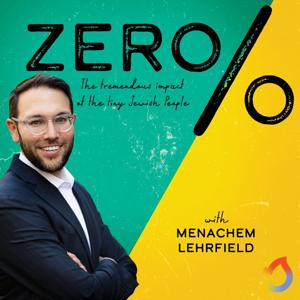
Zero Percent
Download on the App Store

Zero Percent episodes

  • 24- The GOAT
    This week, Rabbi Lehrfield dives into Yom Kippur.

    View the full transcript here: www.joidenver.com/zeropercent/24--the-goat
    19 min
  • 23 - Constant Change
    In this episode we continue our discussion on Jewish holidays with an emphasis on Rosh Hashanah.

    See the full transcript here: www.joidenver.com/zeropercent/23--constant-change
    19 min
  • 22- New Month New You
    In this episode, Rabbi Lehrfield dives a little deeper into the Jewish calendar with a focus on the new month, Rosh Chodesh and its lessons of renewal. If you are interested in a Spirals in Time podcast, email Rabbi Lehrfield at [email protected].

    View the full transcript here: www.joidenver.com/zeropercent/22--new-month-new-you
    19 min
  • 21- The Truth
    Continuing our discussion on antisemitism with a look back in history.

    View the full transcript here: www.joidenver.com/zeropercent/21--the-truth
    19 min
  • 20- A Unique Hatred
    In this episode, Rabbi Lehrfield continues unpacking the classic reasons for Anitsemitism.

    To view the full transcript visit: www.joidenver.com/zeropercent/20--a-unique-hatred
    19 min
  • 19- Reasons Or Excuses
    Continuing our talk on Antisemitism, Rabbi Lehrfield speaks more on why it's the most unique hatred.

    To view the full transcript, visit: www.joidenver.com/zeropercent/19--reasons-or-excuses
    19 min
  • 17- What Is Love? Hopefully More Than Baby Don't Hurt Me
    In this episode, we wrap up our discussion about Jewish lifecycles by looking at love, relationships, and marriage.

    Episode transcript-

    Hey everyone. I'm Menachem Lehrfield and this is Zero Percent. We are now wrapping up our Jewish life cycles with a conversation about relationships, from a Jewish perspective. Specifically where we see the growth mindset research in the Jewish approach to relationships, the Jewish approach to marriage. And I hope that it will help enhance your relationships again, whether you're Jewish or not.
    So we left off last episode talking about the difference between love and infatuation. We said, love is not blind, love is a magnifying glass. Just as your parents love you more than anyone else, they also see your faults more than anyone else. The thing that is blind is infatuation. If you recall, we talked about the three phases of every human experience. There's phase one, the male phase, which is all about quick flashes of inspiration. Then comes the middle phase, the phase where it's unclear and it's difficult and it takes work and effort. But in that phase, in that stage, things become real. And that's why it's so hard, that's why it takes work and effort. That is the stage and the phase where real life happens. That is the growth mindset at its best. It's about rolling up our sleeves and working hard. And then the beauty of phase three is I get to experience phase one again, but this time it's real. This time it's worked for, its earned.
    The Rambam Maimonides uses the analogy to describe these three phases and the concept of inspiration in general. With the analogy of a person who's lost on a dark night, and imagine it's pitch black and you're lost trying to find your way home. And all of a sudden there's a flash of lightning. And in that instant, the entire sky lights up. I'm from Miami, we have these torrential downpours in the summer. And when you hear that crack of thunder followed by that lightning, that lights up the sky. You know what I'm talking about. The sky lights up and in that instant, you see everything clearly. But as soon as it comes, it goes. So now you have to reconstruct in your mind the way home. In that moment, in that instant, you saw everything clearly, you understood you have to move a little bit to the right and then go straight and then turn a little bit. And now you have to make your way home with the memory of what that all looked like when it was clear.
    And then a little while later you get another flash of lightning and that allows you to course correct, and figure out how to get home. The same is true with life. You have those moments, those flashes of inspiration. But those are not real. It's not really light. You have moments where you see those things clearly. You have those moments where you feel inspired. But if I think that that inspiration is there to last forever, I'm setting myself up for a life of disappointment. The inspiration lasts exactly as long as it has to. And as soon as I think this is the way it's supposed to be, that's exactly when it ends.
    So you might ask, "Why would God create the world that way? Why would the Almighty make us in a way that we have this artificial fake experience at the beginning of the process?" I think in relationships, we understand this analogy the best. What is infatuation? What is the initial stage of a relationship where we feel this deep romance? We feel all the feels. The fireworks and the feelings and the emotion, and just this walking on clouds experience. What is that? What is infatuation? It is, I think, the most tangible way we can understand phase number one. It is completely artificial, it's fake. So why would God give it to us?
    And as soon as we think it's going to last forever, it doesn't. And then we say, "You know what? Maybe this relationship is not what I thought it was. Maybe it's broken. Or even worse, maybe I'm broken. Maybe she's broken." The Almighty gave us the gift of phase one to show us how great phase three can really be. It's a preview, it's a taste. Just like in the trailer, you get to see the best parts of the movie without watching the whole movie. Phase one is a trailer of phase three. But we can't skip the phase in the middle. We can't skip the work of phase two or else we'll never truly get to phase three. But if we do it right, phase three is just as remarkable and magical and exciting as phase one. But now it's real.
    You see this all the time. You have a friend who's dating a girl and he tells you, "Oh, she is perfect." First of all, if you say someone is perfect, you know that is a red flag. But he says, "No, she is perfect. She's amazing. And she's funny. And I feel so great when I'm with her." And sometimes all those things are true, but more often than not, it's not true. And the friends are all looking at each other, like, "What does he see in her? This girl is a psycho." And yet he cannot see it. Why? Because he's infatuated. And as we said, infatuation is blind as a bat. And only once the relationship is over, does the guy say, "What was I thinking? She was totally wrong for me. But I couldn't see it because the three parts of my soul were not in the proper order. I wasn't thinking with my head."
    Once a person enters that infatuation stage, it's so hard to think clearly. And what makes it even worse? What makes it even more difficult is when the relationship becomes physical. Because as soon as it becomes physical, now I am completely lost hook, line and sinker. When we think that stage one, infatuation, is really love. When we confuse love and infatuation, we make really bad choices. The reality is that real love takes a lifetime to build. In describing Isaac and Rebecca's relationship, the Bible tells us that Rebecca became his wife and then he loved her. And many people look at this verse and they say, "It's out of order. Surely he loved Rebecca first and only then married her. Why would he have married her if he didn't love her?"
    What it's teaching us is that true love takes a lifetime to build. And in Judaism marriage comes first. If your wedding day is the happiest day of your life, then don't get married. I tell this to every single couple that I marry. Every single time I officiate a wedding, my blessing to the bride and groom is that this should not be the happiest day of your life. If it is, don't do it. And we see this so often, couples who live together for years and decades and they're happy and everything's great. And then all of a sudden they get married and within six months they're divorced. What went wrong? Now that they're married, things became real. Now there's a real level of commitment. And you know what? Relationships are hard. Relationships take work.
    The problem is that we grow up with these ridiculous ideas that we get from fairy tales. I mean, just look at the story of Cinderella for a second. Years ago I was reading ... I wasn't actually reading, you'll see in a second. But I was tucking in my daughter, [Rahel 00:08:23] she was maybe three at the time, now she's 11. So this was a while ago. And we were laying down in her bed getting ready to go to sleep. And I had on my iPad this ebook which was the story of Cinderella. And it basically had the pictures and you pushed the button each page and it would read the words and continue to the next page. And I don't think I truly understood how stupid the story of Cinderella was until I heard this ebook reading it to my daughter. To Disney's defense, they did a much, much better job with the remake of Cinderella, with the real characters.
    But at least in the original story, you have a prince who's looking for a princess. He dances with this girl and she runs off leaving behind a glass slipper. And they search the kingdom high and low, trying to find the girl whose foot fits in the glass slipper. And they're trying it on the ugly stepsisters and stop for a second and think about that. He wants to marry this woman, he doesn't even remember what she looks like. He can't pick her up out of a lineup. You're telling me the ugly stepsister who looks nothing like Cinderella, maybe that's her. I don't know. We're reading this page after page and at least in this book version, the prince is actually going along through the process. He doesn't know what the girl looks like. He knows nothing about her or aspirations or her thoughts or ideals or the things that are important to her. And yet he wants to spend the rest of his life with this girl.
    And then all of a sudden Cinderella comes out, she tries on the slipper, it fits. And then the prince says, "Oh, that's the girl." Flip to the next page, they're getting married. They're standing there under their altar or at the altar, under their ... not quite a chuppah, but looks like a chuppah. And the prince turns to Cinderella and says, "I love you." Because of course they always have English accents. And she looks to the prince and says, "I love you, too." And the next page, they all lived happily ever after. Are you kidding me? That is the worst ending to the worst story ever. They lived happily ever after. They don't even know each other. What is the statistic probability that they lived happily ever after? No, I bet you, the next morning they had some blowout fight over some miscommunication because they don't know each other. They know nothing about each other and they probably don't even like each other. And the whole basis of their relationship was that a stupid shoe fit on her foot. Or that the prince like dancing with her.

    Get the full transcript here: www.joidenver.com/zeropercent/17---what-is-love%3F-hopefully-more-than-baby-don't-hurt-me
    19 min
  • 16- More Bar or More Mitzvah?
    In this episode we continue our discussion on Jewish lifecycles and talk about the transition into adulthood.

    Episode transcript-

    Hey, everyone. I'm so glad that you're here. This is [inaudible 00:00:11], and this is 0%. I'm so grateful that you are taking some time to learn with us today. We've been talking about the growth mindsets in Judaism, and more specifically where we see them throughout the Jewish life cycle. Last week, we left off talking about the transition between childhood and adulthood, and that transition is marked in a life cycle event in Judaism known as the bar or bat mitzvah, which literally translates as the son or daughter of the mitzvah. And this is the lifecycle event that is marked in a young boy or girl's life as they transition from a child to an adult.
    And I love the terminology we use to describe this life cycle event, the bar or bat mitzvah, the idea that a person can be the son or daughter of Mitzvot. Mitzvot are often translated as good deeds. And I think that is a inadequate description at best, perhaps a bad description, but I don't want to go that far. And I don't want to talk today about what a mitzvah actually is. In short, it's a way that we connect to either God ourselves or people around us. It's a means of connection, a means of building relationships. But in any event, when we talk about someone being the son or daughter of something, what we mean is that it is an integral part of who they are. Every human being on earth has a mother and a father. And even if they've never even met their biological parents, their parents, the people who gave them life are an integral part of who they are in a way that a person could never completely cut off or divorce themselves from that relationship.
    A person will always be the son of the person who fathered them and the daughter of the person who gave birth to them, no matter what. That is something that is inseparable. It's something that you cannot separate from the identity of that person. Oftentimes we'd like to, but we can't. Look at that term in relation or in contrast to a different term we have in Judaism. When a person makes a mistake, they are known as a [inaudible 00:02:35], which means the owner of a mistake. What that means is I am not defined by the mistakes that I've made. I am not defined by those of [inaudible 00:02:46]. Quite the contrary, I am a [inaudible 00:02:50]. I'm the owner of that mistake. And the same way an airline can lose your luggage as they do often, our mistakes are like baggage.
    They are things and items that I own, and therefore I can cut those things off. I can disconnect those things from who I am. I am not defined by the mistakes of my past. I might be a [inaudible 00:03:13]. I might own that mistake, but I'm just an owner of it. In the same way I can own something and I can get rid of it, I can choose to get rid of my mistakes. I can choose to let go of them and move past them beyond them. We'll bring this up again when we talk about the different holidays in Judaism, when we talk about Yom Kippur, but I like to contrast that term [inaudible 00:03:35] with the idea of a bar or bat mitzvah. When we say that a child becomes a bar or bat mitzvah, what we're saying is in the words of CS Lewis, "You don't have a soul. You are a soul. You might have a body."
    What we say to this young bar mitzvah or bat mitzvah boy or girl is you are essentially good. Deep down inside, you have a soul that is a piece of the infinite. And because of that, you are essentially good. You have this deep connection to what is right and what is good in this world. And you have the ability to make good choices with that soul. You are a bar mitzvah. You are a bat mitzvah. It is an integral part of who you are. You are defined by the mitzvot that you strive to achieve. Not by the mistakes you might have made. And you know what? In life, there's going to be lots of mistakes. That's what it means to be a human being. To be a human being means to make mistakes, to fall.
    But as we've learned so far, falling is not a permanent condition. You can always get up. The righteous fall seven times. It's not despite the falling, it's because of the falling. And we look at this young child and we say, yes, there are going to be moment throughout your journey that you are going to fall, but you have the ability, you have everything you need deep down inside to get back up and to become even stronger as a result of your falling. Now, I use that term become a bar mitzvah or become a bat mitzvah as opposed to have a bar mitzvah, because it's not about marking the life cycle event. It happens whether or not you do anything, whether or not you get up in synagogue and read from the Torah, whether or not you have a party. None of those things make you a bar or bat mitzvah and not having those things does not take away from the fact that you become a bar or bat mitzvah.
    It is a reality and something that happens to you. Unfortunately today, the bar mitzvah becomes more bar than it does mitzvah. It's really all about surviving [inaudible 00:05:56], just so that you can have a big party and get lots of presents. That is obviously not what this is about. In fact, it's exactly the opposite. What it essentially is, is a celebration of responsibility. It's celebrating the fact that now this young child is no longer a child. Now you are responsible for yourself and for the entire Jewish people. You are now a card carrying participatory member of the Jewish people. And with that comes the responsibility of all of the Mitzvot. With that comes the responsibility to support and defend and take care of the entire Jewish people. For a boy this takes place at 13. And for a girl, it takes place at 12. And I know a lot of people celebrate the bar and bat mitzvah for a boy and a girl at the age of 13 in order to make everyone the same.
    And I know some of you are going to be offended by what I'm about to say, and I apologize in advance, but having your daughters bat mitzvah at the age of 13 is essentially telling your young daughters, I know that you are more mature than let's say your twin brother. And I know that Judaism tells us that you are ready to take on the mantle of responsibility to be an active member of the Jewish community. But because we want you to be the same as your brother, you have to wait another year. Number one, I don't think that's empowering to her as a human being. I don't think that's empowering to her as a young woman. And I think it's just simply wrong. Telling ourselves the lie that we are all the same, that boys and girls are the same, that everything is the same and everyone is the same does us such a disservice because we're not the same.
    We develop differently. We develop at different times. That is true both spiritually. That is true emotionally. And that's true physically. I almost fell out of my chair. I was listening to a TedTalk and they were talking about the different development stages of the human brain. There are three primary parts of the brain. There's the neocortex, which is responsible for rational thinking. There's the limbic brain, which is responsible for the emotions. And then there's the reptilian brain, which is responsible for our instincts. It's fascinating, by the way, way before there was a brain scan or any ability to know the parts of the brain, Jewish sources.Talk about the human soul, having these three components, one responsible for intellect on the top, the middle responsible for the emotions. And the third is the part of our soul that's responsible for our urges, our desires, our human instincts.
    And when we talk about mankind being an upright being as opposed to an animal, which is horizontal, what we mean is that a human being has the ability to put our brain, put our soul in the proper order in a way that our intellect rules over our emotions, which in turn rules over our drives. I had a teacher used to say, Hollywood wants to do the exact opposite. They want to cut off our head and put us upside down. They say, do what feels right. Do what you feel like doing. Follow those instincts. And what that does is it convinces our emotions to feel a certain way. And then we rationalize it afterwards. But Judaism teaches exactly the opposite. We have the ability to control the way we feel.
    So these are the three parts of the brain. The reptilian brain, the instinctual brain is fully developed by months in utero. That means before the baby is born, the reptilian brain is completely developed. It's what demands instant comfort and satisfaction of all of our physical desires. That is not being developed. Then comes the limbic brain. The limbic system, which is located between our ears tries to satisfy emotional needs, like our need for attention and belonging. It's what's responsible for all of the things that we feel and then comes the neocortex. Now just 20 years ago, we thought that most of the brain growth happens between the ages of zero and five. Only now because of new advances in MRIs, which have shown us the function and structure of the brain in a way that we weren't able to see before, do we now understand that the brain continues to develop and grow throughout adolescence and into the 20s and even 30s?

    Get the full transcript here: www.joidenver.com/zeropercent/16---more-bar-or-more-mitzvah%3F
    19 min
  • 15- The Gift of Childhood
    In this episode we continue our discussion about Jewish lifecycles with a spotlight on the Bris Millah.

    Episode transcript:


    Hey everybody, I'm Menachem Lehrfield. Welcome back to Zero Percent. We're in the middle of talking about how we see the growth mindsets and the way Judaism marks lifecycle events. So the first stop on our Jewish lifecycle journey is probably the bris milah or the brit milah. This is the oldest Jewish ritual dating all the way back to our patriarch, Abraham, Abraham Avinu, and in the words of the mohel from the famous Seinfeld episode.

    This is a bris, a sacred ancient ceremony, symbolizing the covenant between God and Abraham, or something.

    Today, I want to talk about that something. What is the bris and why do we do it? If man was meant to be circumcised, wouldn't God just make us that way? Why create us in a way that we need this procedure done in order to fix what seems like God's mistake? We know that He can make a creature without requiring circumcision, he made women.

    I just got back maybe two weeks ago from the bris of my nephew and my brother-in-law was telling me that a few weeks before the baby was born, my niece, the older sister of the baby who had the bris, didn't know if the baby was going to be a boy or a girl. She said to her father, she said to my brother-in-law, "Are we going to have a bris when the baby's born?" So my brother-in-law said, "Well, it depends. If it's a boy, then we'll have a bris. If it's a girl, then we won't."

    She looked at him, stunned and said, "Well, why won't you have a bris for a girl?" And he began going through a complicated anatomy lesson for a seven year old, which I think went way over her head and freaked her out just a little bit. Leaving the anatomy aside, why don't girls need a bris? Why would God have created us in a way that boys do need a bris but girls don't?

    The Talmud records dialogue between the evil Roman general Turnus Rufus and the great sage Rabbi Akiva. Rabbi Akiva by the way, was eventually killed brutally by the Romans for teaching and studying the Torah, we'll probably get to that story in a future episode. But here he comes to Rabbi Akiva and he asks him, "Whose deeds are more beautiful, God's or man's?"

    He was obviously expecting that Rabbi Akiva, who's a rabbi and a God-fearing Jew, would say, "Obviously what God does is better than what man does." To which he was trying to catch Rabbi Akiva in a trap and say, "Well, if God's actions are greater than man's, so then why wouldn't you leave baby boys the way they are, the way God made them? Why would you change them?" Which reminds me of a line from Duante Culpepper. He was explaining to somebody why he smokes weed. And again, this is not in any way an endorsement of doing drugs or drinking alcohol, but someone asked him why he smokes weed. And he said, "Well, it's quite simple, man made booze, God made weed. Who do you trust?" One would think that if God made it, it must be perfect.

    So the evil Roman general, asked Rabbi Akiva, "Whose deeds are better, whose deeds are more beautiful, God's or Man's?" Rabbi Akiva obviously understood where Turnus Rufus was going with this and in response, he brought him bread, rolls of bread, and he brought him some stalk of wheat. He said to him, "The stalks of wheat are the work of God. But these baked rolls, this bread, this is the work of people. Aren't the rolls better than the wheat?" As if to say, "Well, obviously God made the wheat, but God didn't make the wheat for us to eat plain wheat." He made the wheat, but he also gave us the intellect and the ability to take that wheat and transform it into delicious bread. I don't know about you, but there is nothing I would rather eat than to delicious, warm bread. I've never really tried chewing on raw wheat.

    The ritual of circumcision represents the idea and the awareness that God made the world perfectly imperfect. He didn't create a perfect world. Even better, he created an imperfect world and he allowed mankind to partner with him in perfecting that world. And so, God creates at least some of us, the males among us, imperfect. He makes us in a way that we are not physically perfect, we're not complete, so that we can work to perfect ourselves.

    We work to perfect our physical bodies that are created imperfect, but on a deeper level, we work to perfect ourselves. We don't strive to leave this world the way we came in. We were created imperfect in an imperfect world and our job is to work hard to perfect ourselves and to perfect the world and make it a better place.

    We do believe that women who are given the ability to create life themselves are more in God's image than men are and because they are on a higher spiritual level, they come into the world more physically perfect, just like they are more spiritually perfect as well. But the concept of the bris milah, the concept of working and striving to perfect ourselves is true both with men and women, all of us are created in a way that we are perfectly imperfect so that we can work drive to perfect ourselves.

    Throughout the entire creation dialogue, every step of the way, every day of creation, the verse says, "[Hebrew 00:05:55] and God saw that it was good." Which is really strange, what's going on? Is God patting himself in the back and saying, "Ooh, I had a great day at work today. Look, I did a great job." We're talking about God over here. He doesn't need to pat himself on the back. He doesn't need to say, "Oh, look what a great job I did." That's first of all.

    Second of all, really? "And God saw all that he did, and it was good." Have you seen the manatee? Have you seen the platypus? What does this mean, "And God saw that it was good?" And why is the very first time we find the expression, [Hebrew 00:06:31], that something is not good, with the creation of man? Why by the creation of man do we find for the very first time, [Hebrew 00:06:41], it's not good?

    So to understand this, let's take a detour and travel to the garden of Eden. God says to Adam and Eve essentially, "You can eat from all the trees of the garden, just not this one tree." Where does he put that tree? Right in the middle of the garden. I don't know about you, but if I don't want my kids to play with something, I'm not going to stick it in the middle of the living room and say, "Don't play with this." If I put it in the middle of the living room, it's going to get broken. If God didn't want them to eat from that tree, why not put it somewhere else? Why not put in a completely different place? God puts it in the middle of the garden and He gives them the commandment not to eat from it, to remind Adam and Eve that they were guests in the garden. They were not the creators of the world. They were not in charge, they were just guests.

    Only the creator can choose if something is [Hebrew 00:07:50] or not [Hebrew 00:07:51]. The word [Hebrew 00:07:52] doesn't really mean good, it means it's finished. It's good in its current state. So when God looks at creation, there are three options. Something that is [Hebrew 00:08:04] is good the way it is. On the flip side, we have something that is [Hebrew 00:08:09], something that is bad. In the middle, we have something that is [Hebrew 00:08:15], doesn't mean it's not good. [Hebrew 00:08:19] means it's not good yet.

    When an artist is painting on a canvas, they get to a point where the art is perfect the way it is. One more brushstroke and you're ruining it. When the art is [Hebrew 00:08:37], when it's good, it goes in the wall, it gets framed. If the artwork is [Hebrew 00:08:43], it's bad, that means there's no way it's going to reach the purpose for which it was created. There's no way this is ever going to look like it's supposed to look and the response is it gets destroyed. The art gets ripped up and thrown in the garbage.

    In fact, the very first time we find the word [Hebrew 00:09:01], bad, used in the Torah as by the flood. When something is [Hebrew 00:09:07] it needs to be destroyed, needs to get rid of, but then we have something in the middle and that's [Hebrew 00:09:14], means it's not good yet, it means it needs improvement.

    When Adam and Eve eat from the tree, what they really wanted to do is they wanted to be the decider of good and evil. They wanted to choose what is [Hebrew 00:09:33], what is good? And what is [Hebrew 00:09:35], what is bad? And God says, "You are the created." The piece of art on the canvas can never make that determination. Only the creator, only the artist can make that determination. You see, as human beings, God says, "You are rationalizing beings." And what that means is you confuse [Hebrew 00:09:55] and [Hebrew 00:09:57]. You confuse good and bad because instead of defining good by that which is actually good, you define good by what you desire, what you want.

    So, I look at ice cream and I say, "That is good." And I look at broccoli and I say, "That's bad." That's not true, that's not reality. When as a human being, I say that ice cream is good. I don't mean it's actually good. What I mean is I like it, I desire it. It makes me feel good, it tastes good. But that's not good. The human being is always capable of saying that if I want something, I convince myself that it is the right thing.

    For the full transcript visit www.joidenver.com/zeropercent/15--the-gift-of-childhood

    19 min

About Zero Percent

From the publisher's feed

The Jewish People make up just .2% of world population. How does a People that makes up virtually zero percent of humanity have such a huge impact on our world?

More shows like Zero Percent

Dear Rabbi by Menachem Lehrfield

Dear Rabbi

14 Listeners

JOI to the World by Menachem Lehrfield

JOI to the World

3 Listeners