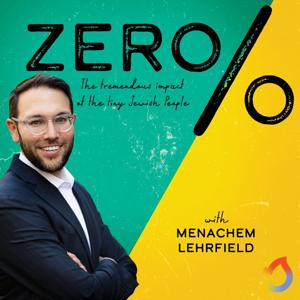
Zero Percent
Download on the App Store

Zero Percent episodes

  • 4 - Praise
    In this episode, we continue our exploration of Dr. Carol Dweck's Growth and fixed Mindsets and learn about the profound impact of praise on building a growth mindset.

    Check out Menachem Lehrfield's Dear Rabbi Podcast at https://podcasts.apple.com/us/podcast/dear-rabbi/id1565016262

    You can hear more from Dr. Dweck here: https://www.google.com/url?sa=t&rct=j&q=&esrc=s&source=web&cd=&cad=rja&uact=8&ved=2ahUKEwipi-3RjLbzAhWYvp4KHaBkCEEQwqsBegQIBRAB&url=https%3A%2F%2Fwww.youtube.com%2Fwatch%3Fv%3DhiiEeMN7vbQ&usg=AOvVaw0ZqEGfXWawIoLla_rt0vmU

    You can get a copy of Mindset: The New Psychology of Success by Dr. Carol Dweck here:
    https://www.amazon.com/Mindset-Psychology-Carol-S-Dweck/dp/0345472322

    Episode Transcript:

    Hey everybody. I'm Menachem Lehrfield welcome to Zero Percent, where we explore world-changing ideas introduced by Judaism. Ancient wisdom for modern living. We've been discussed the book Mindset by Carol Dweck. And before we continue exploring some of Dr. Dweck's research, it's important to get a little bit of context. Professor Dweck wanted to understand why some people reached their potential while others do not. And she discovered that a person's success has less to do with our abilities and everything to do with our belief about our abilities. She introduced this research at the height of the self-esteem movement. We believed, and I think we still do, that self-esteem is perhaps the most important thing, especially when it comes to our children's performance. If we want our children to perform. If we, as individuals and human beings want to perform at our optimum best, we need to have a healthy self image. Self-esteem is crucial.
    And for decades, parents and psychologists and teachers were operating under the assumption that if we want to increase a child's self-esteem, the best way to do it is through praise and reward. And that created an entire generation that gave participation trophies. I remember when I graduated high school, every single kid in the class got an award. It was a small class. We only had 20 kids or something. But I remember I got an award which I thought I really... I didn't do very much academic work, but I did do a lot of service work and I was the president of student body. And I got this award at the end, and I felt very proud of that accomplishment until I realized literally every single kid in the class was getting an award. When we all win, nobody wins. We got into a situation where we couldn't tell our children when they were doing anything wrong, because their self-esteem, their way of looking at themselves was so fragile that if we did anything, we were going to crush it. And then came the prizes and the reward, and most importantly, the praise.
    What Carol Dweck recognized is that praise alone does not equal self-esteem. Praise alone does not produce self-esteem. What's crucial is not whether or not we praise, but how we praise. When I praise somebody for who they are, I say you are so... fill in the blank. You are so pretty. You are so smart. You are so athletic. What I am telling that person is, "You are fixed. That's the way you are." I'm labeling them. And what that does is it puts them into a fixed mindset. So not only does that praise not build their self-esteem, in fact, it crushes it. When a child receives praise for something they know they didn't deserve, something they know they didn't earn, their brain actually translates it as criticism, which is amazing.
    Think about it. I'm giving the child a piece of praise, because I want to help their self-esteem. The way the child translate that is I know I didn't do a good job. Right? All this negative self talk. I know I didn't do a good job. If you're telling me I did a good job, I must have done on so poorly that you felt the need and the necessity to tell me, I did a good job. Think about how backwards that is, but that's the way we interpret it. So it's not about the praise. It's about the way we praise. When I praise somebody for who they are, what I'm saying is, "You are fixed. And if you want to continue getting my praise, you need to show me that that's the way you always are." Somebody with a fixed mindset will never try new things, because when I try new things, it shows the world, when I don't succeed right away, I'm not so talented.
    When I praise somebody for what they do, I praise somebody for the process. I praise somebody for the effort that they put into the process. And again, she happened to have done her research on children, but this has been replicated and done in a business setting. It's been done with adults in a personal setting. This works regardless of who it's working on. This works, whether this is the way I speak to somebody else. This works in regards to how I speak to myself, how I speak to my spouse, to my partner, to my friend, to my coworkers, to my boss, to my employees. And I can tell you, when you first learn about this, I know at least me personally, when you first hear about this concept of well praising natural ability is not only neutral, it's actually negative and bad for our children, it's very difficult to switch gears. And you find yourself saying the words and trying to like rip them back. Like, "Oh, you're so ..."
    And you find yourself trying to edit because it's a very difficult thing to do to make that paradigm shift. I remember when we had... We used to have an early childhood center, which hopefully we will restart one day. But one of the basises of our early childhood center was the idea of the growth mindsets. And one of the things that we did on a regular basis is I would go in and I would have workshops with the teachers to help them incorporate certain growth mindset philosophies into the classroom, into the way they interacted with the children. And it's actually really difficult to do, and it's not the way you are brought up.
    I mean, think about it. Most of our society, the greatest compliment you can give them is, "You're a natural. Wow, such a natural." When you think about the types of compliments that make us feel good, what are they? Oh, you look beautiful. I remember when I was living in Israel, I used to sell photographs as a hybrid between a hobby and a excuse for a profession. And I would sell photographs. And I remember somebody once giving me a quote unquote compliment where they said to me, "Wow, that's a really beautiful picture. You must have a great camera." And I thought to myself, can you imagine translating that into an anything else in the world? Can you imagine going to somebody's house for dinner and after dinner saying, "That was delicious. You must have amazing pots. Your oven must be out of this world." It's obnoxious. But when you think about it, the compliments that make us feel the best are things we did absolutely nothing to achieve. When somebody says that you look beautiful and that's the first thing they mention about you, we should be embarrassed.
    When the first thing somebody says to you is, "You look beautiful," we should be thinking to ourselves, that means that that was the first thing the person noticed about me. I didn't do anything for that. "Oh wow. Your eyes are gorgeous." I was born like that. I did literally nothing. You can say maybe I put on makeup. I worked out. My eyes? I did literally nothing. I was born. That was it. Why do I feel good when someone compliments my eyes? I hear this all the time. After a big lecture, someone will come out to me and say, "Wow, you're such a natural."
    And for many people, and the truth is, for a long time, I would look at that as a compliment and say, "Wow." Because that's a fixed mindset. In a fixed mindset, I want to appear like a natural. I want to get off the stage and for everyone to think, wow, that was so effortless. But for someone with a growth mindset, that's embarrassing. For someone with a growth mindset, effortless, that's not something to be proud of. In our home, we sit around the dinner table. We'll each share something that was challenging or what's something that you failed at, what's something you tried, you didn't try before. Or what's a question that you asked, something that you you didn't know the answer to that you wanted to know and now you know something that you never knew before?
    When our children come home and we say, "How was school?" They're going to say, "Fine." And even more detrimental when our children come home, we say, "Oh, did you have fun today?" What we're doing is we're creating an entire generation of children who believe that the ultimate goal of everything we're doing is to have fun. Life is not about having fun. Yes, it's important to have fun in life, but that's not our goal. When my children come home after a long day of school and they tell me they had no challenges that day, my response is, "That's so sad. I'm so sorry your brain didn't have a chance to grow today." Usually at that point, they'll come up with something.
    But our approach totally changes. If we still feel most proud about the things we did absolutely nothing to achieve, that means we're still primarily operating from a fixed mindset. The good news is we can change. One of the most amazing things about her research and what really got me so drawn to it was how quickly we can create an onset of a growth mindset versus a fixed mindset. And I've tried this with my own children and it is remarkable. She brought in groups of two children one by one. And they gave them a visual IQ test. The first test was very easy. It was way below their grade level. They gave them the test, a test that they were all going to do very well at.

    For full transcript, visit: www.joidenver.com/zeropercent/4---praise
    19 min
  • 3 - The Mindsets
    This week we will introduce Carol Dweck's Growth Mindset and Fixed Mindset and begin exploring how Judaism encourages the growth mindset!

    Check out Menachem Lehrfield's Dear Rabbi Podcast at https://podcasts.apple.com/us/podcast/dear-rabbi/id1565016262

    You can hear more from Dr. Dweck here: https://www.google.com/url?sa=t&rct=j&q=&esrc=s&source=web&cd=&cad=rja&uact=8&ved=2ahUKEwipi-3RjLbzAhWYvp4KHaBkCEEQwqsBegQIBRAB&url=https%3A%2F%2Fwww.youtube.com%2Fwatch%3Fv%3DhiiEeMN7vbQ&usg=AOvVaw0ZqEGfXWawIoLla_rt0vmU

    You can get a copy of Mindset: The New Psychology of Success by Dr. Carol Dweck here:
    https://www.amazon.com/Mindset-Psychology-Carol-S-Dweck/dp/0345472322

    Episode Transcript:

    Hey, everybody, I'm Menachem Lehrfield. Welcome to Zero Percent, where we explore world-changing ideas introduced by Judaism. Ancient wisdom for modern living. In this week's episode, we're going to introduce the growth and the fixed mindset so that in future episodes, we can begin to understand how Judaism is constantly encouraging a growth mindset.
    We used to believe that teachers were feeders of information. The role of a teacher was to feed information to children. I have information. You need it. Let's all come together to one convenient place and I will impart wisdom onto you. That was the belief. We now understand that teachers are not feeders of information. Teachers are cultivators of curiosity. The role of a teacher is not to give the children information. The kids have more information on their wrist than we could possibly ever have in our heads and that we could possibly ever give them. The child is not coming to school for me to give them information. They don't need me for that. All they have to do is ask Alexa and she has all the answers.
    So what is the role of an educator? The role of an educator is to be a cultivator of curiosity. You see, my four-year-old loves learning. I'm told that when she turns 14, it might not be the same. Well, why not? Why don't our 14-year-old teenagers have the same love of learning as our four-year-olds? We come into this world naturally inquisitive. We come into this world with this limitless curiosity to want to know how everything works and to be fascinated by new information. I mean, you look at the way children learn. It's one of the most remarkable things in the entire world. There is perhaps nothing more inspiring than watching a child learn something new. And it's exciting and it's engaging and it's inspiring. And then something happens along the way.
    We're finally understanding that education is not about bubbling in the right answer on a test. Judaism teaches that every child is an individual and every child needs to be taught in a way that is necessary for that child based on their learning style. Judaism teaches that the information is nowhere near as important as the process, the journey, the questioning. The question is always more important than the answer.
    When I was in second grade, my teacher came up with a nickname for me, and she called me minimum Menachem. And that was a name that I think I earned and didn't just earn it in second grade, but that kind of stuck, at least in theory, all the way through my educational career. And the main reason why she gave me that name is that I made it my life's mission to put in the absolute least amount of effort possible. So I would size up a situation, figure out how can I put it in the least amount of effort possible and kind of coast my way through. If I was any more relaxed, I would slip into a coma.
    I remember going through most of my high school career, which used to drive my teachers absolutely crazy, where I would look at a test and I'd scan it up and down. And if I knew all the answers, I would take it. And if I didn't, I would just hand it back and blink. Now at the time, I couldn't tell you why I was doing that. I couldn't look at you and say, "Well, if I take the test and I try my hardest and I get a B, then that shows that I'm not really so bright. But if I get a zero, that just shows I have an attitude problem, and everybody already knows I have an attitude problem. It doesn't do anything to tarnish that status. It doesn't do anything to tarnish the either self or outside imposed title of this thing that I have to live up to."
    And that's how I went through most of my educational career. Then I graduated high school and went off to Yeshiva and there things were very, very different. So Yeshiva, for those who don't know, is essentially a school of Jewish studies, where it's more advanced Jewish studies. And it was a very foreign environment because there were no grades. There was no class rank. There was no one there really motivating me. And I began to sink. You see, I really got a good hold of the whole high school thing. I figured out how to go through most of my high school career getting A's without having to, like I said, put in much effort. And as long as you can do well on the test, that's all that matters.
    Nobody, at least in the high school I went to, and I think it's pretty similar for most of the schools, nobody really cares if you know the information. Nobody really cares what you're actually learning. The only thing that really matters is do you bubble in the "correct" answer on the test. Here I am in Yeshiva and I'm looking around and there's guys all around me who are very motivated and they're studying late into the night. And we had no tests and no finals. Once a semester we had, which was terrifying, this oral exam, but there was no grade. It was kind of like this experience where you have to face your teacher, who's going to, the way they say it in Yeshiva, is talk to you in learning, which means essentially you're going to be grilled on the subject that we're learning, that we've been learning for the past six months. And either you know it well or you don't. And when you don't, you know you don't know it. And it's an extremely difficult and embarrassing experience.
    But again, there's no grade. There's no you got this right, you got this wrong. We spent most of our time, for those who've ever studied Talmud, you know that Talmud is essentially the study not of the right answer but of multiple answers. In fact, we study more of the wrong answers than we do the right answers. And that's something that we're going to explore as we go through this. In Talmudic study, in traditional Jewish learning, it's not about the answer as much as it is about the questions. And as I went through this process of Jewish learning, I began to understand more and more that it wasn't about the end result. It was about the journey. It was about the process. It was about the experience of learning. And that was a completely different outlook, a completely different way of looking at all of this.
    So fast-forward a couple of years, I'm in grad school. And again, just trying to wing my way through without putting in any more effort than I absolutely have to. And I'm introduced to, at the time, the groundbreaking work of Carol Dweck. And she is a professor of positive psychology at Stanford. Her research basically shows that people look at the world in one of two ways. Either I look at the world with a fixed mindset, which means that I believe that I and the world, everything is fixed. A fixed mindset believes that everything is exactly the way it is always going to be. I am fill in the blank. Either I'm smart or I'm not. Either I'm attractive or I'm not. Either I'm athletic or I'm not.
    But the reality is, at least according to the fixed mindset, that whatever I am is fixed and it's never going to change. There's no point in trying. It doesn't even matter because ultimately it's fixed. It was all predetermined. It was all pre-decided. And I have X amount of everything. Then there's the growth mindset. The growth mindset believes that a person can constantly change. A person can constantly grow. The fixed mindset believes that intelligence and really everything is static. It's exactly the way it's always going to be. Somebody with a fixed mindset wants more than anything to look smart. I don't necessarily care about being smart. I just want to look smart.
    Now, if my whole goal is looking smart, what happens when I get to a challenge? See, a challenge is something that's hard and success is not assured. When I am faced with a challenge, it's not guaranteed that I'm going to succeed. It's challenging. So when I see a challenge, I avoid it at all costs. Because taking the risk when I am challenged means to the fixed mindset, again, keep in mind if a fixed mindset means that I am fixed, I am the way that I am, when I approach a challenge and I fail, it means I'm a failure. If I approach the question and I get it wrong, it means I'm dumb. So that particular challenge will directly affect my self-image. It will directly affect everything that I know about myself. So somebody with a fixed mindset will avoid challenges at all costs.
    Now, what happens when I can't control the situation around me? What happens when I come up with a challenge that I didn't choose, otherwise known as an obstacle. Here's an obstacle, something in front of me. It's something that I can't necessarily decide. When I am faced with an obstacle, I am going to give up easily. As Homer Simpson famously said, "If at first you don't succeed, burn all the evidence that you tried in the first place." That's the classic fixed mindset. If I don't know all the answers, I'm just going to hand it back and blink. When I am faced with an obstacle, somebody with a fixed mindset will say, "I'd rather do nothing than give the impression that I tried. Because if I tried and I still failed, that means I'm a failure." And so when they're faced with an obstacle, they give up very easily.

    For full transcript, visit
    19 min
  • 2 - The Most Jewish Business
    In this episode we explore the importance education plays in Judaism and how Jewish education has shaped the world.

    Check out the Dear Rabbi Podcast with Rabbi Lehrfield at https://podcasts.apple.com/us/podcast/dear-rabbi/id1565016262

    Episode Transcript:

    Hi everybody, I'm Menachem Lehrfield, and this is Zero Percent, where we explore world changing ideas introduced by Judaism, ancient wisdom for modern living. In the last episode we mentioned in passing so many Jewish contributions and inventions, and in the 18 minutes that we had we barely even scratched the surface. And the truth is, we could spend an entire episode on each and every one, and one day maybe we will. But first I think it's so much more important, so much more crucial to understand what we mentioned last time, is the black box that produces that success. To me it's so much more interesting to understand what produces the success that we see in science and medicine and technology, in all these different arenas and areas, so much more so than just understanding the stories of the Jewish people who have contributed to those different areas.
    So I want to begin our discussion trying to understand what are the pieces, what are the elements that contribute to and produce the success that we see around us in the world? The Jewish people have truly civilized the world, and we take so many of these ideas and ideals for granted. The very concept of basic human rights is a Jewish idea. The notion that the sick and the elderly shouldn't just be left to die or murdered, but they should be taken care of and cared for. The idea of a society assisting the poor and disadvantaged all come naturally to us, they seem like they make sense, but for so much of our history, before the Jewish people introduced those ideas, it wasn't the case. In the ancient world infanticide was commonplace, it was a normal way of ridding society of potentially burdensome or deformed members. Any baby that appeared weak or sickly at birth, or even had the smallest birth defect, like a cleft palate or a harelip or something, was just killed.
    And it wasn't just children with birth defects. Aristotle, someone who we regard as one of the most enlightened intellectuals who ever lived, argued in his politics that sometimes killing children was essential to the functioning of society. He wrote, "There must be a law that no imperfect or maimed child shall be brought up, and to avoid an excess and population some children must be exposed, for a limit must be fixed to the population of the state." That was the way he saw fit to deal with the population issue, and unfortunately there are people today who still believe that. We have to understand that Jewish wisdom introduced so many of the concepts that we take for granted today, and so it's so crucial for us to explore that Jewish wisdom that led to those discoveries.
    What's important to point out, though, is that when we look at these Jewish inventions, these Jewish ideals and concepts, they weren't just taught in an academic form, they were taught as a way of life. And so as we begin to explore, not just, again, the Jewish contribution to the world, but the ideas, ideals, concepts that led to that success, it's important to keep in mind that it's not just in the intellectual realm, in the academic realm, but the reason why it's been so successful at becoming part of a entire nation, entire people's DNA, is because it has been organically seeping into every aspect of our lives. Every aspect of Judaism, both in the ideas that we teach ourselves and our children, to the ways that we act on a regular basis, the ways that we mark time, the ways that we celebrate our holidays, all of these things combined together reinforce all of the things that we learn, all the things that we teach.
    Most often, it's the nonverbal messages that we give over to our children, that we reinforce for ourselves, that are so much more powerful than the verbal messages that we share. So yes, telling your children for 3000 years that they can change the world will obviously produce the result that they will, in fact, change the world. But it's so much more powerful to show them, to imbue within ourselves and our children these deep messages organically, in a way that it just seeps in.
    In this first season I want to begin our conversation with the most Jewish business that there is. When you think of a Jewish business, some want to look at entertainment, Hollywood, as we said, so many of the major studios were founded by Jews, or perhaps law or medicine, but the truth is the most Jewish business out there is education, and that's where I want to begin our discussion, exploring and understanding what Jewish wisdom says about education. Jewish wisdom teaches that the almighty sealed a covenant with the Jewish people, making them an eternal people specifically because he understood that Abraham would educate his children, he would teach his children.
    Jewish wisdom places education as our highest value. Jewish wisdom introduced the idea of education for all, it commands parents to educate their children and requires the community to take on that responsibility if the parents are not able to. Unlike most of the ancient world, literacy and education was never reserved for the scholars and the clergymen, it was never something just for the rabbis. The ideal was always constant, lifelong learning as a requirement for every single Jew man, woman and child. In the ancient world literacy rate were generally a 10th of a percent of the general society. Education was almost unheard of, except for perhaps the elite and the wealthy of society. Even in Rome, the beacon of enlightenment education, even Rome only had a literacy rate of maybe 10 or 15%.
    Not only did Greece and Rome not deem it beneficial to educate the masses, they actually viewed education as a potential danger to the stability of society, but Judaism taught that education was a human right, that every single person, regardless of their background, regardless of their stature, what was entitled to. It was a value that was so crucial and so important to the Jewish people. Every single parent saw their role primarily as educator. Their responsibility was not just to raise their children and make sure they were alive and living, it wasn't just teaching their child a trade, it was educating them, imbuing within their children a love of learning that would last forever. It was sharing with their children the ability to learn on their own, and parents took that responsibility seriously. It was a primary part of every single person's day.
    In 64 of the Common Era, Rabbi Joshua ben Gamla understood that many parents were not able to spend so much time every day teaching their children. It was then, close to 2000 years before the establishment of our modern public school system, that Rabbi Joshua ben Gamla ruled that every single Jewish child aged six and up should attend school, regardless of a child's background, that means no matter whether or not the parents can afford to send them, the community was responsible to ensure that every single Jewish child received a free Jewish education. And he didn't stop there, he even instituted how the education was going to be carried out. He mandated a maximum class size, no more than 25 students per teacher, to ensure that children didn't just get an education, but they got a quality education.
    This is the basis of Jewish schools that exist throughout the world today. No matter what city you go to, any city with a Jewish community will have a Jewish school that will offer subsidized Jewish education for any student who can't afford it. As far as I know this is the first instance in recorded history where we find a compulsory universal education funded by the larger community, because they recognized the value that education played on not just those children's lives, but on the society as a whole.
    Many scholars look at ben Gamla model as the basis of our modern public school system. It's hard to say that we would even have have a public school system had Judaism not introduced it thousands of years before. And it didn't end when a child "graduated," or became an adult, Judaism taught to constantly have this lifelong love of learning. There's a Jewish teaching that states, "Do not say when a I'm free I will study, for perhaps you will never become free." It required that every single person set aside time every single day to study and to learn something new. How many people today in our society do that? We spend 12 years or so in school, and then maybe go to college or grad school, and then what?
    For most of us learning ends after graduation. We get a job, we start in a career, and then if we're required to take some sort of continuing ed course we take it, but specifically in the area that we're already working at. How many of us continue learning for the sake of learning throughout the rest of our lives? That is a Jewish value that is so crucial. Education is not just limited to a student as a means to get a degree, as a means to be able to practice a specific profession, but the education is there as an ideal in and of itself. And that's why it's so crucial to make time to study, to make the time to learn, because if we're just waiting until we find the time we'll never truly find the time, because there will always be something else to fill our time, there will always be another excuse.

    For full transcript visit: https://www.joidenver.com/zeropercent/2---the-most-jewish-business
    19 min
  • 1 - Zero Percent
    The Jewish People make up just .2% of world population. How does a People that makes up virtually zero percent of humanity have such a huge impact on our world?

    Check out the Dear Rabbi Podcast at https://podcasts.apple.com/us/podcast/dear-rabbi/id1565016262

    Episode Transcript:
    Mark Twain wrote, "If the statistics are right, the Jews constitute but 1% of the human race. Properly, the Jew ought hardly be heard of, but he is heard of, has always been heard of. He is as prominent on the planet as any other people, and his commercial importance is extravagantly out of proportion to the smallness of his bulk. His contributions to the world's list of great names in literature, science, art, music, finance, medicine, and abstruse learning are also way out of proportion to the weakness of his numbers."
    This 1% is a gross exaggeration. The Jewish people today actually make up way less than a percent. We make up 0.2% of the world's population. Now, math was never my strong point, but if we're going to round 0.2 to the closest number, that's zero. The Jewish people make up just 0% of world population. Now, how does a people who make up just 0% have such a huge impact on the world? As Mark Twain wrote, "The Jew ought hardly be heard of," and yet we cannot escape the fact that the Jewish people have contributed so much to our world. I'm Menachem Lehrfield, and this is Zero Percent, a podcast where we explore the enormous impact a tiny people has made that enhances and affects all of our lives on a daily basis.
    We will explore ancient wisdom for modern living. As the second president of the United States, John Adams, said, "I will insist that the Hebrews have done more to civilize men than any other nation. If I were an atheist and believed in blind eternal fate, I should still believe that fate had ordained the Jews to be the most essential instrument for civilizing nations." Whether you love the Jewish people or you hate them, it is very difficult to deny the impact that the Jewish people have had on the world, that the Jewish people have had on civilizing nations. I believe that we have access to the longest-running case study on success.
    Now, as a Jew, I'm so uncomfortable with the topic of Jewish success, and I know many others are as well. Whenever someone begins talking about how successful the Jewish people are, it naturally makes us uncomfortable, but it's hard to deny the numbers. No matter what your definition of success is, the Jew is over-represented. Perhaps the best benchmark of success is the Nobel Prize. It was established by the Swedish inventor Alfred Nobel in 1895. Nobel was most well-known for the discovery of dynamite. And at the end of his life, in his will he bequeathed all of his assets to be used to establish five prizes, which we now know as the Nobel Prize.
    And they'd go to individuals in recognition of cultural or scientific advances in six categories, literature, chemistry, economics, physics, world peace, and medicine. Between 1901 and 2020, last year, the Nobel Prize has been awarded to more than 900 individuals and organizations. Now, how many of those recipients would you expect to be Jewish? Being that the Jewish people make up just 0.2% of world population, we would expect 1.8 Nobel Prize laureates to be Jewish. That would be the proportionate number based on population. In fact, 208 Jewish people have won Nobel Prizes. 208 is an over-representation of more than 11,500%.
    That's huge, but it's not just in Nobel Prizes that we see such over-representation. Look at practically every arena that can be measured. Can you imagine the scientific world without the contributions of Einstein to modern physics or Freud to psychoanalysis or Asimov to robotics? The scientific world would be a completely different place. And let's say you're going to look at finance and economics as your benchmark of success. It's interesting to note that according to Forbes, Jews make up 22% of the world's top 50 billionaires, 33% of the world's top 15 billionaires, and 28% of the top 25, not to mention finance household names like Goldman Sachs, Rothschild, Warburg, Kohlberg, Kravis and Roberts, Wells Fargo.
    What would the world of technology look like without Intel's Andrew Grove and Leslie Vadasz, or Google without Sergey Brin and Larry Page, or Oracle's Larry Ellison, or Microsoft's Steve Ballmer, Dell's Michael Dell, Qualcomm's Irwin Jacobs, Facebook without Mark Zuckerberg or Sheryl Sandberg? And what about medicine? There's an old Jewish joke where a Jewish person is finally elected president of the United States, and he calls up his mother and says, "Mom, I'm the president of the United States. Are you going to come to the inauguration?" And she says, "Well, I've got nothing to wear." So he says, "Ma, I'm going to be the president. I'll get you a dressmaker. She'll make you a beautiful dress. Don't worry about that."
    And she says, "Well, I only eat kosher." He says, "Ma, I'm the president. I'll get you a kosher meal." She says, "Well, how am I going to get there?" He says, "Mom, I'll send Air Force One to pick you up. Just come to the inauguration." So she comes, and she ends up at the inauguration and she's standing there on the reviewing stand, and on her left are all the Supreme Court justices, and on the right is the president's cabinet. And the ceremony begins, and her son, the new president, raises his hand as he's about to be sworn into office, and his mother nudges the person next to her and says, "You see that guy with his hand up? His brother is a doctor."
    You may be familiar with the stereotype of the nice Jewish doctor, but it comes from somewhere. Throughout the world, consistently on lists of top doctors, you will find Jewish names. And that's not to mention the enormous Jewish contributions to medical research and pharmacology, including the invention of Prozac, Valium, the synthetic fertilizer, radiation, chemotherapy, the artificial kidney dialysis machine, the defibrillator, the cardiac pacemaker, laser technology, not to be confused with Jewish space lasers, the invention of blood transfusions and penicillin, the mammogram, the pill, vaccines against the deadly polio and hepatitis B and measles, not to mention the vaccinating needle itself.
    And we can't forget about the enormous impact that Dr. Albert Bourla, the CEO of Pfizer, has had in developing the world's first safe and effective COVID-19 vaccine. And Dr. Bourla is the son of Holocaust survivors. Today, Israel is on the forefront of medical innovation. Israel is the home to Teva, the world's largest generic pharmaceutical company. Israel is number one in the world for medical device patents per capita. The medical technology that's coming out of Israel is the stuff of science fiction. I don't know if you saw the ReWalk, which was featured years ago in the hit show Glee, but it's basically a bionic robotic exoskeleton which allows paraplegics the ability to walk and even run.
    Runners in London and Tel Aviv have actually completed marathons with the ReWalk. Here are paraplegics that thought they would never walk again, and they're running marathons thanks to Israeli technology. The PillCam, which allows doctors to see the inside of the digestive track without any invasive procedures or colonoscopies or anything. You just swallow a pill and they can see the inside of your body. Or this thing called Bio Weld, which is used now instead of stitches or glue, which uses cold plasma, and within minutes, it seals the wound and disinfects it with almost no scarring and no recovery time.
    And have you seen this thing called Bio-Retina? It's a technology that restores vision to people blinded by retinal disease. It's basically this tiny implantable device that's inserted into the retina in a 30 minute outpatient procedure, and it turns into an artificial retina that melds to the neurons in the eye. And it charges itself with this pair of glasses that it comes with. And if somebody is blind or visually impaired and that's not an option, there's another Israeli technology called OrCam, which is a camera that magnetically attaches to the side of a pair of glasses. You can barely even see it, and it reads text displayed on any surface, and it can also identify objects or specific faces or amounts of currency or anything that somebody who's visually impaired or blind would need to see.
    So it has this discreet earpiece which will basically, through audio, tell you everything that you would be seeing with your eyes. So blind people can interact with their world without the need of somebody else. It really gives them a sense of independence. There are so many successful cancer treatments coming out of Israel, and we can spend hours discussing the impact the Jewish people have had in the world of medicine. But let's say you want something a little lighter. Maybe entertainment is your benchmark of success. Well, if it is, six of the eight biggest Hollywood studios were founded by Jews. And still today, the rolling credits of almost every single movie can be confused for a Hebrew school roll call. It's just Jew after Jew after Jew.

    For full transcript please visit: www.joidenver.com/zeropercent/1---zero-percent

    19 min

About Zero Percent

From the publisher's feed

The Jewish People make up just .2% of world population. How does a People that makes up virtually zero percent of humanity have such a huge impact on our world?

More shows like Zero Percent

Dear Rabbi by Menachem Lehrfield

Dear Rabbi

14 Listeners

JOI to the World by Menachem Lehrfield

JOI to the World

3 Listeners