
Sign up to save your podcasts
Or

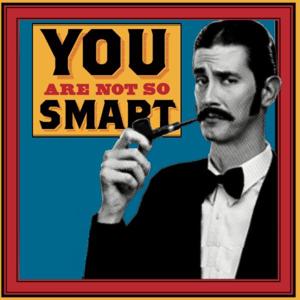

When you desire meaning, when you want things to line up, when looking for something specific, you tend to notice patterns everywhere, which leads you to ask the question, “What are the odds?” Usually, the odds are actually pretty good.
For instance: Does the Bermuda Triangle seem quite as mysterious once you know that just about any triangle of that size drawn over the globe just about anywhere planes and ships frequently travel will contain as many, if not more, missing planes and ships?
Drawing circles (or triangles) around the spots where randomness clusters together seemingly chance events is called The Texas Sharpshooter fallacy, and it is one of the easiest mistakes to make when trying to understand big, complex sets of data.
Though some things in life seem too amazing to be coincidence, too odd to be random, too similar to be chance, given enough time (and enough events) randomness will begin to clump up in places. Since you are born looking for those spots where chance events have built up like sand into dunes, picking out clusters of coincidence is a predicable malfunction of a normal human mind, and it can easily lead to the Texas Sharpshooter Fallacy.
Listen as three experts in reasoning and logic explain why it is so easy to find what you are looking for when you go anomaly hunting in a large set of data.
This episode of the You Are Not So Smart Podcast is the fifth in a full season of episodes exploring logical fallacies. The first episode is here.
• Show Notes: http://bit.ly/1Nokeze
• Patreon: https://www.patreon.com/youarenotsosmart
• Donate Directly through PayPal: https://www.paypal.me/DavidMcRaney
SPONSORS
• Mac Weldon: https://www.mackweldon.com/
• The Great Courses Plus: https://www.thegreatcoursesplus.com/smart
• SquareSpace: http://www.squarespace.com - Offer Code SoSmart
Patreon: http://patreon.com/youarenotsosmart
Hosted by Simplecast, an AdsWizz company. See pcm.adswizz.com for information about our collection and use of personal data for advertising.
 View all episodes
 By You Are Not So Smart

4.5
16911,691 ratings
When you desire meaning, when you want things to line up, when looking for something specific, you tend to notice patterns everywhere, which leads you to ask the question, “What are the odds?” Usually, the odds are actually pretty good.
For instance: Does the Bermuda Triangle seem quite as mysterious once you know that just about any triangle of that size drawn over the globe just about anywhere planes and ships frequently travel will contain as many, if not more, missing planes and ships?
Drawing circles (or triangles) around the spots where randomness clusters together seemingly chance events is called The Texas Sharpshooter fallacy, and it is one of the easiest mistakes to make when trying to understand big, complex sets of data.
Though some things in life seem too amazing to be coincidence, too odd to be random, too similar to be chance, given enough time (and enough events) randomness will begin to clump up in places. Since you are born looking for those spots where chance events have built up like sand into dunes, picking out clusters of coincidence is a predicable malfunction of a normal human mind, and it can easily lead to the Texas Sharpshooter Fallacy.
Listen as three experts in reasoning and logic explain why it is so easy to find what you are looking for when you go anomaly hunting in a large set of data.
This episode of the You Are Not So Smart Podcast is the fifth in a full season of episodes exploring logical fallacies. The first episode is here.
• Show Notes: http://bit.ly/1Nokeze
• Patreon: https://www.patreon.com/youarenotsosmart
• Donate Directly through PayPal: https://www.paypal.me/DavidMcRaney
SPONSORS
• Mac Weldon: https://www.mackweldon.com/
• The Great Courses Plus: https://www.thegreatcoursesplus.com/smart
• SquareSpace: http://www.squarespace.com - Offer Code SoSmart
Patreon: http://patreon.com/youarenotsosmart
Hosted by Simplecast, an AdsWizz company. See pcm.adswizz.com for information about our collection and use of personal data for advertising.
21,790 Listeners

43,898 Listeners

32,100 Listeners

43,528 Listeners

26,197 Listeners
10,729 Listeners

93 Listeners
26,250 Listeners

105 Listeners

64 Listeners

211 Listeners

9 Listeners

25 Listeners

12,237 Listeners

6,435 Listeners
41 Listeners

63 Listeners

378 Listeners

1,197 Listeners

934 Listeners
1,627 Listeners
5,120 Listeners

15,950 Listeners
2,306 Listeners