
Sign up to save your podcasts
Or

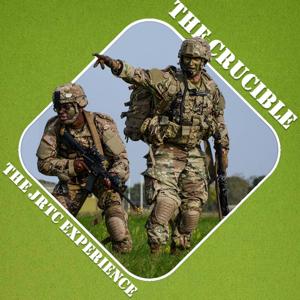

The Joint Readiness Training Center is pleased to present the one-hundredth-and-eighteenth episode to air on ‘The Crucible - The JRTC Experience.’ Hosted by the Senior Enlisted Medical Advisor and Role II Observer-Coach-Trainer for the Task Force Sustainment (BSB / CSSB), MSG Timothy Sargent on behalf of the Commander of Ops Group (COG). Today’s guests are all combat medicine professionals across the JRTC. SFC William Deutsch is the Senior Medical OCT with TF-3 (IN BN), SFC Robert Schimmelpfenneg is the Medical Advisor and Role II OCT with TF Sustainment (BSB / CSSB), and SFC Anthony Norris is the Senior Medical OCT with Live Fire Division.
This episode dives deep into combat medicine at the tactical small-unit level, focusing on what 68W medics truly face in a large-scale combat operations environment. The discussion highlights how today’s medics arrive from Basic Combat Training and Advanced Individual Training with significantly more clinical capability: whole blood transfusions, chest tubes, finger thoracotomies, FAST exams, etc. Yet often lose proficiency once they reach their units due to lack of repetitions, limited clinical exposure, and competing taskings like motor-pool duties and gate guard. The panel emphasizes the widening gap between what new medics learn in the schoolhouse and what line units actually reinforce day to day. Just as importantly, the episode stresses that modern LSCO demands a return to mastery of basics: triage under mass-casualty conditions, reassessments, deliberate casualty collection point (CCP) management, documentation, and base-level soldier tasks such as security, dispersion, movement, and survivability. We routinely observe high-casualties at JRTC, often 60–80 casualties at once and hundreds per rotation. Poor triage and poor soldier-skill fundamentals, not lack of “sexy medicine,” are the leading causes of died-of-wounds outcomes.
The episode also examines how units can better sustain medical readiness during home-station training. Leaders discuss integrating medics into ER rotations, EMS ride-alongs, sick-call operations, and realistic trauma/medical lanes that reinforce both prolonged field care and everyday DMBI cases. They argue that NCOs must reclaim ownership of training through proper DTMS programming, use of existing doctrinal resources, and deliberate linkage to mission-essential tasks. The conversation closes on three high-value priorities for the future fight: deliberate triage, accurate/documented patient care, and competent CCP & CASEVAC execution—all grounded in disciplined soldiering, not just advanced interventions. Ultimately, the episode makes clear that on the LSCO battlefield, combat medics must be clinicians, communicators, and soldiers, capable of saving lives while enabling commanders to maintain combat power forward.
Part of S05 “Beans, Bullets, Band-Aids, Batteries, Water, & Fuel” series.
For additional information and insights from this episode, please check-out our Instagram page @the_jrtc_crucible_podcast
Be sure to follow us on social media to keep up with the latest warfighting TTPs learned through the crucible that is the Joint Readiness Training Center.
Follow us by going to: https://linktr.ee/jrtc and then selecting your preferred podcast format.
Again, we’d like to thank our guests for participating. Don’t forget to like, subscribe, and review us wherever you listen or watch your podcasts — and be sure to stay tuned for more in the near future.
“The Crucible – The JRTC Experience” is a product of the Joint Readiness Training Center.
 View all episodes
 By JRTC CALL Cell

4.7
2929 ratings
The Joint Readiness Training Center is pleased to present the one-hundredth-and-eighteenth episode to air on ‘The Crucible - The JRTC Experience.’ Hosted by the Senior Enlisted Medical Advisor and Role II Observer-Coach-Trainer for the Task Force Sustainment (BSB / CSSB), MSG Timothy Sargent on behalf of the Commander of Ops Group (COG). Today’s guests are all combat medicine professionals across the JRTC. SFC William Deutsch is the Senior Medical OCT with TF-3 (IN BN), SFC Robert Schimmelpfenneg is the Medical Advisor and Role II OCT with TF Sustainment (BSB / CSSB), and SFC Anthony Norris is the Senior Medical OCT with Live Fire Division.
This episode dives deep into combat medicine at the tactical small-unit level, focusing on what 68W medics truly face in a large-scale combat operations environment. The discussion highlights how today’s medics arrive from Basic Combat Training and Advanced Individual Training with significantly more clinical capability: whole blood transfusions, chest tubes, finger thoracotomies, FAST exams, etc. Yet often lose proficiency once they reach their units due to lack of repetitions, limited clinical exposure, and competing taskings like motor-pool duties and gate guard. The panel emphasizes the widening gap between what new medics learn in the schoolhouse and what line units actually reinforce day to day. Just as importantly, the episode stresses that modern LSCO demands a return to mastery of basics: triage under mass-casualty conditions, reassessments, deliberate casualty collection point (CCP) management, documentation, and base-level soldier tasks such as security, dispersion, movement, and survivability. We routinely observe high-casualties at JRTC, often 60–80 casualties at once and hundreds per rotation. Poor triage and poor soldier-skill fundamentals, not lack of “sexy medicine,” are the leading causes of died-of-wounds outcomes.
The episode also examines how units can better sustain medical readiness during home-station training. Leaders discuss integrating medics into ER rotations, EMS ride-alongs, sick-call operations, and realistic trauma/medical lanes that reinforce both prolonged field care and everyday DMBI cases. They argue that NCOs must reclaim ownership of training through proper DTMS programming, use of existing doctrinal resources, and deliberate linkage to mission-essential tasks. The conversation closes on three high-value priorities for the future fight: deliberate triage, accurate/documented patient care, and competent CCP & CASEVAC execution—all grounded in disciplined soldiering, not just advanced interventions. Ultimately, the episode makes clear that on the LSCO battlefield, combat medics must be clinicians, communicators, and soldiers, capable of saving lives while enabling commanders to maintain combat power forward.
Part of S05 “Beans, Bullets, Band-Aids, Batteries, Water, & Fuel” series.
For additional information and insights from this episode, please check-out our Instagram page @the_jrtc_crucible_podcast
Be sure to follow us on social media to keep up with the latest warfighting TTPs learned through the crucible that is the Joint Readiness Training Center.
Follow us by going to: https://linktr.ee/jrtc and then selecting your preferred podcast format.
Again, we’d like to thank our guests for participating. Don’t forget to like, subscribe, and review us wherever you listen or watch your podcasts — and be sure to stay tuned for more in the near future.
“The Crucible – The JRTC Experience” is a product of the Joint Readiness Training Center.

153,606 Listeners
1,079 Listeners
768 Listeners

717 Listeners
423 Listeners
45,665 Listeners
688 Listeners
402 Listeners
143 Listeners

377 Listeners
22 Listeners
469 Listeners
3,356 Listeners
9 Listeners

390 Listeners