
Sign up to save your podcasts
Or

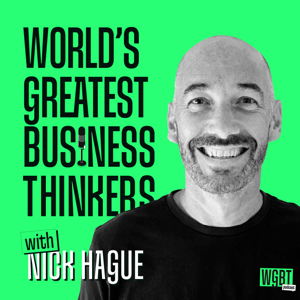

What if everything you thought about branding was missing the real asset underneath? What if the most powerful driver of growth in your business isn't your product, your pricing, or your marketing spend?
In this episode of World's Greatest Business Thinkers, Nick Hague speaks with David Aaker, widely regarded as the father of modern branding, to unpack why brand equity and not awareness is the real strategic asset behind sustainable growth. David explains how the Five B's framework elevates branding from a cost centre to a core business discipline, why relevance beats visibility in crowded markets, and how leaders can resist short-term thinking while navigating AI-driven disruption. David makes his points with real-world examples from Uniqlo to Dove, to highlight how brand building creates a lasting competitive advantage.
What You Will Learn:
How to shift brand thinking from expense to asset
The Five B's Framework for modern brand building
Why brand relevance trumps brand awareness in today's crowded marketplace
How to use cognitive anchors to cut through communication clutter
The critical role of branding in disruptive innovation
How to avoid the purpose-washing trap and build authentic brand energizers
If you enjoyed this episode, make sure to subscribe, rate, and review it on Apple Podcasts, Spotify, and YouTube Podcasts. Instructions on how to do this are here.
David Aaker Bio
David Aaker, called the "Father of Modern Branding" by Philip Kotler, is Vice Chairman at Prophet, a global growth consultancy, and one of the world's foremost authorities on brand strategy. A Professor Emeritus at UC Berkeley's Haas School of Business, he created foundational models, including the Aaker Brand Vision Model. Inducted into the American Marketing Association Hall of Fame, Aaker has authored 18 bestselling books translated into 18 languages and continues to advise, teach, and speak globally on building strong brands.
Quotes:
"Everybody was trying to increase market share, and never mind how you did it, never mind how you damaged brands, but that's what you did. They destroyed brands. They achieved no growth, and they destroyed profits. So at the end of the eighties, people kind of were looking around the strategies, the top managers were saying, it's not working, and we need something else."
"What I did was to add brand loyalty to the concept of brand equity, and that really changed everything because brand loyalty involves the whole customer journey. It involves all the R and D and so forth. It involves segmentation, and it involves all elements of business strategy. So that meant that there was now a seat at the executive table for marketing."
"The first B is the fact that brands are equity. It's not something that is a communication task. You're building up an asset that you will use to leverage to build future growth. Brand relevance is a much more strategic concept because you no longer have to just be visible; you have to be visible in a certain context and be credible as well."
"Virtually the only way to grow is with disruptive innovation. It's the most extreme form of differentiation, which we know has been a driver forever. Branding is absolutely essential for disruptive innovation to prosper and succeed, and it has four jobs to do. The first job is to position the new disruptive innovation and tell customers why they should go to this disruption instead of what they used to do."
Episode Resources:
David Aaker on LinkedIn
Prophet Website
Nick Hague on LinkedIn
World's Greatest Business Thinkers on Apple Podcasts
World's Greatest Business Thinkers on Spotify
World's Greatest Business Thinkers on YouTube
 View all episodes
 By Nick Hague

4.4
55 ratings
What if everything you thought about branding was missing the real asset underneath? What if the most powerful driver of growth in your business isn't your product, your pricing, or your marketing spend?
In this episode of World's Greatest Business Thinkers, Nick Hague speaks with David Aaker, widely regarded as the father of modern branding, to unpack why brand equity and not awareness is the real strategic asset behind sustainable growth. David explains how the Five B's framework elevates branding from a cost centre to a core business discipline, why relevance beats visibility in crowded markets, and how leaders can resist short-term thinking while navigating AI-driven disruption. David makes his points with real-world examples from Uniqlo to Dove, to highlight how brand building creates a lasting competitive advantage.
What You Will Learn:
How to shift brand thinking from expense to asset
The Five B's Framework for modern brand building
Why brand relevance trumps brand awareness in today's crowded marketplace
How to use cognitive anchors to cut through communication clutter
The critical role of branding in disruptive innovation
How to avoid the purpose-washing trap and build authentic brand energizers
If you enjoyed this episode, make sure to subscribe, rate, and review it on Apple Podcasts, Spotify, and YouTube Podcasts. Instructions on how to do this are here.
David Aaker Bio
David Aaker, called the "Father of Modern Branding" by Philip Kotler, is Vice Chairman at Prophet, a global growth consultancy, and one of the world's foremost authorities on brand strategy. A Professor Emeritus at UC Berkeley's Haas School of Business, he created foundational models, including the Aaker Brand Vision Model. Inducted into the American Marketing Association Hall of Fame, Aaker has authored 18 bestselling books translated into 18 languages and continues to advise, teach, and speak globally on building strong brands.
Quotes:
"Everybody was trying to increase market share, and never mind how you did it, never mind how you damaged brands, but that's what you did. They destroyed brands. They achieved no growth, and they destroyed profits. So at the end of the eighties, people kind of were looking around the strategies, the top managers were saying, it's not working, and we need something else."
"What I did was to add brand loyalty to the concept of brand equity, and that really changed everything because brand loyalty involves the whole customer journey. It involves all the R and D and so forth. It involves segmentation, and it involves all elements of business strategy. So that meant that there was now a seat at the executive table for marketing."
"The first B is the fact that brands are equity. It's not something that is a communication task. You're building up an asset that you will use to leverage to build future growth. Brand relevance is a much more strategic concept because you no longer have to just be visible; you have to be visible in a certain context and be credible as well."
"Virtually the only way to grow is with disruptive innovation. It's the most extreme form of differentiation, which we know has been a driver forever. Branding is absolutely essential for disruptive innovation to prosper and succeed, and it has four jobs to do. The first job is to position the new disruptive innovation and tell customers why they should go to this disruption instead of what they used to do."
Episode Resources:
David Aaker on LinkedIn
Prophet Website
Nick Hague on LinkedIn
World's Greatest Business Thinkers on Apple Podcasts
World's Greatest Business Thinkers on Spotify
World's Greatest Business Thinkers on YouTube

43,549 Listeners

2,542 Listeners

8,785 Listeners
9,115 Listeners

176 Listeners
44 Listeners
670 Listeners
628 Listeners
11 Listeners
3,566 Listeners

2,145 Listeners
1,633 Listeners

1,222 Listeners
45 Listeners

2,382 Listeners