
Sign up to save your podcasts
Or

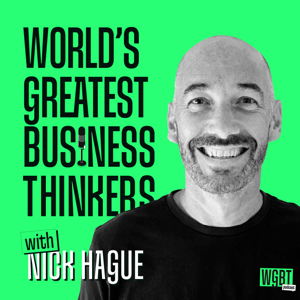


What if your biggest business opportunity lies in solving a problem nobody else has recognised?
On World's Greatest Business Thinkers, host Nick Hague sits down with Jo Fairley, keynote speaker and co-founder of Green & Black's and Beauty Bible, to explore the principles behind building successful, purpose-driven businesses. Drawing on her experience as a serial entrepreneur, Jo explains why genuine conviction in your product, exceptional quality, and ethical business practices can create powerful competitive advantages.
The conversation explores how identifying unmet needs can reveal untapped market opportunities, why purpose should be embedded in a business model rather than treated as an afterthought, and how complementary skills strengthen founding partnerships. Jo also shares insights into strategic focus, market research, and the importance of resisting the temptation to follow competitors.
From pioneering organic chocolate to challenging conventions in the beauty industry, her entrepreneurial journey offers valuable lessons for anyone looking to build a sustainable business that combines commercial success with meaningful impact.
What You Will Learn:
Why fundamental belief in your product simplifies every downstream business decision
The case for treating yourself as your own best market researcher
Why embedding social and environmental impact into the core business model outperforms treating it as a bolt-on initiative
How complementary skill sets, rather than shared ones, make founding partnerships genuinely greater
Why unfocused growth dilutes energy and sustained growth
The value of mentorship that goes beyond encouragement
Why resisting the urge to watch competitors closely preserves conviction and keeps strategic focus on your own mission
If you enjoyed this episode, make sure to subscribe, rate, and review it on Apple Podcasts, Spotify, and YouTube Podcasts. Instructions on how to do this are here.
About the Guest:
Jo Fairley is a serial entrepreneur, keynote speaker, and co-founder of Green & Black's, the pioneering brand behind the UK's first organic chocolate and first Fairtrade-marked product, and the co-founder of Beauty Bible. A former magazine editor who became the UK's youngest at 23, she has built ventures spanning organic food, wellbeing, beauty, and fragrance. She co-authored the bestselling Beauty Bible series and The Story of Green & Black's, and advises brands on product development, positioning, and PR. Through her speaking and entrepreneurial work, Jo champions purpose-driven business, ethical principles, and the power of exceptional products to create lasting commercial success.
Quotes:
"When you've got that fundamental belief in your product or your service, it just makes it so easy because everything flows from there." - Jo Fairley
"If you don't have imposter syndrome when you're first given a new role, you're not being stretched enough." - Jo Fairley
"The only difference between you and me is I just roll up my sleeves and do it." - Jo Fairley
"You can't ask consumers because they can only talk retrospectively, so that's the wrong place to be looking." - Jo Fairley
"Don't look at what the competition is doing because every time you look back over your shoulder, you slow down." - Jo Fairley
Keywords:
Primary Keywords (Core Themes): ethical business, social enterprise, organic chocolate, fair trade, purpose-driven business, Green and Blacks, serial entrepreneur, business with values, sustainable business, impact investing
Secondary Keywords (Related Subtopics): organic food market, fair trade certification, farmer income improvement, Coco Life program, chocolate industry, supply chain ethics, consumer behavior, brand strategy, product innovation, business partnership, complementary skills, cash flow management, market research, beauty industry
Episode Resources:
Jo Fairley on LinkedIn
Green and Black's Website
Beauty Bible Website
World's Greatest Business Thinkers on Apple Podcasts
World's Greatest Business Thinkers on Spotify
World's Greatest Business Thinkers on YouTube
Special thanks to Triangle for sponsoring this episode.
Triangle's founder, Matt, is offering a complimentary one-hour strategy session for founders seeking to grow their personal brand. I can't recommend this service enough, and get in quick as there are only three remaining slots available this month!
Get in touch at [email protected] or book directly at https://www.triangle-branding.com/book-a-call
Winning a market sometimes matters more than growing efficiently. The hard part is knowing when that trade-off makes sense.
On this episode of World's Greatest Business Thinkers, Nick Hague sits down with Chris Yeh, entrepreneur, investor, and co-author of Blitzscaling and The Alliance, to talk about what happens when companies choose speed over efficiency.
Chris explains why blitzscaling only makes sense in certain markets. He breaks down winner-take-most markets, network effects, customer lock-in, and the conditions that give a company a real competitive advantage.
The conversation also looks at companies that got this right, as well as companies that grew quickly without having the market structure to support that growth.
What You Will Learn:
How to spot a winner-take-most market before making a major growth bet
Why network effects and customer lock-in matter when building competitive advantage
When it makes sense to prioritize speed over efficiency
Why rapid startup growth does not always lead to a stronger business
What WeWork's story says about growth strategy and market structure
How Amazon built advantages around customer loyalty and lock-in
Why market timing matters when deciding how aggressively to grow
How AI is changing the way leaders think about startup growth and competitive advantage
How leaders can build trust when the old idea of lifelong employment no longer fits the modern workplace
Chris also shares lessons from his own experience as an entrepreneur and investor, including a decision he still thinks about years later.
If you enjoyed this episode, make sure to subscribe, rate, and review it on Apple Podcasts, Spotify, and YouTube Podcasts. Instructions on how to do this are here.
About the Guest:
Chris Yeh is an entrepreneur, investor, and author best known for his work on startup growth, business strategy, and organizational leadership. He co-authored Blitzscaling with Reid Hoffman and The Alliance with Reid Hoffman and Ben Casnocha. In this conversation, Chris explains when blitzscaling makes sense, why some markets naturally favor a winner-take-most outcome, and how network effects and customer lock-in can create lasting competitive advantage. He also talks about growth strategy, market timing, AI, organizational trust, and what leaders need to think about when building companies in a fast-changing market.
Quotes:
"Blitzscaling is a competitive strategy to win the market." - Chris Yeh
"If you ain't first, you're last. This is a terrible motto for most of life, but it is actually an accurate way of representing the blitzscaling principle." - Chris Yeh
"The key to success is identifying the market and then prioritizing speed over efficiency to beat the competition." - Chris Yeh
"Trust doesn't matter if the person's a great person if they're not reliable. You can't trust them if you can't count on them to keep their promises." - Chris Yeh
"Once you've won the market, the goal is no longer to blitzscale. The goal is to harvest some of that value and develop new products or services that you can blitzscale." - Chris Yeh
"People who feel unsafe are not able to take chances unless they take them out of desperation, which is not the way you should run a company or drive innovation." - Chris Yeh
"The greatest mistakes you make are not the investments you make that fail. It's the investments you failed to make that succeeded." - Chris Yeh
Keywords:
Primary Keywords (Core Themes):
blitzscaling
Secondary Keywords (Related Subtopics):
winner-take-most markets, network effects, growth strategy, startup growth, competitive advantage
Episode Resources
LinkedIn Profiles:
Chris Yeh's LinkedIn: https://www.linkedin.com/in/chrisyeh/
Nick Hague's LinkedIn: https://www.linkedin.com/in/nickhague/
Websites:
Chris Yeh's Official Website: https://www.chrisyeh.com
Books:
Blitzscaling: Lightning-Fast Growth and How to Achieve It by Chris Yeh & Reid Hoffman
The Alliance: Managing Talent in the Networked Age by Chris Yeh, Reid Hoffman & Ben Casnocha
Special thanks to Triangle for sponsoring this episode.
Triangle's founder, Matt, is offering a complimentary one-hour strategy session for founders seeking to grow their personal brand. I can't recommend this service enough, and get in quick as there are only three remaining slots available this month!
Get in touch at [email protected] or book directly at https://www.triangle-branding.com/book-a-call
What if the 15–20% of the workforce that is neurodivergent could become one of your organization's greatest sources of innovation?
In this episode of World's Greatest Business Thinkers, host Nick Hague sits down with Maureen Dunne, Oxford-trained cognitive scientist, neurodiversity expert, author, and President and CEO of Autism Community Ventures, to explore how leaders can turn neurodiversity into a genuine competitive advantage.
Maureen explains why traditional hiring and workplace systems often filter out talented people by rewarding conformity rather than capability, and why organizations need to rethink recruitment through skills-based assessment. She also shares practical ways leaders can create greater clarity, psychological safety, and flexibility without lowering performance standards.
The conversation explores how AI could help neurodivergent employees overcome executive-function challenges while amplifying their strengths in creative and non-linear thinking, and why diverse perspectives must be built into AI systems to prevent existing biases from becoming embedded in the future.
What You Will Learn:
How to shift from a deficit mindset to a design problem
Why your recruitment process is silently excluding high performers
The clarity framework for inclusive leadership
How AI amplifies both opportunity and risk in neurodiversity inclusion
Why the talent recognition problem requires intentional guardrails against pattern matching
Why manager training and environment design matter more than accommodations alone
If you enjoyed this episode, make sure to subscribe, rate, and review it on Apple Podcasts, Spotify, and YouTube Podcasts. Instructions on how to do this are here.
About the Guest:
Maureen Dunne is a cognitive scientist, neurodiversity expert, global keynote speaker, author, board director, and President and CEO of Autism Community Ventures. With more than two decades of experience helping organizations build thriving cultures, she has advised Fortune 500 companies, universities, venture capital funds, and government leaders, and co-created Harvard Kennedy School's Future-Ready Leadership executive education program. A Rhodes Scholar and Oxford-trained cognitive scientist, Maureen is global head of NODI (Neurodiversity + Opportunity drives Innovation) and a leading voice on neurodiversity and the future of work, featured in Forbes, Bloomberg, and MIT Sloan Management Review.
Quotes:
"We need to move from seeing neurodiversity as merely a collection of labels. It's really a design problem." - Maureen
"If someone's neurodivergent, that doesn't mean that person is less capable." - Maureen
"Organizations can either design around that reality or can continue designing for an imaginary average brain that really doesn't exist." - Maureen
"There's a talent recognition problem; we may be filtering out talent that is actually the same exact talent which companies desperately need to stay competitive." - Maureen
"The advantage to companies does not come from simply hiring neurodivergent people; you need to design the conditions in which their strengths can be used effectively." - Maureen
Keywords:
Primary Keywords (Core Themes): neurodiversity, neurodivergent talent, neurodiversity in business, neurodiversity workplace inclusion, ADHD, autism, dyslexia, cognitive diversity, neurodiverse hiring, neurodiversity competitive advantage, neurodiversity edge, neuroinclusivity, neurodivergent employees, neurodiversity leadership
Secondary Keywords (Related Subtopics): inclusive hiring practices, talent recognition, recruitment strategies, cognitive science, neurodiversity accommodations, manager training, neurodiversity disclosure, sensory sensitivities, executive functioning, diversity and inclusion, organizational culture, talent pipeline, apprenticeships, job crafting, accessible workplace design, neurodiversity awareness
Episode Resources:
Maureen Dunne on LinkedIn
Autism Community Ventures Website
The Neurodiversity Edge on Amazon
World's Greatest Business Thinkers on Apple Podcasts
World's Greatest Business Thinkers on Spotify
World's Greatest Business Thinkers on YouTube
Special thanks to Triangle for sponsoring this episode.
Triangle's founder, Matt, is offering a complimentary one-hour strategy session for founders seeking to grow their personal brand. I can't recommend this service enough, and get in quick as there are only three remaining slots available this month!
Get in touch at [email protected] or book directly at https://www.triangle-branding.com/book-a-call
What if the secret to peak performance wasn't about working harder, but about removing the masks we wear and connecting to what truly matters?
In this episode of World's Greatest Business Thinkers, host Nick Hague sits down with Ben Crowe, Director at Mojo Crowe, elite performance coach, and author of Where the Light Gets In, to explore what really drives extraordinary performance. Drawing on his work with Nike, Ash Barty, and Richmond Football Club, Ben reveals why vulnerability, psychological safety, and intrinsic motivation can be more powerful than pressure, expectations, and external rewards.
He explains how separating identity from outcomes can help leaders stay grounded, why play, purpose, and potential fuel sustainable excellence, and how replacing expectations with clear intentions can transform performance under pressure. Ben also shares the mindset behind Richmond's remarkable transformation and practical techniques for finding calm and focus in high-stakes moments. Ultimately, this conversation challenges conventional ideas about success, showing why the path to peak performance starts not with becoming more, but with recognizing that you are already enough.
What You Will Learn:
How to Separate Identity from Outcome
The Three Intrinsic Motivations Framework
How to Ban the Word "Expectations" to Eliminate Pressure
Why Vulnerability Is Your Competitive Advantage
The "I Am Enough, But I'm Not Done Yet" Belief System
From Perfectionism to Connection: The Richmond Tigers Case Study
Practical Flow Hacks for High-Pressure Moments
If you enjoyed this episode, make sure to subscribe, rate, and review it on Apple Podcasts, Spotify, and YouTube Podcasts.
About the Guest:
Ben Crowe is a renowned mindset coach, performance strategist, and bestselling author who has worked with elite athletes, global sports teams, and Fortune 500 organizations. A former Nike leader, Ben draws on decades of experience to help high performers redefine success through purpose, play, and potential. His work with Richmond Football Club and world No. 1 tennis player Ash Barty demonstrates the power of vulnerability and connection in unlocking extraordinary performance. Through Mojo Crowe, Ben brings these principles to leaders and teams worldwide. He is also the best-selling author of 'Where the Light Gets In.'
Quotes:
"The best organizations share three qualities: they're purpose-driven, values-based, and they're performance focused."
"Leadership is not about having all the answers; it's about creating an environment to help others realize their potential."
"Connection is one of the last truly great competitive advantages inside organizational culture because your competitors can't see it, so they can't defend against it."
"Do the right thing for the right reason in the right way at the right time with the right people. If the word wrong is in any of those five, it's the quickest way to identify what might be going wrong."
Keywords:
Primary Keywords (Core Themes): mindset coaching, performance anxiety, intrinsic motivation, vulnerability in leadership, psychological safety, expectation management, purpose-driven culture, belief systems, flow state, personal identity vs. performance
Secondary Keywords (Related Subtopics): authenticity in business, self-compassion, intrinsic vs. extrinsic motivation, leadership vulnerability, confidence building, play state vs. fear state, redefining success, imposter syndrome, team connection, organizational culture transformation
Episode Resources:
Ben Crowe on LinkedIn
Mojo Crowe Website
World's Greatest Business Thinkers on Apple Podcasts
World's Greatest Business Thinkers on Spotify
World's Greatest Business Thinkers on YouTube
Special thanks to Triangle for sponsoring this episode.
Triangle's founder, Matt, is offering a complimentary one-hour strategy session for founders seeking to grow their personal brand. I can't recommend this service enough, and get in quick as there are only three remaining slots available this month!
Get in touch at [email protected] or book directly at https://www.triangle-branding.com/book-a-call
What if the future of business isn't about spotting trends, but understanding the deep cultural currents shaping them?
In this episode of World's Greatest Business Thinkers, Nick Hague is joined by Grant McCracken, Cultural Anthropologist, author, and Founder and CEO of Tailwind Radar, to explore the cultural forces shaping the future of business. Drawing on decades of work in anthropology and consumer culture, Grant explains why cultural intelligence is a more powerful predictor of success than traditional trend analysis.
He unpacks the return of the artisan, the rise of the craft economy, and the importance of authentic branding in an era of increasing skepticism. The conversation also examines the micropolitan movement, AI-driven disruption, and how businesses can identify emerging cultural trends before competitors. From Alice Waters' influence on foodie culture to the dangers of craft washing and the growing desire for community-driven business, Grant explains how leaders can turn anthropology into a competitive advantage.
What You Will Learn:
How to read culture as a leading indicator of market opportunity
Why "Tailwind Radar" beats traditional trend spotting for navigating chaos
The critical difference between authentic artisanal engagement and "craftwashing"
How the "micropolitan movement" will reshape where opportunity concentrates
Why code-switching masculinity resolves the "failure to launch" crisis
How to spot emerging cultural bubbles before they reach mainstream awareness
If you enjoyed this episode, make sure to subscribe, rate, and review it on Apple Podcasts, Spotify, and YouTube Podcasts.
About the Guest:
Grant McCracken is the Founder and CEO of Tailwind Radar and a renowned cultural anthropologist, author, and thought leader specializing in cultural trends and consumer behavior. With a PhD in anthropology from the University of Chicago, he has advised organizations including Google, Netflix, Nike, Coca-Cola, Microsoft, and the Obama White House. Grant is the author of fourteen books, including Chief Culture Officer and The Return of the Artisan, which explores the shift toward a more artisanal and community-driven economy.
A former affiliate of Harvard Business School and MIT, he helps businesses uncover emerging cultural signals and turn them into strategic opportunities through his seminars, Culture Camp and Ethno Camp.
Quotes:
"I got my PhD at a time that anthropology was contemplating the possibility of studying its contemporary culture. American culture has changed so often, and so violently in the years I've been watching it that it has been a challenge. Everything's a motion picture, and unless you're using theory capable of capturing motion pictures, you're in real trouble."
"Everything that was so successfully anonymous about capitalism was being taken down and replaced by small batches and personal connections. As we climb Maslow's hierarchy, we begin to say, wait, something is missing from the capitalist proposition. Those things are a very personal and intimate connection to our communities and to our commerce, which are accomplished more surely by the artisanal than by conventional markets."
"There's a special place in hell marked for people who engage in craft washing. Taking a notion as powerfully transformative as this one and using it for very commercial purposes is especially cynical. Authenticity is too often something that acts like a confinement, which says there's only one way to be artisanal."
"For the first time, I heard someone talk about the home and the importance of fortification. People are capturing rainwater, building victory gardens, allowing themselves to feel freestanding. When Ford came out with an armored car selling as a domestic SUV, you could tell they were speaking to people who thought, what if, what if, what if."
Keywords:
Primary Keywords (Core Themes): artisan economy, return of the artisan, cultural trends, anthropology business, consumer culture, craft economy, artisanal movement, cultural intelligence, business strategy, consumer behavior analysis
Secondary Keywords (Related Subtopics): Alice Waters foodie culture, authentic branding, craft washing, artisanal goods, micropolitan movement, small batch production, local commerce, community-driven business, handmade products, cultural shift capitalism
Episode Resources:
Grant McCracken on LinkedIn
Tailwind Radar Website
World's Greatest Business Thinkers on Apple Podcasts
World's Greatest Business Thinkers on Spotify
World's Greatest Business Thinkers on YouTube
Special thanks to Triangle for sponsoring this episode. Triangle's founder, Matt, is offering a complimentary one-hour strategy session for founders seeking to grow their personal brand. I can't recommend this service enough, and get in quick as there are only three remaining slots available this month! Get in touch at [email protected] or book directly at https://www.triangle-branding.com/book-a-call
What if the feedback culture you're desperate to build is actually being blocked by bias you don't even see?
Leadership is not a choice between empathy and accountability; it demands both. In this episode of World's Greatest Business Thinkers, Nick Hague speaks with Co-founder of Radical Candor and bestselling author Kim Scott about the principles behind her books Radical Candor and Radical Respect. Kim shares how leaders can build teams grounded in trust, honesty, and psychological safety.
Kim explains why respect must come before candid feedback and how managers can distinguish between bias, prejudice, and bullying to respond appropriately. She shares practical strategies for soliciting honest feedback, conducting more effective one-on-ones in hybrid workplaces, and helping employees grow through meaningful career conversations.
The discussion also explores why high-performing individuals don't always become great managers and how leaders can create environments where people feel safe to challenge ideas and speak openly.
What You Will Learn:
The Radical Candor Framework
Why Feedback Feels Like Existential Dread
Three Distinct Problems Requiring Different Solutions
The Four Steps to Soliciting Feedback That Actually Works
How Radical Respect Becomes the Foundation for Radical Candor
Building Teams Where Everyone Steps Toward Their Dreams
Why Managers Must Solicit Feedback First
Making It Work in Hybrid Environments
If you enjoyed this episode, make sure to subscribe, rate, and review it on Apple Podcasts, Spotify, and YouTube Podcasts.
About the Guest:
Kim Scott is a bestselling author, leadership expert, and co-founder of Radical Candor. She is the author of Radical Candor and Radical Respect, two influential books on management, feedback, and workplace culture. Kim has coached CEOs at Dropbox, Qualtrics, Twitter, and other leading technology companies, served on the faculty at Apple University, and led AdSense, YouTube, and DoubleClick teams at Google. A TED speaker and podcast host, she helps leaders build high-performing teams through candid communication, mutual respect, and human-centered leadership.
Quotes:
"If you don't teach that dog to sit, you're gonna kill that dog. And then he pointed at the ground with this kind of harsh gesture, and he said, sit. The dog sat. I had no idea she even knew what that meant. And I kind of looked up at him in amazement, and he said to me, it's not mean. It's clear."
"At some level, Radical Candor is about love and truth at the same time. If you care personally and you challenge directly at the same time, that's radical candor. You can be really kind and really successful at the same time; you don't have to choose between being a jackass and being successful."
"From the time we get our first job, we're maybe 18, 19, 20 years old, right when our egos are maximally fragile. Someone comes along and says, be professional. I think an awful lot of us leave our emotions, leave who we really are, leave our humanity at home, and show up at work like some kind of robot. And you can't possibly care personally if you're showing up at work like some kind of robot."
"Radical respect is sort of the prequel to radical candor. The most helpful feedback I got was from a CEO colleague who explained that as soon as she would give even the most compassionate, gentle criticism, they would call her an angry black woman. In that moment, I realized I hadn't been the kind of colleague I wanted to be, and that I had been in denial about disrespectful attitudes happening around me."
Keywords:
Primary Keywords (Core Themes): radical candor, radical respect, leadership feedback, management training, psychological safety, caring personally, challenging directly, workplace culture, bias in the workplace, prejudice vs bias, bullying at work, honest communication, employee feedback
Secondary Keywords (Related Subtopics): CEO coaching, team building, one-on-one meetings, performance management, organizational culture, diverse teams, inclusive leadership, conflict resolution, difficult conversations, workplace respect, managing bias, soliciting feedback, giving criticism, praise and recognition
Episode Resources:
Kim Scott on LinkedIn
Radical Candor Website
Radical Candor Book
Radical Respect Book
World's Greatest Business Thinkers on Apple Podcasts
World's Greatest Business Thinkers on Spotify
World's Greatest Business Thinkers on YouTube
Special thanks to Triangle for sponsoring this episode. Triangle's founder, Matt, is offering a complimentary one-hour strategy session for founders seeking to grow their personal brand. I can't recommend this service enough, and get in quick as there are only three remaining slots available this month! Get in touch at [email protected] or book directly at https://www.triangle-branding.com/book-a-call
What if the most successful companies of the future are the ones that give back more than they take?
In this episode of World's Greatest Business Thinkers, host Nick Hague sits down with sustainability strategist, driver of change, and Net Positive co-author Andrew Winston to explore how businesses can move beyond minimizing harm and start creating measurable positive impact.
They discuss why purpose-driven companies build stronger competitive advantages, how the five principles of net positive leadership reshape strategy, and why true impact requires looking across the entire value chain. Andrew shares lessons learned from companies like Unilever and Tony's Chocolonely to explain how leaders can build collective courage through partnerships. Nick and Andrew also discuss how AI can drive operational efficiency while simultaneously preparing organizations for workforce disruption. Be sure to listen in to this conversation about why creating a better world may be the smartest business strategy today.
What You Will Learn:
How to reframe sustainability as a profit driver, not a cost
The Five Core Principles framework for building a net positive enterprise
Why the Unilever vs. Kraft Heinz battle reveals the future of corporate strategy
How to identify and measure what actually matters in your business
Why collective courage, not individual heroism, drives meaningful change
How to navigate the AI revolution without repeating past sustainability mistakes
If you enjoyed this episode, make sure to subscribe, rate, and review it on Apple Podcasts, Spotify, and YouTube Podcasts. Instructions on how to do this are here.
About the Guest:
Andrew Winston is a globally recognized sustainability strategist, author, speaker, and advisor helping companies build strategies that create value for business, society, and the planet. Named to the Thinkers50 2021 list of top management thinkers, Andrew is the coauthor of Net Positive: How Courageous Companies Thrive by Giving More Than They Take and author of The Big Pivot and Green to Gold. For over 20 years, he has worked with leading organizations, including Unilever, HP, PepsiCo, Marriott, and PwC, to navigate sustainability, innovation, and long-term growth. His writing has appeared in Harvard Business Review, MIT Sloan Management Review, and other leading publications.
Quotes:
"We felt that the kind of flag we needed to plant was to say that businesses need to be regenerating, helping heal at the same time, so that they are profiting and growing by improving the world, and improving the lives of all their stakeholders. The core question we ask throughout the book is: Is the world better off because your business is in it? It's not the kind of question we're taught in business school, which is really remarkable when you think about it."
"We've gotten into a kind of fifty-year period where the purpose of business is apparently just being short-term profits for shareholders. But the system optimizes for profits, and that generates quality of life for people; it's not nothing. But it doesn't actually optimize for making sure we have a thriving world for all, and that's really the ultimate purpose of our mission."
"To set yourself up for the future and innovate requires some courage, to sometimes kill things you've done very well for a long time because somebody else will. Businesses have gotten much more conservative, not politically, but in terms of innovation and driving their thinking. That's a shame, and it also means we're not maybe innovating as much as we could."
"When you take ownership, think long-term, engage multiple stakeholders, and commit to partnership, it yields shareholder value. Shareholder value is the fifth principle, but it's shareholders, not only. It's what causes the shareholder value: a mode of business that creates value over time and builds and compounds."
Keywords:
Primary Keywords (Core Themes): net positive business, sustainable business practices, corporate sustainability, business purpose and profit, stakeholder capitalism, environmental responsibility, social impact business, regenerative business model, long-term value creation, business ethics and values
Secondary Keywords (Related Subtopics): supply chain sustainability, corporate social responsibility, ESG investing, green business strategy, climate action for companies, sustainable leadership, business transformation, stakeholder engagement, purpose-driven companies, value chain management, living wages, biodiversity metrics, community impact measurement, sustainable materials
Episode Resources:
Andrew Winston on LinkedIn
Andrew Winston Website
Net Positive Book
World's Greatest Business Thinkers on Apple Podcasts
World's Greatest Business Thinkers on Spotify
World's Greatest Business Thinkers on YouTube
Special thanks to Triangle for sponsoring this episode. Triangle's founder, Matt, is offering a complimentary one-hour strategy session for founders seeking to grow their personal brand. I can't recommend this service enough, and get in quick as there are only three remaining slots available this month! Get in touch at [email protected] or book directly at https://www.triangle-branding.com/book-a-call
What if the biggest opportunities for building wealth aren't found in technology or venture capital, but in the overlooked businesses around you?
In this episode of World's Greatest Business Thinkers, host Nick Hague sits down with Nick Huber, founder of Storage Squad and author of The Sweaty Startup, to explore why "boring" service businesses often outperform flashy startups and how entrepreneurs can build sustainable companies from simple ideas.
Nick shares his approach to validating opportunities quickly, mastering sales as the foundation of entrepreneurship, and creating systems that allow businesses to scale.
The conversation explores why delegation is essential for growth, why passive income is a myth, and how entrepreneurs can design businesses that support the life they actually want. Listeners will learn practical strategies for spotting opportunities, building teams, and playing the long game of entrepreneurship.
What You Will Learn:
How to identify overlooked opportunities in your local market
Why sales is the non-negotiable skill that determines your entrepreneurial ceiling
The framework for validating a business idea in five minutes instead of three months.
How to delegate without losing control, the "monkey on the back" principle
Why "delusional confidence" is a critical entrepreneurial asset
The hidden cost of entrepreneurship that social media won't tell you
How to build sustainable wealth by rejecting the "passive income" myth
Why geography creates an unbreakable competitive moat in service businesses
The critical life decision framework that most entrepreneurs ignore until it's too late
How to inject fun and sustainable pace into building multiple businesses
If you enjoyed this episode, make sure to subscribe, rate, and review it on Apple Podcasts, Spotify, and YouTube Podcasts.
About the Guest: Nick Huber is an entrepreneur and author known for championing the "sweaty startup" philosophy of building profitable, unglamorous service-based businesses that solve real problems in local markets. With a background in founding Storage Squad, a multi-state college storage business that grew to $1.5M in annual revenue over ten years, Huber has since expanded into real estate, recruiting, and construction engineering, managing over $120M in assets across 60+ properties. He is the author of *The Sweaty Startup*, which provides actionable strategies for founders seeking financial independence through proven, non-tech business models.
Quotes:
"I don't care about any of that. I think I can make a little bit of money here doing some math on how much the competitor in our town is making. They're not very good at what they do. I think I can do it a little bit better, and they're making a ton of money. That's the recipe, in my opinion, for an opportunity."
"I do not think entrepreneurship is right for everybody. I think it's right for a very small portion of people who are okay with chaos and are good salespeople. Every problem comes to you. You only hear about it if it's negative, if it's a bad thing. So I think that's right for a very small portion of the population, less than 1%."
"Dealing with stress is a muscle. You have to exercise that. You gotta go to the gym and lift weights. I think dealing with these uncomfortable situations, whether it be sales or people problems, it's a muscle you have to exercise. Your tolerance for stress increases."
"If you try to solve a fundamental problem in your town, if you close your laptop and look around you and figure out what problem is happening here, business starts to get a whole lot simpler and more approachable. You can trade your time for money at the beginning without taking all this risk. You can actually get paid to try it out by servicing some people."
Keywords:
Primary Keywords (Core Themes): sweaty startup, service-based business, entrepreneurship, sales skills, business fundamentals, local business opportunities, delegation, team building, cash flow management, business growth strategy, founder mindset, decision-making in business
Secondary Keywords (Related Subtopics): picking a business idea, competitive advantage, geographic moat, finding customers, hiring employees, problem-solving in business, uncommon business execution, business structure, profitability over growth, entrepreneur success factors, managing stress in business, scaling without venture capital
Episode Resources:
Nick Huber on LinkedIn
Nick Huber Website
The Sweaty Startup Book
World's Greatest Business Thinkers on Apple Podcasts
World's Greatest Business Thinkers on Spotify
World's Greatest Business Thinkers on YouTube
Special thanks to Triangle for sponsoring this episode. Triangle's founder, Matt, is offering a complimentary one-hour strategy session for founders seeking to grow their personal brand. I can't recommend this service enough, and get in quick as there are only three remaining slots available this month! Get in touch at [email protected] or book directly at https://www.triangle-branding.com/book-a-call
What if the 35,000 decisions you make daily could actually align with your deepest values and drive real success?
In this episode of World's Greatest Business Thinkers, host Nick Hague sits down with Adrienne Adhami, author of Decisions That Matter, and co-founder of Part Two Agency, to explore how leaders can navigate the thousands of decisions they face every day with greater confidence and clarity. Adrienne shares a practical framework for separating high-stakes decisions from low-stakes ones, reducing decision fatigue, and aligning choices with personal values.
The conversation examines the role of joy as a meaningful measure of success, the power of intuition as learned pattern recognition, and why uncertainty should be embraced rather than feared. Listeners will learn actionable strategies for making better decisions, avoiding analysis paralysis, and building a more intentional approach to leadership and life.
What You Will Learn:
How to distinguish between high-stakes and low-stakes decisions
The Six Rules of Engagement framework for structuring decisions
Why values aren't virtuous abstractions but practical decision filters
The overlooked power of joy as a business metric
How to use the decision-making matrix to score competing options
Why embracing uncertainty and reframing mistakes as data
If you enjoyed this episode, make sure to subscribe, rate, and review it on Apple Podcasts, Spotify, and YouTube Podcasts.
About the Guest:
Adrienne Adhami is a bestselling author, podcast host, decision-making strategist, and co-founder of Part Two Agency. She has over 15 years of experience working with high-performing entrepreneurs, CEOs, and Olympic athletes across the health, wellness, and fitness industries. Her expertise spans habit formation, goal setting, decision-making, and leadership, developed through roles ranging from fitness trainer to Director of Innovation at a scaling fitness technology startup. She is the author of *The Power Hour* and *Decisions That Matter: How to Make Decisions in a World of Endless Choice*, where she introduces her proprietary six-rules framework for confident decision-making.
Quotes:
"The small, low-stakes decisions in personal and professional life, they really, really matter. When I think about it in the business context, you know, the small, mundane decisions around ownership of certain things, around team capacity, around culture, around work, there are so many small, mundane things that, little by little, they really add up. They are what defines the success of the company."
"It's more about uncovering what you already value and then questioning those. If you think about somebody in business, someone a professional leader who you really admire, someone who you aspire to be like, somebody whose work you find impressive and inspiring, what is it about them that you look up to, that you admire? Write the things down."
"There is a direct correlation between health outcomes and stress and things like the inverse of happiness and joy. When we lack those things, we're more likely to suffer from things like chronic illness, heart disease, diabetes, strokes. If the absence of joy can create these outcomes, then joy really is essential; it's not a frivolous thing, it's essential."
"Intuition isn't this woo-woo thing that's just a feeling. It's actually based on pattern recognition in the brain. Our brains take in hundreds and thousands and millions of data points, and we spot patterns and red flags. Your gut feeling is not random; listen to it, pay attention to it."
Keywords:
Primary Keywords (Core Themes): decision making frameworks, habit formation, goal setting, decision making process, business decision making, daily decisions, high stakes decisions, low stakes decisions, values-based decision making, decision matrix, uncertainty in business, regret and decision making, intuition and gut instinct, professional decision making
Secondary Keywords (Related Subtopics): six rules of engagement, decision filters, personal mission statement, core values identification, joy in work, professional joy, mental load management, digital boundaries, work-life balance, entrepreneurship mindset, mistake as learning opportunity, reversible decisions, pattern recognition, compounding effect of small decisions, impact assessment
Episode Resources:
Adrienne Adhami on LinkedIn
Part Two Agency Website
Decisions That Matter: How to Make Decisions In a World of Endless Choices Book
World's Greatest Business Thinkers on Apple Podcasts
World's Greatest Business Thinkers on Spotify
World's Greatest Business Thinkers on YouTube
Special thanks to Triangle for sponsoring this episode. Triangle's founder, Matt, is offering a complimentary one-hour strategy session for founders seeking to grow their personal brand. I can't recommend this service enough, and get in quick as there are only three remaining slots available this month! Get in touch at [email protected] or book directly at https://www.triangle-branding.com/book-a-call
What if the blueprint for building a multi-million dollar business from scratch was sitting right in front of you?
In this episode of World's Greatest Business Thinkers, host Nick Hague speaks with Art Juedes and Rick Gering, co-founders of Eastbay, about how a chance meeting at a Wisconsin 10K race led to the creation of Eastbay, one of the most influential mail-order athletic retailers in history. Starting with just 108 pairs of running shoes, they built a multi-million-dollar business by focusing relentlessly on direct customer access, operational excellence, and fast adaptation to customer behavior.
The conversation explores how Eastbay survived supplier crises, built loyalty through community rather than marketing, and maintained a 40-year partnership grounded in trust and compromise. It's a masterclass in customer obsession, entrepreneurial resilience, and building enduring competitive advantage without massive capital.
What You Will Learn:
How to build a competitive advantage through radical customer focus
Why operational excellence becomes your moat when you lack capital
The pivot principle: Let your customers redesign your business model:
How to navigate supplier relationships when you're undercapitalized
Why trust and compromise are the non-negotiable foundations of long-term partnerships
The framework for decision-making under uncertainty
If you enjoyed this episode, make sure to subscribe, rate, and review it on Apple Podcasts, Spotify, and YouTube Podcasts. Instructions for doing this are here.
About Guest:
Rick Gering and Art Juedes are co-founders of East Bay, the pioneering mail-order athletic footwear retailer that revolutionized direct-to-consumer sports retail. Born two days apart in June 1952 in Warsaw, Wisconsin, these lifelong runners transformed their passion for athletics and customer service into a business empire that grew from a basement operation to a $35+ million enterprise before their 1997 sale to Foot Locker. Their expertise spans supply chain innovation, brand building in competitive markets, and creating loyal communities through exceptional customer experience, lessons forged during the "sneaker wars" of the 1980s and 90s, when they secured exclusive partnerships with Nike, Reebok, and emerging brands like Under Armour.
Quotes:
"We were at our wits' end trying to figure out how we would get product, how we would get shoes because we had no money. There were three of us who originally were going to go into it, and I had called Art to maybe be the fourth because he was the one who would have made it work. It was a number of chances all put together, by people who didn't really know what the end game was going to be." - Rick
"Our first sale became our second business plan. Once the kids tried the shoes on, they weren't giving them up; they were selling right there. The kids couldn't wait to get the shoes so much that they loved them, so we realized that our idea to take orders and send shoes later was out the door." - Art
"There weren't a lot of other distractions, so we really could focus on the athlete and our customer, listen and learn, and figure out what makes what's important to them. In a larger town, there's so much more noise that even the athletes get distracted. The big thing that we did differently than any other retail store is go directly to the kids." - Rick
"We decided to go all in on the Nike Air line. If that line didn't sell, we were toast. But it was a great seismic shift for East Bay because Jordan was a seismic shift in the shoe and footwear industry. Before that, everyone looked at athletic footwear as equipment, and after that, athletic footwear became part of your identity." - Art
Keywords:
Primary Keywords (Core Themes): East Bay running shoes, mail order business, sneaker entrepreneurship, direct-to-athlete business model, small town startup, customer-centric business strategy, athletic footwear industry, Nike Air Jordan partnership, business partnership success, mail order catalog strategy
Secondary Keywords (Related Subtopics): inventory management startup, supplier relationships Nike Reebok, business pivots adaptation, catalog marketing strategy, mail order logistics, athletic retail innovation, team sports sales, sneaker culture history, vertical integration business, customer service excellence, competitive advantage small business
Episode Resources:
The Book of Eastbay on Amazon
World's Greatest Business Thinkers on Apple Podcasts
World's Greatest Business Thinkers on Spotify
World's Greatest Business Thinkers on YouTube
From the publisher's feed

43,363 Listeners

2,549 Listeners

8,303 Listeners
9,065 Listeners
175 Listeners
43 Listeners
672 Listeners
636 Listeners
10 Listeners

3,040 Listeners

2,058 Listeners

1,650 Listeners

1,119 Listeners

45 Listeners
2,299 Listeners