
Sign up to save your podcasts
Or



Today’s episode is a feed swap with Hard Truths, the podcast from Generation Squeeze, whose founder Dr. Paul Kershaw you might remember from our housing episode.
In this conversation, Paul shares surprising new data: home ownership among young Canadians (under 35) has climbed to 44%—the highest level in five decades—with 18% owning mortgage-free. What does this means for the future? Canada is shifting away from a meritocracy toward a kind of landed aristocracy—where access to secure housing and wealth increasingly depends on the family you’re born into.
There are many reasons why someone may require a third-trimester abortion, including both fetal implications and maternal implications (such as health diagnoses and difficult life circumstances). Dr. Shelley Sella, retired OB-GYN, first woman to openly provide third-trimester abortion care in the U.S., and author of Beyond Limits: Stories of Third-Trimester Abortion Care, sits down to share her expertise, discuss the multitude of reasons why someone seeks a third-trimester abortion, and touch on the personal stories shared in the book.
Dr. Sella became involved in the women’s health movement in college, which eventually sent her to medical school to begin her journey studying to be an OB-GYN. Dr. Sella was mentored by Dr. George Tiller, who provided late term abortions and who was assassinated in Kansas in 2009. Beyond Limits follows Dr. Sella during a week at the abortion clinic, sharing stories of patients requiring third-trimester abortions for a myriad of reasons.
Link: https://www.reprosfightback.com/episodes-blog/dr-shelley-sella-on-her-new-book-beyond-limit
Listen to more rePROs Fight Back: https://www.reprosfightback.com/
Erin shares her experience having a termination for medical reasons—a rare procedure, making up fewer than 1% of abortions in Canada annually. Often taking place later in pregnancy, these abortions are surrounded by political controversy but are, in reality, life-saving care in heartbreaking circumstances and an essential part of reproductive justice. Plus, it’s served with a side of housing justice.
What do abortion and housing have in common? Well, they are both recognized as human rights by the UN and multiple other international organizations and agreements. But you wouldn’t necessarily know it from living in Canada as the ongoing housing crisis locks people into unaffordable living situations. In this episode, we explore the gendered impacts of the housing affordability crisis and how it impacts reproductive decisions, with insights from the Women’s National Housing and Homelessness Network, the National Right to Housing Network, and the Canadian Centre for Policy Alternatives.
What do abortion and housing have in common? Well, they are both recognized as human rights by the UN and multiple other international organizations and agreements. But you wouldn’t necessarily know it from living in Canada as the ongoing housing crisis locks people into unaffordable living situations. In this episode, we explore the gendered impacts of the housing affordability crisis and how it impacts reproductive decisions, with insights from the Women’s National Housing and Homelessness Network, the National Right to Housing Network, and the Canadian Centre for Policy Alternatives.
For Karen, her abortion was a straightforward and empowering decision. In this episode, she shares how making the right choice for herself at the time set her on the path to where she is today — and why she has no regrets. “It was a relatively, you know, I want to say ‘good’ experience. And I kind of never looked back, to be honest. I never thought twice about it. It was absolutely the right decision for me at that time in my life and brought me to where I am today.” Now working at the intersection of mental and reproductive health, Karen shares how her experience informs her work, including a pilot project between YWCA Hamilton and McMaster University that provides respite beds and wraparound support for pregnant people experiencing homelessness.
As people delay starting families and the average age of first-time parents increases, the demand for continuous caregiving — from cradle to grave — grows. In this episode, we broaden the conversation around caregiving and reproductive choice to include the often overlooked responsibility of caring for adult dependents such as aging parents. We explore the intersection of paid and unpaid caregiving and its contributions to creating healthy communities and society. Featuring insights from CanAge, the National Institute of Aging, the Child Care Research Unit and Child Care Now.
Erica deconstructs the arbitrary limits we place on reproductive choices and challenges the stigma around abortion, especially when you need more than one. “I remember saying to him, ‘I can't do a third one. Like, three abortions? Non-negotiable — I'm not doing that.’ Why’s there a number? It shouldn't matter. And I talked myself out of it and was like, ‘Erica, don't be ridiculous. That's the patriarchy speaking. You do what you gotta do. It's not a big deal. Like, people get their wisdom teeth out every day. If you need an abortion, you get an abortion.’”
See the play that inspired the podcast. Get your tickets to “Hypothetical Baby” on stage in Toronto from Feb 22 to Mar 8, hailed for its “sharp and witty writing and nuanced exploration of wider social issues” (She Does the City) from “one of the country’s most original actors.” (The Globe and Mail). Podcast listeners can use the code ABORSH10 for tickets!
Abortion and sex work are two issues that you may not immediately think have a lot in common. In reality, they share many parallels because, at their core, they are both issues of bodily autonomy and both call into play deeply rooted cultural beliefs about female sexuality. In this episode, we draw on those parallels to discuss how criminalizing and restricting abortion and sex work only makes them more dangerous and harmful. Join us in conversation with the Canadian Alliance for Sex Work Law Reform, the Canadian Public Health Association, and social scientist Cecelia Benoit to examine these issues and their impact on public health and human rights.
See the play that inspired the podcast. Get your tickets to “Hypothetical Baby” on stage in Toronto from Feb 22 to Mar 8, hailed for its “sharp and witty writing and nuanced exploration of wider social issues” (She Does the City) from “one of the country’s most original actors.” (The Globe and Mail). Podcast listeners can use the code ABORSH10 for tickets!
As a healthcare provider working with families through pregnancy loss and terminations, Diana offers a compassionate perspective on these deeply personal and complex decisions. Drawing parallels to her own experience, she discusses the shared emotional journey of relief, sadness and all the emotions in between. “No matter the reason, no matter the gestation, all those emotions are similar to what I went through in terms of that roller coaster of making the decision that feels right, even though it's not an easy decision in any way.”
See the play that inspired the podcast. Get your tickets to “Hypothetical Baby,” on stage in Toronto from Feb 22 to Mar 8, hailed for its “sharp and witty writing and nuanced exploration of wider social issues” (She Does the City) from “one of the country’s most original actors.” (The Globe and Mail). Podcast listeners can use the code ABORSH10 for tickets!
From the publisher's feed
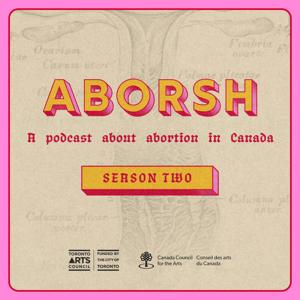
Aborsh examines why talking about abortion is still such a big deal, what “choice” really means and looks like and why that answer is different for different people. Join Toronto-based artist…

90,922 Listeners

241 Listeners
258 Listeners

112 Listeners

405 Listeners

208 Listeners

168 Listeners

1,038 Listeners

62 Listeners
746 Listeners

45 Listeners

90 Listeners

242 Listeners

103 Listeners
10,243 Listeners