
Sign up to save your podcasts
Or



Based on Podcast App listening data
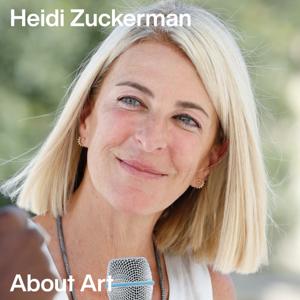
Artist Refik Anadol joins Heidi Zuckerman for a conversation about art, nature, memory, imagination, and the new forms of creativity made possible through technology.
Refik describes data as an artistic material—a way of giving form to memories and information that would otherwise remain invisible. He and Heidi talk about his early fascination with computers, his desire to make the invisible visible, and the role dreaming and imagination play in his work.
Their conversation moves deeply into the natural world. Refik shares his experiences with the Yawanawa people in the Amazon and a profound idea offered to him there: for them, nature is their AI—a living intelligence humans have not yet fully understood. He considers whether technology might now help us listen more closely to the natural world rather than move further away from it.
They also discuss an extinct Hawaiian bird whose final recorded song appears in DATALAND, his personal connection to memory after losing his uncle to Alzheimer’s, what it means to collaborate with a machine, and the responsibility artists have to help us see differently.
At the center of Refik’s work is a belief in art’s ability to transform perception—and his hope that what we make can leave meaningful memories behind.
Ryan Stanier joins Heidi Zuckerman for a conversation about access, permission, play, and what happens when we question the ways people have traditionally encountered art.
Ryan founded The Other Art Fair after watching artist friends struggle to find meaningful opportunities to show and sell their work. After 15 years and 100 fairs, he stepped away and eventually began asking what he would do differently if he started again.
His answer is Fair Play, a new artist-led fair built around a different economic model and a belief that encountering art can also be social, surprising, and fun.
Ryan and Heidi talk about why galleries and art fairs can still feel intimidating, how to break down barriers to entry, and the difference between telling people they are welcome and creating an environment in which they actually feel free to participate.
They also share stories about nudity, tattoos, defacing art, unexpected experiences, and the importance of creating spaces for adults to play.
Artist Rashid Johnson joins Heidi Zuckerman for a deeply personal conversation shaped by their long friendship and history of collaboration.
They talk about the difference between doing and being, and Rashid’s growing belief in the importance of becoming what he calls a “pauser”—someone willing to make room for patience, reflection, and even idleness in a culture that continually rewards action.
Rashid reflects on success and the difficulty of allowing ourselves to acknowledge when we are genuinely good at something. He questions the performance of humility and considers honesty as a more useful measure: being able to recognize both what we do well and where we fall short.
Their conversation moves through anxiety, freedom, peace, joy, regret, failure, middle age, parenthood, and love. Rashid talks about learning to understand anxiety as a tool rather than simply a condition, why joy feels more achievable to him than happiness, and why love and peace contain far more complexity and rigor than we sometimes allow them.
They also discuss Casa Gràcia, the residency Rashid helped create in Menorca, and what becomes possible when artists and writers are given time and space without the expectation of producing an outcome.
Chloë Catán is the executive director of the Lassonde Art Trail, a public art experience set within the landscape of Toronto’s new island and waterfront park.
In this episode of About Art, Heidi Zuckerman and Chloë discuss the origins of the trail and what it means to build art into people’s everyday lives. They explore the relationship between art and landscape, the possibilities and complexities of creating art in the public realm, and how artists can respond to the histories, ecology, and changing conditions of a particular place.
Chloë shares how growing up surrounded by music, theater, literature, and visual art shaped the way she sees, including an early encounter with Matisse that taught her that if she looked at an artwork long enough, something could be revealed.
Heidi and Chloë also talk about walking, discovery, slowing down, creating multiple entry points into contemporary art, and the choreography of encountering artworks in a landscape. Their conversation considers how public art can become part of the life of a city—and how seeing something differently can change our relationship to the world around us.
Heidi Zuckerman speaks with artist Danielle McKinney, whose intimate paintings depict women absorbed in moments of reflection, rest, reading, music, and contemplation.
Richly atmospheric and emotionally resonant, McKinney’s work draws on photography, film, literature, music, and memory while leaving space for viewers to bring their own stories to each painting.
In their conversation, Heidi and Danielle discuss solitude, imagination, beauty, motherhood, observation, and the emotional life of painting. Danielle speaks about growing up as an only child and finding an early home in books and storytelling; her transition from photography to painting; and why being alone can offer a way to reclaim what is sacred.
They also talk about music and silence, self-doubt and imperfection, learning to get out of one’s own way, and the women who inhabit Danielle’s paintings—women who are alone but not lonely, who do not perform for the viewer, and who, as Danielle says, “are not afraid to be seen.”
This conversation is the final episode in a special six-episode About Art series presented in collaboration with the Aspen Art Fair.
Zanele Muholi is a South African visual activist, photographer, and artist whose work documents and celebrates the lives of Black queer and trans people in South Africa and beyond. Through portraiture, self-portraiture, and an ever-expanding visual archive, Muholi creates images that honor identity, memory, community, and belonging while challenging histories of exclusion and invisibility.
This episode is part of a special six-episode About Art series presented in collaboration with the Aspen Art Fair.
In this episode, Heidi Zuckerman and Zanele Muholi discuss photography as an act of healing, the responsibility of creating images, portraiture, beauty, chosen family, visibility, love, and the importance of preserving stories for future generations. Together they explore how art can become a bridge between memory and hope.
What if the divisions we see in the world are not actually there?
In this episode of About Art, Heidi Zuckerman speaks with artist Mariko Mori as part of a special six-part series presented in collaboration with the Aspen Art Fair.
For more than three decades, Mori has created sculptures, installations, and immersive environments that bring together ideas we often consider separately: science and spirituality, technology and nature, the ancient and the future, the visible and the invisible.
Mori traces this way of thinking back to her childhood in Japan, her father’s work as an inventor and engineer, the death of her father while she was an art student in London, and the questions about life, death, and existence that followed. She discusses Buddhism and Shintoism, prehistoric cultures, contemporary science, meditation, tea ceremony, nature, light, and her belief in the fundamental interconnectedness of all things.
At the center of the conversation is an idea of oneness. As Mori says, we create divisions between nations and cultures, between people, and between humanity and nature. But when we look at the Earth, those divisions disappear.
Together, they consider art’s ability to make the invisible perceptible and to offer a different vision of the world—one in which connection, love, wonder, joy, and hope are forces with the potential to change how we see and how we live.
“What we see is very little of what is as a whole.” — Mariko Mor
What does it mean to understand ourselves as existing somewhere between the planet and the cosmos?
In this episode of About Art, Heidi Zuckerman speaks with artist Lita Albuquerque as part of a special series created in collaboration with the Aspen Art Fair.
For more than five decades, Albuquerque has explored our relationship to the Earth, the cosmos, time, color, consciousness, and the natural world. Born in Tunisia, raised between North Africa and Europe, and based for much of her life in California, she describes how landscape became fundamental to the way she sees and makes work.
Together, they discuss the desert as a place of discovery, the relationship between nature and culture, ephemeral art and what remains after an artwork disappears, and Albuquerque’s understanding of the Earth as “a sculpture in space” and the cosmos as an installation in which we participate every day.
Their conversation moves between the immense and the intimate: astronomical time and everyday life, the movement of the planet and the feeling of the sun on our skin, creativity and freedom, remembering and forgetting. At its center is the possibility of another way of living—one grounded in attention, curiosity, presence, and the freedom to follow what we love.
As Albuquerque says, “The more you slow down, the more you can hear yourself.”
Patrick Martinez is a Los Angeles-based artist whose paintings, sculptures, and neon works transform the visual language of the city into layered reflections on memory, community, history, and belonging. Drawing on graffiti, signage, architecture, and everyday materials, his practice reveals the stories embedded in the urban landscape while asking us to look more closely at the world around us.
In this episode of About Art, Heidi Zuckerman and Patrick Martinez discuss growing up in Los Angeles, graffiti as an artistic foundation, language as material, beauty and social reality, the importance of slowing down, and the ways artists preserve the experience of living through a particular moment in time.
This episode is part of a special six-episode About Art series presented in collaboration with the Aspen Art Fair.
In this special live episode of About Art, recorded in Aspen as part of a collaboration with the Aspen Art Fair, Heidi Zuckerman speaks with artist, architect, designer, inventor, and educator Ronald Rael.
Raised on a sheep and cattle ranch in southern Colorado, Ronald comes from a family that has lived in the region for seven generations. His work brings that history into conversation with the future, combining traditional adobe construction with robotics and new technologies while exploring borders, sustainability, cultural memory, and the meaning of place.
Heidi and Ronald discuss growing up in an adobe house, preserving historic buildings, his celebrated Teeter-Totter Wall project at the U.S.–Mexico border, teaching, technology, and his desire to practice being both a good descendant and a future good ancestor.
From the publisher's feed

6,784 Listeners

3,338 Listeners

4,052 Listeners
879 Listeners
2,003 Listeners
297 Listeners

210 Listeners
443 Listeners

495 Listeners
536 Listeners
365 Listeners
145 Listeners

15,941 Listeners

1,647 Listeners

663 Listeners