
Sign up to save your podcasts
Or



Based on Podcast App listening data
Since the early 1990’s, Charles Long has explored the possibilities of sculpture through a rich vocabulary of materials, colors, images and shapes. Incorporating references to art history, popular culture, nature and his own experiences, Long’s work embraces modernist convention as a means of connecting inner and outer realities, forming pathways between one’s mental and bodily experiences and the surrounding environment. Through his many bodies of work over the years, the artist has consistently confronted formal parameters associated with sculpture as obstacles to push beyond, seeing modernism’s trajectory as unfinished and full of possibility.
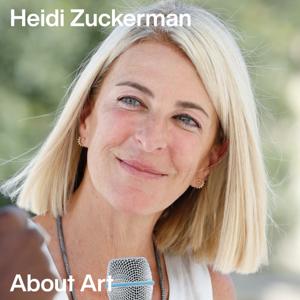
He and Zuckerman spoke about metaphysical research, why things are happening, the secret of teaching, refinding art on his own terms, psychedelics, Donald D. Hoffman of UC Irvine, “wisdoms of the masters” and access to pure being, what it’s like to die, what he has to offer, wanting everything he makes to be sacred, not finishing anything, and making art that you don’t have to talk about!
New York-based writer LJ Rader is the person behind the social media account ArtButMakeItSports, which features images of sports compared to fine art. He works full-time in the sports world as a Director of Product at a sports data and technology company.
He and Zuckerman discuss his curatorial choices, unique moments, a sports related lens, sports equality, feedback he gets, his favorite artists, his image filing system, feelings on AI, meme fuel, the legacy of art, and of course why art matters!
American artist Rodney McMillian’s paintings, sculptures, videos, and performances address the African-American experience while examining race, gender, and class in a broader political context. Aspects of his work negotiates between the body of a political nature and the politic of a bodily nature. McMillian modifies familiar and found objects into new – he offers an alternative reality that reveals how past ideas relate to the present. He is now a professor of sculpture at the School of Arts and Architecture at UCLA. McMillian’s work can be found in the permanent collections of the Los Angeles County Museum of Art, UCLA Hammer Museum, and the Museum of Contemporary Art Los Angeles, The Orange County Museum of Art, among others.
He and Zuckerman discuss the role of chance in his paintings, intimacy and residue, what landscape can mean, issues of class and taste, retitling, existing within uncomfortable contexts, “hitting it on the one,” napping, the physicality of making art, the present moment, working with a voice coach, and the thrill of accomplishing hard things!
Art historian and curator Stephanie Stebich is the Margaret and Terry Stent Director of the Smithsonian American Art Museum. She was named director of the Smithsonian American Art Museum in January 2017. Stebich serves on the Smithsonian’s Capital Board as well as the Smithsonian-London Strategic Advisory Board. In May 2018, she was named co-chair of the Smithsonian American Women’s History Initiative. Before coming to Washington, D.C., Stebich was executive director of the Tacoma Art Museum for 12 years. Under her leadership, the museum underwent a major renovation that doubled its exhibition space, and secured major collection gifts, including the Haub Family Collection of Western American Art, 300 masterworks from the 1790s to the present by Charles Bird King, Thomas Moran, Frederick Remington, Georgia O’Keeffe and others. She was assistant director of the Minneapolis Institute of Arts from 2001 to 2004 and assistant director at the Cleveland Museum of Art from 1995 to 2001.
She and Zuckerman discuss feeling at home in museums, taking risks, making a museum free, house favorites, why museums buy certain things, finding the optimal location for an artwork, having a broad definition of art to include craft, mentorship, how to get a job, speaking up while active listening, America as a hopeful experiment, artists as makers of hope!
Cliff Einstein is the founding partner of Dailey Advertising with a noted history of creating positions for some of the world’s major brands. Throughout a career spanning a half century he has received a long list of industry honors, among them, the American Advertising Federation naming him their Leader of the West. Cliff is Chair Emeritus of the Board of the Los Angeles Museum of Contemporary Art (MOCA) and a Trustee of Otis College of Art and Design. He is a recipient of the California Governor’s Victims’ Service Award for his work with the Rape Foundation, and he is the Marketing Chair of the Jewish Community Foundation. Cliff and his late wife, Mandy, have been listed in Art and Antiques “100 Collectors of America,” and they have been featured in a wide range of international publications as noted collectors and patrons of contemporary art.
He and Zuckerman discuss his collection of 100 knives, the difference between commercial and fine art, his rules for collecting including meeting the art before you meet the artist, what roles he and Mandy each play in forming their collection, asking people what they like, not to be missed sites to shop for art, what work he bought back after selling it, being philanthropic and what people want back for what they give, his relationship with MoCA and an analysis of the current Los Angeles museum environment, and buying things you don’t instantly like!
Mindy Shapero creates lively, meticulous sculptural and canvas works comprised of materials as various as studio scraps, spray paint, gold, copper, and silver leaf. Her works on canvas are formed by stencils sourced from discarded sculptural bits, and portions of those stencils eventually find their way back into the artist‘s sculptural work. In this process, Shapero transmutes negatives from past sculptural pieces into positive shapes that form the bedrock of her cosmic abstractions. Shapero’s repeating motifs—irregular rectangles and ovals that resemble “scars” or ruptures in the surface— are highlighted through the artist’s application of delicate gold leaf, an adornment dating back more than 8,000 years in the canon of art history. She is interested in the combination of old and new techniques. Shapero’s techniques harken back to the artist’s personal history rooted in the DIY aesthetics of punk counterculture.
She and Zuckerman discuss her approach to narrative, spirituality, alchemy and transformation, surprising herself, the responsibility of being climate aware, repurposing, being a hoarder, titling as poetry, duality, color as everything, how hard it is to talk about art, the process of making, rules, and making what you want to see!
Sotheby's Principal Auctioneer Oliver Barker joined Sotheby’s in 1994 moving to the Contemporary Art department in 2001, rising to Chairman, Sotheby’s Europe, Senior International Specialist in 2016. He is a key figure on the rostrum at the major auctions in both London and New York. Barker oversaw the iconic sale of Banksy's "Love is in the Bin," famously shredded by the artist moments after hammering for $1.04 million in 2018. Additionally, Barker participated in the livestream hybrid auctions – The Webby Awards introduced during the pandemic. Notable achievements include the sales of Francis Bacon's "Triptych Inspired by the Oresteia of Aeschylus'' for $84.6 million, Botticelli's "Portrait of a Young Man Holding a Roundel" for $92.2 million, and this year, the sales of Impressionist, Modern, and Contemporary art that brought $597 million in a single night.
He and Zuckerman discuss three decades in a career, representing the company and the vendors, relationships with objects, the aesthetic experience, how should one start a collection, art as a place of solace, long term relationships, the YBA and the London art world of the early 1990s, the work that happens outside of the sales, the profound influence of art, and little know aspects of how he spends his personal life!
Journalist Charlotte Burns is the founder of Studio Burns, which creates and commissions original editorials and provides strategic advice. She is also the co-founder of the Burns Halperin Report, which analyses equity in museums and the art market. She also produces the weekly podcast "The Art World: What If...?!" for Art& at the New York advisory, Schwartzman&. The second season of the show launches 18 January 2024. Previously the executive editor of In Other Words, a weekly newsletter and podcast (2016-20), she was the US news and Market editor for The Art Newspaper (2009-16) and has written for publications including The Guardian, Cultured and Monocle magazine. Before that she worked for galleries including Anthony d’Offay and Hauser & Wirth.
She and Zuckerman discuss podcasting, grace in space, the imagined idea of America, not feeling at home, maternity, having ego leave, living life, how dreams need to evolve, hope and dread, an appetite for conversations, and talking about feelings!
Fred Tomaselli has shown his work in museums, biennials and galleries around the world, including MoMA, MoCA, the MET and SFMoMa. Biennials include the Whitney Biennial, Berlin Biennial, and the Lyon Biennial. Solo museum shows include the Whitney Museum at Philip Morris, The Aspen Art Museum, The Brooklyn Art Museum, and the Orange County Art Museum. Tomaselli is known for his intricate, engulfing images of earthly and cosmic realms made by suspending collage and painted imagery as well as an unorthodox array of real-world materials in thick layers of clear, epoxy resin. These works on wood panels mix snippets of botanical, ornithological and anatomical illustrations cut from books and magazines, prescription pills, medicinal herbs and psychoactive plants with the artist’s own designs. Tomaselli sees his mixture of psychedelic imagery and substances as windows into hallucinatory universes: “It is my ultimate aim to seduce and transport the viewer into the space of these pictures while simultaneously revealing the mechanics of that seduction.”
He and Zuckerman discuss a shared love of nature, what art can do, what drugs and birding have in common, the shelf life of art, altering perception and dislocated, settling for oblivion, nocturnal experiences, community, a sample choir, and AI!
From the publisher's feed

6,784 Listeners

3,338 Listeners

4,052 Listeners
879 Listeners
2,003 Listeners
297 Listeners

210 Listeners
443 Listeners

495 Listeners

536 Listeners
365 Listeners
145 Listeners

15,941 Listeners

1,647 Listeners
663 Listeners