
Sign up to save your podcasts
Or



Okay, now what? We graduated, and there's a fucking writer's strike, and a pending actors strike. Wait, this is not what I showed up for.
I've been a member of SAG AFTRA for over 30 years and a working actress for over 30 years.
And let me tell you something, I've been through a lot of strikes, and you know what the greatest thing about them is? They end.
There is a lot you can do right now, and that's getting ready.
The number one thing I recommend to actors getting out of drama school is learning "the Language of the Agents and the Casting Directors."
If you think you learned it in drama school, I am here to tell you that, no, you did not. Chances are that you did not learn what the industry was like from the agents and the casting director's points of view.
Some of the things to know, though, is that yes, you are the newbies on the block, and you are fresh meat. Everybody's all excited about you, but this is the thing you need to know is there have been thousands of you beforehand, and the more you can learn to be professional, and what I mean by that is to not waste an agent and a casting director's time.
So it is best to keep your ears open and listen to what industry professionals are saying.
As a casting director, the number one thing I cannot stand is actors who waste my time.
And one of the ways they waste my time is if I'm in the middle of casting and I want to audition you, I need you to already know some of the things that I talk about in that masterclass because I don't have time to train you.
You also understand that if somebody goes out of their way to give you advice, listen to it.
That's why when people reach out to me over social media, if they make some kind of a blunder, I actually say to them, "Hey, I'm going to be honest with you. I'm not going to take your submission seriously because you did this or that or the other thing.
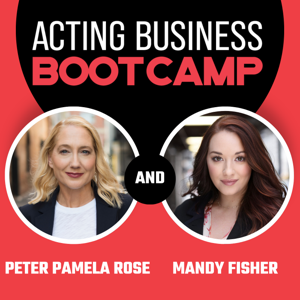
A lot of people call me Pamela. My name is Peter. A lot of people say, dear Peter and Pamela, well, you obviously haven't done your research on me.
And if you are looking for me to hire you on a job, I would hope that you would know what to call me.
And I know that sounds like a really silly thing, but that's just kind of that immediately tells me that you haven't even done one ounce of a bit of research on me. You've got Google, the internet, do your research.
The other thing that I would say is that although you may have been told how special you were in drama school, you are entering a whole new realm here.
There are lots of special people here, and there are lots of really talented actors here.
One of the pieces of advice that I wish somebody had given me many years ago was, don't ever, ever, ever underestimate how good you need to be.
This means keep up your training and keep doing your warmups.
Keep practicing your voice. Keep going to dance classes, keep going to movement classes. Keep going to acting classes.
Finally, I want to talk to you about core work.
That's the work on yourself, and that's the hardest thing because when you are early in your career, you can be given phenomenal opportunities.
I was given some, and I'm going, to be honest with you, I blew it. I auditioned for two films.
I'll talk about the Jerry Lee Lewis film Great Balls of Fire with Dennis Quaid, and Winona Rider got the part I also auditioned for. For Say Anything, I auditioned for the Lily Taylor role in that.
First of all, I should mention I was very young. I was still a minor actually, when I auditioned, and this was the thing, I didn't have the confidence. I didn't believe that I was talented enough. I didn't believe I was good enough. As even a human being, I don't even think I got a call back for that one, and that's okay.
I wish I'd had the core work and the work on myself at even that young age because what I didn't understand was that I needed to work for me when all I was doing was working against me.
I remember going into the audition and giving away the part to every other actress in that room.
I remember being scared to meet this big casting director when I felt so small. There are so many things I wish I had worked on as a young actor, but more than any of them, it's core work.
I let my ego get in the way of giving a great audition. I was so right for that part. I could have kicked some serious ass, but my focus was in the wrong place.
Stop working against yourself. Start working for yourself. You can do this. You can do this, and although I understand you are coming to this industry in one heck of an interesting time period with AI and strikes and so much going on.
The fact of the matter is if you work for you instead of against you, you can do it.
Become a damn good actor. Be good at your job. That's what we, the casting director, are hiring you for.
Know "the Language of the Agents and the Casting Directors," I can help you with that in the Working Actor Road Map.
You Can Heal Your Life
Letting the Past Hold You Back.
"Many people come to me and say they cannot enjoy today because of something that happened in the past.
Because they did not do something or do it in a certain way in the past, they cannot live a full life today. Because they no longer have something they had in the past they cannot enjoy today. Because they were hurt in the past, they will not accept love now. Because something unpleasant happened when they did something once, they are sure it will happen again today. Because they once did something that they are sorry for, they are sure there are bad people around them forever. Because once someone did something to them, it is now all that other person's fault their life is not where they want it to be today. Because they became angry over a situation in the past, they will hold on to that self, self-righteousness. Because of some very old experience where they were treated badly, they will never forgive and forget."
Ways that we use our past as an excuse.
Forgiving is not forgetting; it's letting go of the hurt.
When you are so angry at your past or at someone in your past, it's like you are taking the poison and expecting them to die.
Not even the universe can change the past.
If something happened to you in your past, it is important that you look back but don't stare. It is important that you trace it, face it, and erase it.
Let's talk about an audition that was botched up or a meeting that was botched up, or you were late, so you didn't get to do something in your career.
Always keep in mind that you are doing the very best you can, if you could have done better than you would've.
If you say, "Well, I could do it better now, you're probably right."
Letting the past hold you back is working against you instead of for you.
As an actor, this business is so darn hard. Why are you going to make it harder for yourself?
You don't deserve that. You deserve the very best the universe has to offer. Now it's time to accept that, and we accept that by starting to let go of our past.
Let me focus on today on the present so that I may create a better future for myself, a future that works for me instead of against me.
Because somebody else hurt, you doesn't mean you need to keep punishing yourself for that hurt.
It all comes down to self-love.
One day I realized this is the only person I can be. So let's have a love affair with ourselves.
Just because something happens to you once doesn't mean it will happen to you again.
I now look at challenges in my life as opportunities to grow stronger and to show myself that I am more capable, stronger, and smarter than I ever thought.
I think everyone deserves to be forgiven.
Forgiving ourselves is sometimes the hardest thing to do.
Do you want to be right, or do you want to be happy?
Forgiving is not forgetting. It's hanging onto the hurt, and this is the thing. If you're hanging onto the hurt, the only person you're hurting is you.
The past is over and done with and cannot be changed.
This is the only moment we can experience, even when we lament about the past. We are experiencing our memory of it in this moment and losing the real experience of this moment in the process.
If you have one foot in the past and one foot in the future, you're pissing on the present.
If there is something that you want to let go of. Write it down on a piece of paper and put it in a box. And then, in a month from now, look at it and see if you have let go of it just a little bit.
And in the process, be as loving to yourself, as good to yourself, and as kind to yourself as you possibly can.
Because I'm in your corner.
I genuinely am in your corner to make your life and career move forward instead of staying stuck in the past.
Learn about Wendy's Class
About Wendy:
Wendy Allnutt trained at the Central School of Speech and Drama. She held the post of Head of Movement at the Guildhall School of Music and Drama for 25 years and is a founder member of L'Oltrarno, Acting School in Florence. Other teaching credits include Colorado College USA, Conservatoire Stratford Ontario, Canada, Penn State summer schools, Laboratorio Internationale Teatro Degli Astrussi in Montalcino/St Mineato, l'Accademia SilviovD'Amico, Rome, LAMDA, Colby London Programme, BESG, and BADA.
Movement Director: Sky TV's Fungus the Bogeyman (2016), BBC's Walking with Cavemen, and The Iceman Murderer. Wendy has been the Master of Movement at Shakespeare's Globe 1st season and recently Henry V1 parts 1, 2, and 3. Revival choreographer for Welsh National Opera's Magic Flute (Out of Joint / RNT) She Stoops to Conquer and A Laughing Matter, Romeo, and Juliet & Private Lives (Mercury) Brothers Karamazov, Maybe and Private Lives (Manchester Royal Exchange) India Song (Clywd), Goliath, Voyage in The Dark, and A Wedding Story (Sphinx).
Bad Habits
Slumping
Animals into people
Being in your body as an actor
Just standing in the space. It takes quite a lot of understanding where your weight is in the space.
Do you lean forward, which gives maybe an air of anxiety or enthusiasm? I would hate to say that if you stand in a certain way, it is a certain thing. Right. But we do read bodies.
I work on trying to find a neutrality
Neutral plus, so that your body is relaxed in line and ready to go.
Your body and your voice, and your everything are ready to go. That's why you see so many British actors that you think are mind-blowing because they're ready.
Musicians train every day. The actors don't, and if you're lucky enough, you need to be ready to play Hamlet now.
Not in five weeks when you've done the work. No. Now. Yeah. And I think actors are a bit lazy about that.
Are you keeping up with your instrument?
It's about finding your inner self, your inner balance, and how your body works.
It's a tough old business. It's not a nice game to play.
We mustn't do mindless movement.
Maybe you should challenge yourself on the treadmill, run towards something, or somebody's chasing you. It alters the way you run on the treadmill.
I love it because it's talking about being conscious in your movement.
I think that if we can apply a little bit of thought to why we do something about finding the weight in a movement.
We have to keep the mind alive. There are so many things that block the mind off.
You're going to be exploring conscious movement, that one to warm up the body, but also that can be used in learning what the conscious movement of your characters would be.
I think you have to start with yourself. And discover maybe that your rib cage is very tight and that perhaps you can find a way to make it move a bit more. And also, if you change the thought, the quality of the movement changes.
So again, if I reach up and I want to hail someone over there, it's a different kind of reach.
That's what interests me about movement. How we move and why we move rather than just, it's an exercise.
So that is actually if you are going to play an old person just for argument's sake. Why is their body decreed? What is it about their body? What are they? What are they working against?
I mean, fears, for instance, in the Cherry Orchard. What is his body like? Is it just arthritis? What is it that makes his movements? And if you know the why and the how, then it's easier to inhabit the body of fears.
To be bringing questions to you.
The language changes the body.
A physical imagination.
Just try it. And try not to judge.
Variation is what's interesting. It's not about being a clone.
Free month of The Weekly Adjustment Coaching Group
The Language of Letting Go
"It is important to identify what we want and what we need, but where does this concept leave us? Well, generally, what it leaves us with is a large but clearly identified package of currently unmet wants and needs, but we've taken the risk to stop denying and to start accepting what we want and need.
But the problem is now that the want or the need hangs there unmet. This can be frustrating. Painful, annoying, and sometimes obsession producing."
After identifying our needs, there is a next step in getting our wants and needs met. The next step is letting go of our wants and needs after we have painstakingly identified what they are and the steps to achieve them.
We let go. We give them up on a mental, emotional, spiritual, and physical level. It's not always easy to get to this place, but this is usually where we need to go."
I'm not talking here about giving up as an actor and giving up your dream.
What I am talking about is giving up the obsession, giving up the frustration, and giving up the pain, giving up the annoyance.
Because how often have I denied a want or a need? Then I went through the steps to identify my needs, only to become even more annoyed, frustrated, and challenged because I didn't have what I want and didn't know how to get it.
If I embark on a plan to control or influence getting that want or need met, I usually make things worse.
"Searching, trying to control the process doesn't work. I must, and I have learned to my dismay, need to let go."
This is very different from getting a practical plan of action, taking the steps, aligning the thoughts, and then letting go.
"Visiting our own head is like visiting a bad neighborhood because it's a place that works against us instead of for us."
I'm going to take these actions, let go of the results, and produce amazing results.
The more I hope and try to get it, the more frustrated I feel because I'm not getting it.
We often find that we really actually can have what we want and need or even something better. But sometimes, letting go is part of it.
Letting go of that obsession, of that frustration, of that annoyance, of that pain.
Keeping at it as an actor.
For me, that means continuing to practice healthy habits as an actor, meaning a devotion to training, business skills, to core work, which is the work on yourself.
We need to work on these things with diligence, effort, and repeated practice.
But every time we go just a little bit out of our comfort zone, that's where we get stronger, and that's where our new boundaries end.
We can practice our acting training, do business skills, and work on ourselves even when we don't quote-unquote feel like it.
And again, I would say especially then, because if we don't feel we are worth it and we do it anyway, we are acting our way into right thinking and sending a very powerful message to not only to ourselves, but to the universe as well.
We can act as if it is worth it. We can act as if we are worth it, but we need to do it and do it, and do it, and do it, and do it day after day, year after year.
It's unreasonable to expect this a hundred percent commitment to your life and your career.
In fact, I dare say that success will come when you are ready. So that is why the core work is so important.
So when that opportunity comes, you know, in and of yourself, that you are enough.
We need to use our minds to govern our brains.
And especially using your mind to govern your brain when you find yourself getting tired, stressed, frustrated, et cetera, because that is when you will revert back to old ways of thinking and behaving that will work against you instead of for you. Getting you to work for you instead of against you so you can keep at it.
Building solid relationships in this industry. Understanding and learning how you tick and operate takes time. It takes self-love, it takes practice, and it takes time, and life experience.
It takes keeping at it over and over again.
One of the things my mom always said to me when I was a little girl and, um, things wouldn't go my way. She'd say, pick yourself up, dust yourself off, and start all over again.
And you know when you do that over and over and over again, and just when you think you've got it, guess what you find out. You have more to learn.
But that's the beauty. That's the beauty of life. That's the beauty of the process of expansion. Keep training as an actor. Keep sharpening your business skills. Keep deepening your core work and learning more about yourself. Keep at it even when you don't feel like it.
Just keep at it.
Today I'm going to talk about making it happen or if you're me forcing it to happen.
The Language of Letting Go.
"Stop trying so hard to make it happen.
Stop doing so much. If doing so much is wearing you out or not achieving the desired results, stop thinking so much and so hard about it.
Stop worrying so much about it. Stop trying to force, manipulate, coerce, or make it happen."
Now around an acting career, it feels like so much is out of our control, so I get it. The actor mentality is, well, I'm going to make it happen. But again, it's out of our control.
"Stop doing so much if doing so much is wearing you out or not achieving the desired results."
Recording a podcast, I need number eight, nine, and ten energy, and I was operating at four, so it wasn't working.
Also, there's obsession. Oh, obsession. You know, one of the things that I used to suffer terribly from was that my thinking was unbearable because I would just obsess about wanting to be a working actor or a famous actor, or I want this, I want that.
How am I going to make this happen? It was so toxic in my own brain.
Stop trying to force. To manipulate.
My thinking was crazy. So I would do, I would do, do, do, and force, force, force, even though it wouldn't get me the desired result.
I would think, think, think, trying to get the universe to get me what I wanted.
And I'm not talking about positive affirmations here. I'm talking about worrying, thinking, obsessive thinking, and stinking thinking. And all of this was about trying to make something happen instead of stopping, taking a step back, observing, asking myself if it was healthy for me or unhealthy for me to do this, and then maybe responding.
That is the anecdote to this. That is the way to change things around, and I do this at Acting Business Bootcamp by ensuring you're getting the best training, the best business skills, and learning how to manage this.
The obsessive doing and the obsessive thinking. Making things happen is controlling.
We can take positive action to help things happen, that's more of a response, and we can do our part, which, again, is a response, but many of us do much more than our part.
We overstep the boundaries from caring and doing our part into controlling or overcare taking or over coercing our careers. And this is the thing, controlling is self-defeating.
It doesn't work by overextending ourselves to make something happen. We may actually be stopping it from happening.
Let that land.
Wow. I wish I could return to that 18 or 19-year-old girl and teach her the lesson of let.
Not even God can change the past, and I can only coach you and teach you from the lessons I've learned because I know people, and I can see when I get myself into it that it just doesn't work.
It's painful to understand that when you have a goal, you need to align your thoughts and then align your actions in positive, affirmative, and effective ways.
You're gonna have to do a lot of un uncomfy things to get successful.
"Do your part. In relaxed, peaceful harmony with the universe. Then let it go. Just let it go. Force yourself to let it go. If necessary, act as if you're letting it go. Put as much energy into letting go and relaxing as you have into trying to control you will get much better results."
Learn to let things happen because that's what they'll do anyway. Learn to let things happen because that's what's gonna happen anyway.
And while we're waiting around to see what happens, we will be happier, and so will the people around us.
I'll be happier and have more energy to do the things that will be effective for my career and life instead of ineffective. So instead of worrying about whether agent x, y, or z will call that, I focus on something that will actually be effective, like reading a play or taking a class.
Think of that energy instead of staying home and worrying or staying home and forcing.
Let it happen. Take the steps, and then let it happen.
David's Advanced Commercial Class
About David:
DAVID CADY is currently a professor of commercial and musical theatre performance at AMDA, NYU, and Pace University.
Prior, he was a casting director for Donna DeSeta Casting for close to 30 years.
In addition to countless commercials, his casting credits include the original Dirty Dancing, Disney's Enchanted, Michael John LaChiusa's The Petrified Prince for the Public Theater, and the world premiere of Andrew Lloyd Webber and Jim Steinman's Whistle Down the Wind, directed by Harold Prince.
He was an original cast member of Stephen Sondheim and George Furth's Merrily We Roll Along, and can be seen in Lonny Price's film about the experience, The Best Worst Thing That Ever Could Have Happened.
Most of the auditions are self-tapes.
When do you make a daring choice?
The times when I didn't ask for permission to be Peter Pamela Rose. Those were the times I got the callback or maybe booked the job.
Really understanding how to interpret that script.
What is your relationship to the product?
When you have a theatrical text, it's your job to become the person on the page. And when you have a commercial text, it's your job to make the person on the page you.
It's odd because even though you are filming something, you are capturing a live performance.
It must still have that sense of spontaneity, that alive quality if something is 95%. Great. Or let's even say 90% great. You don't throw it out because 10% is not exactly what you would want it to be.
How many takes do you do?
What am I trying to achieve here?
They have to have performance energy, and they have to have performance commitment.
It's hard to develop a healthy perspective as to what they are looking for.
Ask yourself: What am I looking for when I watch myself tapes?
Go to an audition with the, "I can't wait to show you what I've got. Like I can't wait to show you what I have."
And I think in some ways if you can bottle that excitement in your self-tape, and I think there's a real trick there.
Dropping off the gift of your talent.
Are you someone who has strong ideas about what this performance looks like? Are you someone who makes choices? Are you someone who makes interesting choices? Are you someone who does something that's out of the box that gets their attention, whether it's something that ever ends up in the commercial or not?
It's a sense of self, and it's a freedom, and it's a joy in, in doing this that just, that comes through.
There isn't a tentativeness.
It's not your job to tell the audience how they felt about your performance.
I would always love it when an actor screwed something up or said something that wasn't in the script. And I would say to them, do you know that that happened? And they'd say, oh, really?
Improv in Commercials is different.
You want to be accessible to yourself.
How to handle one-liners.
For over 40 years, Peggy has studied and performed Improv with The Groundings, Gross National Product, National Lampoon Players, TheatreSports, and Improvatorium.
She is a current performing member of Puppet Up! (Adult Improv Puppet Show produced by The Jim Henson Company).
She can be seen in The Barbarian and The Troll (series regular), Seinfeld, Boston Legal, Crash and Bernstein, The Last Champion, Earth to Ned, among others...
She studied at San Francisco State University, Pacific Conservatory of the Performing Arts, American Conservatory Theatre, and holds a degree in Theatre.
She taught short form at Improvatorium.
It's also great for learning communication skills in your day-to-day time. Listening in your day-to-day.
The power of Yes and.
Let's try that again, but this time with a yes, try with a yes.
The Who, the What, and the Where.
Listening is a skill, and it's a muscle.
Emotional response as another tool.
Improv works onstage, it works in auditions, and it works in life.
So now what?
"Few situations, no matter how greatly they appear to demand it, can be bettered by going berserk."
It's important to put all of this into perspective.
This is survivable. It's going to be survivable. Is it tough? Is it a pain in the neck? Does it potentially throw off some of our career plans? Does it maybe stop some stuff that we hoped would go forward and now isn't because of the strike?
Absolutely.
Is it survivable? Is it manageable? The answer is yes, it is.
Us freaking out about it doesn't do us any good. What I would say is, Let's try and move into accepting it.
I need to do what I can to be proactive in supporting the writers and keep the focus on myself.
I need to take care of myself, my finances, my family, and especially my sanity.
So let's look at how we deal with panic and uncertainty during this time.
"Don't panic. If panic strikes, we do not have to allow it to control our behaviors."
I don't have to let this strike control my behavior.
"Behaviors controlled by panic tend to be self-defeating. No matter what the situation or circumstance, panic is usually not a good foundation. No matter what the circumstance or the situation, we usually have at least a moment to breathe deeply and restore ourselves to serenity and peace."
Strikes can be marathons, not sprints.
If we panic and we don't look at this by taking that step back and observing, what happens is that we lose our path.
Breathe deeply, and let peace flow through our body and mind from our source, the power that makes the sunshine, the energy that knows best. Our higher selves shall supply the necessary resources.
Let's stick together. Let's take care of each other. And the best way to do that is to take care of ourselves.
Ken Rea's Outstanding Actor Workshop
Well, this week, I turn another year older.
In the 30-plus years, I've been in this industry, I've watched it change dramatically.
Age is wisdom
Age is an advantage
Aging is beautiful
Aging is a privilege
"The walls of your comfort zone are lovingly decorated with your lifelong collection of favorite excuses." -Jen Sincero
I was using age as an excuse.
When you see what you're weak at, you don't want to shy away from it. You want to lean into it. You want to practice it more. You want to get stronger and better and master it.
I've learned so much through getting older.
They are looking for everything. They just want real.
Start saying to yourself. "Why not me? Why not now?"
What is stopping me? What is stopping me because if it's age or any other lifelong collection of excuses, then keep in mind you're the one who's making those excuses, and you can just as easily choose to overcome them.
From the publisher's feed

56,447 Listeners
77 Listeners

323 Listeners
27 Listeners
28 Listeners
14 Listeners
57 Listeners