
Sign up to save your podcasts
Or


Send us Fan Mail
Almost 30% of Saudi teachers already correct biased AI outputs, highlighting an urgent need for students to interrogate AI, not just trust it.
In this episode:
Chapters:
How can teachers address AI bias in education in their classrooms?
Teachers can address AI bias by becoming 'epistemic intermediaries,' systematically assessing AI-generated content with students for factual accuracy, linguistic precision, cultural relevance, and contextual appropriateness.
What does AI critical thinking education look like for students?
AI critical thinking education involves teaching students to systematically critique AI responses, compare outputs across languages, identify inconsistencies, and consciously inject missing cultural nuance into AI-generated content.
Why is responsible AI in education crucial for non-English dominant contexts?
Responsible AI in education is crucial because most AI tools are trained on English-language and Western-dominant datasets, leading to inherent linguistic and cultural blind spots that can misrepresent local realities for students in other regions.
Featuring: Dan Fitzpatrick, Basmah AlBuhairan, Reem Taibah, Amani AlOlayani, King Abdulaziz City for Science and Technology, Centre for the Fourth Industrial Revolution Saudi Arabia, Ministry of Education, Saudi Arabia, World Economic Forum.
Follow AI in Education with Dan Fitzpatrick for more on AI in education.
 View all episodes
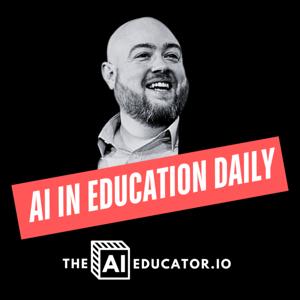
 By Dan Fitzpatrick, The AI Educator

4.9
2121 ratings
Send us Fan Mail
Almost 30% of Saudi teachers already correct biased AI outputs, highlighting an urgent need for students to interrogate AI, not just trust it.
In this episode:
Chapters:
How can teachers address AI bias in education in their classrooms?
Teachers can address AI bias by becoming 'epistemic intermediaries,' systematically assessing AI-generated content with students for factual accuracy, linguistic precision, cultural relevance, and contextual appropriateness.
What does AI critical thinking education look like for students?
AI critical thinking education involves teaching students to systematically critique AI responses, compare outputs across languages, identify inconsistencies, and consciously inject missing cultural nuance into AI-generated content.
Why is responsible AI in education crucial for non-English dominant contexts?
Responsible AI in education is crucial because most AI tools are trained on English-language and Western-dominant datasets, leading to inherent linguistic and cultural blind spots that can misrepresent local realities for students in other regions.
Featuring: Dan Fitzpatrick, Basmah AlBuhairan, Reem Taibah, Amani AlOlayani, King Abdulaziz City for Science and Technology, Centre for the Fourth Industrial Revolution Saudi Arabia, Ministry of Education, Saudi Arabia, World Economic Forum.
Follow AI in Education with Dan Fitzpatrick for more on AI in education.
208 Listeners

986 Listeners

27,775 Listeners
10 Listeners
5,485 Listeners

2,209 Listeners
1,344 Listeners
259 Listeners

5,530 Listeners

15,950 Listeners

3,336 Listeners

1,183 Listeners
682 Listeners
111 Listeners
41 Listeners