
Sign up to save your podcasts
Or



Based on Podcast App listening data
On June 13, 1985, Aldrich Ames packed up six pounds of top secret documents into a plastic bag and walked out the door of the CIA headquarters. He drove to lunch, where he gave the documents to a Soviet diplomat. They contained the identities of America’s most important spies within the Soviet Union.
Not long after, the Soviets told Ames that $2 million had been set aside for him. Ames had become the highest-paid American spy of the Cold War, and his betrayal would soon prove disastrous.
That fall, the CIA was mystified by a string of mysterious disappearances. The agency’s best assets within the Soviet Union were vanishing, never to be heard from again. But it would be years before investigators uncovered the mole within their ranks.
See Privacy Policy at https://art19.com/privacy and California Privacy Notice at https://art19.com/privacy#do-not-sell-my-info.
In September 1949, the world was shocked to learn that the Soviet Union had conducted its first nuclear weapons test, just four years after the United States dropped the first atomic bombs on Hiroshima and Nagasaki. U.S. authorities thought there was only one way the Soviets could narrow the nuclear arms gap so quickly -- by stealing atomic secrets from the U.S.
In 1950, the FBI arrested a young Jewish couple, Julius and Ethel Rosenberg, for running a spy ring and passing nuclear secrets to the Soviet Union. At their trial, the Rosenbergs became lightning rods for controversy and anti-communist hysteria. But the true extent of their guilt would remain shrouded in mystery for decades to come.
See Privacy Policy at https://art19.com/privacy and California Privacy Notice at https://art19.com/privacy#do-not-sell-my-info.
On the night of April 14, 1865, John Wilkes Booth stepped into the presidential box at Washington’s Ford’s Theatre, raised a pistol at President Abraham Lincoln, and squeezed the trigger. Lincoln would soon die of his wounds, making him the first president to be assassinated in American history. As the nation plunged into mourning, the hunt for Lincoln’s killer began.
But authorities soon revealed a conspiracy much bigger than just one man. The investigation would focus on an unlikely accomplice: a widow and boarding house owner named Mary Surratt.
In the months leading up to the assassination, Booth and his men met frequently at Surratt’s boarding house, and her tavern was their first stop on their escape. But her exact role in the plot and subsequent military trial led to controversy and conflict that would rage for years to come.
Listen ad free by subscribing now to https://wondery.app.link/historytellers!
See Privacy Policy at https://art19.com/privacy and California Privacy Notice at https://art19.com/privacy#do-not-sell-my-info.
Early in the Revolutionary War, Major General Benedict Arnold built a reputation as a courageous commander. He was a favorite of George Washington’s. But he also revealed a fragile ego and a penchant for holding grudges. As the war went on, Arnold’s temper, ambition, and greed would turn him from hero to villain.
In this four-part series, American History Tellers explores the stories of America’s most infamous traitors -- the men and women who were charged, rightly or wrongly, with betraying their country. All of them paid a high price for their crimes. And all of them changed the course of our nation’s history -- starting with the man whose name is now synonymous with treason: Benedict Arnold.
See Privacy Policy at https://art19.com/privacy and California Privacy Notice at https://art19.com/privacy#do-not-sell-my-info.
The Roaring 20s are often described as a time of optimism and decadence, teeming with flappers, jazz and bootlegged liquor. It was the decade that birthed modern America. But with that birth came growing tensions over civil rights, the urban-rural divide and other culture wars.
Historian Michael E. Parrish captured the period in his book Anxious Decades: America in Prosperity and Depression, 1920 -1941. In this episode, Parrish joins host Lindsay Graham to discuss Ponzi schemes, the birth of celebrity culture, and how the lessons learned from the ‘20s still resonate today.
See Privacy Policy at https://art19.com/privacy and California Privacy Notice at https://art19.com/privacy#do-not-sell-my-info.
On a misty morning in May 1927, Charles Lindbergh climbed into the cramped cockpit of his single engine plane, The Spirit of St. Louis. After a bumpy taxi and takeoff at a New York runway, he took to the skies, on a flight that would break records and make him a national hero.
At the end of the 1920s, Americans united around a culture of celebrity, and no celebrity was bigger than Lindbergh. It was a time of limitless optimism and a stock market that seemed to know no ceiling.
But there were warning signs on the horizon. Every day, banks in rural America were closing. Farmers were mired in debt. And unsold products lined department store shelves. Soon, Americans would learn that the good times couldn’t last forever.
Support us by supporting our sponsors!
See Privacy Policy at https://art19.com/privacy and California Privacy Notice at https://art19.com/privacy#do-not-sell-my-info.
In 1921, Republican President Warren G. Harding entered the White House, ushering in a new era of conservative government. Harding was elected by Americans yearning for tradition and old-fashioned values. But they put in power one of the most scandal-ridden presidencies in American history.
Harding filled his administration with corrupt cronies who exploited their offices for personal gain. Americans were shocked as the details of Teapot Dome and other scandals came to light, even after Harding’s abrupt death brought his presidency to a premature end.
But no controversy could sustain Americans’ attention for long in a new era of mass consumerism. As the economy boomed, a bitter rivalry between the two carmaking giants, Ford and GM, brought the power of advertising and marketing to new heights.
Listen to new episodes 1 week early and to all episodes ad free with Wondery+. Join Wondery+ for exclusives, binges, early access, and ad free listening. Available in the Wondery App https://wondery.app.link/historytellers.
Support us by supporting our sponsors!
See Privacy Policy at https://art19.com/privacy and California Privacy Notice at https://art19.com/privacy#do-not-sell-my-info.
In the 1920s, Americans moved to the city in droves, and a new, diverse generation sparked an era of dizzying social change. It was the Age of Jazz, a time when Black Americans brought a revolutionary new musical style to northern cities. Free-spirited flappers haunted urban nightclubs. And Harlem, New York became the epicenter of a renaissance in Black artistic and political expression.
But rapid changes in the city sparked fear and backlash in the countryside. Rural white Americans vigorously defended traditional religious values, and fundamentalist preachers drew massive audiences. Meanwhile, a resurgent Ku Klux Klan drew millions of new members by targeting not just Black Americans, but also Jews, Catholics, and recent immigrants.
In 1925, the divide between urban and rural America came to a head in a sleepy town in eastern Tennessee, where the sensational “Scopes Monkey Trial” pitted the forces of science and religion against each other.
Support us by supporting our sponsors!
See Privacy Policy at https://art19.com/privacy and California Privacy Notice at https://art19.com/privacy#do-not-sell-my-info.
In 1919, American soldiers returned from the battlefields of Europe to face a nation torn apart by a different war. One-fifth of the nation’s workforce put down their tools and went on strike. Anarchists sent deadly bombs in the mail to congressmen and cabinet members. And a terrorist attack on Wall Street killed dozens.
As economic and political turmoil swept the country, government authorities moved to stamp out dissent. Targeting unionized workers, immigrants, and radicals, officials launched ruthless campaigns to drive out what they saw as threats to America.
It was the dawn of the Roaring Twenties, a decade of extremes that saw a rapidly changing nation caught between its past and its future.
Listen to new episodes 1 week early and to all episodes ad free with Wondery+. Join Wondery+ for exclusives, binges, early access, and ad free listening. Available in the Wondery App https://wondery.app.link/historytellers.
Support us by supporting our sponsors!
See Privacy Policy at https://art19.com/privacy and California Privacy Notice at https://art19.com/privacy#do-not-sell-my-info.
Alaska: big, open, frozen and wild. In 1867, the acquisition of Alaska from the Russian Empire was widely derided as “folly.” But early explorers like John Muir saw its potential, and clamored for its preservation in the face of increasing development and calls for statehood. Then oil was discovered in Alaska, and the real fight began. Caught between angry Alaskan individualists and an ambitious federal government, the National Park Service struggled to do what was right for the land and the people who lived and depended on it.
Listen ad free with Wondery+. Join Wondery+ for exclusives, binges, early access, and ad free listening. Available in the Wondery App. https://wondery.app.link/historytellers
Support us by supporting our sponsors!
See Privacy Policy at https://art19.com/privacy and California Privacy Notice at https://art19.com/privacy#do-not-sell-my-info.
From the publisher's feed
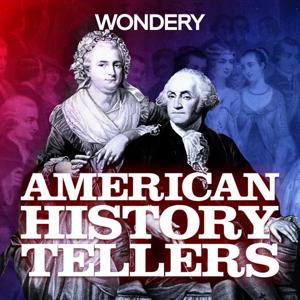
The Cold War, Prohibition, the Gold Rush, the Space Race. Every part of your life - the words you speak, the ideas you share - can be traced to our history, but how well do you really know the…
Audible subscribers can listen to all episodes of American History Tellers ad-free right now. Join Audible today by downloading the Audible app.
Ranked by our users in the last 21 days
10,438 Listeners

30,148 Listeners
777 Listeners
467 Listeners

784 Listeners

3,988 Listeners

6,175 Listeners

12,827 Listeners

3,637 Listeners

19,100 Listeners

2,149 Listeners

2,934 Listeners

115 Listeners

3,044 Listeners
22,943 Listeners

4,220 Listeners

905 Listeners
1,465 Listeners

7,767 Listeners

256 Listeners

2,517 Listeners

2,826 Listeners

251 Listeners

2,160 Listeners

1,596 Listeners
848 Listeners
1,531 Listeners

239 Listeners
591 Listeners

69 Listeners

535 Listeners

875 Listeners

163 Listeners