
Sign up to save your podcasts
Or



Based on Podcast App listening data
On October 17th, 1859, John Brown was barricaded inside the federal armory at Harpers Ferry with his hostages and his remaining followers. His attempt to lead an antislavery insurrection had failed. A detachment of U.S. Marines led by Colonel Robert E. Lee had the armory surrounded. For the radical abolitionist, it was his last stand.
But after he was captured and sentenced to death, Northern abolitionists rallied to Brown’s cause. By the time he ascended the scaffold and prepared to meet the hangman’s rope, Brown had become a martyr and folk hero. His bold, violent actions polarized Americans on both sides of the slavery debate, and hurtled the nation closer to the brink of the Civil War.
Listen to new episodes 1 week early and to all episodes ad free with Wondery+. Join Wondery+ for exclusives, binges, early access, and ad free listening. Available in the Wondery App https://wondery.app.link/historytellers.
Support us by supporting our sponsors!
See Privacy Policy at https://art19.com/privacy and California Privacy Notice at https://art19.com/privacy#do-not-sell-my-info.
In December 1858, John Brown was back in Kansas and Missouri, making headlines for dramatic and deadly raids on plantations. He and his followers freed 11 enslaved men and women and led them on an 1,100-mile journey to freedom in Canada.
But all the while, Brown was focused on finally launching his long-planned attack on slavery in Harpers Ferry, Virginia. After months of preparation, on the night of October 16th, 1859, Brown and his “army” captured the town’s federal arsenal and armory. It was the start of 36 hours of chaos and bloodshed that would shake America to its core.
Listen to new episodes 1 week early and to all episodes ad free with Wondery+. Join Wondery+ for exclusives, binges, early access, and ad free listening. Available in the Wondery App https://wondery.app.link/historytellers.
Support us by supporting our sponsors!
See Privacy Policy at https://art19.com/privacy and California Privacy Notice at https://art19.com/privacy#do-not-sell-my-info.
On the night of May 24th, 1856, radical abolitionist John Brown and seven of his followers crept along the banks of Kansas’s Pottawatomie Creek and stormed a proslavery settlement. They dragged five men from their cabins and killed them in cold blood.
Soon, Brown’s name was splashed across the nation’s newspapers, making him a lightning rod for controversy. He would exploit his notoriety to escalate his crusade against slavery, taking his guerrilla war to a new theater: the slaveholding South.
Support us by supporting our sponsors!
See Privacy Policy at https://art19.com/privacy and California Privacy Notice at https://art19.com/privacy#do-not-sell-my-info.
In the 1850s, the United States was lurching toward a crisis over slavery -- and abolitionist John Brown stepped into the fray. Brown believed it was his God-given destiny to destroy slavery. His crusade took him from abolitionist meetings in the Northeast, to the Underground Railroad in Ohio, to the bloody plains of Kansas.
In 1854, a fierce conflict erupted over whether the territory of Kansas would join the Union as a free state or slave state. As tensions escalated, Brown would rush to the center of the gathering storm and hatch a violent plan for striking back against proslavery forces.
Listen to new episodes 1 week early and to all episodes ad free with Wondery+. Join Wondery+ for exclusives, binges, early access, and ad free listening. Available in the Wondery App https://wondery.app.link/historytellers.
Support us by supporting our sponsors!
See Privacy Policy at https://art19.com/privacy and California Privacy Notice at https://art19.com/privacy#do-not-sell-my-info.
In recent years, there’s been a movement to remove statues of Confederate leaders and other monuments that some see as celebrations of America’s racist history. But does taking down these statues help address the racial inequities that plague our nation to this day? Or is it just erasing history?
In his forthcoming book How the Word Is Passed: A Reckoning With the History of Slavery Across America, author Clint Smith tackles these and other questions around what our public monuments say -- or, sometimes, fail to say -- about America’s past. He and Lindsay discuss such landmarks as Monticello, the Whitney Plantation, and the Statue of Liberty, and explore the different meanings they have for different Americans, especially in our present moment of racial reckoning.
For more on Clint Smith: https://www.clintsmithiii.com/
Listen to new episodes 1 week early and to all episodes ad free with Wondery+. Join Wondery+ for exclusives, binges, early access, and ad free listening. Available in the Wondery App https://wondery.app.link/historytellers.
Support us by supporting our sponsors!
See Privacy Policy at https://art19.com/privacy and California Privacy Notice at https://art19.com/privacy#do-not-sell-my-info.
The Vietnam War was one of the most divisive conflicts in American history. Over 58,000 Americans died in the fighting; many more returned home with wounds both visible and hidden.
When veterans lobbied for a memorial to honor American soldiers lost in Vietnam, a young college student named Maya Lin was picked from a blind competition to design it. Her unconventional vision would lead to a bitter dispute over the nature and purpose of public art in America — and how a nation heals its wounds after a collective loss.
Listen to new episodes 1 week early and to all episodes ad free with Wondery+. Join Wondery+ for exclusives, binges, early access, and ad free listening. Available in the Wondery App https://wondery.app.link/historytellers.
Support us by supporting our sponsors!
See Privacy Policy at https://art19.com/privacy and California Privacy Notice at https://art19.com/privacy#do-not-sell-my-info.
Few historic residences are more synonymous with their owners than Graceland. Purchased by Elvis Presley in 1957, the stately Memphis mansion was the heart of his private world and his most prized possession. He always swore he’d never sell it.
But after Elvis’s sudden and tragic death, Graceland faced an uncertain future. It would take a risky move by his ex-wife Priscilla to save the mansion and secure its place as a lasting monument to one of America’s greatest musical icons.
Listen to new episodes 1 week early and to all episodes ad free with Wondery+. Join Wondery+ for exclusives, binges, early access, and ad free listening. Available in the Wondery App https://wondery.app.link/historytellers.
Support us by supporting our sponsors!
See Privacy Policy at https://art19.com/privacy and California Privacy Notice at https://art19.com/privacy#do-not-sell-my-info.
In the early 1920s, San Francisco was a picturesque city on a narrow, isolated peninsula. Known for its scenic, natural beauty, it had the potential to become one of America’s leading metropolises. But to fuel its economic growth, it needed a bridge -- across one of the most treacherous bodies of water on the Western seaboard.
To build a bridge across the strait known as the Golden Gate, engineers and construction crews would have to fight against blistering winds, vicious currents, and punishing weather. Workers would dive below the frigid water, and ascend to breathtaking heights. In the end, they would forge an engineering marvel at the western entrance to America – and capture the spirit of an iconic city.
Listen to new episodes 1 week early and to all episodes ad free with Wondery+. Join Wondery+ for exclusives, binges, early access, and ad free listening. Available in the Wondery App https://wondery.app.link/historytellers.
Support us by supporting our sponsors!
See Privacy Policy at https://art19.com/privacy and California Privacy Notice at https://art19.com/privacy#do-not-sell-my-info.
In 1927, workers began blasting granite rock off a towering cliff in South Dakota’s Black Hills. It was the start of an arduous 14-year struggle to carve the portraits of four American presidents into Mount Rushmore.
The feat required grueling labor in extreme conditions. And it was led by an obsessive sculptor named Gutzon Borglum. Borglum was the creative genius behind Rushmore, with a talent and ego as big as the monument itself. But he was also the biggest threat to its completion.
His masterpiece would become one of the most iconic — and controversial — monuments in America.
Listen to new episodes 1 week early and to all episodes ad free with Wondery+. Join Wondery+ for exclusives, binges, early access, and ad free listening. Available in the Wondery App https://wondery.app.link/historytellers.
Support us by supporting our sponsors!
See Privacy Policy at https://art19.com/privacy and California Privacy Notice at https://art19.com/privacy#do-not-sell-my-info.
For centuries, sailors and merchants dreamed of finding a passage between the Atlantic and Pacific Oceans across the narrow isthmus of Central America. But no natural passage existed. To get ships across the fifty-mile stretch of land, someone would have to dig a canal.
The French tried first, and failed. Then, in 1904, President Theodore Roosevelt and the U.S. took on the challenge. Struggling against harsh weather, forbidding terrain and political turmoil, the United States would endeavor not just to build a canal – but to establish itself as a formidable international power in the new century.
Listen to new episodes 1 week early and to all episodes ad free with Wondery+. Join Wondery+ for exclusives, binges, early access, and ad free listening. Available in the Wondery App https://wondery.app.link/historytellers.
Support us by supporting our sponsors!
See Privacy Policy at https://art19.com/privacy and California Privacy Notice at https://art19.com/privacy#do-not-sell-my-info.
From the publisher's feed
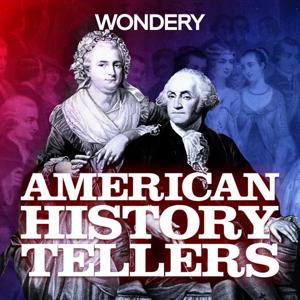
The Cold War, Prohibition, the Gold Rush, the Space Race. Every part of your life - the words you speak, the ideas you share - can be traced to our history, but how well do you really know the…
Audible subscribers can listen to all episodes of American History Tellers ad-free right now. Join Audible today by downloading the Audible app.
Ranked by our users in the last 21 days
10,438 Listeners

30,148 Listeners
777 Listeners
467 Listeners

784 Listeners

3,988 Listeners

6,175 Listeners
12,827 Listeners

3,637 Listeners

19,100 Listeners

2,149 Listeners

2,934 Listeners

115 Listeners

3,044 Listeners
22,943 Listeners

4,220 Listeners

905 Listeners
1,465 Listeners

7,767 Listeners

256 Listeners

2,517 Listeners

2,826 Listeners

251 Listeners

2,160 Listeners

1,596 Listeners

848 Listeners

1,531 Listeners

239 Listeners
591 Listeners

69 Listeners

535 Listeners

875 Listeners

163 Listeners