
Sign up to save your podcasts
Or



Based on Podcast App listening data
The 1929 stock market crash saw 14 billion dollars vanish in a matter of hours — and with it, the Republican party’s decades-long grip on American politics. As Americans lost their livelihoods, they turned to President Herbert Hoover for relief. But the self-made man who had so successfully reversed his own fortunes seemed unable to do the same for his country. With discontent growing, Hoover turned on World War veterans demanding early bonus payouts to support their families. It would prove the last straw for many Americans.
The landslide election of 1932 would mark a profound realignment in U.S. politics, bringing urban centers under Democratic control for the first time in the party’s history. And it would propel into the White House Franklin Delano Roosevelt, whose sweeping New Deal would permanently transform the American political landscape.
Support this show by supporting our sponsors!
See Privacy Policy at https://art19.com/privacy and California Privacy Notice at https://art19.com/privacy#do-not-sell-my-info.
As the Civil War came to a close, the government set its sights once again on the future of the United States. Working closely with a Republican President, the Republican Congress expected a swift and peaceful road to Reconstruction. But then, a mere four weeks into his second term, Lincoln was assassinated, leaving the country in the hands of Andrew Johnson, a Southern Democrat who had personally owned slaves just three years before.
While Johnson’s unwavering commitment to states rights cultivated a fraught relationship with his Congress, the tumult would ultimately be short-lived. After just four years of a Democratic president, America’s Grand Old Party would ascend to power—and hold it—for over 70 years.
Listen ad-free on Wondery+ here
Support us by supporting our sponsors!
See Privacy Policy at https://art19.com/privacy and California Privacy Notice at https://art19.com/privacy#do-not-sell-my-info.
The United States won the The Mexican–American War in the 1840s, and with it vast new stretches of western land. But in the 1850s, the question of what to do with this land – and whether to allow slavery in the new territories or not – became a redning issue for politicians of all stripes.
While the Whig Party collapsed over the issue, Democrats split into Northern and Southern factions, and a new Republican Party tried to bind the Union with an appeal to old Jeffersonian values. But in the houses of Congress and across the nation, negotiations fail, compromise is abandoned; and the issue of slavery will overshadow all else, leading to Civil War.
Support us by supporting our sponsors!
See Privacy Policy at https://art19.com/privacy and California Privacy Notice at https://art19.com/privacy#do-not-sell-my-info.
Andrew Jackson lost the 1824 presidential election to John Quincy Adams through what some called a “corrupt bargain” in the House of Representatives. The maneuver was masterminded by hot-headed but politically savvy Henry Clay, who with Adams, announced their intent for far-reaching new federal programs. Fierce opposition to these policies united pro-Jackson supporters who formed a new party, the Democrats, to rally around their hero and elect him to president in 1828.
But while Adams was defeated, Henry Clay had no intention of leaving the fight. He helped lead a new party which gathered together anti-Jackson, fiscal conservatives, and pro-states rights factions. The rise of Clay’s new Whig party seemed unstoppable–they captured both houses of Congress and the presidency–until, on April 4, 1841, president William Henry Harrison died in office and gave John Tyler the power of the veto.
Support this show by supporting our sponsors!
See Privacy Policy at https://art19.com/privacy and California Privacy Notice at https://art19.com/privacy#do-not-sell-my-info.
In the earliest days of the United States, there was no such thing as an organized political party. George Washington, elected twice to the presidency unanimously in the Electoral College, warned the new nation against political factions, writing that organized parties would become, “potent engines, by which cunning, ambitious, and unprincipled men subvert the power of the people.”
But immediately after Washington vacated the Presidency, factions did spring up and bitter personal rivalries began to shape the nation. The two first political parties–the Federalists and the Republicans–had very different views of what America should become, and were led by very different men: Alexander Hamilton and Thomas Jefferson.
Listen ad free with Wondery+. Join Wondery+ for exclusives, binges, early access, and ad free listening. Available in the Wondery App. https://wondery.app.link/historytellers
Support us by supporting our sponsors!
See Privacy Policy at https://art19.com/privacy and California Privacy Notice at https://art19.com/privacy#do-not-sell-my-info.
Throughout our series, corporate giants and their exploitation of workers was disturbing evidence of capitalism run amok. That greed and disregard for the working class defined the Gilded Age.
But the problems of that era haven’t disappeared. The economic disparities that were forged in the Gilded Age are still affecting our country. And monolithic companies like Facebook and Apple continue to grow, leaving a burning question of whether big tech has too much power.
Today, Lindsay speaks with Tim Wu, a Columbia law professor and author of “The Curse of Bigness: Antitrust in the New Gilded Age,” about the economic and social changes that took place then, and how they set the stage for modern America.
For more on Tim Wu: http://www.timwu.org/about.html
Listen ad-free on Wondery+ here
Support us by supporting our sponsors!
See Privacy Policy at https://art19.com/privacy and California Privacy Notice at https://art19.com/privacy#do-not-sell-my-info.
In the spring of 1894, hundreds of unemployed workers trudged through rain and snow on a 400-mile trek from Ohio to the nation’s capital. They joined armies of jobless men from all across the country to march on Washington, fed up with the government’s inaction in the face of the crippling Panic of 1893.
The century’s most punishing economic depression unleashed fierce political turmoil. A bitter debate over the gold standard consumed Americans nationwide. With the Treasury on the brink of collapse, President Cleveland made the desperate and controversial decision to turn to the nation’s top banker for a bailout.
The conflict over currency culminated in the emotional election of 1896, which pitted William McKinley against the charismatic reformer William Jennings Bryan, who electrified voters with his sensational “Cross of Gold” speech.
Listen ad-free on Wondery+ here
See Privacy Policy at https://art19.com/privacy and California Privacy Notice at https://art19.com/privacy#do-not-sell-my-info.
As the century came to a close, labor unrest reached explosive new heights. Industrial expansion made businessmen and bankers rich. But workers faced low wages, long hours, and dangerous conditions. They sought strength in numbers, fighting for basic rights against the power of big business—and often faced violent pushback.
In May 1886, a bomb exploded at a peaceful labor protest in Chicago’s Haymarket Square. Police fired their guns into the crowds. Panic engulfed the city. And the nation’s most powerful labor union suffered a devastating blow.
In Homestead, Pennsylvania, steelworkers waged a bloody battle against private security forces. And in Pullman, Illinois, railroad workers laid down their tools, sparking a nationwide railroad shutdown—one that President Grover Cleveland would crush with brutal force.
Listen ad-free on Wondery+ here
See Privacy Policy at https://art19.com/privacy and California Privacy Notice at https://art19.com/privacy#do-not-sell-my-info.
Amid the glamor and growth of the Gilded Age, racism and anti-immigrant hostility swept the nation. With the end of Reconstruction, white communities across the South stripped African Americans of their hard-won political rights and economic gains. But a new generation of activists fought the growing wave of discrimination and violence. Booker T. Washington championed black education, and journalist Ida B. Wells waged a fierce campaign against lynching.
In the West, labor groups fueled anti-Chinese resentment, building support for the first major federal law limiting immigration. In the mid-1880s, white mobs from Wyoming to Washington descended on Chinese neighborhoods, stoking hysteria and casting immigrants out of their homes.
Listen ad-free on Wondery+ here
Support us by supporting our sponsors!
See Privacy Policy at https://art19.com/privacy and California Privacy Notice at https://art19.com/privacy#do-not-sell-my-info.
In the spring of 1883, Mrs. Alva Vanderbilt threw the grandest party New York had ever seen, claiming her spot at the top of the city’s social hierarchy. The Gilded Age drove feverish growth in America’s cities. Populations swelled. Skyscrapers and steel bridges soared above city skylines. And the new economic elite poured their outrageous fortunes into magnificent mansions and lavish balls.
But there were two sides to Gilded Age cities. Less than a mile away from Manhattan’s elegant brownstones, the poor eked out a living in sooty factories and crowded slums. In the 1880s and 1890s, reformers rose up to challenge inequality—galvanizing workers and exposing the dark underbelly of urban growth.
Listen ad-free on Wondery+ here
Support us by supporting our sponsors!
See Privacy Policy at https://art19.com/privacy and California Privacy Notice at https://art19.com/privacy#do-not-sell-my-info.
From the publisher's feed
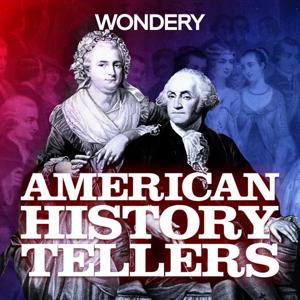
The Cold War, Prohibition, the Gold Rush, the Space Race. Every part of your life - the words you speak, the ideas you share - can be traced to our history, but how well do you really know the…
Audible subscribers can listen to all episodes of American History Tellers ad-free right now. Join Audible today by downloading the Audible app.
Ranked by our users in the last 21 days
10,438 Listeners

30,148 Listeners
777 Listeners
467 Listeners

784 Listeners

3,988 Listeners

6,175 Listeners
12,827 Listeners

3,637 Listeners

19,100 Listeners
2,149 Listeners

2,934 Listeners

115 Listeners

3,044 Listeners
22,943 Listeners

4,220 Listeners

905 Listeners
1,465 Listeners

7,767 Listeners

256 Listeners

2,517 Listeners

2,826 Listeners

251 Listeners

2,160 Listeners

1,596 Listeners
848 Listeners
1,531 Listeners

239 Listeners

591 Listeners

69 Listeners

535 Listeners

875 Listeners

163 Listeners