
Sign up to save your podcasts
Or



Based on Podcast App listening data
Twelve years after Henry Hudson's 1609 trip charting the Hudson River, the Dutch used his voyage as the basis for a new colony, which would be wedged between the English colonies in New England and Virginia. New Netherland began with tiny numbers of people from different backgrounds. They settled the entire region that Hudson had traveled, from Delaware to New York to Connecticut. But being spread out so thinly exposed them to danger. In 1626, in the area around the future Albany, New York, a small party became embroiled in a fight between two native tribes, and some settlers were killed.
In the aftermath, the colonists chose a new leader. Peter Minuit's first decision was to call all the settlers together for strength. Then he selected a location for a capital city, one that was strategically located in a world-class harbor and at the mouth of the colony's central river—a wilderness island called Manhattan.
Support us by supporting our sponsors!
See Privacy Policy at https://art19.com/privacy and California Privacy Notice at https://art19.com/privacy#do-not-sell-my-info.
In 1609, a headstrong English sea captain named Henry Hudson set out on behalf of the Dutch East India Company to find a trade route to Asia — and promptly found himself and his crew stranded in icy waters off the coast of Norway. As supplies dwindled, Hudson announced to his frostbitten crew that the ship would change course. They set off across the Atlantic Ocean in search of an alternative route through the North American continent.
Hudson never found the Northwest Passage, but he did come across something else on that journey — a small island the native people called Manna-hatta. That settlement would eventually give rise to a new Dutch colony called New Netherland, with Manhattan Island, or New Amsterdam, as it would come to be known, as its capital. New Amsterdam would come to be defined by two key Dutch values: tolerance and capitalism. This series by Russell Shorto, based on his book The Island at the Center of the World, traces how Manhattan’s brief chapter as a Dutch colony shaped the city for centuries to come.
See Privacy Policy at https://art19.com/privacy and California Privacy Notice at https://art19.com/privacy#do-not-sell-my-info.
The murder of Emmett Till galvanized the nascent civil rights movement. But the full story of what happened in Money, Miss., on August 28, 1955, is significantly different than the narrative that emerged at the time. A new app developed by scholars at Florida State University now seeks to give a fuller picture of Till’s lynching by taking users on a GPS guided tour around the Mississippi Delta and the important sites related to the case. Davis Houck, a professor of rhetorical studies at FSU, developed the app, and he joins us to talk about educating people on the legacy of Till’s killing and why it's more significant than ever.
Support us by supporting our sponsors!
See Privacy Policy at https://art19.com/privacy and California Privacy Notice at https://art19.com/privacy#do-not-sell-my-info.
The Alsos mission had a hard-charging leader in Boris Pash and an eccentric band of recruits. But if the so-called Bastard Brigade was going to track down the Nazi atomic bomb, they would also need scientific expertise. For that, they turned to the Dutch-American physicist Samuel Goudsmit.
Goudsmit wasn’t the brigade’s first choice—far from it. He was considered weak and timid, and even Goudsmit himself worried he lacked the courage for the mission. But the scientist had been friends with Werner Heisenberg as a young man in Europe, and he felt personally betrayed by Heisenberg’s work for the Nazis. And as a Jew who’d lost his parents to the concentration camps, Goudsmit was determined to fight back against Hitler.
But Goudsmit would eventually prove himself, and his brilliant detective work would lead the mission to a cave in Germany hewn into the side of a cliff — Heisenberg’s secret lair and the heart of the Nazi bomb project.
Support us by supporting our sponsors!
See Privacy Policy at https://art19.com/privacy and California Privacy Notice at https://art19.com/privacy#do-not-sell-my-info.
As the Nazis inched closer to acquiring a nuclear weapon, panic grew among the Allied forces. The Alsos Mission — otherwise known as the Bastard Brigade — was put in charge of gathering intelligence on Hitler’s bomb project, seizing stores of Nazi uranium, and hunting down members of the Uranium Club. The first atomic spy outfit in history was underway.
Their mission was led by the American-born son of a Russian Orthodox bishop, Colonel Boris Pash — a high school teacher, irreverent prankster, and veteran of two wars by his 18th birthday. Pash’s team would pursue leads across Europe, taking them on a dangerous journey from an Antwerp zoo to a French laboratory beset by snipers.
Support us by supporting our sponsors!
See Privacy Policy at https://art19.com/privacy and California Privacy Notice at https://art19.com/privacy#do-not-sell-my-info.
By mid-1944, the Allies’ fight to track down and stop the Nazi atomic program had met with failure and disappointment. And so the Manhattan Project took a new tack by recruiting and developing atomic spies — including a backup catcher for the Boston Red Sox named Moe Berg.
Although little known today, Berg was one of the most famous athletes of his day, and a certified genius. He could charm sports writers and fans alike with his tales of palling around with Babe Ruth and other celebrities, but he also held degrees from Princeton, Columbia, and the Sorbonne and spoke a dozen languages. When World War II broke out, Berg volunteered to work on behalf of the Office of Strategic Services as a spy.
Over time, however, Berg’s focus would shift from espionage toward assassination. Soon, he would travel abroad to target the most feared scientist in the world and the sharpest mind in the Nazi Uranium Club: German physicist Werner Heisenberg.
Support us by supporting our sponsors!
See Privacy Policy at https://art19.com/privacy and California Privacy Notice at https://art19.com/privacy#do-not-sell-my-info.
In early 1944, the Allies developed a desperate plan to destroy several massive bunkers in Nazi-controlled France—bunkers that reportedly housed atomic missiles. The plan called for filling up airplanes with napalm, flying them over to France via remote control, and ramming them into the bunkers, blowing them sky-high. But the military still needed pilots to get the napalm-filled planes off the ground and pointed in the right direction.
It was dangerous in the extreme. But one of the first volunteers for the mission was none other than Joe Kennedy, the daring older brother of future president John F. Kennedy. John had recently become a war hero, and a ragingly jealous Joe was willing to risk everything to destroy Hitler’s bunkers—and, more importantly, turn the spotlight back on himself.
Support us by supporting our sponsors!
See Privacy Policy at https://art19.com/privacy and California Privacy Notice at https://art19.com/privacy#do-not-sell-my-info.
The discovery of uranium fission in Nazi Germany in 1938 terrified Allied nuclear scientists—especially since the Nazi atomic bomb project, the dreaded Uranium Club, had a two-year head start on the Manhattan Project.
So the Allies decided to strike back. They couldn’t prevent Germany from acquiring uranium, but they could disrupt access to another key ingredient in atomic research—heavy water. Only one company in the world produced heavy water at the time, an isolated plant in Norway, so the Allies decided to send in teams of elite commandos on a top-secret mission to destroy it.
These missions certainly didn’t go perfectly—some were in fact disasters. But to prevent Hitler from getting an atomic bomb, no price was too high to pay.
Support us by supporting our sponsors!
See Privacy Policy at https://art19.com/privacy and California Privacy Notice at https://art19.com/privacy#do-not-sell-my-info.
The Second World War ended with two black mushroom clouds rising over the scorched remains of Hiroshima and Nagasaki. But most people don’t realize how easily the war could have ended not with an American atomic bomb but a German one, obliterating not a Japanese city but Paris, London, or even New York. As the war began, all the pieces were in place for the Germans to develop an atomic weapon. They had scientific visionaries like Werner Heisenberg, a manufacturing base committed to total war—and a big head start. The Allies were willing to go to desperate lengths to stop Adolph Hitler from getting his hands on an atomic bomb. They assembled a team of men and women to spy on, sabotage, and even assassinate members of the Nazi bomb project. They would become known as The Bastard Brigade.
But in the years leading up to the war, the scientific community couldn’t yet anticipate that artificial radioactivity was possible, let alone that it could lead to a weapon on the scale of an atomic bomb. That initial discovery would fall to a husband and wife team in Paris with a famous surname, a string of failures behind them, and a lot to prove: Frédéric and Irène Joliot-Curie.
Support us by supporting our sponsors!
See Privacy Policy at https://art19.com/privacy and California Privacy Notice at https://art19.com/privacy#do-not-sell-my-info.
The Statue of Liberty is one of America’s most iconic monuments to freedom. As we head into the Fourth of July holiday, we’ll look back on the amazing effort it took to get Lady Liberty built.
Beckett Graham is co-host of The History Chicks podcast, a show that explores the legacies of women throughout history. Beckett joins us to talk about her approach to telling women’s stories and we’ll also play a portion of The History Chicks podcast episode on how the Statue of Liberty came to be. It’s a story that includes New York’s first ticker tape parade, some challenging construction issues and suffragists on a boat protesting the statue’s dedication.
Support us by supporting our sponsors!
See Privacy Policy at https://art19.com/privacy and California Privacy Notice at https://art19.com/privacy#do-not-sell-my-info.
From the publisher's feed
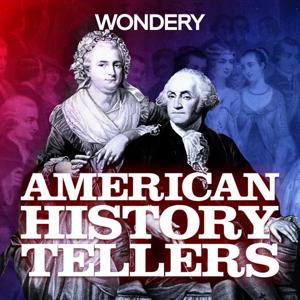
The Cold War, Prohibition, the Gold Rush, the Space Race. Every part of your life - the words you speak, the ideas you share - can be traced to our history, but how well do you really know the…
Audible subscribers can listen to all episodes of American History Tellers ad-free right now. Join Audible today by downloading the Audible app.
Ranked by our users in the last 21 days

10,438 Listeners

30,148 Listeners
777 Listeners
467 Listeners

784 Listeners

3,988 Listeners

6,175 Listeners
12,827 Listeners

3,637 Listeners

19,100 Listeners

2,149 Listeners

2,934 Listeners

115 Listeners

3,044 Listeners
22,943 Listeners

4,220 Listeners

905 Listeners
1,465 Listeners

7,767 Listeners

256 Listeners

2,517 Listeners

2,826 Listeners

251 Listeners

2,160 Listeners

1,596 Listeners

848 Listeners

1,531 Listeners

239 Listeners
591 Listeners

69 Listeners

535 Listeners
875 Listeners

163 Listeners