
Sign up to save your podcasts
Or

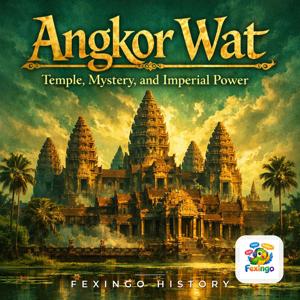


While we have explored the stone, water, and labor of Angkor Wat, few episodes have examined what happened inside its vaults. This conversation turns to the Khmer Empire’s immense wealth, specifically the gold mined from Srey Santhor and the administrative machinery that managed it. Lucas and Luna discuss the role of the royal treasurers, the inscriptions detailing tribute flows from conquered Champa and Sri Vijaya, and how this economic power underwrote the temple’s construction. We look at the K. 235 inscription, which records the transfer of goldsmiths and artisans, revealing a state economy far more sophisticated than simple subsistence agriculture. The episode also touches on the eventual depletion of these resources and the shifting political landscape that followed Suryavarman II’s death, offering a materialist counterpoint to the spiritual narratives often told about the site.
#KhmerEmpire #SuryavarmanII #AngkorWatHistory #SoutheastAsianHistory #MedievalEconomics #GoldMining #SreySanthor #RoyalTreasurer #K235Inscription #ChampaWar #Srivijaya #TempleEconomy #MonsoonAgriculture #IndianOceanTrade #AncientTreasury #FexingoHistory #HistoryPodcast #AngkorThom
Keep every episode free: buymeacoffee.com/fexingo
In this episode, Lucas and Luna turn their gaze from the grand architecture of Angkor Wat to a single, enigmatic figure carved into its walls: the apsara who seems to smile. They explore the artistry of the devatas, the divine guardians whose serene faces have puzzled archaeologists and art historians for over a century. Drawing on the bas-reliefs that depict the Churning of the Ocean of Milk, the conversation reveals how these celestial dancers were not mere decoration but embodied the Khmer Empire's beliefs about cosmic order and royal power. Along the way, Lucas shares the story of an obscure French conservator, Jean Commaille, who first documented these carvings in the early 1900s, and reflects on the ongoing restoration efforts by the APSARA Authority. The episode also touches on the subtle differences between apsaras and devatas, the symbolism of their poses, and what modern 3D scanning has uncovered about the carvers' techniques. For listeners who have followed the series, this episode offers a fresh perspective on a familiar monument, reminding us that history lives not just in the stones but in the human touch left behind.
#AngkorWat #Apsara #Devata #KhmerEmpire #SuryavarmanII #BasRelief #ChurningOfTheOceanOfMilk #MountMeru #Vishnu #APSARAAuthority #JeanCommaille #EFEO #3DScanning #AncientArt #Cambodia #SoutheastAsia #History #FexingoHistory
Keep every episode free: buymeacoffee.com/fexingo
In this episode, Lucas and Luna explore the thousands of stone inscriptions scattered across Angkor — the empire's true archives, written in Sanskrit and Old Khmer. They follow the story of a single inscription from 1052 CE, the Sdok Kak Thom, which records a royal lineage stretching back to the devaraja cult of Jayavarman II. Along the way, they uncover the work of early French epigraphers like Étienne Aymonier and George Coedès, who pieced together Khmer history from these stones. They discuss what inscriptions reveal about daily life, land disputes, temple endowments, and the shifting role of Buddhism. The episode also touches on the fragility of these records, the threats of looting and weathering, and the ongoing efforts to digitize them. A quiet reflection on how an empire wrote itself into permanence — and what we lose when that writing fades.
#AngkorWat #KhmerEmpire #SanskritInscriptions #OldKhmer #Epigraphy #GeorgeCoedes #EtienneAymonier #SdokKakThom #Devaraja #JayavarmanII #TempleInscriptions #SoutheastAsia #Archaeology #HistoryOfWriting #DigitalHumanities #FexingoHistory #History #AncientHistory
Keep every episode free: buymeacoffee.com/fexingo
Before he became the empire's greatest builder, Jayavarman VII was a prince in exile, a reluctant heir who watched his family lose the throne and then took it back. This episode follows his early life: the coup that scattered the royal line, his years in voluntary exile in Champa, and the desperate war that brought him home at sixty. We walk through the battles he fought, the alliances he made, and the brothers who died so he could rule. Lucas and Luna also unpack the mystery of his missing years, the inscriptions that hint at his secret return, and the sheer strangeness of a king who waited so long to claim his birthright. It's the story behind the temples, told through the man who built them.
#JayavarmanVII #AngkorWat #KhmerEmpire #Champa #SoutheastAsia #CambodianHistory #exile #civilWar #SuryavarmanII #AngkorThom #Bayon #BuddhistKing #12thCentury #MedievalHistory #royalSuccession #warAndPolitics #FexingoHistory #History
Keep every episode free: buymeacoffee.com/fexingo
When we picture Angkor Wat today, we see grey stone against green jungle. But in the twelfth century, the temple blazed with color. In this episode, Lucas and Luna explore the lost polychromy of Angkor Wat—the reds, ochres, and golds that once covered its walls. They look at the chemical evidence of paint on the sandstone, the accounts of early Chinese visitors like Zhou Daguan, and the painstaking work of conservators from the APSARA Authority and the EFEO who are now uncovering traces of pigment. They examine what the colors meant symbolically—how red evoked the earth and divine power, how gold mirrored the sun and the god Vishnu—and how the temple's appearance changed over centuries of weathering, iconoclasm, and restoration. Along the way, they confront a troubling question: did the Western obsession with 'ancient ruins' erase the vibrant reality of these monuments? And they consider what it means to see Angkor Wat as a living, colorful building rather than a silent relic. Specifics include the use of hematite and ochre, the burnishing of the stone surface, and the traces of a white lime wash. This episode challenges how we look at one of the world's most famous temples.
#AngkorWat #KhmerEmpire #Polychromy #TemplePaint #ZhouDaguan #APSARAAuthority #EFEO #Vishnu #SuryavarmanII #MountMeru #Sandstone #Pigment #Conservation #SoutheastAsia #Archaeology #History #FexingoHistory #HiddenHistory
Keep every episode free: buymeacoffee.com/fexingo
In episode 217, Lucas and Luna dig into the bronze axes of Angkor — the everyday iron and bronze tools that quarried, shaped, and carved the sandstone blocks of Angkor Wat. How did Khmer smiths, working far from the temple site, supply an army of laborers with chisels that could hold an edge against sandstone? The episode follows the metal from the Phnom Dek mines in the northern hills, through the crucible and forge, to the corbelled arches and bas-reliefs. We meet the smiths behind the devaraja cult, the trade routes that carried copper and tin from as far as the Malay Peninsula, and the unique alloys that made Khmer tools a cut above. Along the way, Lucas explains the evidence from slag heaps, iconography, and experimental archaeology — how modern smiths have tested replica tools against the same stone. And he weighs a quiet mystery: why did the Khmer, who mastered bronze, never adopt iron on the same scale? A story of skill, sweat, and the unsung hands that raised a mountain of stone.
#AngkorWat #KhmerEmpire #BronzeAge #Archaeology #SuryavarmanII #PhnomDek #Sandstone #Devaraja #Metallurgy #CorbelledArch #BasRelief #ZhouDaguan #MountMeru #Iron #Copper #Tin #History #FexingoHistory
Keep every episode free: buymeacoffee.com/fexingo
In this episode, Lucas and Luna explore the remarkable hydraulic engineering of Angkor Wat and the Khmer Empire, focusing on the little-known mechanical pumps and water-lifting devices that kept the city's canals, moats, and reservoirs flowing. We trace the evolution from simple buckets to the innovative noria and chain pump, and examine how the monsoon-driven system was managed by a specialized corps of technicians. We also weigh the evidence for the 'hydraulic city' theory, the role of the barays, and the controversies around Angkor's water management that may have contributed to its decline. Along the way, we meet Zhou Daguan's vivid accounts of waterborne life, and consider how the Khmers' mastery of water shaped their cosmology and their empire.
#AngkorWat #KhmerEmpire #HydraulicEngineering #WaterManagement #ZhouDaguan #Noria #ChainPump #Baray #Monsoon #SoutheastAsia #AncientTechnology #Archaeology #FexingoHistory #History #WaterPump #Angkor #SuryavarmanII #AncientEngineering
Keep every episode free: buymeacoffee.com/fexingo
In this episode, Lucas and Luna step away from the grand battle scenes and explore the quieter, more intimate carvings that fill Angkor Wat's walls. They look at scenes of daily life in the 12th-century Khmer Empire — the cooks, musicians, merchants, and farmers who are immortalized in stone — and ask what these images tell us about the people who built and served the temple. Along the way, they discuss the famous inscription by the Chinese diplomat Zhou Daguan, the role of the devaraja cult, and the ongoing work of historians to reconstruct the lives of ordinary Khmers from these bas-reliefs. The conversation also touches on the dangers of over-interpreting ancient art, and the importance of seeing these carvings as both historical records and expressions of imperial power.
#AngkorWat #BasReliefs #KhmerEmpire #SuryavarmanII #ZhouDaguan #devaraja #MountMeru #SoutheastAsia #12thCentury #DailyLife #AncientKhmer #Archaeology #ArtHistory #Cambodia #History #FexingoHistory #AncientHistory #AsianHistory
Keep every episode free: buymeacoffee.com/fexingo
When people picture Angkor Wat, they see temples and moats — but the real marvel may have been the roads. In this episode, Lucas and Luna explore the Khmer Empire's vast highway system, the stone bridges that still stand, and the rest stops that kept an empire moving. They follow the route from Angkor to Phimai, the great temple-city in modern Thailand, and meet the French archaeologist Henri Marchal, who first mapped these roads in the 1930s. Along the way, they talk about the dharmaśāla fire-houses, the arogyaśālā hospitals built by Jayavarman VII, and the inscriptions — like the one at Preah Khan — that record the empire's infrastructure. It's a story about logistics as much as it is about stone, and about how the Khmer built not just to worship, but to connect.
#AngkorWat #KhmerEmpire #SuryavarmanII #JayavarmanVII #Phimai #HenriMarchal #dharmaśālā #arogyaśālā #PreahKhan #SoutheastAsia #AncientRoads #Infrastructure #AngkorianEra #KhmerArchaeology #History #FexingoHistory #MongkolBorei #BanteayChhmar
Keep every episode free: buymeacoffee.com/fexingo
Episode 213 of Fexingo History peels back the jungle to trace the hydraulic genius behind Angkor Wat. While the temple's towers reach for heaven, its true power lay in a vast network of channels, embankments, and the enormous West Baray — a human-made reservoir larger than many modern cities. Lucas and Luna follow the flow from the Kulen hills to the great barays, where engineers mastered monsoon and drought to feed a capital of nearly a million people. They meet the unnamed surveyors who laid out canals with a precision that still impresses, and the kings who turned water into political control, and ultimately into the divine mandate of the devaraja. Drawing on inscriptions, LiDAR surveys, and the work of scholars like Bernard-Philippe Groslier, they confront the mystery of Angkor's collapse — not as a simple story of failed irrigation, but as a slow unraveling of a system strained by climate, war, and the very scale of its own ambition. A story of water, power, and the fragile balance between human ingenuity and a changing world.
#AngkorWat #KhmerEmpire #HydraulicCity #WestBaray #SuryavarmanII #devaraja #LiDAR #Groslier #SoutheastAsia #Archaeology #AncientEngineering #Monsoon #AngkorCollapse #MountMeru #IndravarmanI #YasovarmanI #PhnomKulen #FexingoHistory
Keep every episode free: buymeacoffee.com/fexingo
From the publisher's feed