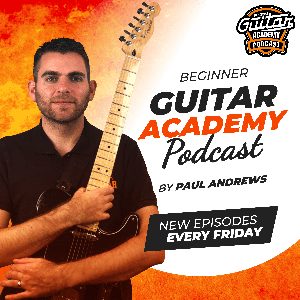
Beginner Guitar Academy

Beginner Guitar Academy

By Beginner Guitar AcademyEducation
Download on the App Store

Beginner Guitar Academy episodes

  • 251 - 10 Albums Every Guitar Player Should Listen To – Part 2

    Episode Summary

    In this episode, Paul Andrews rounds out his two-part guide to the "10 Albums Every Guitar Player Should Listen To." Picking up from last week's list, Paul dives into the final five influential records that have shaped the world of guitar—breaking down their impact, sharing some backstory, and extracting key lessons for guitarists of all levels. Plus, there’s a quick update about the Beginner Guitar Academy community and what’s new this month inside the Academy.

    Episode Highlights:

    Beginner Guitar Academy News

    • Paul reminds listeners to check out the latest Academy Show where he gives member shout-outs, highlights level assessment passers, celebrates anniversary milestones, and shares new content and upcoming Academy features.

    Album #6: Back in Black – AC/DC (1980)

    • Tribute to late singer Bon Scott and one of the best-selling albums ever.
    • Angus Young’s powerful, rhythmic riffs are simple but enormous.
    • Key lesson: Guitar riffs don’t have to be complex—focus on rhythm, groove, and confidence.

    Album #7: The Dark Side of the Moon – Pink Floyd (1973)

    • Features some of David Gilmour’s most emotive, melodic solos.
    • Gilmour redefines lead guitar: slow, melodic, and expressive rather than shredding.
    • Key lesson: Every note matters. Don’t rush—let your bends, vibrato, and phrasing do the talking.

    Album #8: Abbey Road – The Beatles (1969)

    • Beatles push boundaries with innovative, song-serving guitar parts.
    • George Harrison’s lyrical solo in "Something" and dueling guitar lines stand out.
    • Key lesson: Think like a songwriter—use guitar to enhance the song, not just showcase skills.

    Album #9: Paranoid – Black Sabbath (1970)

    • Tony Iommi’s dark, heavy riffs define heavy metal despite physical setbacks.
    • Pioneers low tuning and new techniques, creating an iconic sound.
    • Key lesson: Limitations inspire innovation; embrace unique challenges to find your sound.

    Album #10: Hotel California – The Eagles (1976)

    • Blends rock, country, and folk with lush electric and acoustic guitar layers.
    • Legendary dual guitar harmonies on the title track.
    • Key lesson: Collaboration elevates your playing—try harmonised leads or layering with a loop pedal.

    Featured Tracks (Live Performances Referenced):

    • AC/DC – “Back in Black” (1981, Capitol Center, Landover, Maryland)
    • Pink Floyd – “Money” (2005, Live 8, London)
    • The Beatles (George Harrison) – “Here Comes the Sun” (1971, Concert for Bangladesh)
    • Black Sabbath – “Paranoid” (1985, Live Aid)
    • Eagles – “Life in the Fast Lane” (1994, MTV Live)

    Listener Challenge:

    Paul invites you to share your pick for an essential guitar album. Reach out with your suggestions for a chance to be featured in a future episode or on the blog!

    Academy Resource Reminder:

    Beginner Guitar Academy members can access loads of resources to help apply these album-inspired lessons to their own playing. Not a member yet? Try for just $1 with a two-week trial at Beginner Guitar Academy.

    Thanks for listening—keep practicing and see you next week!

    30 min
  • 250 - 10 Albums Every Guitar Player Should Listen To – Part 1

    Celebrating a huge milestone, Paul Andrews marks the 250th episode of the Beginner Guitar Academy Podcast by launching a brand-new two-part series: "10 Albums Every Guitar Player Should Listen To."

    In this first instalment, Paul dives into the history, lasting impact, and key guitar lessons from five essential albums. If you’re looking for inspiration, fresh practice ideas, or just an excuse to revisit some legendary records, this episode is packed with practical takeaways for guitarists of any level.

    What’s Inside This Episode

    A Heartfelt Thank You

    • Paul opens the episode with gratitude for listeners’ ongoing support and shares a milestone celebration for reaching 250 episodes.

    Member Update

    • Beginner Guitar Academy members: Last week’s live Q&A (audio & video) is now available in your member dashboard!

    The First 5 Essential Albums for Guitarists

    1. Are You Experienced – Jimi Hendrix (1967)

    • Hendrix revolutionised the electric guitar with feedback, effects, and a fearless, creative approach.
    • Key Lesson: Don’t be afraid to experiment; creative use of effects and tone is as important as technical skill.
    • https://youtu.be/cJunCsrhJjg?si=3VFxAsDiXLbCVVBH

    2. Led Zeppelin IV – Led Zeppelin (1971)

    • Home to classics like “Stairway to Heaven” and “Black Dog,” this album showcases electric riffs and acoustic textures, emphasising dynamic contrast.
    • Key Lesson: Dynamics matter—experiment with loud/soft, clean/distorted, and acoustic/electric to add emotion to your playing.
    • https://youtu.be/6tlSx0jkuLM?si=SSNlFxv8s9yvxm38

    3. Rumours – Fleetwood Mac (1977)

    • Featuring tasteful, song-serving guitar work by Lindsey Buckingham, this album is a masterclass in restraint and melody.
    • Key Lesson: Serve the song. Taste and restraint are as vital as flashy solos.
    • https://youtu.be/ozl3L9fhKtE?si=nj8fRxrfJCSyMRhQ

    4. Texas Flood – Stevie Ray Vaughan (1983)

    • Vaughan brought fire and emotion back to blues with incredible phrasing, tone, and expression.
    • Key Lesson: Feel is everything. Focus on phrasing, vibrato, and playing each note with intention.
    • https://youtu.be/kfjXp4KTTY8?si=pXyMMp7KigtpDSDX

    5. Nevermind – Nirvana (1991)

    • Nirvana’s raw, simple, and energetic approach inspired a new generation of guitarists.
    • Key Lesson: Don’t underestimate simplicity. Powerful songs can be built with just a few chords and tons of attitude.
    • https://youtu.be/R3XIGon2RjY?si=Wt91k_VJd5ePcQn5

    Useful Links & Resources
    • Catch up on the latest member Q&A – Now available in the Beginner Guitar Academy dashboard.
    • Join Beginner Guitar Academy – Try a 14-day trial for just $1, access lessons, live trainings, and a supportive guitar community. Visit beginnerguitaracademy.com

    Coming Up Next

    Stay tuned for Part 2 next week, where Paul will reveal five more classic albums every guitarist should listen to!

    Thanks again for helping us reach 250 episodes—here’s to many more. Until next time, keep practicing!

    36 min
  • 249 - Where to Find Accurate Guitar Tabs

    In this week’s episode, Paul dives into a common question from students: “Where can I find decent, authentic tabs to learn songs?”

    Building on last week’s three-step song-learning system (practice, playthrough, perform), Paul takes a deep look at both free and paid online resources for guitar tabs, discusses their pros and cons, and gives expert advice on what to trust when searching for accurate music.

    Key Topics Covered🎸 Beginner Guitar Academy News
    • Reminder for BGA members: the live Q&A session is scheduled for Sunday, 31st August, at 9pm GMT. Members can join the Zoom meeting to ask Paul questions or submit questions in advance by email if they are unable to attend live. Recordings and audio will be available afterwards via the Academy platform.

    🖥️ Top Online Resources for Guitar Tabs

    1. Ultimate Guitar (ultimate-guitar.com)

    • Largest online tab database.
    • Mostly user-submitted tabs; quality varies.
    • Ratings help determine accuracy.
    • Paid version (Pro/Ultimate) includes playback, looping, and may have more professionally transcribed tabs.
    • App available for mobile practice.

    2. Songsterr (songsterr.com)

    • Interactive tabs with playback, loop, and speed control (more features with Plus subscription).
    • Transcriptions often superior since they include rhythm information.
    • App available.

    3. GuitarProTabs.org

    • Download Guitar Pro files (.gp3, .gp4) for use with Guitar Pro software (which Paul highly recommends for creating, playing back, and slowing down tabs).
    • Great for multi-guitar songs.
    • BGA members get a Guitar Pro discount.

    4. “Classic” Sites

    • GuitarTabs.cc, 911Tabs.com, Guitar E-Tab: Longstanding online databases with extensive archives. Mostly user-submitted—so always double-check for accuracy.

    💰 Paid & Official Sheet Music

    1. MusicNotes.com

    • Professionally published, highly accurate digital sheet music, often by Hal Leonard and Cherry Lane.
    • Preview first page for free; pay (approx. €4/song) for full versions.
    • Monthly pro membership brings discounts.

    2. SheetMusicDirect.com

    • UK-based; offers a subscription “Pass” with access to a vast catalogue (print/download options require a higher plan or extra charge).
    • Student discounts available.

    3. GuitarInstructor.com (Paul’s Top Pick)

    • Official Hal Leonard website; highly accurate, downloadable PDF tabs.
    • Video lessons from pro instructors included.
    • Annual subscription available; best value for teachers and students wanting authentic, printable tabs.

    📚 Old-School Physical Books
    • Remember the value of physical songbooks available from Amazon, MusicRoom (UK), and SheetMusicPlus (US). Sometimes importing is less expensive!

    Paul’s Recommendations & Pro Tips
    • For beginners: Use Ultimate Guitar or Songsterr for exploring a wide variety of songs, but always verify accuracy.
    • For teachers or those seeking authenticity: GuitarInstructor.com offers the best official tabs with PDF downloads, and lessons bundled in.
    • For multi-guitar/tabbed arrangements: Invest in Guitar Pro software; BGA members can get a significant discount.
    • Physical copies: Books are still a great, reliable option and sometimes offer the most precise transcriptions.

    Listener Q&A
    • Thanks to Mark Old for inspiring this episode’s topic with his question about finding authentic tabs.

    Join Beginner Guitar Academy

    If you’re enjoying the podcast and Paul’s teaching style, consider joining Beginner Guitar Academy! Members get structured lessons, song libraries, workshops, live Q&As, and access to a vibrant community. Try it for just $1 at beginnerguitaracademy.com.

    22 min
  • 248 - How To Learn Songs on Guitar: Simple System for Learning, Memorizing, and Improving

    In this week’s episode, Paul Andrews addresses a common challenge among beginner guitarists: learning and actually remembering songs.

    Paul shares a structured approach to not just learning new songs but maintaining and improving them over time.

    Whether you’re struggling to recall previously learned tunes or looking to build a solid repertoire, this episode offers practical tips and actionable steps to level up your song practice routine.

    Key Topics Covered

    Community Update:

    • Paul announces a live Zoom Q&A taking place on Sunday, 31st August at 9 pm GMT for Beginner Guitar Academy members. He details how to join, submit questions, and access the recorded session if you can’t attend live.

    Practicing Songs vs. Practicing Skills:

    • Songs are a collection of different skills (chords, rhythms, techniques).
    • Key tip: Break songs down into their skill components to assess if they’re suitable for your current level.
    • Avoid picking songs that are too far above your ability; focus on skills first, then songs.

    A System for Learning Songs Efficiently:

    Step One: Pick the Right Song:

    • Choose a song that aligns with your current skillset.
    • Listen to the original, identify sections (intro, verse, chorus), and loop those sections in practice.
    • Start with simplified versions and play the song slowly. Only increase tempo as you gain confidence.

    Step 2: The 3 Ps System for Maintaining Songs:

    1. Practice – For new or challenging songs/sections. Loop and break down tricky parts.
    2. Playthrough – For songs you can mostly play but need to keep fresh.
    3. Perform – For songs you know inside out; these are gig-ready or can be played start to finish confidently.

    • Rotate songs between these categories as your abilities improve.

    Step 3 - Balancing New Songs and Old Songs (The 50/50 Rule):

    • Don’t just chase new songs or only maintain old ones. Spend half your practice on new material and half on revisiting and maintaining what you already know.

    Common Mistakes (and How to Fix Them):

    1. Always starting at the beginning of a tune.
    2. Not listening to the original recording.
    3. Neglecting old songs.
    4. Not keeping a song log.
    5. Collecting snippets instead of completing full songs.
    6. Practicing without a clear goal.

    Action Plan for This Week:

    1. Make a list of every song you can (or almost can) play.
    2. Categorize each into Practice, Playthrough, or Perform.
    3. Schedule a setlist run-through (like a mini gig at home).
    4. Add a new, suitable song to your practice pile, balance new and old (50/50).
    5. Track your song practice and progress.

    Takeaways
    • Focus on skill-appropriate songs, break them down, and use a structured maintenance method to truly own your repertoire.
    • Rotate between learning new material and refreshing old songs to keep your playing both exciting and reliable.
    • Set clear intentions with every song practice session to avoid getting stuck or demotivated.
    • Celebrate your progress as songs move from “Practice” to “Playthrough” and finally “Perform”.

    Resources Mentioned
    • Beginner Guitar Academy: Join for a structured, supportive approach to learning, with access to live Q&As, workshops, a song library, and two weeks of access for just $1.

    Next Steps:

    Ready to make progress with your song repertoire? Follow Paul’s five-step plan this week and start building a song list you can truly play and enjoy!

    Don’t Forget:

    If you enjoyed this episode, please leave a rating or review, subscribe for future episodes, and check your email for details about the upcoming live Q&A.

    Stay Tuned:

    New episodes drop every Friday with actionable tips to help you become a better guitarist. Until next week, keep practicing and have fun!

    22 min
  • 247 - How To Solo Over A Minor Blues Progression

    In this week’s episode, Paul dives into the moody and expressive world of minor blues progressions.

    Building on last week’s look at soloing over major blues, this episode walks you through the structure, chord options, and soloing approaches for a classic 12-bar minor blues.

    By the end, you'll know how to play and solo over a minor blues progression, select the right scales, and discover great artists and tracks for inspiration.

    Key Topics Covered

    What is a Minor Blues Progression?

    • Explained as a 12-bar blues that swaps dominant 7th chords for minor chords, resulting in a darker, more emotional feel.
    • Variations include using minor 7th chords or introducing a dominant 7th on chord 5 for extra bluesy tension.

    Common Minor Blues Variations

    • Paul demonstrates the classic A minor progression and a B.B. King-inspired variation (“The Thrill Is Gone”) that introduces a major 7th chord for extra drama.

    Beginner-Friendly Approaches

    • Tips on using open chords (A minor, D minor, E minor, D7, E7, and Fmaj7) for easier playability.
    • How to simplify strumming and tempo for beginners.

    Soloing Over Minor Blues

    • Introduction to the A minor pentatonic scale—your go-to for minor blues soloing.
    • Shows both open and fifth-fret positions.
    • Expressive techniques: bends, vibrato, slides, and targeting root notes (A notes).
    • Advanced flavour: how to add blues scale notes and natural minor notes for richer phrasing.

    Listening for Inspiration

    Song recommendations to practice and internalise the sound of minor blues:

    • “The Thrill Is Gone” by B.B. King
    • “Still Got the Blues” by Gary Moore
    • “Tin Pan Alley” by Stevie Ray Vaughan
    • Curated Spotify playlist with 25 minor blues classics. Click here to access it

    Homework for the Week

    1. Practice playing the minor blues progression in A using both open and minor 7th chords.
    2. Improvise with the A minor pentatonic, starting with simple phrases and working up to bends and slides.
    3. Listen to the Spotify playlist and focus on picking out phrasing, note choice, and expressive techniques from the pros.

    Resources Mentioned

    Spotify Playlist: 25 Minor Blues Tracks – https://open.spotify.com/playlist/5M3zmU5zHT7d1h5sNWtG3l?si=sr3fLJRXSqqcT6yrL9vX3g

    Video Version: Watch Paul’s finger placement and demonstrations here.

    Beginner Guitar Academy: Try the Academy for two weeks for just $1 and get access to step-by-step courses, songs, and community support.

    22 min
  • 246 - How to Solo Over a Major Blues Progression

    This week, Paul continues the deep dive into blues guitar, building on foundation concepts from Episode 245. The focus shifts to soloing over a major blues progression—specifically, what scales to use, how to target chord tones, and the techniques that legendary blues artists like B.B. King, Eric Clapton, and Stevie Ray Vaughan employ in their solos.

    Key Topics Covered

    Recap: Major vs. Minor Blues (12-Bar Blues Structure)

    • Definition and structure of a 12-bar major blues progression using dominant 7 chords (A7, D7, E7).
    • Why the turnaround bar matters, and options for looping or finishing the progression.

    Foundational Scale for Soloing

    • Why the A minor pentatonic scale (A, C, D, E, G) works so well, even over major blues progressions.
    • The “bluesy” tension created by overlapping the scale’s minor third (C) against the chord’s major third (C#).

    Targeting Chord Tones for More Musical Solos

    • Root, third, and flat 7th notes of each dominant 7 chord (A7, D7, E7).
    • How to start by simply hitting the root notes as the chords change, or add more complexity by incorporating other chord tones.
    • Examples: bending C to C# for A7, sliding to F# for D7, emphasizing B for E7.

    Making Your Solos Sound More Interesting: Advanced Scale Choices

    • Major Pentatonic Scale: Adds brightness and connects with more chord tones.
    • Blues Scale: Introduces the flat five (the “devil’s note” for added tension).
    • Mixolydian Mode: A sophisticated, more “perfect” match for dominant 7 chords.

    Blues Soloing Approaches of the Legends

    • B.B. King: Simple, expressive phrases in the “BB box,” blending major and minor pentatonic. Focuses on bending and vibrato over flashy scale runs.
    • Stevie Ray Vaughan: Aggressive mixing of major and minor pentatonic, with embellishments like hammers, pull-offs, and expressive picking.
    • Eric Clapton: Known for chord tone targeting, major-minor pentatonic blends, and signature licks that follow the progression.

    Practice Tips

    • Start by jamming over backing tracks with A minor pentatonic.
    • Progress to targeting root notes and other chord tones as the progression changes.
    • Add in extra notes from the major pentatonic, blues scale, or Mixolydian mode as you become comfortable.
    • Don’t rush—focus on phrasing, feel, and emotion, not just speed and complexity.

    Resources & Recommendations
    • Backing Tracks & Playlists:
    • Academy members: Check the dashboard’s backing tracks section for new major and minor blues tracks. Search “A blues backing track” on YouTube or Spotify.
    • Spotify Playlist: https://open.spotify.com/playlist/5qoEzDgKllxygGKgQGjei4?si=Nj7PFvFKREiOvbi8OmZy4Q
    • Join the Discussion: Academy members: Share your favorite tracks or soloing progress on the forum!
    • Not Yet a Member? Try Beginner Guitar Academy with a $1 two-week trial: beginnnerguitaracademy.com

    Final Thoughts

    The essence of blues soloing is feel—the right note, at the right time, with the right emotion. Start with the basics, experiment slowly, and let the greats inspire you.

    Subscribe, leave a review, and—most importantly—keep practicing!

    26 min
  • 245 - Major vs. Minor Blues: What’s the Difference?

    In this week’s episode, Paul tackles a common question from Beginner Guitar Academy members: What exactly does it mean when someone says “a blues”—is it a minor blues, and is there such a thing as a major blues?

    Paul breaks down the differences between major and minor blues progressions, walks you through classic chord sequences, offers examples of famous songs you can listen to and learn, and shares practical tips for practicing both styles.

    Key Topics Covered:

    Community Updates:

    • Recap of the recent live Q&A (available in the Academy and member-only podcast)
    • Announcement of a new, easier capo version of “Every Breath You Take” (now available in the riff section)

    Main Topic: Blues Explained

    • What guitarists mean by "a blues in A"
    • Almost always refers to a 12-bar blues progression in A using dominant 7th chords (A7, D7, E7)
    • Concept of the “major blues”:
    • Based on dominant 7th chords—these have both major and minor elements due to the flattened seventh
    • The most common form you’ll encounter
    • Guitarists often solo over these chords using the minor pentatonic or blues scale, creating a signature, gritty sound

    Examples of Major Blues Songs:

    • “Pride and Joy” — Stevie Ray Vaughan
    • “Hoochie Coochie Man” — Muddy Waters
    • “Johnny B. Goode” — Chuck Berry

    What is a Minor Blues?

    • Structured identically (12-bar format) but uses minor chords (e.g., Am, Dm, E7)
    • Creates a darker, moodier, and more soulful sound
    • Suitable scales: natural minor, Dorian mode for colour, and minor pentatonics for soloing

    Examples of Minor Blues Songs:

    • “The Thrill Is Gone” — B.B. King
    • “Tin Pan Alley” — Stevie Ray Vaughan
    • “Ain’t No Sunshine” — Bill Withers

    Major vs. Minor Blues at a Glance:

    • Major blues: dominant 7 chords, upbeat and gritty
    • Minor blues: minor chords, soulful and emotional

    Why This Matters for Beginners:

    • Understanding the difference helps when searching for backing tracks or improvising
    • Knowledge of these forms is crucial for jamming, songwriting, and selecting suitable scales while soloing

    Practice Tips:

    • Try out both progressions with open and dominant 7 chords
    • Jam over loops you record yourself for both major and minor blues
    • Learn one song in each style, such as “Before You Accuse Me” (major) or “Ain’t No Sunshine” (minor)
    • Record your playing to compare the feel between major and minor blues

    Extensions/Chord Choices:

    • Use dominant 7 chords for major blues (not just major triads or major 7 chords)
    • For minor blues, try minor 7 extensions for a richer sound

    Links & Resources:

    • Watch the video podcast: BGAPodcast.com/245
    • Learn more and start your two-week trial for just $1: beginnerguitaracademy.com
    • Member Q&A and riff lessons are accessible in the Academy dashboard

    Enjoying the Show?

    If you’ve been finding these episodes valuable, please rate and review the podcast on your listening app or at bgapodcast.com.

    Thanks for tuning in to the Beginner Guitar Academy Podcast!

    12 min
  • 244 - 1990s: Britpop & the Indie Revival

    In this week’s episode, Paul dives into the fourth part of the British Guitar Music series, spotlighting the vibrant era of Brit Pop and the indie rock revival of the 1990s and early 2000s.

    These decades brought guitar music back into the mainstream, known for their catchy hooks, jangly chords, and a strong sense of attitude, along with many riffs and techniques that are highly accessible to beginner guitarists.

    Paul explores iconic bands like Oasis, Blur, Arctic Monkeys, Franz Ferdinand, and The Libertines, highlighting the essential gear and tones of the era, breaking down famous songs and riffs, and sharing practical takeaways that you can apply to your playing. Additionally, he concludes with a challenge for listeners to work on during the week.

    What You’ll Learn in This Episode:

    Brit Pop & Indie Rock Essentials:

    • The defining features of Brit Pop (think Oasis & Blur) and the raw energy of the 2000s indie scene (like Arctic Monkeys & Franz Ferdinand).
    • Chords, confidence, and big choruses: why rhythm, open chords, and simple song structures are the backbone of this genre.

    Key Guitar Gear of the Era:

    • The classic guitars (Epiphones, Gibson Les Pauls, Telecasters, Stratocasters, Rickenbackers, hollow bodies).
    • Amps that shaped the sound (Vox AC30, Marshall, Fender Hot Rod Deluxe).
    • Go-to pedals (BOSS DS-1/2, Ibanez Tube Screamer, delay pedals like the Boss DD3).

    Essential Songs & Riffs to Try:

    • “Wonderwall” by Oasis
    • “Song 2” by Blur
    • “I Bet You Look Good on the Dancefloor” by Arctic Monkeys
    • “Take Me Out” by Franz Ferdinand
    • “Naive” by The Kooks
    • Tips for simplifying and learning these riffs if you’re a beginner.

    Learning Takeaways:

    • Why mastering rhythm guitar is so important in these styles.
    • Ways to improve your chord changes, song structure understanding, and rhythmic feel.
    • Experimenting with tone and effects—even/especially with a simple setup.
    • How these bands wrote songs with solid structure and infectious energy.

    Paul’s Challenge for You:

    • Learn one Brit Pop or indie riff/rhythm from the curated Spotify playlist (link below)—whether it’s a riff from “Take Me Out,” the intro to “Wonderwall,” or a rhythm from “Parklife.” Progress is the goal!

    Member Updates

    New riffs added to the Academy:

    • “Tie Your Mother Down” by Queen
    • “Should I Stay or Should I Go” (The Clash)
    • “Every Breath You Take” (The Police)
    • “Just Like Heaven” (The Cure)

    Upcoming Live Q&A:

    • Sunday, July 27th, 9 pm UK time on Zoom.
    • Ask questions live, or pre-submit if you can’t attend. Watch the recording later!
    • Check emails for details and links.

    Resources & Links

    Spotify Playlist: https://open.spotify.com/playlist/049CCrxBQTqkuV2WW5jnNA?si=LNrEU2-AS7KZzJVuVRIAcQ

    Academy Members:

    • Workshop: “How to Play Like Oasis”

    Recap of the British Guitar Music Series
    • Ep 241: The 1960s & The British Invasion
    • Ep 242: 1970s Rock Legends & British Metal
    • Ep 243: 1980s Punk & New Wave
    • Ep 244: 1990s Brit Pop & Indie Revival (this episode!)

    Thanks for listening!

    Don’t forget Paul’s challenge for the week and check out the playlist for tons of inspiration. Reach out on the Academy forum or join the upcoming Q&A if you have questions, song requests, or want help with a tricky riff.

    New episode drops next Friday—until then, have a fantastic week and keep practicing!

    32 min
  • 243 - 1980s: British Punk & New Wave

    In the third instalment of the special British Music Series, Paul Andrews takes us on a deep dive into the raw, rebellious, and energetic music scene of 1980s Britain.

    This episode delves into how British punk evolved into new wave, introducing iconic bands, innovative guitar techniques, and essential songs for beginner guitarists.

    What You’ll Learn

    The Rise of British Punk:

    • Explore the roots of punk in the late '70s/early '80s with bands like The Clash, Sex Pistols, and The Damned. Discover why punk guitar is all about attitude, rhythm, and simplicity.

    Transition to New Wave & Post-Punk:

    • Discover how punk evolved into the more melodic and atmospheric sounds of post-punk and new wave, exemplified by artists such as Joy Division, Siouxsie and the Banshees, The Police, Duran Duran, and The Cure.

    Essential Guitar Skills:

    • Mastering power chords, barre chords, and palm muting
    • Embracing rhythm and aggression in your strumming
    • Experimenting with effects like chorus, delay, and reverb
    • Understanding how to blend rhythm and melody in your playing
    • Focusing on how your guitar sits in the band mix with synths and other instruments

    Key Bands & Songs Mentioned
    • The Clash: “London Calling,” “Should I Stay or Should I Go”
    • Sex Pistols: “Pretty Vacant”
    • The Damned: “New Rose”
    • Joy Division: “Love Will Tear Us Apart”
    • The Police: “Every Breath You Take,” “Message in a Bottle”
    • The Cure: “Just Like Heaven”
    • The Jam: “Town Called Malice”

    Practice Tips & Takeaways

    Keep It Simple, but Tight:

    • You don’t need complicated solos—focus on solid timing and feel.

    Play with Effects:

    • Invest in a beginner-friendly multi-effects pedal (like the Zoom G1X) to capture true ’80s tones.

    Blend Rhythm & Melody:

    • Combine chord progressions with melodic hooks to develop your sound.

    Embrace Attitude:

    • It’s not just what you play, but how you play it!

    Listener Challenge

    Pick a punk or new wave song from this episode, record yourself playing it, and share in the Beginner Guitar Academy community. Bonus: Try one of the new riffs being released in the Academy this week!

    Resources & Extras

    Spotify Playlist:

    • Plug in and turn up the attitude — here’s your essential guide to the wild world of 1980s British Punk & New Wave. From mohawks and mosh pits to synths and soaring choruses, discover 25 iconic tracks to inspire your playing and expand your guitar style. Best played loud! https://open.spotify.com/playlist/1nGUtAR2T6wTArc09PnKzt?si=5dqmbL_8TWak2vf6RV1ETA

    Beginner Guitar Academy:

    • Structured lessons, supportive community, and direct help from Paul. Try two weeks for just $1 at beginnerguitaracademy.com

    Next Episode

    Stay tuned for the fourth and final episode in this British Music Series!

    Thanks for tuning in! Keep strumming, keep experimenting, and don’t forget to check out the playlist for this week’s musical inspiration!

    19 min
  • 242 - 1970s: Rock Legends & the Birth of British Metal

    Welcome back to the Beginner Guitar Academy podcast with your host, Paul Andrews! In this second instalment of the British Guitar Music series, Paul takes us on a journey through the iconic 1970s—a decade defined by stadium rock, legendary guitarists, and the birth of British heavy metal.

    If you missed last week's trip through the swinging '60s and the British Invasion, don’t forget to catch up and check out the new riffs added to the Academy from The Rolling Stones, The Who, and The Kinks.

    This episode explores the rise of guitar heroes, how massive riffs filled arenas, and the revolutionary new sounds that came from some of the UK’s most influential bands. Get ready for practical tips, classic riffs to try this week, inspiration from rock greats, and a peek at what’s happening inside the Beginner Guitar Academy community.

    What’s New in Beginner Guitar Academy?

    New Riffs Added:

    • “Paint It Black” – The Rolling Stones
    • “Substitute” – The Who
    • “All Day and All of the Night” – The Kinks

    All available now in the Academy’s riff section, complete with a new lesson format: riff introduction, playthrough, breakdown, and various practice speeds with scrolling tab.

    Main Topics Covered1. The Rise of Stadium Rock
    • 1970s British bands like Led Zeppelin, Queen, and Pink Floyd redefined rock.
    • Led Zeppelin / Jimmy Page: Riff mastery (“Whole Lotta Love”), alternate tunings, innovative studio layering.
    • Queen / Brian May: Homemade “Red Special” guitar, unique tone with a 6 pence coin, lush harmonies (“Bohemian Rhapsody”, “Tie Your Mother Down”).
    • Pink Floyd / David Gilmour: Emphasis on note choice, emotion, and phrasing (“Comfortably Numb”).

    2. The Birth of British Heavy Metal
    • How bands like Black Sabbath created darker, heavier sounds.
    • Tony Iommi (Black Sabbath): Overcame injury, invented prosthetic fingertips, dropped tunings (“Paranoid”, “Iron Man”).
    • Black Sabbath’s recent final show in Birmingham—an epic event featuring metal legends.
    • Deep Purple / Ritchie Blackmore: Classical influence (“Smoke on the Water”), a must-know riff for beginners.
    • Judas Priest: Twin guitar harmonies and high-energy metal paved the way for the 80s.

    3. Beginner Tips for Playing 70s Rock & Metal
    • Power chords, bending, hammer-ons, pull-offs—all essential techniques rooted in the 70s.
    • Metal riffs often use simple power chords, making them great for beginners.

    4. Homework – Riffs To Practice This Week
    • “Smoke on the Water” – Deep Purple: Learn it on one string, then progress to more advanced versions.
    • “Iron Man” – Black Sabbath: Excellent for practicing power chords.
    • “Tie Your Mother Down” – Queen: Coming soon to the Academy.

    Resources & Links
    • British Music Spotify Playlist: check it out here: https://open.spotify.com/playlist/1c4k92MPjuDPXVSPnHLz19?si=315535319c304f89
    • Workshop Section:
    • Learn five awesome metal riffs (including Black Sabbath, Megadeth, Pantera, Iron Maiden, Slayer).
    • Power chord, bending, hammer-on, and pull-off workshops for beginners.

    Beginner Guitar Academy Membership:

    • Try out all lessons, workshops, community support, and more for just $1 for 14 days at beginnerguitaracademy.com.

    Community Question

    Which 1970s British rock or metal guitarist inspires you the most?

    Jimmy Page’s riffs? Brian May’s harmonies? Tony Iommi’s power chords?

    Join the discussion in the community section—pinned topic at the top!

    Next Week’s Preview

    Don’t miss next week’s episode in the British music series! We’re moving into the 1980s to discuss the new wave of British heavy metal, punk, indie, and pop transformations.

    If you enjoyed the episode, please leave a review and subscribe!

    It helps spread the word and supports more beginner guitarists around the world.

    Keep rocking and have a fantastic week!

    13 min

About Beginner Guitar Academy

From the publisher's feed

This podcast is for beginner guitarist who want to take the confusion out of learning and the pain out of practice

More shows like Beginner Guitar Academy

Guitar Music Theory by Desi Serna

Guitar Music Theory

819 Listeners

Guitar Nerds by Guitar Nerds

Guitar Nerds

153 Listeners

Retirement Starts Today by Benjamin Brandt CFP®, RICP®

Retirement Starts Today

542 Listeners

Revisionist History by Pushkin Industries

Revisionist History

58,980 Listeners

Chasing Tone - Guitar Podcast About Gear, Effects, Amps and Tone by Wampler Pedals

Chasing Tone - Guitar Podcast About Gear, Effects, Amps and Tone

481 Listeners

The SBL Podcast by Scott's Bass Lessons

The SBL Podcast

416 Listeners

Music Student 101 by Jeremy Burns, Matthew Scott Phillips

Music Student 101

253 Listeners

Know Your Gear Podcast by Phillip Mcknight

Know Your Gear Podcast

315 Listeners

Play Guitar Podcast by Lee Anderson

Play Guitar Podcast

213 Listeners

The Peter Attia Drive by Peter Attia, MD

The Peter Attia Drive

7,943 Listeners

The Daily Stoic by Daily Stoic | Backyard Ventures

The Daily Stoic

4,961 Listeners

The Steve Stine Podcast by Steve Stine

The Steve Stine Podcast

79 Listeners

Chewing the Gristle with Greg Koch by Greg Koch

Chewing the Gristle with Greg Koch

225 Listeners

Dipped In Tone by Dipped in Tone

Dipped In Tone

221 Listeners

The Economics of Everyday Things by Freakonomics Network & Zachary Crockett

The Economics of Everyday Things

1,618 Listeners