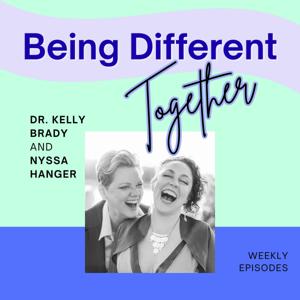
Being Different Together
Download on the App Store

Being Different Together episodes

  • #15 - How to Handle Conflict in Relationships (Without Making Things Worse)

    In this episode of Being Different Together, Kelly and Nyssa unpack why conflict doesn’t have to mean something is wrong—in fact, it can be the very path to deeper connection.

    Drawing on the work of Dr. Polly Young-Eisendrath and the Center for Real Dialog, they explore how “healthy conflict” in relationships can reduce emotional threat, calm our inner “baby,” and transform repetitive fights into opportunities for understanding. You’ll hear how real dialog helps with couples conflict, family estrangement, and everyday triggers like dishes, laundry, and tone over email—plus why “working for peace” is different from stopping war in our homes and in the world.

    Along the way, they weave together stories from a big week of events in Tampa, including Polly’s talks on Buddhism, Jung, and real dialogue, and Kelly’s role as Chief of Staff at the Center. Themes like how to handle conflict in relationships, how to communicate during conflict, why we get stuck in the same arguments, and how to know your path (by doing the next relevant thing) all show up in practical, down-to-earth language. If you’ve ever wondered how to stay in relationship when you don’t agree—or how to turn “enemy button” moments into curiosity—this episode is a warm, honest guide.


    Main Topics Covered:

    • How conflict can actually be the way to peace (and why trying to “keep the peace” often backfires)
    • Why conflict doesn’t automatically mean there’s a “problem” in your relationship
    • What “real dialog” is and how it lowers emotional threat between people
    • The surprising power of healthy conflict in couples, families, and communities
    • How Dr. Polly Young-Eisendrath’s work blends Buddhism, Jungian psychology, and relationships
    • The “enemy button” and the baby inside us that still runs our reactions in conflict
    • Projective identification: the invisible pattern that keeps pulling you into the same fights
    • “Do the next relevant thing”: a simple way to navigate your path when you feel lost
    • What happened when Polly brought real dialog to a high-end social club—and why people opened up
    • Kelly’s new role as Chief of Staff at the Center for Real Dialog and what she’s learning about working in conflict every day

    Links: 

    • Center for Real Dialogue
    • Time is Honey Radiolab Episode - mentioned in the podcast
    • Ep #1: Welcome to Being Different Together: How It All Started
    • Ep #2: What Our “Enemy Button” Gets Wrong About Conflict


    Stay in Touch:

    Nyssa Hanger: www.nyssahanger.com | IG: @nyssahanger

    Kelly Brady: www.kellybrady.me | IG: @drkellybrady

    52 min
  • #14 - What Is a Meditation Bell For? Benefits for Focus, Presence, and Communication

    In this episode, Nyssa and Dr. Kelly answer a listener question about one simple but powerful object: the meditation bell. 

    What is the purpose of a bell in your meditation space? They explore how a meditation bell (or singing bowl, chime, or timer bell) can mark transitions, create a ritual for mindfulness, and help you “come home” to yourself. From Thich Nhat Hanh’s bell of mindfulness to Insight Timer bells, church bells, traffic lights, and even phone notifications, they look at how sound can become a cue to pause, breathe, and pay intentional attention.

    They also extend the idea of the bell into everyday life and relationships—introducing the idea of a “relational bell” for when conversations get heated. You’ll hear about code words like “lunch meat,” using heart-rate monitors as a bell for conflict, and how sound, silence, and space can transform how we communicate. 

    If you’ve ever wondered how to use a bell in meditation, how sound and ritual can deepen your mindfulness practice, or how to build in gentle pauses in your relationships and conflict conversations, this episode offers playful, practical, and heartfelt ideas to try.

    Main Topics Covered:

    • How a simple meditation bell can completely change the energy of a room
    • Why humans seem wired to respond to bells, gongs, and chimes (and what that has to do with archetypes)
    • The “bell of mindfulness” in Buddhist practice and what Thich Nhat Hanh teaches about coming home to yourself
    • Turning everyday sounds—traffic lights, phone dings, microwaves—into mindfulness cues
    • How to create a simple, meaningful meditation space (even if you don’t have a whole room)
    • What Nyssa’s stop sign, Kelly’s wooden pyramid timer, and acupuncture chimes all have in common
    • The idea of a “relational bell” for pausing hard conversations before they blow up
    • Code words like “lunch meat,” heart-rate watches, and other creative ways couples can de‑escalate
    • Why silence, rest, and space are just as important as sound in music, poetry, and relationships
    • How playfulness, humor, and a well-timed pause can shift you from “you’re my enemy” back to “you’re my person”


    Stay in Touch:

    Nyssa Hanger: www.nyssahanger.com | IG: @nyssahanger

    Kelly Brady: www.kellybrady.me | IG: @drkellybrady

    41 min
  • #13 - The Spring Equinox Episode: Peaches, Pruning, and Becoming More Yourself

    In this episode of Being Different Together, Nyssa and Kelly welcome the spring equinox by exploring what this turning point in the seasons can teach us about personal growth, relationships, and real dialogue. 

    Using the story of their unassuming little peach tree—hidden, pruned back hard, and now bursting with blossoms—they unpack the difference between cultivation and control, and why pruning (in your garden and your life) can feel painful but is often exactly what allows new growth to emerge. 

    Along the way, they touch on the meaning of the spring equinox, the symbolism of eggs and Easter, and how ancient rhythms of light and dark mirror our own inner seasons.

    Main Topics Covered:

    • How the spring equinox mirrors the inner seasons of your own growth and change
    • Why a scraggly little peach tree became a powerful symbol for self-discovery
    • The surprising connection between pruning and becoming more of who you already are
    • What Jungian individuation really means (and how it’s different from self‑improvement)
    • How real dialogue “prunes” people-pleasing, politeness, and performative responses
    • Simple language shifts (like dropping “you” and “we”) that make conversations more honest
    • The idea of “karma farming” and how to plant seeds for the life you actually want
    • Why measuring success by effort and conditions, not outcomes, changes everything
    • How to hold commitment in relationships when you feel stuck in the same old patterns
    • The difference between cultivating growth and trying to control it—in gardens, goals, and love

    Referenced Episodes

    • Ep. #13 on “The Pen”

    Stay in Touch:

    Nyssa Hanger: www.nyssahanger.com | IG: @nyssahanger

    Kelly Brady: www.kellybrady.me | IG: @drkellybrady

    49 min
  • #12 - How to Use the Moon Phases for Goal Setting, Time Management, and Productivity

    Nyssa and Kelly explore how moon phases and lunar cycles can become a practical, soulful framework for goal setting, time management, and personal growth. 

    Nyssa shares how working with new moon intentions and full moon reflections helped her call in a conscious relationship, complete projects, and deepen her spiritual practice—plus the now-classic “have you seen this moon?” story. 

    If you’re curious about using the lunar cycle, astrology, and intuition to build a life that actually feels aligned, this episode is for you.


    Main Topics Covered:

    • How a single new moon intention helped call in a conscious relationship
    • A simple way to use the lunar cycle as a framework for projects, from idea to completion
    • Why the full moon is not the finish line (and what phase actually gets ignored the most)
    • What “creation cycle” means—and how it can help you finally complete what you start
    • The surprising link between moon phases, menstrual cycles, and emotional clarity
    • How a walk to a Zen meditation center under a full moon changed everything
    • The playful edge where the sacred meets the profane (including an unforgettable mooning story)
    • Using the moon for time management and productivity without losing the magic
    • Why Nyssa calls the moon her “forever teacher”and how to let it teach you, too
    • How to tell if you’re in a waxing (build) or waning (edit/finish) season in your own life


    Links:

    • Going Upward Newsletter – Join Nyssa’s list here
    • Essential Oil Moon Guide


    Books: 

    • The Moon Book by Sarah Faith Gottesdiener


    Stay in Touch:

    Nyssa Hanger: www.nyssahanger.com | IG: @nyssahanger

    Kelly Brady: www.kellybrady.me | IG: @drkellybrady

    46 min
  • #11 - How to Get What You Want (Without Toxic Positivity or Wishful Thinking)

    In this episode of Being Different Together, Kelly and Nyssa break down one of Buddhism’s most practical (and misunderstood) teachings: emptiness—using the now-famous story of the pen. Is it a pen or a chew toy? It depends who’s looking. 

    Drawing from the Heart Sutra, the Diamond Sutra, and modern life at the kitchen table (complete with dog Poppy chewing pens), they explore how reality doesn’t come from objects themselves, but from the karmic seeds and meanings our minds project onto them.

    You’ll also learn a simple 4-step Buddhist-inspired method for “getting what you want”—whether that’s more money, better health, deeper love, or greater inner peace—without relying on empty affirmations or spiritual bypassing. 

    Instead of “toxic positivity,” they talk about intentional action, generosity, and planting seeds in your mind through how you treat others. 

    If you’ve ever wondered how karma really works, how to manifest change in a grounded way, or how ancient Buddhist philosophy can actually help your day-to-day life and relationships, this conversation is for you.

    Main Topics Covered:

    • How a simple pen (and a chew-happy pup) can explain Buddhist emptiness
    • Why reality doesn’t come from things, but from you and your mind’s “seeds”
    • The surprising link between karmic seeds, perception, and everyday reactions
    • What Buddhism actually means by “emptiness”(and why it’s not “nothing matters”)
    • A 4-step Buddhist-inspired method to get what you want in life
    • How to use karma and generosity to attract more money, love, health, and peace
    • Why affirmations and prayers alone don’t change your life—and what does
    • The role of intention in shaping your reality (and why that makes humans unique)
    • How to “water” the right seeds at night with a simple bedtime reflection practice
    • Turning your life into a karmic garden: becoming a “karma farmer” on purpose

    Links Mentioned:

    • Going Upward Newsletter – Join Nyssa’s list here

    Books:

    • The Diamond Cutter by Gesha Michael Roach
    • Women Who Run With the Wolves by Clarissa Pinkola Estes


    Stay in Touch:

    Nyssa Hanger: www.nyssahanger.com | IG: @nyssahanger

    Kelly Brady: www.kellybrady.me | IG: @drkellybrady

    51 min
  • #10 - Perfectionism, Play, and Podcasting as a Couple

    If you’ve ever wondered how to start a creative project with your partner—or why it can feel so hard—you’ll feel right at home in this episode. 

    Kelly and Nyssa share the honest story behind launching their podcast: from the initial “we should record this” spark to choosing equipment, taking a podcast course, and dealing with all the resistance that shows up when you actually hit record and publish. 

    They talk about perfectionism, creative block, and resistance, drawing on influences like Seth Godin, Julia Cameron’s The Artist’s Way, morning pages, and Steven Pressfield’s The War of Art to unpack what it really takes to keep creating.

    Main Topics Covered:

    • How a four‑hour phone call and bed‑coffee chats slowly turned into a podcast
    • Why “done is better than perfect” might be the only way any episode gets made
    • Seth Godin on “talker’s block” and what it reveals about creative resistance
    • Julia Cameron’s The Artist’s Way, morning pages, and why blocks often show up in midlife
    • The hidden dynamics of co‑creating with your partner (and what birth order has to do with it)
    • Projective identification, survival dances, and why so many couples just want to be “right”
    • Turning conflict into a “play space” instead of a minefield in your relationship
    • Spreadsheets vs. creative flow: respecting wildly different work styles in a shared project
    • Why they’re waiting for 100 audio episodes before adding video or YouTube
    • “Constipated creativity,” soul‑murdering projects, and finding that sweet spot of challenge

    Links:

    The Movement Maestro (Dr. Shanté Cofield) (Shante's program, Press Publish, is what got us started!)


    Books Mentioned:

    The Artist’s Way – Julia Cameron

    The Practice – Seth Godin

    The War of Art – Steven Pressfield

    Put Your Ass Where Your Heart Wants to Be – Steven Pressfield

    Stay in Touch:

    Nyssa Hanger: www.nyssahanger.com | IG: @nyssahanger

    Kelly Brady: www.kellybrady.me | IG: @drkellybrady

    52 min
  • #9 - How to Stay Grounded When the World Feels Like It’s Falling Apart

    Feeling overwhelmed by the news? In this episode, Kelly and Nyssa unpack how to cope with bad news, negativity bias, and constant stress without totally checking out. 

    They explore why our brains are wired to focus on threats, how the modern news cycle exploits that, and what happens when our stress cycles never fully complete—hello burnout, anxiety, and numbness.

    With a mix of psychology, mindfulness, and real-life stories, they share practical ways to stay informed without destroying your mental health: “titrating” your news intake like strong medicine, completing the stress cycle, grounding in everyday life, and making small but powerful community connections. 

    Drawing on ideas from Burnout, Four Thousand Weeks, Bare Bones Meditation, Rest Is Resistance, and Audre Lorde’s famous insight that self-care is political warfare, this conversation invites you to rethink your relationship with the news, your nervous system, and what “taking care of yourself” really means.


    Main Topics Covered:

    • Why your brain is so obsessed with bad news (and what “negativity bias” really means in daily life)
    • How much news is “enough” before it quietly turns toxic to your nervous system
    • The surprising link between unfinished stress cycles, burnout, and doomscrolling
    • What ancient humans got right about stress that modern life gets totally backwards
    • A simple metaphor that can change how you think about the unconscious (hint: lungs and vacuums)
    • How tiny, mundane interactions—like chatting at the grocery store—protect your mental health
    • The tension between wanting to stay informed and wanting to stay functional
    • Why “self-care” has been co‑opted—and what Audre Lorde really pointed to as political self-preservation
    • Practical ways to double down on what you can control when “the world” feels out of control
    • How small, local actions and community connections quietly reshape big, broken systems


    Links:

    Workshops & Newsletter

    • Partner Thai Massage Workshop – Sign up here
    • Going Upward Newsletter – Join Nyssa’s list here

    Referenced Episodes / Resources

    • “Enemy Button” episode/resource

    Books Mentioned

    • Burnout: The Secret to Unlocking the Stress Cycle – Emily & Amelia Nagoski
    • Four Thousand Weeks: Time Management for Mortals – Oliver Burkeman
    • Buddha’s Brain – Rick Hanson
    • Bare Bones Meditation – Joan Tollifson
    • Rest Is Resistance – Tricia Hersey
    • Real Self-Care – Pooja Lakshmin

    Writers & Substacks

    • Joan Tollifson’s Substack: https://joantollifson.substack.com/
    • Polly’s Substack (on brain/consciousness): https://substack.com/@drpolly/p-185555303


    Stay in Touch:

    Nyssa Hanger: www.nyssahanger.com | IG: @nyssahanger

    Kelly Brady: www.kellybrady.me | IG: @drkellybrady

    57 min
  • #8 - Healing in the Hot Room with Wes Bozeman from Gaze Hot Yoga

    In this episode, Wes Bozeman joins us at the kitchen table for a wide-ranging conversation about yoga, touch, teaching, and community. We talk about Ghosh yoga, Thai massage, authenticity in practice, and what it means to hold tension without trying to resolve it too quickly. The conversation moves between philosophy, lived experience, and the quiet moments where healing actually happens.

    Main Topics Covered:

    • How a dad, yogi, and massage therapist became the founder of Gays Hot Yoga
    • The double meaning behind the studio name “Gaze” and why mirrors matter so much
    • “Silence interrupted 26 times by poses”: Wes’s take on the 26 & 2 practice
    • Why Gaze Hot Yoga is hot, bright, and relentlessly honest—and how that changes people
    • From massage table to mat: why Wes moved from hands-on therapy to teaching movement
    • The no-touch policy at Gaze: verbal cues, mirrors, and vulnerability instead of assists
    • Ghosh yoga 101: Bishnu Ghosh, Paramahansa Yogananda, and the Bikram connection
    • What Bikram got terribly wrong—and what the lineage still offers students today
    • Inside the first-ever Ghosh Yoga Festival coming to Tampa this Spring
    • How standing in front of a hot mirror helped Nyssa transform her post-COVID life
    • Thai massage as “lazy man’s yoga” and a “massage picnic” on the floor
    • The karmic chain: how one Thai massage training led Nyssa and Kelly to meet
    • Why “clear is kind” has become a guiding principle at Gaze Hot Yoga
    • Is Gaze the new modern-day ashram? Community, belonging, and daily practice in Tampa
    • The three words Wes ends every class with—and why they never stop feeling profound


    Links:

    Thai Massage Workshop at Gaze Hot Yoga, Feb. 21, 2026: https://www.nyssahanger.com/workshops

    Gaze Hot Yoga: https://www.gazehotyogatampa.com/

    Stay in Touch:

    Nyssa Hanger: www.nyssahanger.com | IG: @nyssahanger

    Kelly Brady: www.kellybrady.me | IG: @drkellybrady

    56 min
  • #7 - How Touch Shapes Our Relationships

    Touch is both essential and complicated.

    In this episode, Kelly and Nyssa explore touch as a human need—how it can be both deeply healing and highly charged. 

    The discussion moves through consent, subjectivity, non-sexual touch, and how cultural conditioning has shaped the way bodies relate to one another. 

    Drawing from bodywork, psychotherapy, Thai massage, and lived experience, the episode names touch as a form of communication that can support healing, connection, and dialogue.

    Main Topics Covered:

    • Why touch is politicized, sexualized, and often misunderstood, especially in Western culture
    • The importance of consent, communication, and clear boundaries in both professional and personal touch
    • How their work as a psychotherapist, acupuncturist, and massage therapist shapes the way they think about safe, attuned touch
    • The developmental impact of early touch (and lack of it), including attachment and our capacity for empathy
    • The philosophy and practice of Thai massage as a form of slow, negotiated, non-sexual touch that can deepen connection between partners, family members, and friends
    • How expanding our “touch menu” can make it easier to ask for non-sexual touch and potentially even strengthen or “save” relationships

    Links:

    Thai Massage Workshop at Gaze Hot Yoga, Feb. 21, 2026: https://www.nyssahanger.com/workshops

    Book: Constructing the Sexual Crucible by David Schnarch

    Stay in Touch:

    Nyssa Hanger: www.nyssahanger.com | IG: @nyssahanger

    Kelly Brady: www.kellybrady.me | IG: @drkellybrady

    47 min
  • #6 - The Hidden Medicine of Doing Less and Why Retreats Matter

    Kelly and Nyssa dive into the topic of retreat, exploring why stepping back from everyday life—especially through silence and meditation—can be so transformative. 

    Kelly shares stories from her early Zen retreats, including a hilarious (and humanizing) fart-at-the-final-ceremony moment that shattered her assumptions about belonging, and she explains how intensive practice, noble silence, and communal practice shaped her understanding of presence. 

    She then contrasts group retreats with her recent largely self-directed, partly solitary retreat in Florida and North Carolina, describing how extended periods of silence help the “posse dust” of a busy life settle, revealing deeper layers of consciousness, health benefits, and a more intentional way of moving through the world. 

    Together, they reflect on the countercultural nature of retreat in America, the difference between retreat and vacation, and offer accessible first steps for listeners—like carving out small, daily pockets of intentional silence—so that anyone, even without a full week away, can begin to experience the therapeutic and spiritual value of stillness.


    Main Topics Covered:

    • The fart that broke noble silence: a Zen retreat story you won’t forget
    • How Kelly went from “they all hate me” to “I’m part of this warm, funny sangha”
    • Retreat vs. vacation: why they’re not the same thing at all
    • What a Zen sesshin actually looks like—from 4:30 a.m. bells to crying-yourself-to-sleep naps
    • How a marching band inspection taught Kelly the healing power of silence
    • “There is no nothing”: emptiness, relationship, and Buddhist philosophy in plain language
    • The “posse dust” metaphor that perfectly explains what happens when you finally stop
    • Why sitting still is not “doing nothing” (and why our culture gets this so wrong)
    • Kelly’s week-long, mostly solo retreat: Airbnb in the forest + empty Zen center Zendo
    • The subtle ways retreat shifted Kelly’s daily life—more tears, more openness, more intention
    • Why screens make reality feel boring—and one simple grayscale phone hack
    • Practical baby steps: how to start with 10 minutes of silence a day (even with kids)
    • How to create a tiny “retreat space” at home, even without a spare room
    • What to expect when you first try sitting in silence (hint: it may feel worse before it feels better)
    • Why Kelly keeps going back on retreat: not just to feel better, but to understand what’s really going on here


    Links:

    Windhorse Zen Center: https://windhorsezen.org/


    Stay in Touch:

    Nyssa Hanger: www.nyssahanger.com | IG: @nyssahanger

    Kelly Brady: www.kellybrady.me | IG: @drkellybrady

    59 min

About Being Different Together

From the publisher's feed

Being Different Together explores the realms of relationship, entrepreneurship, and personal development through the lens of Real Dialogue, a set of principles, practices, and methods for…