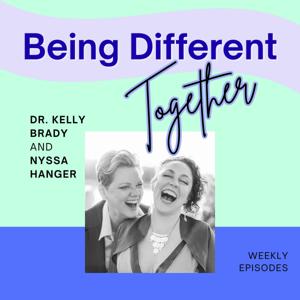
Being Different Together
Download on the App Store

Being Different Together episodes

  • #25 - Intentionality, Part 10: Whatever It Is You Feel, Remember You Don’t Have To

    What if your feelings weren’t the boss of you after all? 

    Kelly and Nyssa continue their Uncle Murray intentionality series with two deceptively simple slogans: “Whatever it is you feel, remember you don’t have to” and “An opportunity missed is an opportunity missed.” 

    They explore emotional regulation, tantrums (child and adult), grief, anxiety spirals, and perfectionism, sharing practices like 90‑second feeling waves, turning emotions into “little monsters” you can send to summer camp, and sending your inner critic on vacation. 

    Through stories about hard conversations, spiritual community, starting a podcast years “late,” and the pressure of the American Dream, they offer a compassionate, practical reframe for anyone who overthinks, overfeels, or obsesses about the chances they didn’t take.


    Main Topics Covered:

    • How to feel big emotions all the way through without getting stuck in them
    • The difference between real fear, everyday anxiety, and “concern”
    • Turning your emotions into little monsters you can lovingly send to “summer camp”
    • Why your inner critic deserves an all‑expenses‑paid vacation (and how to send it)
    • How we use feelings—consciously or not—to manipulate, control, or avoid others
    • “An opportunity missed is an opportunity missed”: what it doesn’t say and why that matters
    • The hidden cost of believing every missed chance will “ruin your life”
    • What a spiritual celebration of life taught them about legacy, memory, and being named
    • The quiet power of choosing not to send the angry text or chase instant reassurance
    • Starting a podcast after years of talking about it—and what imperfect action can unlock


    Links:

    • Shante Cofield | The Movement Maestro
    • Episode #16 - Intentionality, Part 1: Everything You’ve Done Prepared You For This Moment
    • Episode #17 - Intentionality, Part 2: Feeling Good Needs No Excuse
    • Episode #18 - Intentionality, Part 3: If You Think You Can Change the World, You Have a Better Chance
    • Episode #19 - Intentionality, Part 4: Your Reality is as Good as Anyone Else’s
    • Episode #20 - Intentionality, Part 5: It’s Useful to View the Past in a Friendly Way
    • Episode #21 - Intentionality, Part 6: There’s More Than Two Ways to Skin a Cat
    • Episode #22 - Intentionality, Part 7: Take the Hard Things Easy
    • Episode #23 - Intentionality, Part 8: You’re Already Ready
    • Episode #24 - Intentionality, Part 9: Life is a Joke – Either You Get It or You Don’t
    • SONG: Bang Bang by K’naan


    Newsletter Sign Up:

    • Going Upward Newsletter – Get Nyssa’s email newsletter here


    Stay in Touch:

    Nyssa Hanger: www.nyssahanger.com | IG: @nyssahanger

    Kelly Brady: www.kellybrady.me | IG: @drkellybrady

    50 min
  • #24 - Intentionality, Part 9: Life is a Joke – Either You Get It or You Don’t

    Life is a joke … and a precious gift. Kelly and Nyssa explore how both can be true through two of Uncle Murray’s most powerful intentionality slogans: “When in doubt, choose the belief that is most useful to you” and “Life is a joke, either you get it or you don’t.”


    They unpack how consciously choosing your beliefs shapes your emotions, relationships, spirituality, and even how you cope with grief, loss, construction chaos, and dying pets—without bypassing pain or pretending everything is “fine.”
    Drawing on Tibetan Lojong teachings, existential philosophy, family stories, and Murray’s irreverent humor, they explore doubt, faith, openness, and what it really means to “get” life before it’s over.


    If you’ve ever wrestled with what to believe, struggled to lighten up, or wondered how to honor both the absurdity and sacredness of being alive, this conversation on intentionality, mindset, and meaning‑making is for you.


    Main Topics Covered:

    • How choosing the belief that’s most useful (not “most true”) can transform your daily emotional life
    • The hidden link between beliefs, resentment, and why we get so grumpy doing dishes or standing in line
    • What it really means to “get” the joke of life—and what happens if you don’t
    • The double meaning inside the slogan “Life is a joke, either you get it or you don’t”
    • How Tibetan Lojong teachings and Uncle Murray’s sayings overlap in surprising ways
    • Using intentionality to navigate grief, dying pets, and house‑under‑construction chaos without bypassing pain
    • Why people with strong traditions may not feel “in doubt”—and how openness changes your relationship to belief
    • The idea of a “precious human life” and how it can deepen love, gratitude, and presence
    • Finding meaning in synchronicities (like the AC breaking during hospice) and the absurd timing of life
    • How humor, irreverence, and not taking yourself so seriously can actually make you more compassionate


    Links:

    • Episode #16 - Intentionality, Part 1: Everything You’ve Done Prepared You For This Moment
    • Episode #17 - Intentionality, Part 2: Feeling Good Needs No Excuse
    • Episode #18 - Intentionality, Part 3: If You Think You Can Change the World, You Have a Better Chance
    • Episode #19 - Intentionality, Part 4: Your Reality is as Good as Anyone Else’s
    • Episode #20 - Intentionality, Part 5: It’s Useful to View the Past in a Friendly Way
    • Episode #21 - Intentionality, Part 6: There’s More Than Two Ways to Skin a Cat
    • Episode #22 - Intentionality, Part 7: Take the Hard Things Easy
    • Episode #23 - Intentionality, Part 8: You’re Already Ready
    • SONG: Everybody Cook by Sofi Tucker
    • BOOK: The Artist’s Way by Julia Cameron
    • BOOK: Writing Down the Bones by Natalie Goldberg


    Newsletter Sign Up:

    • Going Upward Newsletter – Get Nyssa’s email newsletter here


    Stay in Touch:

    Nyssa Hanger: www.nyssahanger.com | IG: @nyssahanger

    Kelly Brady: www.kellybrady.me | IG: @drkellybrady

    48 min
  • #23 - Intentionality, Part 8: You’re Already Ready

    In this episode of Being Different Together, Kelly and Nyssa continue their intentionality mini-series by unpacking two classic Murray Landsman sayings: "You're already ready" and "Trying is not doing it." 

    They explore how these deceptively simple phrases cut through resistance, perfectionism, and the “I don’t feel like it” mindset, especially around creative work, meditation, relationships, and everyday tasks like decluttering and home projects. Through stories about writing, inner critics, therapy, and the “great stuff shuffle,” they show how willingness, imperfect action, and giving yourself permission to be a beginner can transform how you show up for the things that matter. 

    If you’ve ever felt stuck waiting to feel ready, told yourself you’re “trying” but not actually moving forward, or struggled with following your bliss without becoming self‑indulgent, this conversation will help you take compassionate, grounded action right where you are.

    Main Topics Covered:

    • How the sayings “You’re already ready” and “Trying is not doing it” can bust through resistance and procrastination
    • The sneaky ways “I don’t feel like it” and “I’m not ready yet” block our goals (and what we’re really afraid of)
    • Why following your bliss 24/7 can turn into hedonism—and how to stay intentional without being self‑indulgent
    • The “great stuff shuffle” and what decluttering during a home renovation reveals about readiness and attachment
    • How inner critics overprotect us like an overactive immune system—and how to lovingly turn down their volume
    • Why it’s often easier to talk than to write about big ideas, and how writers can tolerate imperfect first drafts
    • The difference between wanting to do something and being willing to do it (especially for unglamorous tasks)
    • What therapy clients, creative practices, and meditation have in common when it comes to actually doing the work
    • How giving yourself permission to be a beginner changes your relationship with learning, risk, and “getting it right”

    Links:

    • Episode #16 - Intentionality, Part 1: Everything You’ve Done Prepared You For This Moment
    • Episode #17 - Intentionality, Part 2: Feeling Good Needs No Excuse
    • Episode #18 - Intentionality, Part 3: If You Think You Can Change the World, You Have a Better Chance
    • Episode #19 - Intentionality, Part 4: Your Reality is as Good as Anyone Else’s
    • Episode #20 - Intentionality, Part 5: It’s Useful to View the Past in a Friendly Way
    • Episode #21 - Intentionality, Part 6: There’s More Than Two Ways to Skin a Cat
    • Episode #22 - Intentionality, Part 7: Take the Hard Things Easy


    Newsletter Sign Up:

    • Going Upward Newsletter – Get Nyssa’s email newsletter here

    Stay in Touch:

    Nyssa Hanger: www.nyssahanger.com | IG: @nyssahanger

    Kelly Brady: www.kellybrady.me | IG: @drkellybrady

    47 min
  • #22 - Intentionality, Part 7: Take the Hard Things Easy

    In this episode of Being Different Together, Kelly and Nyssa continue their intentionality mini-series by unpacking another Murray Landsman saying: “Take the hard things easy.” 

    They explore how unconscious beliefs about suffering shape our identity—through stories like an anesthesiologist-turned-donut-shop-worker, navigating home renovations, and walking through grief in ways that don’t match other people’s expectations. Along the way, they weave in Zen and Buddhist teachings, the “strong back, soft front” practice, the body’s stress responses (hello, tight psoas and low back pain), and how vulnerability and courage can transform difficult conversations and life transitions. 

    If you’ve ever wondered how to meet hard things without hardening yourself—whether it’s loss, conflict, or everyday stress—this episode offers practical, compassionate insights for approaching life with more ease and intention.

    Main Topics Covered:

    • How much of our suffering is actually required—and how much is a secret performance tied to identity?
    • The anesthesiologist who “lost everything” and found unexpected relief working at a donut shop.
    • What happens when your grief doesn’t look like what other people expect (and why that can be unsettling for them).
    • The surprising connection between low back pain, tight bellies, the psoas muscle, and feeling emotionally under threat.
    • “Strong back, soft front”: a Zen-inspired way to meet hard things without hardening yourself.
    • How Western individualism and Eastern contemplative traditions offer very different stories about who we are.
    • Turning stressful life events—like home renovations and family decluttering—into chances to practice taking the hard things easy.
    • The subtle ways we can get “inflated” around our suffering and slip into martyr mode without realizing it.
    • Why vulnerability always comes with that inner quiver—and how courage depends on letting it be there.

    Links:

    • Episode #16 - Intentionality, Part 1: Everything You’ve Done Prepared You For This Moment
    • Episode #17 - Intentionality, Part 2: Feeling Good Needs No Excuse
    • Episode #18 - Intentionality, Part 3: If You Think You Can Change the World, You Have a Better Chance
    • Episode #19 - Intentionality, Part 4: Your Reality is as Good as Anyone Else’s
    • Episode #20 - Intentionality, Part 5: It’s Useful to View the Past in a Friendly Way
    • Episode #21 - Intentionality, Part 6: There’s More Than Two Ways to Skin a Cat


    Newsletter Sign Up:

    • Going Upward Newsletter – Get Nyssa’s email newsletter here


    Stay in Touch:

    Nyssa Hanger: www.nyssahanger.com | IG: @nyssahanger

    Kelly Brady: www.kellybrady.me | IG: @drkellybrady

    50 min
  • #21 - Intentionality, Part 6: There’s More Than Two Ways to Skin a Cat

    In this episode of Being Different Together, Kelly and Nyssa continue their intentionality mini-series with two Murray Landsman sayings: “Doing it does it” and “There’s more than two ways to skin a cat.” 

    They unpack how taking imperfect action creates clarity, how to move through overthinking and perfectionism, and why there’s never just one “right” way to build a life, business, or relationship. 

    If you struggle with procrastination, fear of doing it wrong, or waiting to feel ready before you start, this conversation offers practical, compassionate guidance for showing up more intentionally and creatively in your everyday life.

    Main Topics Covered:

    • How “Doing it does it” can break you out of overthinking and get you into real-life momentum
    • The surprising link between intentionality and how you actually show up in your relationships, work, and daily life
    • Why clarity comes from engagement, not thought—and what that means for dating, business, and big life changes
    • How perfectionism disguises itself as “planning” and “strategy” (and keeps you safely stuck)
    • The coaching question Nyssa uses to unlock action: “What’s the smallest viable step?”
    • What Murray meant by “There’s more than two ways to skin a cat”—and how it challenges rigid social rules
    • The connection between creativity, anti‑perfectionism, and emotional regulation (including Virginia Satir’s “10 solutions” idea)
    • Why chronic stress and fight‑or‑flight shut down creativity—and how to find more options when you feel boxed in
    • Real-life examples: podcasting with barking dogs, tired brains, and takeout dinners… and choosing to do it anyway

    Links:

    • Episode #16 - Intentionality, Part 1: Everything You’ve Done Prepared You For This Moment
    • Episode #17 - Intentionality, Part 2: Feeling Good Needs No Excuse
    • Episode #18 - Intentionality, Part 3: If You Think You Can Change the World, You Have a Better Chance
    • Episode #19 - Intentionality, Part 4: Your Reality is as Good as Anyone Else’s
    • Episode #20 - Intentionality, Part 5: It’s Useful to View the Past in a Friendly Way


    Newsletter Sign Up:

    • Going Upward Newsletter – Get Nyssa’s email newsletter here


    Stay in Touch:

    Nyssa Hanger: www.nyssahanger.com | IG: @nyssahanger

    Kelly Brady: www.kellybrady.me | IG: @drkellybrady

    46 min
  • #20 - Intentionality, Part 5: It’s Useful to View the Past in a Friendly Way

    In this episode of Being Different Together, Kelly and Nyssa continue their intentionality mini-series by unpacking another Murray Landsman saying: “It is useful to view the past in a friendly way.”

    They explore what it really means to make peace with your past, including how to work with regret, grief, and painful memories without spiritually bypassing or pretending everything was “meant to be.” Through stories of a woman dancing on the beach to honor friends who died, family history at Cocoa Beach, and a powerful dream about everything in life being a gift wrapped in challenges, they show how intentionality and self-awareness can shift how you relate to what’s already happened.

    They also touch on the unconscious mind, Zen teachings on regret, and our cultural obsession with self‑improvement—why it’s so tempting to replay the past, and how to learn from your history without living in the rearview mirror. 

    If you’ve ever wondered how to let go of regret, be kinder to your past self, or hold grief and loss without getting stuck there, this conversation is for you.

    Main Topics Covered:

    • How the simple phrase “It is useful to view the past in a friendly way” can completely change your relationship with regret and memory
    • The story of a woman dancing at sunrise on the beach to honor friends who died—and what it teaches about grief
    • Why humans are 95–99% unconscious (according to some neuropsychologists) and what that means for how we judge ourselves and others
    • The difference between being actually cruel and just being unconscious and automatic in our behavior
    • How to tell the difference between genuinely learning from the past and just replaying it in your mental rearview mirror
    • Why trying to be “less human” (through self‑improvement, perfectionism, or avoiding aging and death) actually increases suffering
    • What Zen teachings suggest about regret, karma, and the idea that things couldn’t have happened any other way
    • A powerful dream message that “everything in life is a gift—and the really good gifts come wrapped in challenges”
    • Practical ways to be friendlier to your past self without bypassing pain or pretending everything is “for the best”
    • How seeing your past more kindly can open up more compassion, freedom, and joy in the present

    Links:

    • Episode #16 - Intentionality, Part 1: Everything You’ve Done Prepared You For This Moment
    • Episode #17 - Intentionality, Part 2: Feeling Good Needs No Excuse
    • Episode #18 - Intentionality, Part 3: If You Think You Can Change the World, You Have a Better Chance
    • Episode #19 - Intentionality, Part 4: Your Reality is as Good as Anyone Else’s


    Books:

    • The Four Tendencies by Gretchen Rubin


    Stay in Touch:

    Nyssa Hanger: www.nyssahanger.com | IG: @nyssahanger

    Kelly Brady: www.kellybrady.me | IG: @drkellybrady

    48 min
  • #19 - Intentionality, Part 4: Your Reality is as Good as Anyone Else’s

    In this episode of Being Different Together, Kelly and Nyssa continue their intentionality mini-series by unpacking two powerful Murray Landsman sayings: “Be nice to yourself” and “Your reality is as good as anybody else’s.” 

    They explore how negative self-talk, shame, and “autoimmune emotions” can impact your mental and physical health, and what it really means to be kinder to yourself without slipping into avoidance or indulgence. 

    They also dive into subjective reality in relationships—why so many arguments become battles over “who’s right,” how to handle conflict and hard conversations, and how tools like real dialogue and paraphrasing can lower emotional threat and help you truly understand someone you disagree with (about anything from daily annoyances to politics and the pandemic). 

    If you’ve ever wondered how to stop being mean to yourself, communicate more intentionally, or stay connected when realities collide, this conversation is for you.

    Main Topics Covered:

    • How “be nice to yourself” can quietly transform harsh inner criticism and negative self-talk
    • Why being mean to yourself is like having an “autoimmune emotional problem”
    • The surprising difference between mindfulness and intentionality (and why it matters)
    • Everyday examples of choosing how you want to show up vs. living on autopilot
    • What “your reality is as good as anybody else’s” really means in relationships
    • How fights turn into battles over “who wins reality” (and how to step out of that trap)
    • The hidden emotional threat behind “How could you believe that?” in political and pandemic debates
    • A simple real dialog tool—paraphrasing—that can instantly cool down conflict
    • Ways subjectivity and curiosity can create a bridge between very different worldviews

    Links:

    • Episode #16 - Intentionality, Part 1: Everything You’ve Done Prepared You For This Moment
    • Episode #17 - Intentionality, Part 2: Feeling Good Needs No Excuse
    • Episode #18 - Intentionality, Part 3: If You Think You Can Change the World, You Have a Better Chance
    • The Power of Connection TED talk by Hedy Schleifer


    Stay in Touch:

    Nyssa Hanger: www.nyssahanger.com | IG: @nyssahanger

    Kelly Brady: www.kellybrady.me | IG: @drkellybrady

    56 min
  • #18 - Intentionality, Part 3: If You Think You Can Change the World, You Have a Better Chance

    In this third episode of our Intentionality series, Nyssa and Kelly return to Murry Landsman’s handwritten bathroom poster to explore one deceptively simple slogan: “If you think you can do something about the world, you have a better chance.” 

    They unpack how this idea sits between toxic positivity and nihilism, framing it as “agency under constraint”—taking real responsibility for your participation in the world without pretending you can control everything. Along the way, they weave together stories of 90s eco‑kids trying to “save the planet,” Nyssa’s work helping clients heal through bodywork, Kelly’s reflections on Buddhism, karma, and projection, and why conflict is often the very thing that helps us evolve. 

    If you’ve ever wondered how to make a difference without burning out, stay hopeful without spiritual bypassing, and see “the whole world as medicine,” this conversation is for you.

    Main Topics Covered:

    • How one simple slogan—“If you think you can do something about the world, you have a better chance”—can change how you see your role in life.
    • The difference between toxic positivity, fantasy “manifestation,” and grounded, realistic hope.
    • What Kelly means by “agency under constraint” and how it helps you avoid both grandiosity and nihilism.
    • How 80s/90s “save the planet” messaging shaped Nyssa’s belief that her actions actually matter.
    • Why believing your work might help someone (in therapy, bodywork, or relationships) gives you a better chance that it will.
    • A playful dive into projective identification and how we unconsciously train people (and pets!) to act the way we expect.
    • The Buddhist idea that “the whole world is medicine” and what it means for everyday conflicts and challenges.
    • A wild pirate parable that reframes karma, intention, and “doing the least harm” in impossible situations.
    • How trying to change anything—yourself, a relationship, or the world—inevitably brings conflict, and why that’s often what helps us evolve.
    • Seeing intentionality as a uniquely human superpower in an age obsessed with AI, efficiency, and quick fixes.

    Links:

    • Episode #16 - Intentionality, Part 1: Everything You’ve Done Prepared You For This Moment
    • Episode #17 - Intentionality, Part 2: Feeling Good Needs No Excuse
    • Episode #11 - How to Get What You Want (Without Toxic Positivity or Wishful Thinking)


    Books:

    • Me, But Better by Olga Khazan

    Stay in Touch:

    Nyssa Hanger: www.nyssahanger.com | IG: @nyssahanger

    Kelly Brady: www.kellybrady.me | IG: @drkellybrady

    39 min
  • #17 - Intentionality, Part 2: Feeling Good Needs No Excuse

    In this second episode of our Intentionality series, Nyssa and Kelly return to the handwritten bathroom poster of Uncle Murry Landsman’s teachings to explore three more life-shaping slogans: “Everything works. Nothing works.” “Feeling good needs no excuse.” and “Anything worth doing is worth doing badly.” 

    They unpack how these paradoxical ideas speak to perfectionism, decision fatigue, and the pressure to “get it right” in self‑improvement, therapy, relationships, work, and even gardening—sharing stories about planners and exercise programs, laughing in the midst of grief, and Kelly’s humbling journey learning Thai massage. 

    Along the way, they explore intentional living as a uniquely human capacity, how “everything works and nothing works” disrupts the fantasy of the one perfect method, and why letting yourself feel good without guilt or justification is essential for emotional healing and resilience. 

    If you’re interested in letting go of perfectionism, starting before you feel ready, and finding more space and freedom in your inner life and relationships, this conversation is for you.

    Main Topics Covered:

    • How “Everything works. Nothing works.” can free you from chasing the one perfect method
    • Why perfectionism quietly keeps you stuck (and how to move anyway, even “badly”)
    • The surprising link between intentionality, being human, and not wanting to be a “god”
    • What it really means that “feeling good needs no excuse” in grief, crisis, and everyday life
    • How numbing difficult emotions can also shut down your capacity for joy
    • The secret life of planners, exercise programs, and self-help methods that “should” fix everything
    • A real relationship moment: choosing not to stay stuck in defensiveness and resentment
    • What gardening and Thai massage can teach us about being beginners again
    • Why hobbies matter more when you’re willing to be bad at them
    • Simple ways to “do it badly” on purpose in your relationships and personal growth

    Links:

    • Episode #16 - Intentionality, Part 1: Everything You’ve Done Prepared You For This Moment


    Stay in Touch:

    Nyssa Hanger: www.nyssahanger.com | IG: @nyssahanger

    Kelly Brady: www.kellybrady.me | IG: @drkellybrady

    39 min
  • #16 - Intentionality, Part 1: Everything You’ve Done Prepared You For This Moment

    In this first episode of our Intentionality series, Nyssa and Kelly pull back the curtain on a wild synchronicity in their shared lineage: a 1970s psychologist named Murry Landsman, the human potential movement, and a handwritten bathroom poster of life-changing intentionality slogans. 

    We explore the first two: “Everything you’ve done in life prepared you for this moment” and “It is frequently easier to get what you want when you know what it is.” Along the way, we talk about trauma reframing, secondary gain, and what it means to move from “this happened to me” to “this is mine to use” in your own healing and personal growth.

    If you’re interested in emotional healing, self-awareness, and the human potential movement, or you’ve ever wondered how to make meaning of your past, this conversation is for you.

    Main Topics Covered:

    • How a 1970s human potential pioneer secretly shaped both our lives decades apart
    • The bathroom poster of “Murray’s slogans” that quietly trained Nyssa’s child brain
    • What “Everything you’ve done in life prepared you for this moment” really asks of you
    • How shifting from “this happened to me” to “this is mine to use” changes your story
    • Why we cling to diagnostic labels (trauma, anxiety, etc.) and what secondary gain has to do with it
    • The surprising connection between intentionality, Buddhism, and 12-step slogans
    • “It’s easier to get what you want when you know what it is” — and why we avoid knowing
    • Vague desires vs. clear wants: how doing “the next relevant thing” brings clarity
    • What it really means to give yourself permission to want what you want
    • Space Mountain, home renovation, and why big life changes feel like roller coasters in the dark


    Stay in Touch:

    Nyssa Hanger: www.nyssahanger.com | IG: @nyssahanger

    Kelly Brady: www.kellybrady.me | IG: @drkellybrady

    51 min

About Being Different Together

From the publisher's feed

Being Different Together explores the realms of relationship, entrepreneurship, and personal development through the lens of Real Dialogue, a set of principles, practices, and methods for…