
Sign up to save your podcasts
Or




Extremist groups in Syria are planting landmines and booby traps all over the country with the intention of killing civilians. Even children aren't safe from bombs that are often disguised as toys.
In this week's Beyond the Headlines, we look at the situation in Syria and the growing civilian deaths from the perspective of humanitarian efforts aimed at helping those affected by these attacks.
Imad Aoun is a field communications adviser for Doctors Without Borders. We talk to him about a report he helped publish out of the organisation that presented their findings on the mine and booby-trap situation in Syria.
Beyond the Headlines, produced by Kevin Jeffers, is The National's weekly podcast for analysis and insight from the Middle East. Follow, subscribe and rate us at Apple Podcasts, Audioboom, Pocket Cast or your favourite podcasting app.
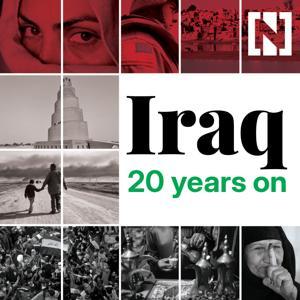
In 2002, a 12-metre statue of Saddam Hussein was erected in Baghdad's Firdos Square, right in the middle of one of the Iraqi capital’s many roundabouts. It depicted the Iraqi dictator standing heels together with his right arm outstretched in an open palm. It was a symbol of Saddam’s confidence and his ruthless grip on the country.
A year later, Operation Iraqi Freedom was just a few weeks underway when the statue was torn down by US coalition forces, as some Iraqi citizens cheered. That was 15 years ago this week. On this episode of Beyond the Headlines, we look at where Iraq is now from those who remember the statue's symbolic fall.
Rasha Al Aqeedi was in Mosul at the time. Today, she works as a researcher in Al Mesbar Studies and Research Centre in Dubai. She talks about the fall of Saddam as both a moment of joy and great concern for the country.
Mina Al Droubi, a reporter on the National’s foreign desk, was in London when she saw the news in April 2003. Although only 14, she remembers the event as sparking a reaction that still marks the politics of Iraq today.
Beyond the Headlines, produced by Kevin Jeffers, is The National's weekly podcast for analysis and insight from the Middle East. Follow, subscribe and rate us at Apple Podcasts, Audioboom, Pocket Cast or your favourite podcasting app.
This week, Saudi Arabia witnessed the most aggressive attack on its own soil since their intervention in the Yemen civil war three years ago.
The Houthis launched seven missiles at Riyadh. Saudi’s ministry of interior claimed to intercept all of them, but debris from one fell on a man’s house, killing him and injuring two others. This comes as all parties were engaged, indirectly, in talks that were believed to be considering a political settlement. The war has claimed thousands of lives, and displaced millions.
In this week's Beyond the Headlines podcast, host Naser Al Wasmi is joined by analyst Baraa Shibanto explain the political fallout that might transpire as a result of the attacks.
We also look at the humanitarian crisis in the country, as more than a million cases of cholera have been reported. As the rainy season in the Arab world’s poorest country approaches, the World Health Organisation is warning that an epidemic that has killed 2,000 people, could flare up again.
Jessica El Zarif, from the International Committee of the Red Cross, tells us what can be done to prevent the disease from spreading.
Saudi Crown Prince Mohammed bin Salman arrived in the United States on an official visit this week. The already strong relationship between the two countries is being reinforced during meetings with President Donald Trump and senior officials. He will then look to engage other aspects of his Vision 2030 in trips to Silicon Valley and other parts of he US.
We talked to Joyce Karam, our Washington correspondent, who was present during Saudi embassy briefings and has been talking to insiders in the capital on what the trip means for bilateral relations.
We were also joined by Thanassis Cambanis, a senior fellow at the Century Foundation, who gave us a wider perspective on Saudis role in the region and the world.
This week, we discuss Saudi Crown Prince Mohammed bin Salman's international outreach. The 32-year-old heir to the Kingdom made stops in Cairo and London and is next heading to Washington for a two-week tour of the US.
This will be more than a political trip. After Washington, the Crown Prince is set to visit New York, Boston, Houston, San Francisco and Seattle to discuss economic co-operation, investments and his Vision 2030.
We talked to Michael Stephens, a research fellow at the Royal United Services Institute. He tells us what he thinks the Crown Prince hopes to accomplish on this historic tour.
Also, we look at the resurgence of ISIL in Iraq. Prime Minister Haidar Al Abadi claimed the defeat of ISIL in 2017, but this week there have been dozens of deaths claimed by the terrorists.
Reporter Campbell MacDiarmid is in Iraq covering the resurgence of ISIL around the country. He told us what he perceives as the new phase in the battle.
The Syrian conflict is now entering its eighth year. Hundreds of thousands have been killed, clashes are fierce in rebel-held areas and the regime of President Bashar Al Assad has again been accused in recent weeks of using chemical weapons in his push to reclaim territory.
Eastern Ghouta's 400,000 residents have lived under government siege since 2013, facing severe shortages of food and medicines even before the latest offensive began.
Host Mina Aldroubi talks to the UN's Humanitarian Coordinator in Syria, Panos Moumtzis, about the challenges that civilians and aid works are facing in Ghouta.
We also spoke to Damien McElroy, The National's London bureau chief who is closely following developments of Saudi Arabia’s Crown Prince Mohammed bin Salman's high-profile visit to the UK.
It has been six months since Myanmar military operations sparked a mass exodus of the country's Rohingya Muslim minority to neighbouring Bangladesh.
But although the crisis has now fallen out of the headlines, on the ground it is only growing by the day.
Rohingya refugees are continuing to arrive at the already overcrowded camps in the Bangladeshi district of Cox's Bazar and, as the rainy season approaches, aid workers are preparing for high winds and flooding — which could exacerbate the spread of disease and illness and destroy shelters.
Host Laura Mackenzie talks to Médecins Sans Frontières' Kate Nolan who is working to co-ordinate the organisation's response to the refugee crisis in Cox's Bazar.
Next up, we hear from Ammar Khamees, the director of an Erbil-based NGO who answered a call to help rescue a bear and lion from Mosul zoo amid the military campaign to retake the city from ISIL.
On this special edition of Beyond the Headlines, host Naser Al Wasmi is joined by the Emirati Ambassadors to three very important countries in the UAE’s global diplomatic network: Ali Al Ahmed, UAE Ambassador to Germany; Dr Ahmed Al Banna, Ambassador to India; and Dr Ali Al Dhaheri, UAE Ambassador to China.
The diplomats are in Abu Dhabi this week for the Annual Ambassador’s Forum held at the UAE Foreign Ministry. They discussed issues ranging from the effectiveness of soft power diplomacy and EXPO 2020, to trade as a pillar of diplomacy and the importance of security cooperation in the battle against extremism.
The UAE has excelled at developing foreign policies and forged a diplomacy that is both unique to itself and effective at streamlining ties for such a young country. This episode brings a unique view into how it conducts itself abroad.
Follow Beyond the Headlines and the rest of our shows on Apple Podcasts.
Iran and Israel were on the brink of war. Tensions arose when Israel shot down an Iranian drone on February 10, after it entered the country from Syria. Then one of the Israel’s F-16 fighters was shot down, the first Israeli plane downed in decades and a huge blow to their air force’s aura of invincibility.
Damien McElroy, The National’s London bureau chief, covered a speech by Israeli Prime Minister Benjamin Netanyahu addressing Iran over their intrusion. He joins host Naser Al Wasmi in discussing how war could break out in the region over the two countries’ interests.
Regardless of the credibility behind the Israelis' claims, it is no secret Iran is trying to push its interests in the region through limited direct military engagement. Nazenin Ansari, the managing editor of Kayhan-London, sheds light on how Iran, Israel and the wider region is conducting operations in a precarious situation in Syria.
An international donor conference opened in Kuwait on Monday with hopes of rebuilding Iraq following its devastating war against ISIL. We discuss Iraq's reconstruction efforts in this week's edition of Beyond the Headlines.
The conference brings together 70 countries, aid groups, UN agencies and corporations aimed at investing in Iraq's crippled economy, infrastructure and humanitarian crisis.
Host Mina Aldroubi is joined by Dr Renad Mansour, senior research fellow at London’s Chatham House, to discuss the challenge of rebuilding and its implication for Iraq’s ability to seal the peace and prevent ISIL from reemerging.
Decades of violence have left 4 million Iraqi children in desperate need of immediate humanitarian help. Juliette Touma, UNICEF’s regional chief of communications in the Middle East and North Africa, discusses how vital it is for Iraq to get the necessary funds to invest in children in order to break the cycle of violence.
Also, Dr Fanar Haddad explains how western powers are suffering from scepticism and donor fatigue and after years of turmoil in the region. Hopes are now resting on Gulf Arab states to step forward for Iraq.
Follow Beyond the Headlines and the rest of our shows on Apple Podcasts.
From the publisher's feed
Dive deeper into the week’s biggest stories from the Middle East and around the world with The National’s multi-award-winning podcast, Beyond the Headlines — winner of two Signal…

7,594 Listeners

4,107 Listeners

2,358 Listeners

285 Listeners

596 Listeners

7 Listeners

111,876 Listeners

267 Listeners
562 Listeners

2,536 Listeners

4 Listeners

1 Listeners

0 Listeners

4 Listeners
5 Listeners

2 Listeners

15,899 Listeners

358 Listeners

143 Listeners

3,036 Listeners

274 Listeners

140 Listeners
0 Listeners

4 Listeners
0 Listeners
6 Listeners

6 Listeners

0 Listeners