Biographers in Conversation

Biographers in Conversation

By GabriellaArtsBooks
Download on the App Store

Biographers in Conversation episodes

  • A Vast Horizon: Artists and Lovers, Freedom and War

    In this latest episode of Biographers in Conversation, Anna Thomasson chats with Dr Gabriella Kelly-Davies about A Vast Horizon: Artists and Lovers, Freedom and War.

    Here’s what you’ll discover in this episode:

    • Why Anna Thomasson chose a collective biography to reveal the chemistry and interconnected lives of nine surrealists.
    • How a 1937 summer at the Hôtel Vaste Horizon became the book’s narrative and symbolic starting point.
    • What photographs reveal about historical lives and why their apparent intimacy can never yield the whole truth.
    • How letters, diaries, poems and artworks became ‘wormholes’ into her subjects’ experiences.
    • Why Anna Thomasson preserves archival silences and honours Ady Fidelin’s right to opacity rather than speculating.
    • How short chapters, juxtaposition and a collage of fragments sustain momentum across nine intersecting lives.
    • Why contradictions, omissions and self-mythologising belong inside biography instead of being smoothed into certainty.
    • Thomasson’s advice to biographers: set research boundaries, trust your instincts and accept that every life remains provisional.
    • 36 min
    • Black, White + Colour

      In this latest episode of Biographers in Conversation, Tim Dobbyn chats with Dr Gabriella Kelly-Davies about Black, White + Colour: A Biography of Mervyn Bishop Australia's First Indigenous Professional Photographer

      Here’s what you’ll discover in this episode: 

      • Mervyn Bishop joined the Sydney Morning Herald at 17, becoming Australia’s first Indigenous press photographer and, soon after, the first Indigenous journalist on a metropolitan daily newspaper.
      • Tim Dobbyn’s family has known Mervyn since 1962; their friendship deepened over decades before evolving into a nine-year biography project, completed largely during pandemic lockdowns.
      • Dobbyn discusses the unusual position of writing about a living, close friend, using journalistic standards, corroborating witnesses and news archives to keep the account truthful rather than reverential.
      • Mervyn’s mother, Marjorie, was a talented amateur photographer whose influence sparked his early interest, reflecting a broader, lesser-known tradition of photography within First Nations families as a way of preserving connection.
      • The death of Mervyn’s wife Elizabeth on the day of his first solo exhibition profoundly altered Mervyn’s life and parenting, with Dobbyn noting she had been his crucial organising force.
      • Mervyn developed a distinctive ethical practice around photographing people in dire circumstances, using humour, empathy and consent to disarm subjects rather than exploit them.
      • Dobbyn faced years of publishing rejection as a first-time author before Ginninderra Press took on the richly illustrated book, timed serendipitously with a State Library exhibition of Mervyn’s photographs.
      • 35 min
      • Trudeau & Doonesbury: The Cartoonist Who Turned the News into Art

        In this latest episode of Biographers in Conversation, Joshua Kendall chats with Dr Gabriella Kelly-Davies about Trudeau & Doonesbury: The Cartoonist Who Turned the News into Art

        Here’s what you’ll discover in this episode:

        • Why Joshua Kendall conceived of Trudeau & Doonesbury as a dual biography of the reclusive cartoonist Garry Trudeau and Doonesbury, his famous comic strip. 
        • How Trudeau transformed his Yale campus strip Bull Tales into Doonesbury, bringing sex, drugs, rock and roll, war and political satire to newspaper comic pages, and pioneering what became known as the reported comic strip.
        • How 200 boxes of Trudeau’s papers at Yale’s Beinecke Library enabled Joshua to reconstruct the evolution of the artist and his work.
        • Why Trudeau described the book as unopposed rather than authorised.
        • How Joshua gradually gained the cooperation of a famously private subject while preserving his independence as a biographer.
        • How Joshua assessed conflicting memories against archival evidence.
        • How Trudeau’s changing treatment of war, from the comparatively shallow Vietnam-era strips to B. D.’s amputation and post-traumatic stress after Iraq, reveals the deepening empathy and maturity of both the cartoonist and his art.
        • The ethical decisions involved in writing about a living subject and his family.
        • How Joshua approached the unusual challenge of concluding the biography of a living subject.
        • Why Joshua regards biography as a distinctive form combining storytelling, history, cultural analysis and access to the inner and emotional life.
        • 48 min
        • Like a Cat Loves a Bird: The Nine Lives of Muriel Spark

          In this latest episode of Biographers in Conversation, Dr James Bailey chats with Dr Gabriella Kelly-Davies about Like a Cat Loves a Bird: The Nine Lives of Muriel Spark. 

          Here’s what you’ll discover in this episode:

          • Why James structures Spark’s life as nine partial portraits rather than a unified chronological narrative.
          • How Muriel Spark’s changing appearance during sittings for Sandy Moffat’s portrait provides the biography’s perfect opening scene.
          • Why James preserves Spark’s contradictions and asks open-ended questions instead of pretending to solve her.
          • How extensive archival research allows James to reconstruct vivid scenes without crossing the border into fiction.
          • The challenge of weaving literary criticism and human story together so that Spark’s life and novels illuminate each other.
          • Why cats, cocktails, hairdresser’s receipts, contaminated pens and green gowns are far from trivial biographical details.
          • How James adopts a witty, nimble style capable of accommodating the darkness, eccentricity and comedy of Spark’s life.
          • Why the biography ends not with Spark’s death but with her imaginative return as a meddling authorial ghost.
          • 50 min
          • Dr Koop: The Many Lives of the Surgeon General

            In this episode of Biographers in Conversation, Dr Nigel Cameron chats with Dr Gabriella Kelly-Davies about Dr Koop: The Many Lives of the Surgeon General.

            Here’s what you’ll discover in this episode:

            • Why Nigel Cameron opened the narrative with a preface portraying the octogenarian Dr C. Everett Koop. 
            • Nigel chose the title, The Many Lives of the Surgeon General, to reflect Koop’s multidimensional roles as a paediatric surgeon, public-health crusader, policymaker and complex human being.
            • How Nigel translated complex scientific and medical concepts into engaging, novelistic prose.
            • How Nigel crafted a kaleidoscopic portrait by balancing Koop’s stern public persona with intimate human stories, family anecdotes and personal vulnerabilities.
            • How Nigel drew on his bioethics background to frame Koop’s decisions in terms of moral conviction, public trust and the ethical dimensions of placing science above politics.
            • 45 min
            • Circle of Wonders - Truth-telling in Storytelling

              In this latest episode of Biographers in Conversation, Dr Kathryn Heyman chats with Dr Gabriella Kelly-Davies about Circle of Wonders.

              Here’s what you’ll discover in this episode:

              • ‘Circle of Wonders’ is a novel about a group of women who gather in the Blue Mountains to support their friend Ronnie Bloom through the final month of her life.
              • ‘Circle of Wonders’ began as a memoir shortly after Kathryn’s sister and mother died in the same month during 2020.
              • Ten weeks later, Kathryn decided to write the book as fictional version of the story. It is then that she found the story’s circular, lunar structure.
              • Kathryn explains why the story needed multiple voices rather than one: capturing an ‘ensemble’ or ‘choral’ experience of community meant she no longer had the ethical right to tell it as memoir.
              • Kathryn reflects on the ethics of writing about real people.
              • Drawing on William Faulkner, Kathryn distinguishes facts from emotional truth, arguing that fiction can sometimes reach a more profoundly truthful place than memoir by freeing the writer from strict fidelity to external events.
              • The book’s structure mirrors the lunar cycle, with the final breath looping back into the first sentence, reflecting Kathryn’s belief that ‘all time is now’ and every ending is also a beginning.
              • Kathryn closes our conversation with advice for writers straddling memoir, biography and fiction: write the story as it arrives first, then decide on its category. She recommends British novelist Jill Dawson as a model for biographical fiction.
              • 36 min
              • Parallel Lives: From Freud and Mann to Arbus and Plath

                In this episode of Biographers in Conversation, Jeffrey Meyers chats with Dr Gabriella Kelly-Davies about Parallel Lives: From Freud and Mann to Arbus and Plath 

                Here’s what you’ll discover in this episode:

                • Jeffrey Meyers adopted Plutarch’s parallel lives approach in Parallel Lives, pairing famous figures to uncover common threads of creativity, ambition and struggle across different fields.
                • Jeffrey selected subjects based on their creative genius and discovered connections, whether through direct relationships or shared psychological and artistic patterns.
                • Jeffrey structured chapters by interweaving the two biographies chronologically from the start rather than alternating focus between subjects.
                • Jeffrey  used personal interviews and unpublished sources as most revealing, including conversations with Sylvia Plath’s mother and unpublished manuscripts.
                • Jeffrey adjusted his authorial voice when writing about different subjects, recognising that Hitler required a different tone than Sylvia Plath.
                • 35 min
                • Love and Need: The Life of Robert Frost’s Poetry

                  In this episode of Biographers in Conversation, Adam Plunkett chats with Dr Gabriella Kelly-Davies about Love and Need: The Life of Robert Frost’s Poetry.

                  Here’s what you’ll discover in this episode:

                  • Why Adam Plunkett spent a decade researching Frost’s life, including accessing previously overlooked audio archives of 500 tapes of Frost’s readings and interviews.
                  • Love and Need blends biography and literary criticism. 
                  • How Adam grounded critical arguments in meticulous examination of source materials.
                  • Adam explored the ‘love and need dynamic’ central to Frost’s creativity by interpretating the nature of the poet’s closest relationships.
                  • Adam portrayed Frost’s poetry as having its own life, crafting an object biography to show how the poet lived for his art.
                  • Why Adam avoided a comprehensive cradle-to-grave structure.
                  • 47 min
                  • Renaissance Quills of Their Own: Shakespeare's Sisters

                    In this episode of Biographers in Conversation, Dr Ramie Targoff chats with Dr Gabriella Kelly-Davies about Shakespeare’s Sisters: Four Women Who Wrote the Renaissance.

                    Here’s what you’ll discover in this episode:

                    • Ramie Targoff selected four female contemporaries of Shakespeare who were publicly recognised writers to challenge Virginia Woolf’s claim that ‘Judith Shakespeare could not exist’.
                    • Why Ramie opened with Virginia Woolf and Judith Shakespeare to confront the powerful but mistaken narrative that there were no female authors in Shakespeare’s England.
                    • Ramie chose female authors who crafted psalms, poetry, tragedy and diaries to showcase the breadth of Renaissance women’s writing.
                    • Ramie initially planned four separate mini biographies but shifted to an intertwined collective biography when she realised the women’s lives and networks overlapped.​
                    • How Ramie braided the women’s stories to craft a biography that reads like a novel but avoids veering into fiction.
                    • Why Ramie treated letters, diaries and memoirs as the richest sources, privileging the women’s own voices wherever they survived.
                    • How Ramie retraced the women’s footsteps by visiting homes, castles, churches and landscapes to evoke their lived environments.
                    • How Ramie marked speculative moments for readers, explaining what is known, what is guessed, and how gaps in the record shaped her interpretations.
                    • 40 min
                    • Chameleon

                      In this latest episode of Biographers in Conversation, Robert Dessaix chats with Dr Gabriella Kelly-Davies about Chameleon: A Memoir of Art, Travel, Ideas and Love.

                      Here’s what you’ll discover in this episode:

                      • Chameleon was shortlisted for the 2026 National Biography Award, with judges calling it ‘vintage Dessaix’ and praising its ‘dazzling display of erudition’.
                      • Chameleon takes its title from the idea that a chameleon changes colour on the surface while staying essentially the same underneath, mirroring how Dessaix ‘blended’ into each era's doctrines while something stubbornly himself remained.
                      • At 80, Dessaix describes his head as an ants' nest, alive with tiny scurrying thoughts, and calls memoir the perfect genre for playing in the gap between what everyone has taken you to be and who you in reality are.
                      • He addresses his naive younger self by his adoptive name, Thomas Robert Jones, and argues by text with his acerbic friend Niall, who may be his alter ego.
                      • Dessaix admits he rearranges the actual sequence of events, placing India before hospital rather than after, because truth for him sits elsewhere than strict chronology, and seducing the reader with a work of art matters more than accuracy.
                      • He aimed for a voice that ‘rattles on’ like a companion on a walk rather than a lecture, echoing the Byron epigraph he quotes from Don Juan.
                      • Rather than a tidy resolution, he closes the book with a chapter called The Green Room, insisting that art and a life are never truly finished.
                      • 40 min

                      About Biographers in Conversation

                      From the publisher's feed

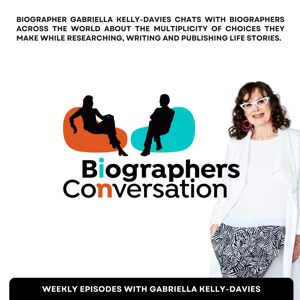
                      Biographer Gabriella Kelly-Davies chats with biographers across the world about the myriad of choices they make while researching, writing and publishing life stories. In every episode, she explores…

                      More shows like Biographers in Conversation

                      The New Yorker Radio Hour by WNYC Studios and The New Yorker

                      The New Yorker Radio Hour

                      6,783 Listeners

                      HistoryExtra podcast by Immediate

                      HistoryExtra podcast

                      3,172 Listeners

                      Desert Island Discs by BBC Radio 4

                      Desert Island Discs

                      1,979 Listeners

                      Late Night Live — Full program podcast by ABC Australia

                      Late Night Live — Full program podcast

                      96 Listeners

                      Conversations by ABC Australia

                      Conversations

                      813 Listeners

                      All In The Mind by ABC Australia

                      All In The Mind

                      758 Listeners

                      Health Report by ABC Australia

                      Health Report

                      126 Listeners

                      The Bookshelf by ABC Australia

                      The Bookshelf

                      46 Listeners

                      Chat 10 Looks 3 by Chat 10 Looks 3

                      Chat 10 Looks 3

                      231 Listeners

                      The Book Show by ABC Australia

                      The Book Show

                      18 Listeners

                      What's That Rash? by ABC Australia

                      What's That Rash?

                      235 Listeners

                      The Rest Is History by Goalhanger

                      The Rest Is History

                      15,558 Listeners

                      The Ezra Klein Show by New York Times Opinion

                      The Ezra Klein Show

                      16,062 Listeners

                      Gone Medieval by History Hit

                      Gone Medieval

                      1,893 Listeners

                      Secret Life of Books by Sophie Gee and Jonty Claypole

                      Secret Life of Books

                      88 Listeners